


 |
BEM711S - SME MANAGEMENT - 1ST OPP - JUNE 2025 |
|
|
1 Page 1 |
▲back to top |
nAmlBIA unlVERSITY
OF SCIEnCE Ano TECHnOLOGY
FACULTY OF COMMERCE, HUMAN SCIENCES AND EDUCATION
DEPARTMENT OF GOVERNANCE AND MANAGEMENT SCIENCES
MANAGEMENT SECTION
QUALIFICATION : BACHELOR OF BUSINESS MANAGEMENT
QUALIFICATION CODE: 07BMAR
LEVEL: 7
-
-----------
--
--- - - -------
COURSE CODE: BEM 711S
--
-- -
COURSE NAME: SMALL AND MEDIUM ENTERPRISE
MANAGEMENT
- - -- - --·- --
-
- --
SESSION: JUNE 2025
---
PAPER: THEORY
--·- ----- -·--
DURATION: 3 HOURS
-
MARKS: 100
---------
------
----
--
FIRST OPPORTUNITY EXAMINATION QUESTION PAPER
----
-------------
--
EXAMINER(S)
DR KARIKARI AMOA-GYARTENG (FULL TIME)
DR MOSES WAIGANJO (PART TIME & DISTANCE)
MODERATOR:
MR ERNESTMBANGA
INSTRUCTIONS
This examination consists of two sections. Section A contains two compulsory questions that all
candidates must answer. Section B contains four questions, from which candidates must select and
answer any three. The total marks for this examination are 100, with Section A worth 40 marks and
Section B worth 60 marks.
1. Answer ALL the questions in the answer book provided.
2. Write clearly and neatly.
3. Number the answers clearly.
4. Indicate your lecturer's name on your answer sheet.
THIS EXAM PAPER CONSISTS OF 6 PAGES {Including this front page)
|
|
2 Page 2 |
▲back to top |
SECTION A- THIS SECTION HAS TWO (2) MAIN QUESTIONS. ANSWER ALL OF THEM (40 Marks)
Question 1)
N.U. Shikongo Meat Traders: Preparing for Succession and Change
Background
N.U. Shikongo Meat Traders is a family-owned meat business in northern Namibia, founded by
Nangula and Usko Shikongo's father. When he passed away unexpectedly in 1996, Nangula and Usko
were still in their late teens. Despite their youth, they took over the business, which then had only two
butcheries in Oshakati. Through their hard work, they expanded the company into a significant
regional operation with 30 retail outlets across four regions and nearly 350 employees. They also
developed their own meat processing facility in Ongwediva.
The Challenge: Leadership Transition and Market Changes
By 2022, Nangula and Usko were approaching retirement age and needed to plan for the business's
future. They faced two major challenges: transitioning leadership to the next generation and
maintaining competitiveness in Namibia's evolving retail meat market. They consulted a local business
advisor, Ndapewa Kambonde, who helped them structure their succession planning.
The Solution: Creating a Family Governance Framework
The Shikongos realized how deeply the family was connected to the business through family
discussions.
To preserve their legacy, they:
i. Developed a written family charter outlining their values and business principles.
ii. Established a family council including themselves, their brother Efraim, and Usko's three adult
children.
iii. Decided to appoint a professional General Manager while maintaining family oversight.
Implementation and Results
In 2023, they hired Gottfried Haingura as General Manager while Usko transitioned to Board Chair.
Usko's daughter, Sesilia, joined management in 2021, and his son took responsibility for northern
region operations. These changes led to a 40% expansion of retail outlets and modernization of their
processing facility, ensuring the business remained competitive in Namibia's growing supermarket
sector.
Questions
a) Why is succession planning particularly important for Namibian family businesses like N.U.
Shikongo Meat Traders? Identify two specific challenges they might face in transitioning
leadership to the next generation. (5 marks)
2
|
|
3 Page 3 |
▲back to top |
b) Explain two key roles the family council played in N.U. Shikongo's transition. Suggest two ways
such councils can help manage family conflicts in Namibian business contexts. (6 marks}
c} Compare family and external leadership by listing two advantages and two disadvantages of
hiring a professional General Manager like Mr. Haingura versus keeping leadership within the
Shikongo family. (4 marks)
d) What two important lessons about business continuity can other Namibian family enterprises
learn from N.U. Shikongo's approach to succession? (2 marks}
e) Describe two strategies N.U. Shikongo used to combine family values with professional
management. Why is this balance especially important for family businesses in Namibia's
economic environment? (3 marks)
Question 2)
Case Study: Step Up Industries Ltd. -A Namibian Entrepreneurial Journey
Background
Step Up Industries Ltd. was established in Windhoek by two unemployed graduates:
• Anthe-Lee Januarie, who holds a BSc in Biochemistry from the University of Namibia (UNAM),
and
• David White, who holds a Bachelor of Business Administration from the Namibia University of
Science and Technology (NUST}.
Their original business idea was to manufacture products for the mining industry using agricultural
waste. However, the high startup costs-estimated at over N$500,000-made the plan unfeasible at
the time.
The Pivot: launching 'Fresh Life' Yoghurt
Instead of giving up, Januarie and White decided to pivot. Using a yogurt recipe Januarie had
developed during university, they started producing 'Fresh Life' Yoghurt in Januarie's kitchen.
• Initial capital: N$3000, made up of N$1500 from internships and a N$1500 personal loan.
• They received mentorship and regulatory support from the Namibia Business Innovation
Institute, which helped them meet local standards, including certification by the Namibia
Standards Institute.
Growth and Early Success
Their yoghurt venture quickly gained traction:
• Sales: 2,000 bottles sold weekly in Windhoek, mainly through informal vendors, at N$10 per
bottle.
• Funding: A N$50,000 loan from the Youth Enterprise Development Fund (YEDF}enabled
them to:
3
|
|
4 Page 4 |
▲back to top |
o Expand production into a small factory in Katutura Industrial Area.
o Purchase ice chests for their vendors.
• Employment Impact: They hired 3 full-time staff and partnered with 15 informal vendors for
distribution.
Current Status
• Financial Progress: Commercial banks, such as Bank Windhoek, now offer Step Up Industries
credit lines through SME support packages.
• Strategic Outlook: With new investor interest, the founders are revisiting their original idea
of producing mining products from agricultural waste-this time with better funding
prospects and market insight.
Questions
a) Discuss two reasons why the founders of Step Up Industries were initially unable to pursue
their idea of manufacturing mining products from agricultural waste. In your response, explain
what this reveals about the broader challenges entrepreneurs face when entering capital-
intensive industries. (4 marks).
b) Drawing on details from the case, assess whether the N$50,000 loan from the Youth
Enterprise Development Fund (YEDF)was used effectively by Step Up Industries. Provide two
specific uses of the funding and evaluate how each contributed to the company
development. (4 marks).
c) Step Up Industries began with personal funds and later secured a government loan to grow
their operations. Critically evaluate two ways this funding approach may have shaped their
early growth. Then, consider how raising capital through equity-by selling shares-might
have affected the founders' control and long-term strategic direction. Discuss two potential
implications. (6 marks).
d) Step Up Industries' founders progressed from self-funding to securing a government loan and
now qualify for commercial SME credit. Suppose they plan to expand the business further.
Compare the financing trade-offs between taking a commercial loan and attracting equity
investors. In your response, identify and discuss two advantages or disadvantages of each
financing option using the context of the company. (6 marks).
4
|
|
5 Page 5 |
▲back to top |
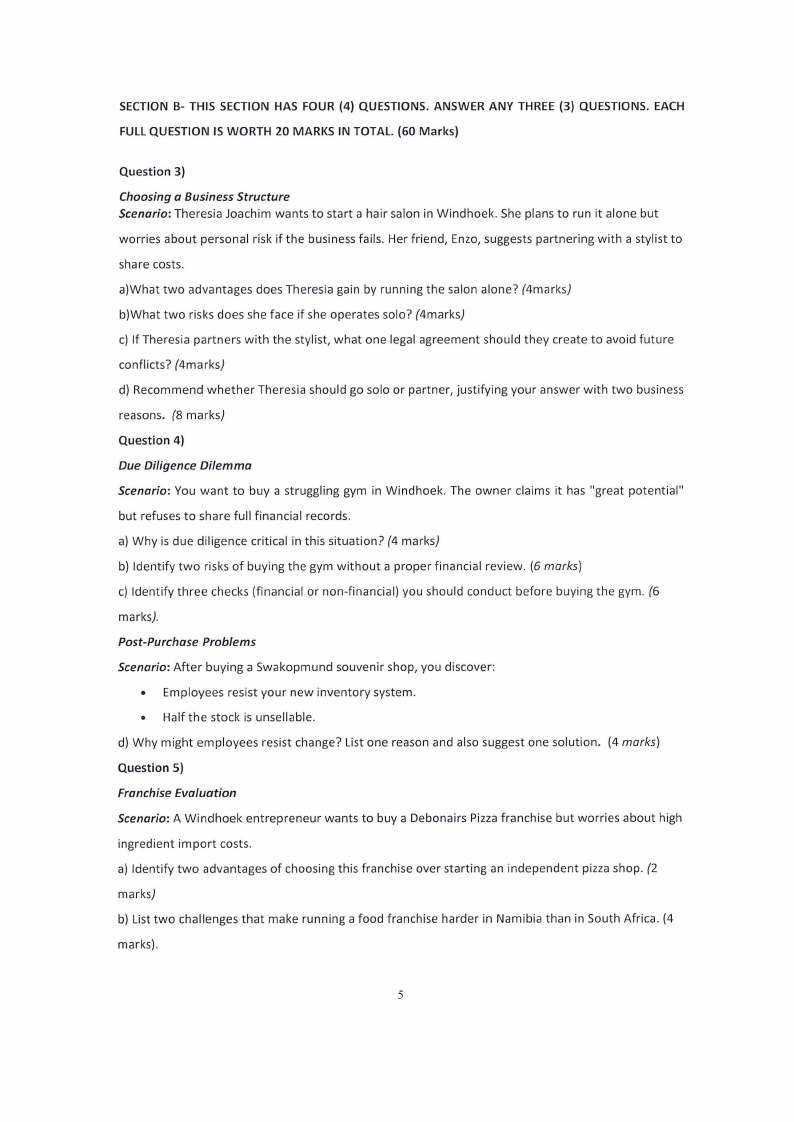
SECTION 8- THIS SECTION HAS FOUR (4) QUESTIONS. ANSWER ANY THREE (3) QUESTIONS. EACH
FULL QUESTION IS WORTH 20 MARKS IN TOTAL. (60 Marks)
Question 3)
Choosing a Business Structure
Scenario: Theresia Joachim wants to start a hair salon in Windhoek. She plans to run it alone but
worries about personal risk if the business fails. Her friend, Enzo, suggests partnering with a stylist to
share costs.
a)What two advantages does Theresia gain by running the salon alone? {4marks)
b}What two risks does she face if she operates solo? {4marks)
c) If Theresia partners with the stylist, what one legal agreement should they create to avoid future
conflicts? {4marks)
d) Recommend whether Theresia should go solo or partner, justifying your answer with two business
reasons. (8 marks)
Question 4)
Due Diligence Dilemma
Scenario: You want to buy a struggling gym in Windhoek. The owner claims it has "great potential"
but refuses to share full financial records.
a) Why is due diligence critical in this situation? {4 marks)
b) Identify two risks of buying the gym without a proper financial review. (6 marks)
c) Identify three checks (financial or non-financial) you should conduct before buying the gym. (6
marks).
Post-Purchase Problems
Scenario: After buying a Swakopmund souvenir shop, you discover:
• Employees resist your new inventory system.
• Half the stock is unsellable.
d} Why might employees resist change? List one reason and also suggest one solution. (4 marks)
Question 5)
Franchise Evaluation
Scenario: A Windhoek entrepreneur wants to buy a Debonairs Pizza franchise but worries about high
ingredient import costs.
a) Identify two advantages of choosing this franchise over starting an independent pizza shop. (2
marks)
b) List two challenges that make running a food franchise harder in Namibia than in South Africa. (4
marks).
5
|
|
6 Page 6 |
▲back to top |
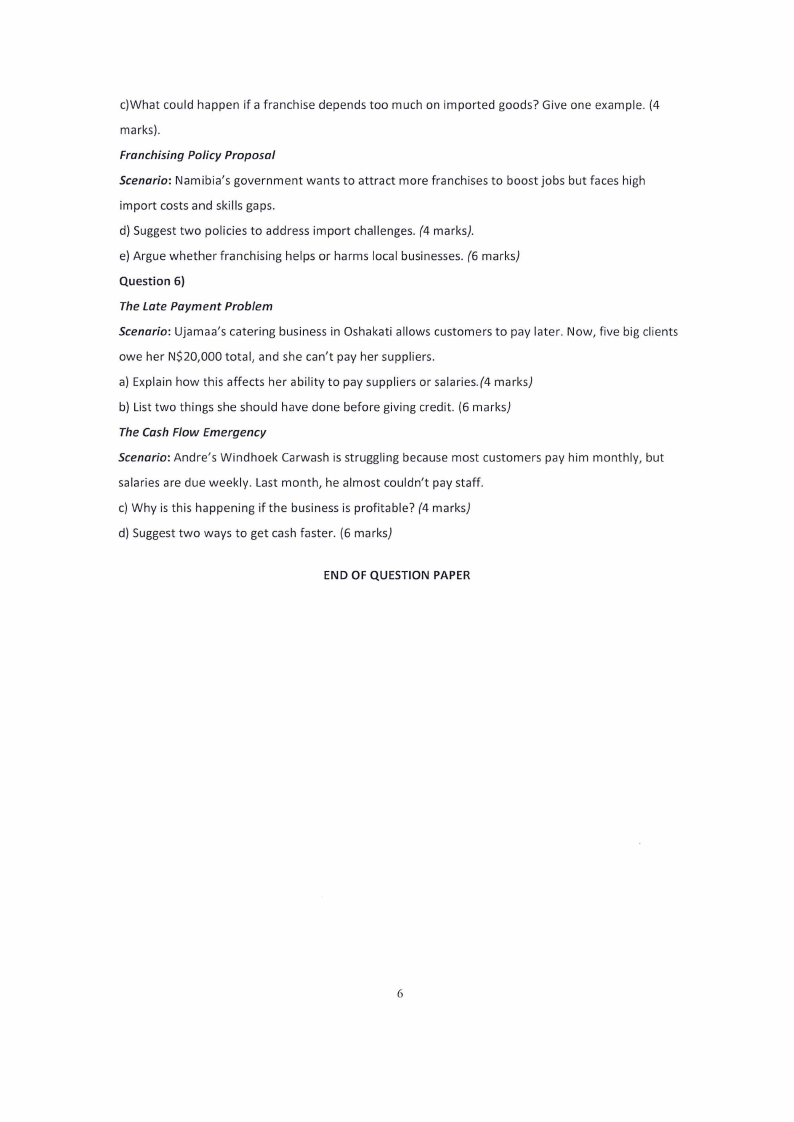
c)What could happen if a franchise depends too much on imported goods? Give one example. (4
marks).
Franchising Policy Proposal
Scenario: Namibia's government wants to attract more franchises to boost jobs but faces high
import costs and skills gaps.
d) Suggest two policies to address import challenges. (4 marks).
e) Argue whether franchising helps or harms local businesses. (6 marks)
Question 6)
The Late Payment Problem
Scenario: Ujamaa's catering business in Oshakati allows customers to pay later. Now, five big clients
owe her N$20,000 total, and she can't pay her suppliers.
a) Explain how this affects her ability to pay suppliers or salaries.{4 marks)
b) List two things she should have done before giving credit. (6 marks)
The Cash Flow Emergency
Scenario: Andre's Windhoek Carwash is struggling because most customers pay him monthly, but
salaries are due weekly. Last month, he almost couldn't pay staff.
c) Why is this happening if the business is profitable? {4 marks)
d) Suggest two ways to get cash faster. (6 marks)
END OF QUESTION PAPER
6