


 |
BEM711S - SME MANAGEMENT - 2ND OPP - JUNE 2025 |
|
|
1 Page 1 |
▲back to top |
n Am I BI A u n IVER s ITY
OF SCIEnCE Ano TECHnOLOGY
FACULTY OF COMMERCE, HUMAN SCIENCES AND EDUCATION
DEPARTMENT OF GOVERNANCE AND MANAGEMENT SCIENCES
MANAGEMENT SECTION
QUALIFICATION : BACHELOR OF BUSINESS MANAGEMENT
-----
-- -----
QUALIFICATION CODE: 07BMAR
LEVEL: 7
f-------------------1----------------------
--
-COURSE CODE: BEM 7115
COURSE NAME: SMALL AND MEDIUM ENTERPRISE
MANAGEMENT
SESSION: JULY 2025
>-------------
·---------
DURATION: 3 HOURS
PAPER: THEORY
---
--- - - - ----
MARKS: 100
>---------------
EXAMINER{S)
MODERATOR:
Second OPPORTUNITY EXAMINATION QUESTION PAPER
- . ·- - -
- -- --
-- - - - - - -
DR KARIKARI AMOA-GYARTENG (FULL TIME)
DR MOSES WAIGANJO (PART TIME & DISTANCE)
MR ERNEST MBANGA
INSTRUCTIONS
1
|
|
2 Page 2 |
▲back to top |
---------~
This examination consists of two sections. Section A contains ONE compulsory question that all
candidates must answer. Section B contains four questions, from which candidates must select and
answer any three. The total marks for this examination are 100, with Section A worth 40 marks and
Section B worth 60 marks.
1. Answer ALL the questions in the answer book provided.
2. Write clearly and neatly.
3. Number the answers clearly.
4. Indicate your lecturer's name on your answer sheet.
THIS EXAM PAPER CONSISTSOF 6 PAGES
2
|
|
3 Page 3 |
▲back to top |
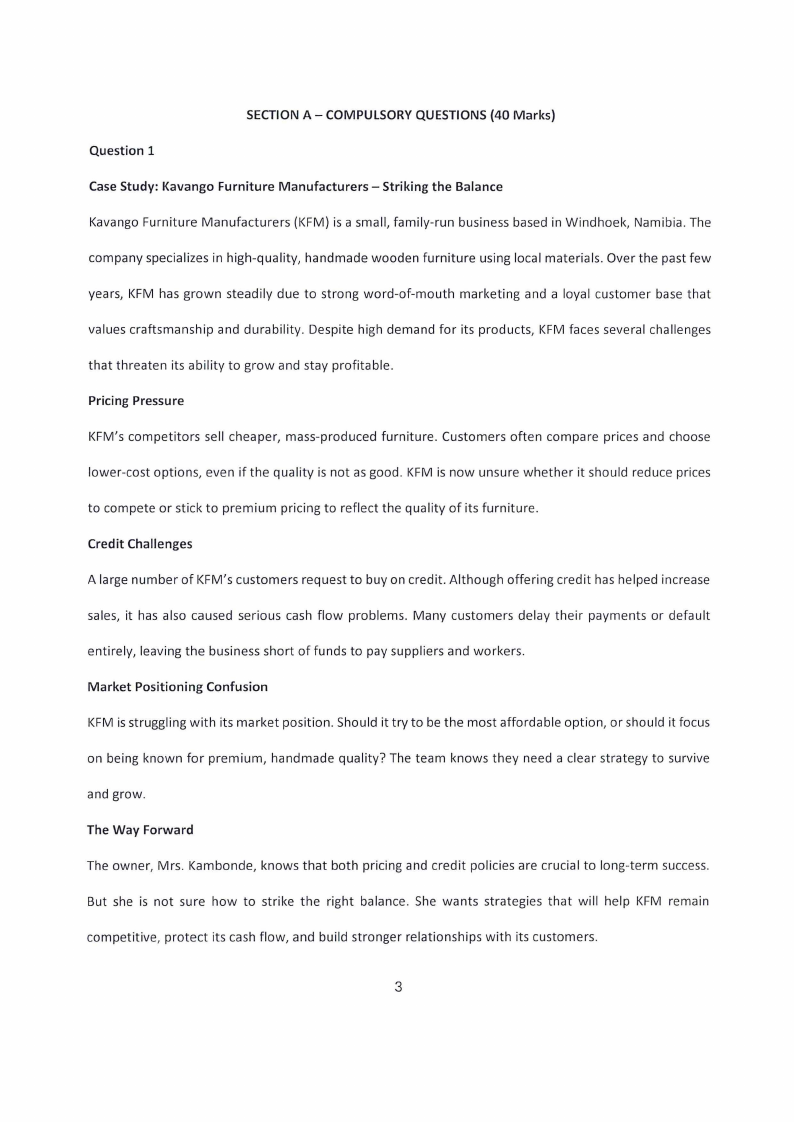
SECTION A- COMPULSORY QUESTIONS {40 Marks)
Question 1
Case Study: Kavango Furniture Manufacturers - Striking the Balance
Kavango Furniture Manufacturers (KFM) is a small, family-run business based in Windhoek, Namibia. The
company specializes in high-quality, handmade wooden furniture using local materials. Over the past few
years, KFM has grown steadily due to strong word-of-mouth marketing and a loyal customer base that
values craftsmanship and durability. Despite high demand for its products, KFM faces several challenges
that threaten its ability to grow and stay profitable.
Pricing Pressure
KFM's competitors sell cheaper, mass-produced furniture. Customers often compare prices and choose
lower-cost options, even if the quality is not as good. KFM is now unsure whether it should reduce prices
to compete or stick to premium pricing to reflect the quality of its furniture.
Credit Challenges
A large number of KFM's customers request to buy on credit. Although offering credit has helped increase
sales, it has also caused serious cash flow problems. Many customers delay their payments or default
entirely, leaving the business short of funds to pay suppliers and workers.
Market Positioning Confusion
KFM is struggling with its market position. Should it try to be the most affordable option, or should it focus
on being known for premium, handmade quality? The team knows they need a clear strategy to survive
and grow.
The Way Forward
The owner, Mrs. Kambonde, knows that both pricing and credit policies are crucial to long-term success.
But she is not sure how to strike the right balance. She wants strategies that will help KFM remain
competitive, protect its cash flow, and build stronger relationships with its customers.
3
|
|
4 Page 4 |
▲back to top |
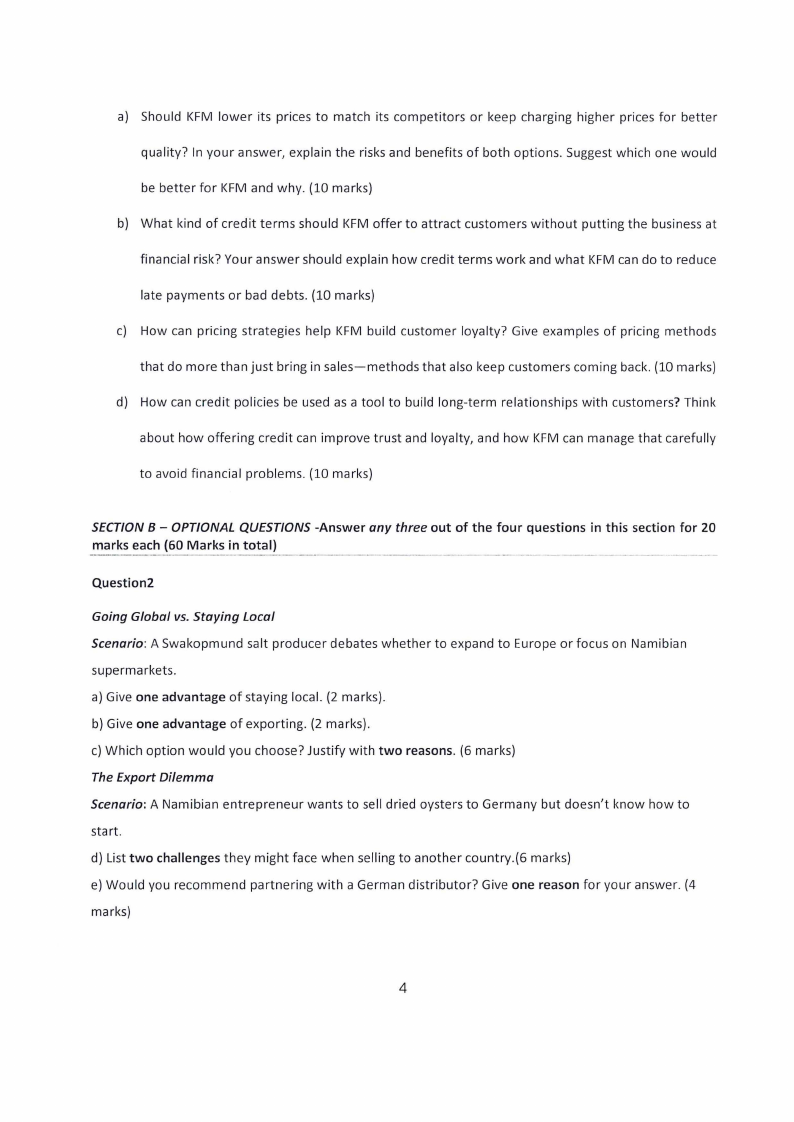
a) Should KFM lower its prices to match its competitors or keep charging higher prices for better
quality? In your answer, explain the risks and benefits of both options. Suggest which one would
be better for KFM and why. (10 marks)
b) What kind of credit terms should KFM offer to attract customers without putting the business at
financial risk? Your answer should explain how credit terms work and what KFM can do to reduce
late payments or bad debts. (10 marks)
c) How can pricing strategies help KFM build customer loyalty? Give examples of pricing methods
that do more than just bring in sales-methods that also keep customers coming back. (10 marks)
d) How can credit policies be used as a tool to build long-term relationships with customers? Think
about how offering credit can improve trust and loyalty, and how KFM can manage that carefully
to avoid financial problems. (10 marks)
SECTION B - OPTIONAL QUESTIONS -Answer any three out of the four questions in this section for 20
marks each (60 Marks in total)
Question2
Going Global vs. Staying Local
Scenario: A Swakopmund salt producer debates whether to expand to Europe or focus on Namibian
supermarkets.
a) Give one advantage of staying local. (2 marks).
b) Give one advantage of exporting. (2 marks).
c) Which option would you choose? Justify with two reasons. (6 marks)
The Export Dilemma
Scenario: A Namibian entrepreneur wants to sell dried oysters to Germany but doesn't know how to
start.
d) List two challenges they might face when selling to another country.(6 marks)
e) Would you recommend partnering with a German distributor? Give one reason for your answer. (4
marks)
4
|
|
5 Page 5 |
▲back to top |
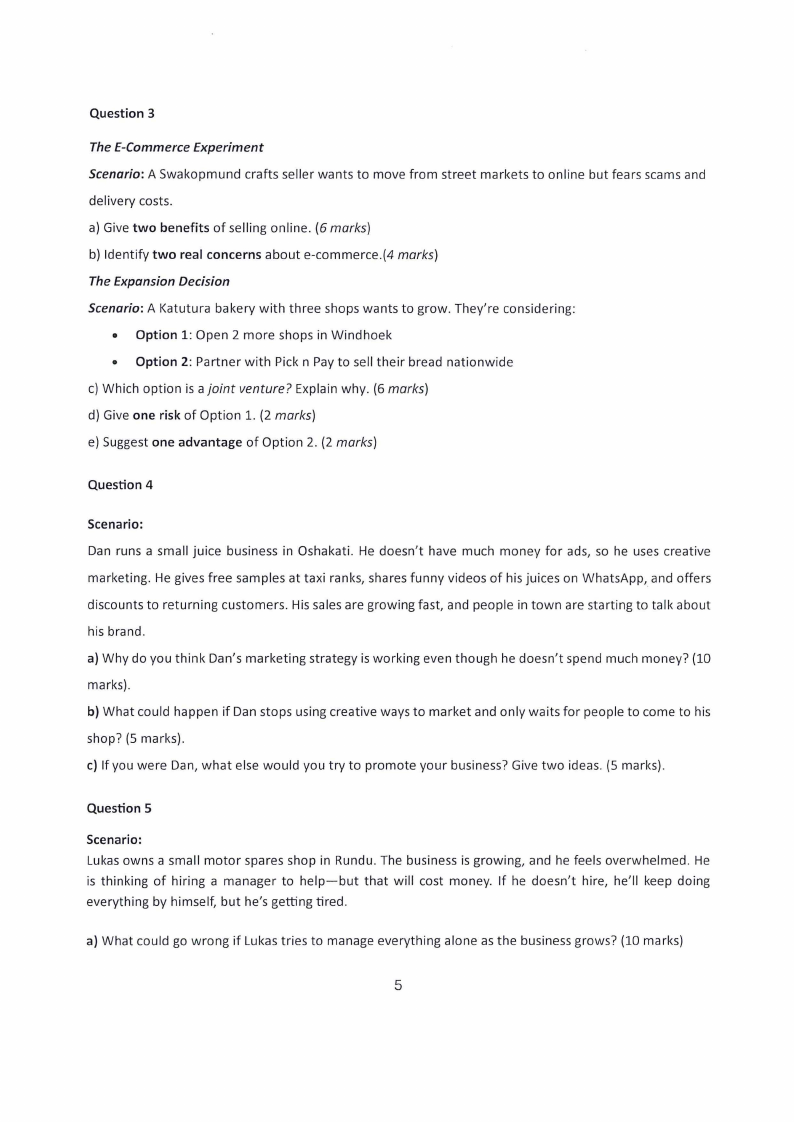
Question 3
The £-Commerce Experiment
Scenario: A Swakopmund crafts seller wants to move from street markets to online but fears scams and
delivery costs.
a) Give two benefits of selling online. (6 marks)
b) Identify two real concerns about e-commerce.(4 marks)
The Expansion Decision
Scenario: A Katutura bakery with three shops wants to grow. They're considering:
• Option 1: Open 2 more shops in Windhoek
• Option 2: Partner with Pick n Pay to sell their bread nationwide
c) Which option is a joint venture? Explain why. (6 marks)
d) Give one risk of Option 1. (2 marks)
e) Suggest one advantage of Option 2. (2 marks)
Question 4
Scenario:
Dan runs a small juice business in Oshakati. He doesn't have much money for ads, so he uses creative
marketing. He gives free samples at taxi ranks, shares funny videos of his juices on WhatsApp, and offers
discounts to returning customers. His sales are growing fast, and people in town are starting to talk about
his brand.
a) Why do you think Dan's marketing strategy is working even though he doesn't spend much money? (10
marks).
b) What could happen if Dan stops using creative ways to market and only waits for people to come to his
shop? (5 marks).
c) If you were Dan, what else would you try to promote your business? Give two ideas. (5 marks).
Question 5
Scenario:
Lukas owns a small motor spares shop in Rundu. The business is growing, and he feels overwhelmed. He
is thinking of hiring a manager to help-but that will cost money. If he doesn't hire, he'll keep doing
everything by himself, but he's getting tired.
a) What could go wrong if Lukas tries to manage everything alone as the business grows? (10 marks)
5
|
|
6 Page 6 |
▲back to top |
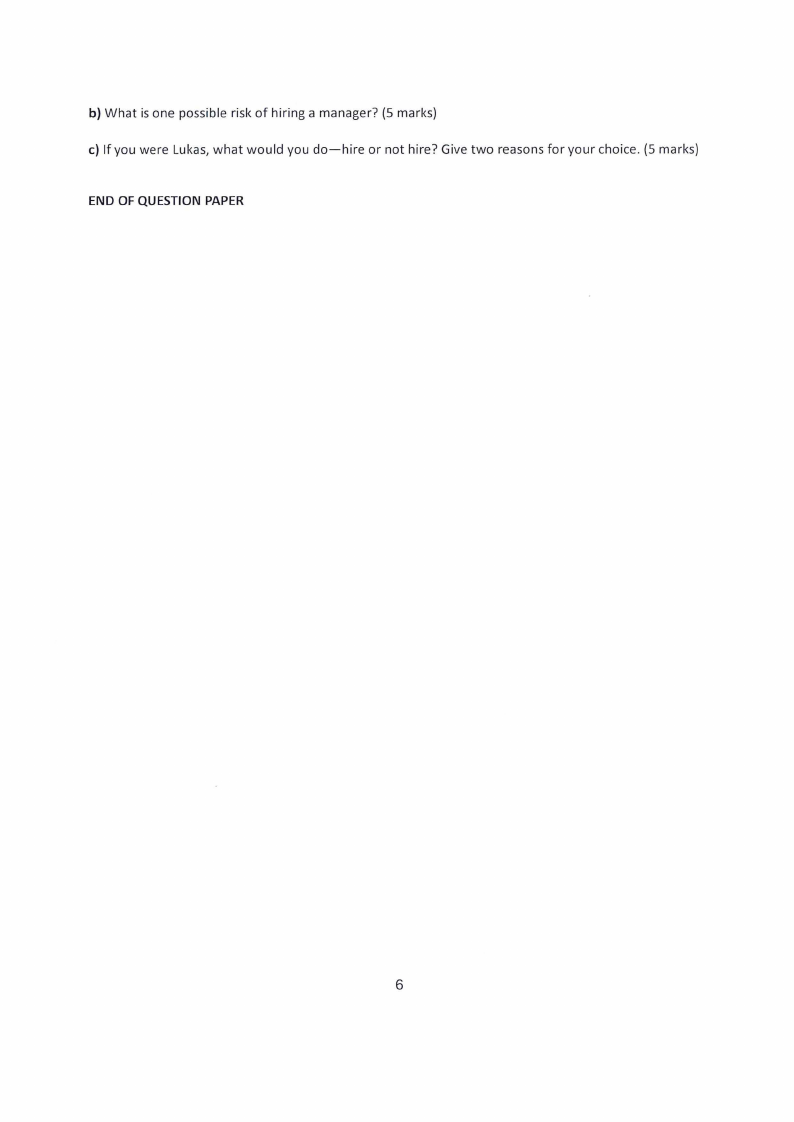
b) What is one possible risk of hiring a manager? (5 marks)
c) If you were Lukas, what would you do-hire or not hire? Give two reasons for your choice. (5 marks)
END OF QUESTION PAPER
6