


 |
CBT811S - CAPACITY BUILDING AND TALENT MANAGEMENT - 1ST OPP - JUNE 2025 |
|
|
1 Page 1 |
▲back to top |
nAmlBIA UnlVERSITY
OF SCIEnCE Ano TECHnOLOGY
FACULTY OF COMMERCE, HUMAN SCIENCES AND EDUCATION
DEPARTMENT OF GOVERNANCE AND MANAGEMENT SCIENCES
QUALIFICATION : BACHELOR OF HUMAN RESOURCES MANAGEMENT HONOURS
DEGREE
QUALi FiCA TION CODE: 08HRM
LEVEL: 8
COURSE CODE: CBT811 S
COURSE NAME: CAPACITY BUILDING AND
TALENT MANAGEMENT
DATE: JUNE 2025
DURATION: 3 HOURS
PAPER: 1
MARKS: 100
EXAMINER(S)
FIRST OPPORTUNITY QUESTION PAPER
Ms. MARTHA NAMUTUWA
MODERATOR:
MR B.U. SHIKONGO
INSTRUCTIONS
1. Answer ALL questions.
2. Write clearly and neatly.
3. Number your answers clearly.
THIS QUESTION PAPER CONSISTS OF4 PAGES (Including this front page)
|
|
2 Page 2 |
▲back to top |
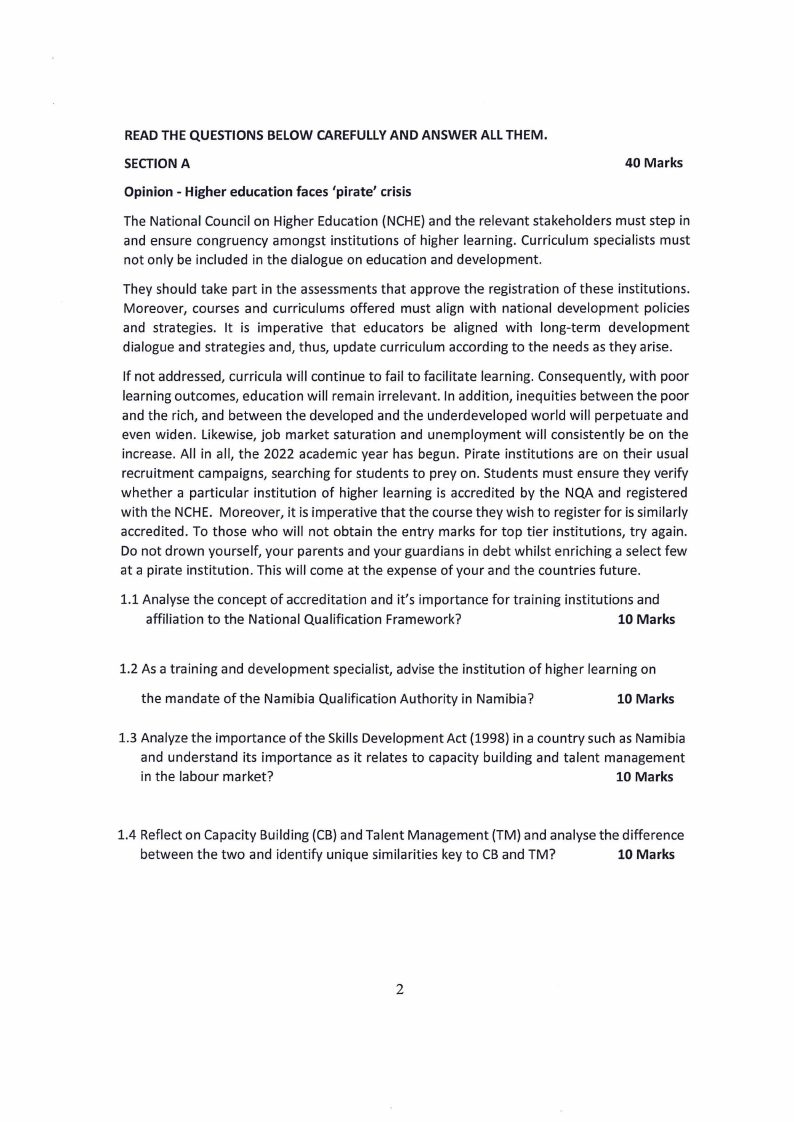
READTHE QUESTIONS BELOWCAREFULLYAND ANSWER ALLTHEM.
SECTIONA
40 Marks
Opinion - Higher education faces 'pirate' crisis
The National Council on Higher Education (NCHE)and the relevant stakeholders must step in
and ensure congruency amongst institutions of higher learning. Curriculum specialists must
not only be included in the dialogue on education and development.
They should take part in the assessments that approve the registration of these institutions.
Moreover, courses and curriculums offered must align with national development policies
and strategies. It is imperative that educators be aligned with long-term development
dialogue and strategies and, thus, update curriculum according to the needs as they arise.
If not addressed, curricula will continue to fail to facilitate learning. Consequently, with poor
learning outcomes, education will remain irrelevant. In addition, inequities between the poor
and the rich, and between the developed and the underdeveloped world will perpetuate and
even widen. Likewise, job market saturation and unemployment will consistently be on the
increase. All in all, the 2022 academic year has begun. Pirate institutions are on their usual
recruitment campaigns, searching for students to prey on. Students must ensure they verify
whether a particular institution of higher learning is accredited by the NQA and registered
with the NCHE. Moreover, it is imperative that the course they wish to register for is similarly
accredited. To those who will not obtain the entry marks for top tier institutions, try again.
Do not drown yourself, your parents and your guardians in debt whilst enriching a select few
at a pirate institution. This will come at the expense of your and the countries future.
1.1 Analyse the concept of accreditation and it's importance for training institutions and
affiliation to the National Qualification Framework?
10 Marks
1.2 As a training and development specialist, advise the institution of higher learning on
the mandate of the Namibia Qualification Authority in Namibia?
10 Marks
1.3 Analyze the importance of the Skills Development Act (1998) in a country such as Namibia
and understand its importance as it relates to capacity building and talent management
in the labour market?
10 Marks
1.4 Reflect on Capacity Building (CB)and Talent Management (TM) and analyse the difference
between the two and identify unique similarities key to CB and TM?
10 Marks
2
|
|
3 Page 3 |
▲back to top |
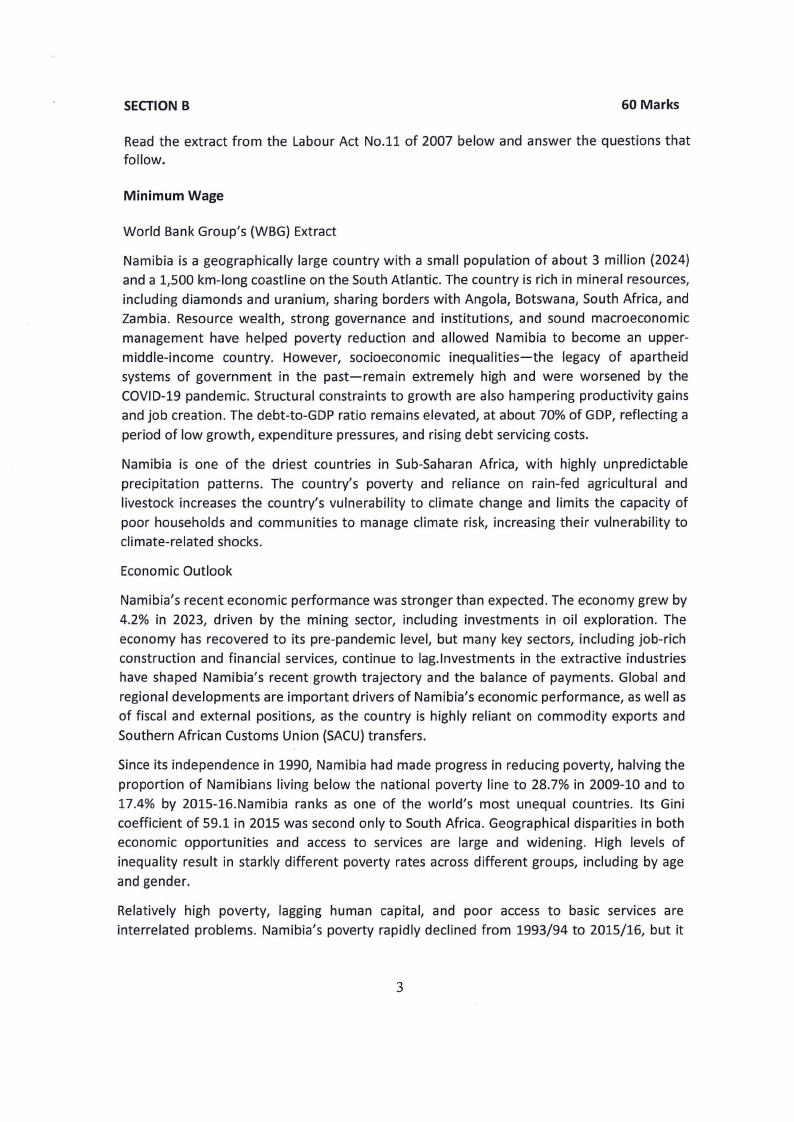
SECTION B
60 Marks
Read the extract from the Labour Act No.11 of 2007 below and answer the questions that
follow.
Minimum Wage
World Bank Group's (WBG) Extract
Namibia is a geographically large country with a small population of about 3 million (2024)
and a 1,500 km-long coastline on the South Atlantic. The country is rich in mineral resources,
including diamonds and uranium, sharing borders with Angola, Botswana, South Africa, and
Zambia. Resource wealth, strong governance and institutions, and sound macroeconomic
management have helped poverty reduction and allowed Namibia to become an upper-
middle-income country. However, socioeconomic inequalities-the legacy of apartheid
systems of government in the past-remain extremely high and were worsened by the
COVID-19 pandemic. Structural constraints to growth are also hampering productivity gains
and job creation. The debt-to-GDP ratio remains elevated, at about 70% of GDP, reflecting a
period of low growth, expenditure pressures, and rising debt servicing costs.
Namibia is one of the driest countries in Sub-Saharan Africa, with highly unpredictable
precipitation patterns. The country's poverty and reliance on rain-fed agricultural and
livestock increases the country's vulnerability to climate change and limits the capacity of
poor households and communities to manage climate risk, increasing their vulnerability to
climate-related shocks.
Economic Outlook
Namibia's recent economic performance was stronger than expected. The economy grew by
4.2% in 2023, driven by the mining sector, including investments in oil exploration. The
economy has recovered to its pre-pandemic level, but many key sectors, including job-rich
construction and financial services, continue to lag.Investments in the extractive industries
have shaped Namibia's recent growth trajectory and the balance of payments. Global and
regional developments are important drivers of Namibia's economic performance, as well as
of fiscal and external positions, as the country is highly reliant on commodity exports and
Southern African Customs Union (SACU)transfers.
Since its independence in 1990, Namibia had made progress in reducing poverty, halving the
proportion of Namibians living below the national poverty line to 28.7% in 2009-10 and to
17.4% by 2015-16.Namibia ranks as one of the world's most unequal countries. Its Gini
coefficient of 59.1 in 2015 was second only to South Africa. Geographical disparities in both
economic opportunities and access to services are large and widening. High levels of
inequality result in starkly different poverty rates across different groups, including by age
and gender.
Relatively high poverty, lagging human capital, and poor access to basic services are
interrelated problems. Namibia's poverty rapidly declined from 1993/94 to 2015/16, but it
3
|
|
4 Page 4 |
▲back to top |
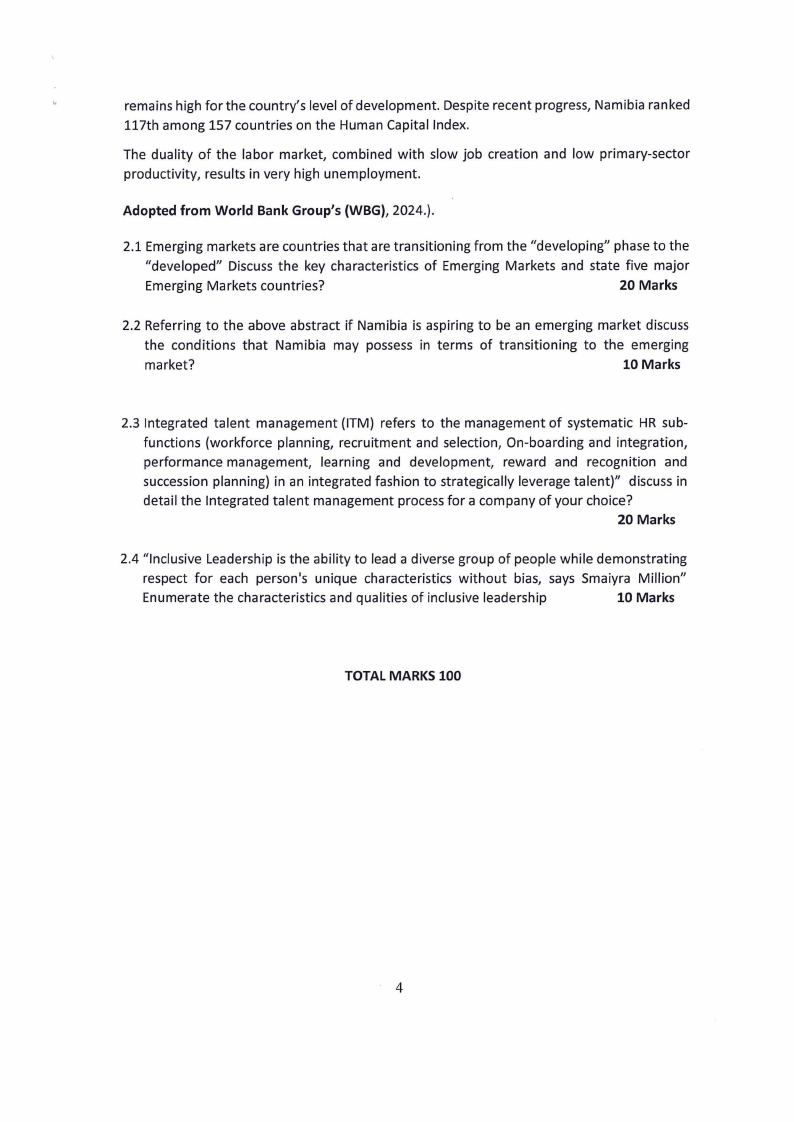
remains high for the country's level of development. Despite recent progress, Namibia ranked
117th among 157 countries on the Human Capital Index.
The duality of the labor market, combined with slow job creation and low primary-sector
productivity, results in very high unemployment.
Adopted from World Bank Group's (WBG), 2024.).
2.1 Emerging markets are countries that are transitioning from the "developing" phase to the
"developed" Discuss the key characteristics of Emerging Markets and state five major
Emerging Markets countries?
20 Marks
2.2 Referring to the above abstract if Namibia is aspiring to be an emerging market discuss
the conditions that Namibia may possess in terms of transitioning to the emerging
market?
10 Marks
2.3 Integrated talent management (ITM) refers to the management of systematic HR sub-
functions (workforce planning, recruitment and selection, On-boarding and integration,
performance management, learning and development, reward and recognition and
succession planning) in an integrated fashion to strategically leverage talent)" discuss in
detail the Integrated talent management process for a company of your choice?
20 Marks
2.4 "Inclusive Leadership is the ability to lead a diverse group of people while demonstrating
respect for each person's unique characteristics without bias, says Smaiyra Million"
Enumerate the characteristics and qualities of inclusive leadership
10 Marks
TOTAL MARKS 100
4