


 |
CBT811S - CAPACITY BUILDING AND TALENT MANAGEMENT - 2ND OPP - JUNE 2025 |
|
|
1 Page 1 |
▲back to top |
nAmlBIA UnlVERSITY
OF SCIEnCE Ano TECHnOLOGY
FACULTY OF COMMERCE, HUMAN SCIENCES AND EDUCATION
DEPARTMENT OF GOVERNANCE AND MANAGEMENT SCIENCES
QUALIFICATION : BACHELOR OF HUMAN RESOURCES MANAGEMENT HONOURS
DEGREE
QUALIFICATION CODE: 08HRM
LEVEL: 8
COURSE CODE: CBT811 S
COURSE NAME: CAPACITY BUILDING & TALENT
MANAGEMENT
DATE: JULY 2025
DURATION: 3 HOURS
PAPER: 1
MARKS: 100
EXAMINER(S)
SECOND OPPORTUNITY QUESTION PAPER
Ms. MARTHA NUMUTUWA
MODERATOR:
MR BU SHIKONGO
INSTRUCTIONS
1. Answer ALL questions.
2. Write clearly and neatly.
3. Number your answers clearly.
THIS QUESTION PAPER CONSISTS OF 7 PAGES (Including this front page)
|
|
2 Page 2 |
▲back to top |
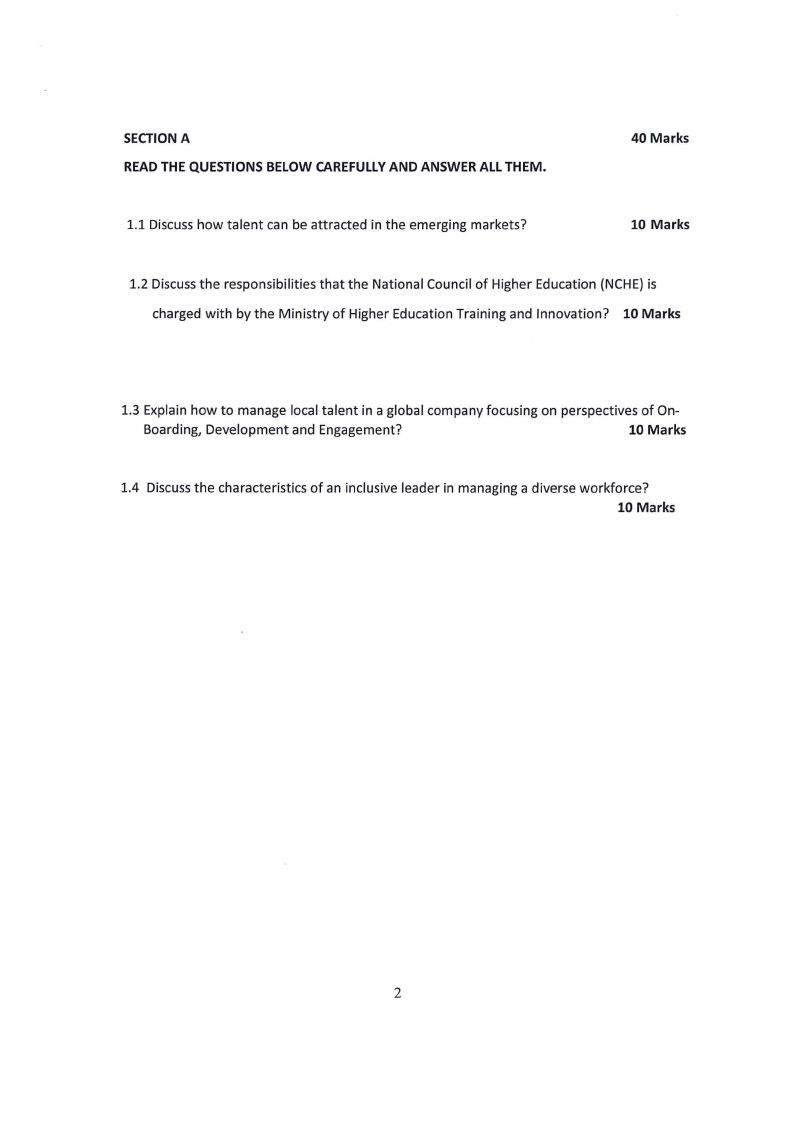
SECTIONA
READTHE QUESTIONSBELOWCAREFULLYAND ANSWERALLTHEM.
40 Marks
1.1 Discuss how talent can be attracted in the emerging markets?
10 Marks
1.2 Discussthe responsibilities that the National Council of Higher Education (NCHE)is
charged with by the Ministry of Higher Education Training and Innovation? 10 Marks
1.3 Explain how to manage local talent in a global company focusing on perspectives of On-
Boarding, Development and Engagement?
10 Marks
1.4 Discussthe characteristics of an inclusive leader in managing a diverse workforce?
10 Marks
2
|
|
3 Page 3 |
▲back to top |
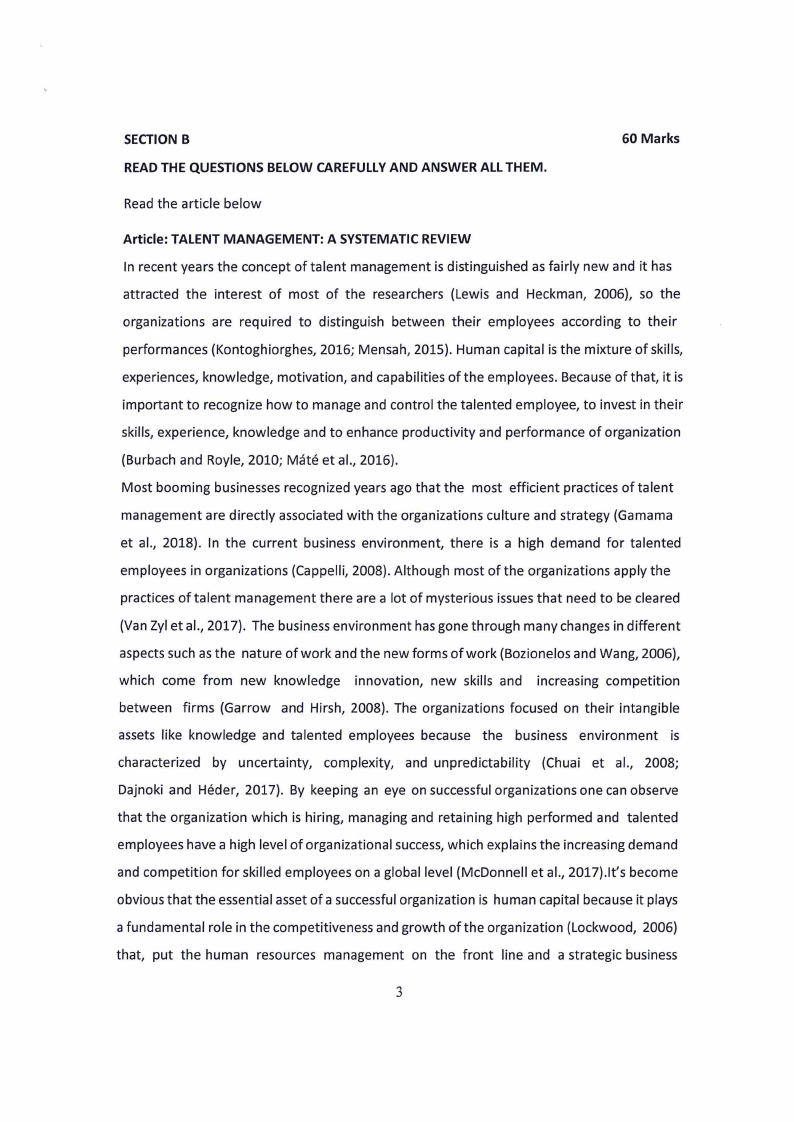
SECTIONB
READTHE QUESTIONSBELOWCAREFULLYAND ANSWERALLTHEM.
60 Marks
Readthe article below
Article: TALENTMANAGEMENT: A SYSTEMATICREVIEW
In recent years the concept of talent management is distinguished as fairly new and it has
attracted the interest of most of the researchers (Lewis and Heckman, 2006), so the
organizations are required to distinguish between their employees according to their
performances (Kontoghiorghes, 2016; Mensah, 2015). Human capital is the mixture of skills,
experiences, knowledge, motivation, and capabilities of the employees. Because of that, it is
important to recognize how to manage and control the talented employee, to invest in their
skills, experience, knowledge and to enhance productivity and performance of organization
(Burbach and Royle, 2010; Mate et al., 2016).
Most booming businesses recognized years ago that the most efficient practices of talent
management are directly associated with the organizations culture and strategy (Gamama
et al., 2018). In the current business environment, there is a high demand for talented
employees in organizations (Cappelli, 2008). Although most of the organizations apply the
practices of talent management there are a lot of mysterious issues that need to be cleared
(Van Zyl et al., 2017). The business environment has gone through many changes in different
aspects such as the nature of work and the new forms of work (Bozionelos and Wang, 2006),
which come from new knowledge innovation, new skills and increasing competition
between firms (Garrow and Hirsh, 2008). The organizations focused on their intangible
assets like knowledge and talented employees because the business environment is
characterized by uncertainty, complexity, and unpredictability (Chuai et al., 2008;
Dajnoki and Heder, 2017). By keeping an eye on successful organizations one can observe
that the organization which is hiring, managing and retaining high performed and talented
employees have a high level of organizational success,which explains the increasing demand
and competition for skilled employees on a global level (McDonnell et al., 2017).lt's become
obvious that the essential asset of a successful organization is human capital because it plays
a fundamental role in the competitiveness and growth of the organization (Lockwood, 2006)
that, put the human resources management on the front line and a strategic business
3
|
|
4 Page 4 |
▲back to top |
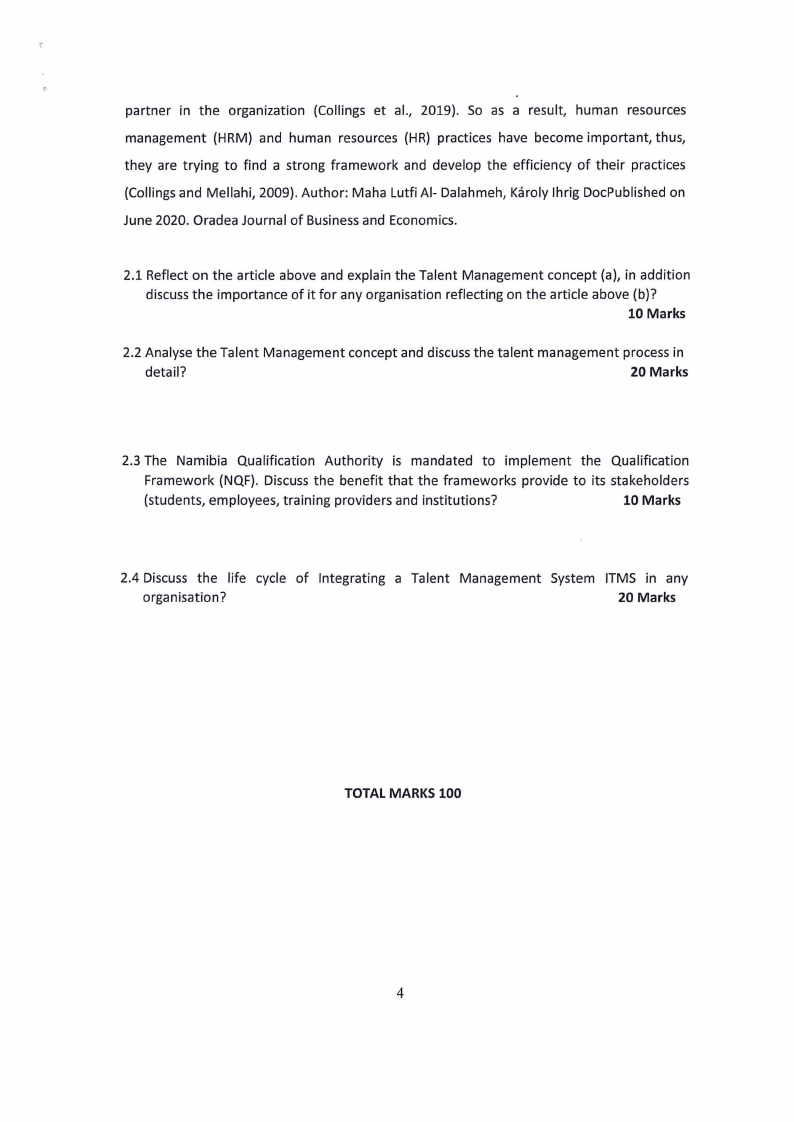
partner in the organization (Collings et al., 2019). So as a result, human resources
management (HRM) and human resources (HR) practices have become important, thus,
they are trying to find a strong framework and develop the efficiency of their practices
(Collings and Mellahi, 2009). Author: Maha Lutfi Al- Dalahmeh, Karoly Ihrig DocPublished on
June 2020. Oradea Journal of Businessand Economics.
2.1 Reflect on the article above and explain the Talent Management concept (a), in addition
discuss the importance of it for any organisation reflecting on the article above (b)?
10 Marks
2.2 Analyse the Talent Management concept and discuss the talent management process in
detail?
20 Marks
2.3 The Namibia Qualification Authority is mandated to implement the Qualification
Framework (NQF). Discuss the benefit that the frameworks provide to its stakeholders
(students, employees, training providers and institutions?
10 Marks
2.4 Discuss the life cycle of Integrating a Talent Management System ITMS in any
organisation?
20 Marks
TOTAL MARKS 100
4