


 |
FMH810S-FINANCIAL MANAGEMENT FOR HOSPITALITY AND TOURISM-2ND OPP- JULY 2025 |
|
|
1 Page 1 |
▲back to top |
nAm I BI A u n IVE RS ITV
OF SCIEnCE Ano
FACULTY OF COMMERCE, HUMAN SCIENCESAND EDUCATION
DEPARTMENT OF ECONOMICS, ACCOUNTING & FINANCE
QUALIFICATION: BACHELOR OF HOSPITALITY AND
TOURISM MANAGEMENT HONOURS
QUALIFICATION CODE: 08BHTH
LEVEL: 8
COURSE CODE: FMH810S
COURSE NAME: FINANCIAL MANAGEMENT FOR
HOSPITALITY AND TOURISM
SESSION: JULY 2025
DURATION: 3 HOURS
PAPER: THEORY AND APPLICATION
MARKS: 100
SECOND OPPORTUNITY EXAMINATION QUESTION PAPER
EXAMINERS:
Kuhepa Tjondu
MODERATOR: Mr. A Okafor
INSTRUCTIONS
• This question paper is made up of FIVE (5) questions.
• Start each question on a new page.
• Answer All the questions and in blue or black ink.
• You are advised to pay due attention to expression and presentation. Failure to do so will
cost you marks.
• Start each question on a new page in your answer booklet and show all your workings.
• Questions relating to this paper may be raised in the initial 30 minutes after the start of
the paper. Thereafter, candidates must use their initiative to deal with any perceived error
or ambiguities and any assumption made by the candidate should be clearly stated.
PERMISSIBLE MATERIALS
Non-programmable calculator/financial calculator
THIS QUESTION PAPER CONSISTS OF 6 PAGES {Including this front page}
1
|
|
2 Page 2 |
▲back to top |
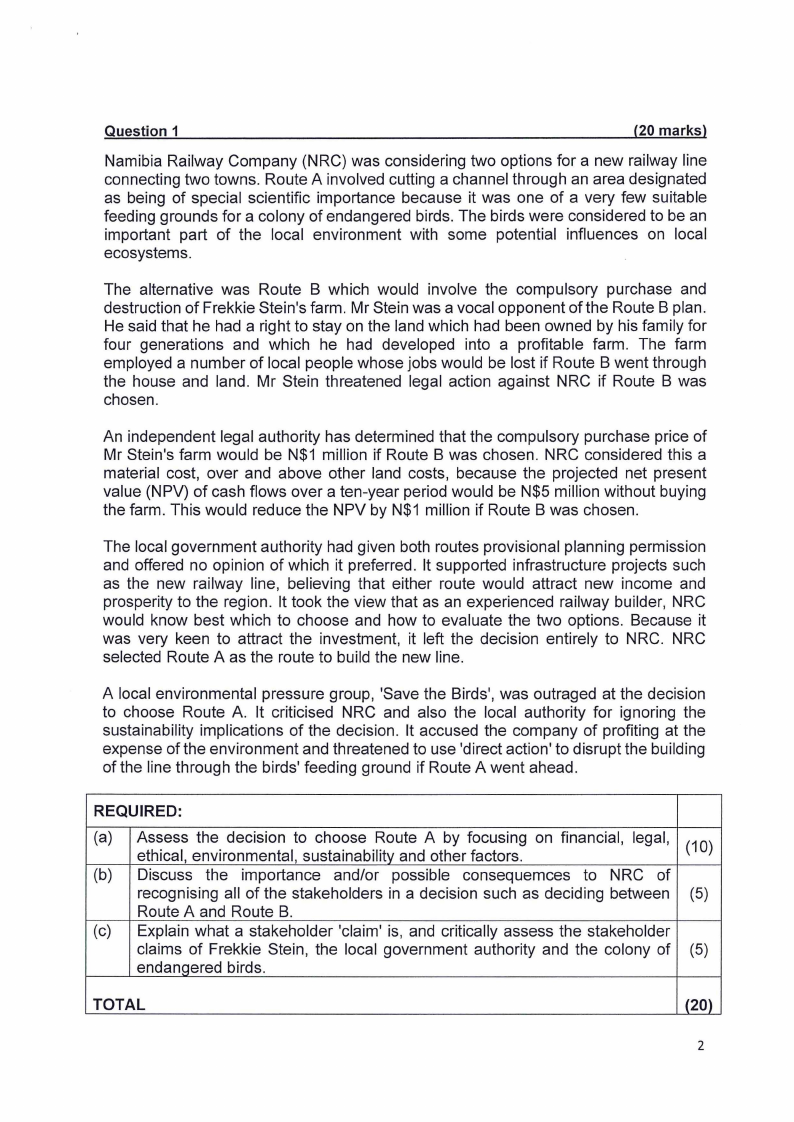
Question 1
(20 marks)
Namibia Railway Company (NRC) was considering two options for a new railway line
connecting two towns. Route A involved cutting a channel through an area designated
as being of special scientific importance because it was one of a very few suitable
feeding grounds for a colony of endangered birds. The birds were considered to be an
important part of the local environment with some potential influences on local
ecosystems.
The alternative was Route B which would involve the compulsory purchase and
destruction of Frekkie Stein's farm. Mr Stein was a vocal opponent of the Route B plan.
He said that he had a right to stay on the land which had been owned by his family for
four generations and which he had developed into a profitable farm. The farm
employed a number of local people whose jobs would be lost if Route B went through
the house and land. Mr Stein threatened legal action against NRC if Route B was
chosen.
An independent legal authority has determined that the compulsory purchase price of
Mr Stein's farm would be N$1 million if Route B was chosen. NRC considered this a
material cost, over and above other land costs, because the projected net present
value (NPV) of cash flows over a ten-year period would be N$5 million without buying
the farm. This would reduce the NPV by N$1 million if Route B was chosen.
The local government authority had given both routes provisional planning permission
and offered no opinion of which it preferred. It supported infrastructure projects such
as the new railway line, believing that either route would attract new income and
prosperity to the region. It took the view that as an experienced railway builder, NRC
would know best which to choose and how to evaluate the two options. Because it
was very keen to attract the investment, it left the decision entirely to NRC. NRC
selected Route A as the route to build the new line.
A local environmental pressure group, 'Save the Birds', was outraged at the decision
to choose Route A. It criticised NRC and also the local authority for ignoring the
sustainability implications of the decision. It accused the company of profiting at the
expense of the environment and threatened to use 'direct action' to disrupt the building
of the line through the birds' feeding ground if Route A went ahead.
REQUIRED:
(a)
Assess the decision to choose Route A by focusing on financial, legal,
ethical, environmental, sustainability and other factors.
(10)
(b) Discuss the importance and/or possible consequemces to NRC of
recognising all of the stakeholders in a decision such as deciding between (5)
Route A and Route B.
(c) Explain what a stakeholder 'claim' is, and critically assess the stakeholder
claims of Frekkie Stein, the local government authority and the colony of (5)
endangered birds.
TOTAL
(20)
2
|
|
3 Page 3 |
▲back to top |
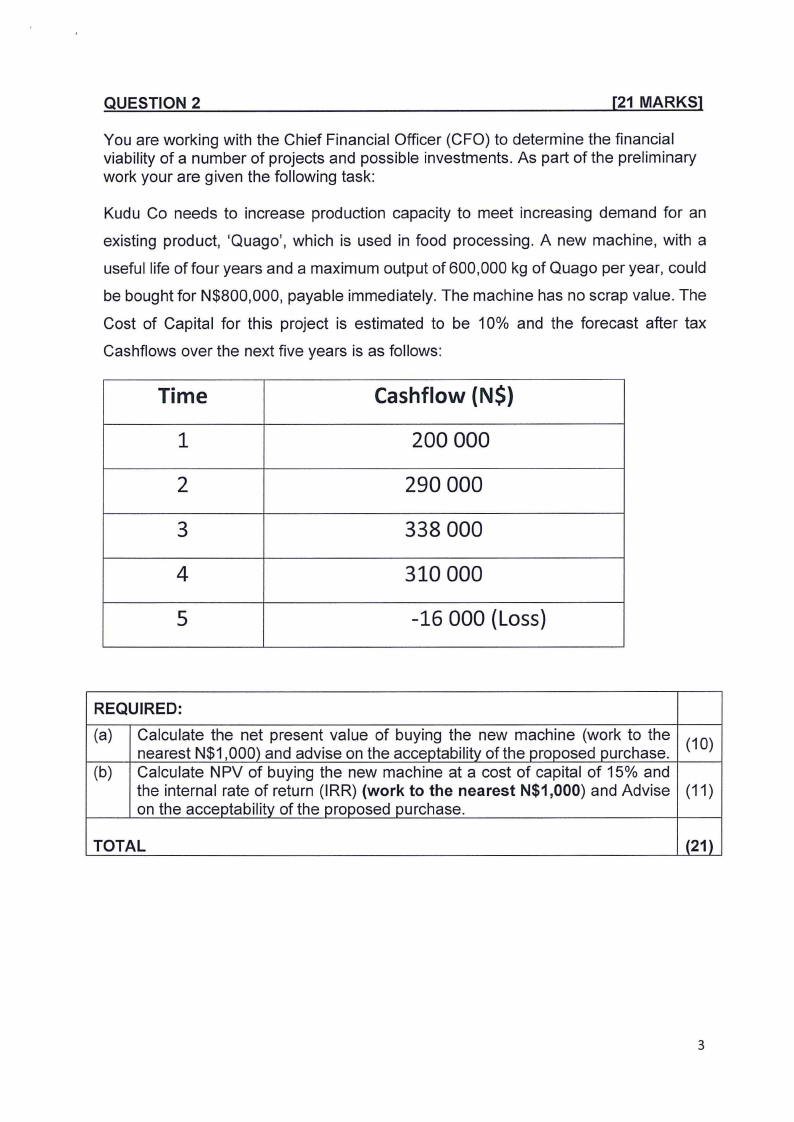
QUESTION 2
[21 MARKS]
You are working with the Chief Financial Officer (CFO) to determine the financial
viability of a number of projects and possible investments. As part of the preliminary
work your are given the following task:
Kudu Co needs to increase production capacity to meet increasing demand for an
existing product, 'Quago', which is used in food processing. A new machine, with a
useful life of four years and a maximum output of 600,000 kg of Quago per year, could
be bought for N$800,000, payable immediately. The machine has no scrap value. The
Cost of Capital for this project is estimated to be 10% and the forecast after tax
Cashflows over the next five years is as follows:
Time
Cashflow (N$)
1
200 000
2
290 000
3
338 000
4
310 000
5
-16 000 {Loss)
REQUIRED:
(a)
Calculate the net present value of buying the new machine (work to the
nearest N$1, 000) and advise on the acceptability of the proposed purchase.
(10)
(b) Calculate NPV of buying the new machine at a cost of capital of 15% and
the internal rate of return (IRR) (work to the nearest N$1,000) and Advise (11)
on the acceptability of the proposed purchase.
TOTAL
(21)
3
|
|
4 Page 4 |
▲back to top |
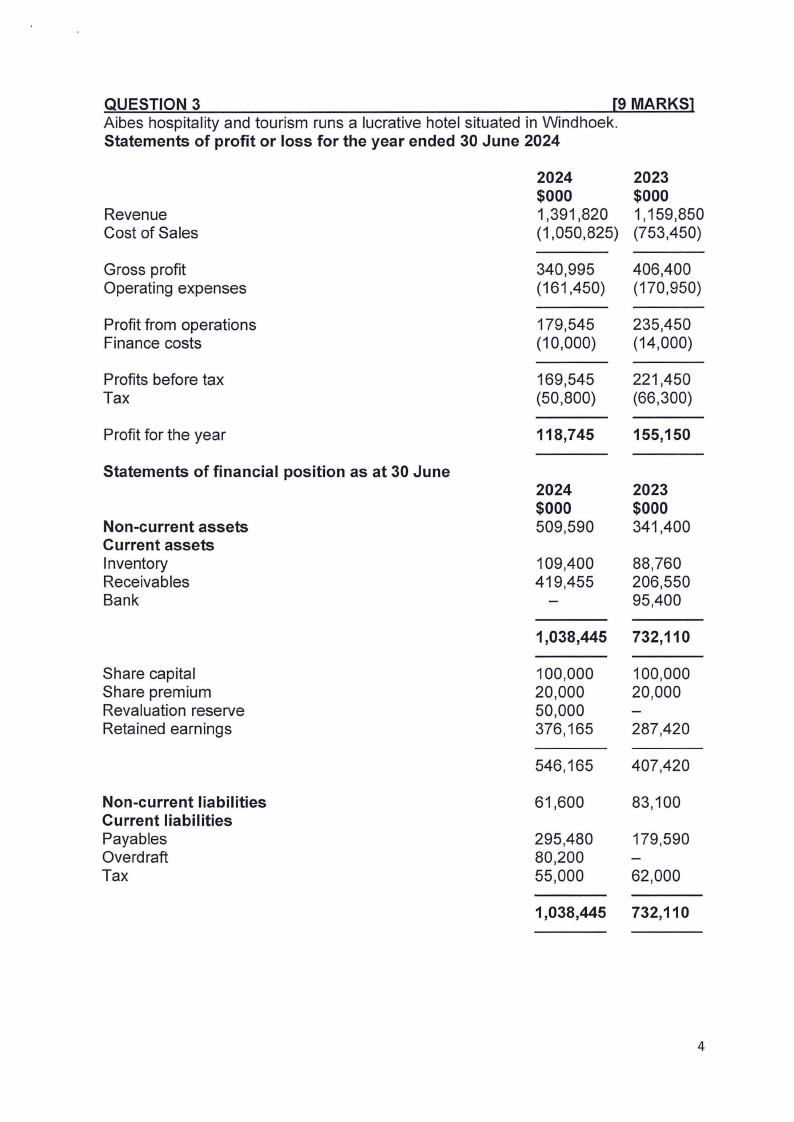
QUESTION 3
[9 MARKS]
Aibes hospitality and tourism runs a lucrative hotel situated in Windhoek.
Statements of profit or loss for the year ended 30 June 2024
Revenue
Cost of Sales
2024
$000
1,391,820
(1,050,825)
2023
$000
1t 159,850
(753,450)
Gross profit
Operating expenses
340,995
(161,450)
406,400
(170,950)
Profit from operations
Finance costs
179,545
(10,000)
235,450
(14,000)
Profits before tax
Tax
169,545
(50,800)
221,450
(66,300)
Profit for the year
118,745
155,150
Statements of financial position as at 30 June
Non-current assets
Current assets
Inventory
Receivables
Bank
2024
$000
509,590
109,400
419,455
2023
$000
341,400
88,760
206,550
95,400
1,038,445 732,110
Share capital
Share premium
Revaluation reserve
Retained earnings
100,000
20,000
50,000
376,165
100,000
20,000
287,420
546,165
407,420
Non-current liabilities
Current liabilities
Payables
Overdraft
Tax
61,600
295,480
80,200
55,000
83,100
179,590
62,000
1,038,445 732,110
4
|
|
5 Page 5 |
▲back to top |
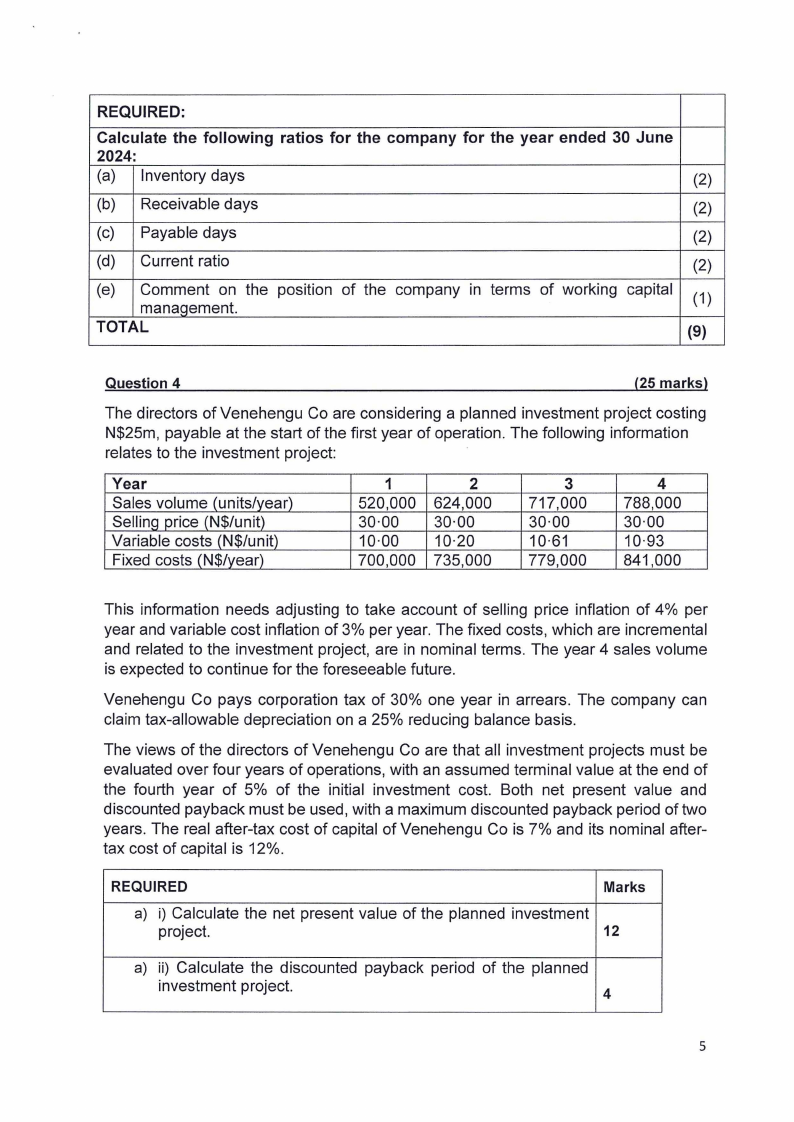
REQUIRED:
Calculate the following ratios for the company for the year ended 30 June
2024:
(a) Inventory days
(2)
(b) Receivable days
(2)
(c) Payable days
(2)
(d) Current ratio
(2)
(e)
Comment on the position of the company in terms of working capital
management.
(1)
TOTAL
(9)
Question 4
(25 marks)
The directors of Venehengu Co are considering a planned investment project costing
N$25m, payable at the start of the first year of operation. The following information
relates to the investment project:
Year
Sales volume (units/year)
Selling price (N$/unit)
Variable costs (N$/unit)
Fixed costs (N$/year)
1
520,000
30·00
10·00
700,000
2
624,000
30·00
10·20
735,000
3
717,000
30·00
10·61
779,000
4
788,000
30·00
10·93
841,000
This information needs adjusting to take account of selling price inflation of 4% per
year and variable cost inflation of 3% per year. The fixed costs, which are incremental
and related to the investment project, are in nominal terms. The year 4 sales volume
is expected to continue for the foreseeable future.
Venehengu Co pays corporation tax of 30% one year in arrears. The company can
claim tax-allowable depreciation on a 25% reducing balance basis.
The views of the directors of Venehengu Co are that all investment projects must be
evaluated over four years of operations, with an assumed terminal value at the end of
the fourth year of 5% of the initial investment cost. Both net present value and
discounted payback must be used, with a maximum discounted payback period of two
years. The real after-tax cost of capital of Venehengu Co is 7% and its nominal after-
tax cost of capital is 12%.
REQUIRED
a) i) Calculate the net present value of the planned investment
project.
Marks
12
a) ii) Calculate the discounted payback period of the planned
investment project.
4
5
|
|
6 Page 6 |
▲back to top |
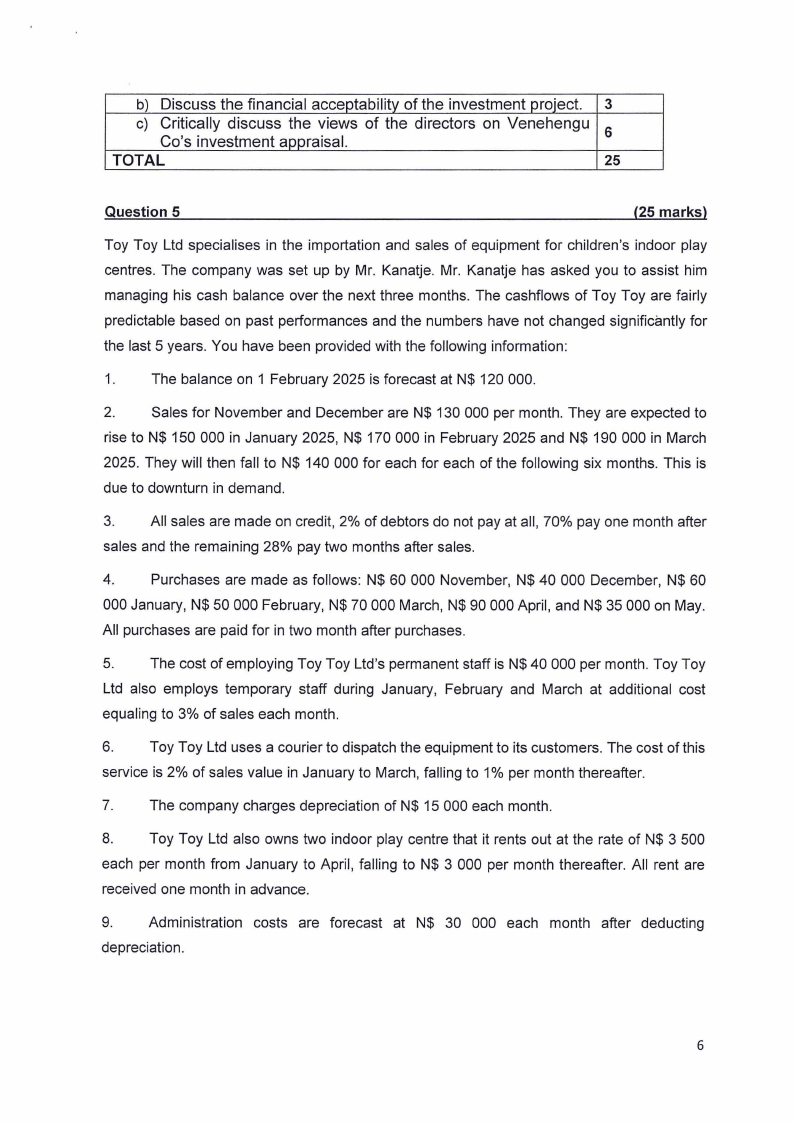
b) Discuss the financial acceptability of the investment project. 3
c) Critically discuss the views of the directors on Venehengu
Co's investment appraisal.
6
TOTAL
25
Question 5
(25 marks)
Toy Toy Ltd specialises in the importation and sales of equipment for children's indoor play
centres. The company was set up by Mr. Kanatje. Mr. Kanatje has asked you to assist him
managing his cash balance over the next three months. The cashflows of Toy Toy are fairly
predictable based on past performances and the numbers have not changed significantly for
the last 5 years. You have been provided with the following information:
1. The balance on 1 February 2025 is forecast at N$ 120 000.
2. Sales for November and December are N$ 130 000 per month. They are expected to
rise to N$ 150 000 in January 2025, N$ 170 000 in February 2025 and N$ 190 000 in March
2025. They will then fall to N$ 140 000 for each for each of the following six months. This is
due to downturn in demand.
3. All sales are made on credit, 2% of debtors do not pay at all, 70% pay one month after
sales and the remaining 28% pay two months after sales.
4.
Purchases are made as follows: N$ 60 000 November, N$ 40 000 December, N$ 60
000 January, N$ 50 000 February, N$ 70 000 March, N$ 90 000 April, and N$ 35 000 on May.
All purchases are paid for in two month after purchases.
5. The cost of employing Toy Toy Ltd's permanent staff is N$ 40 000 per month. Toy Toy
Ltd also employs temporary staff during January, February and March at additional cost
equaling to 3% of sales each month.
6. Toy Toy Ltd uses a courier to dispatch the equipment to its customers. The cost of this
service is 2% of sales value in January to March, falling to 1% per month thereafter.
7. The company charges depreciation of N$ 15 000 each month.
8. Toy Toy Ltd also owns two indoor play centre that it rents out at the rate of N$ 3 500
each per month from January to April, falling to N$ 3 000 per month thereafter. All rent are
received one month in advance.
9. Administration costs are forecast at N$ 30 000 each month after deducting
depreciation.
6
|
|
7 Page 7 |
▲back to top |
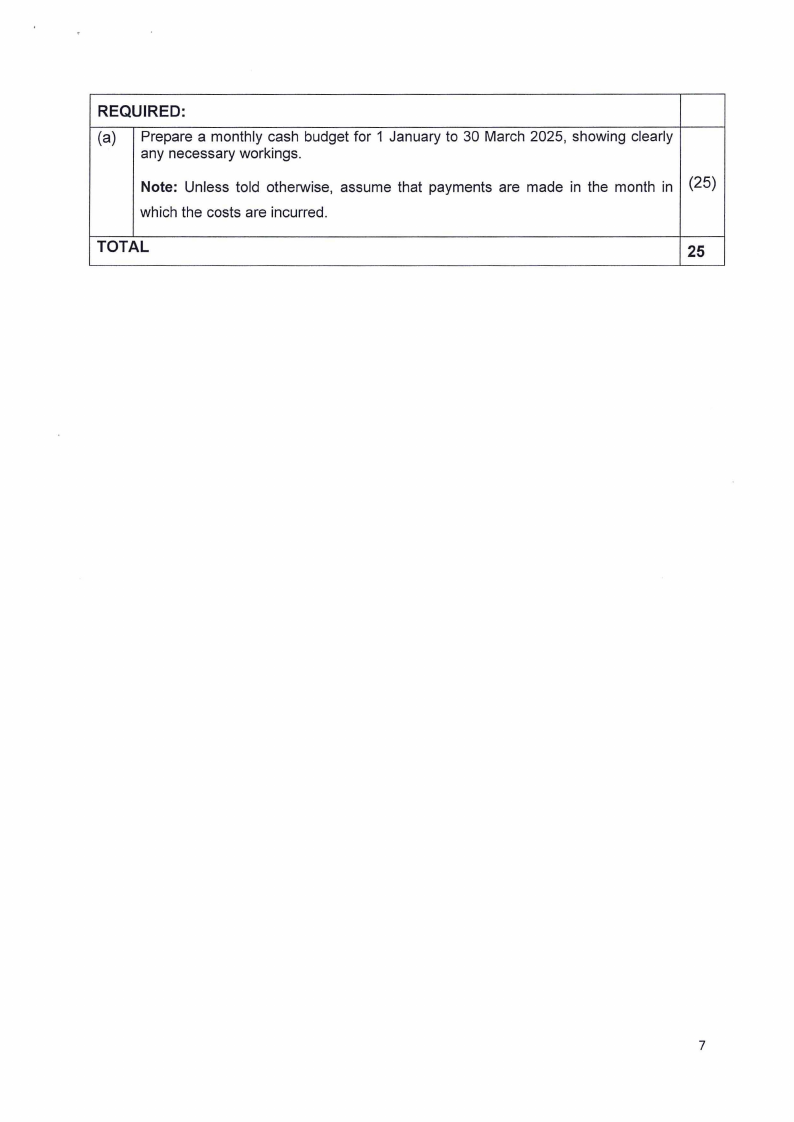
REQUIRED:
(a) Prepare a monthly cash budget for 1 January to 30 March 2025, showing clearly
any necessary workings.
Note: Unless told otherwise, assume that payments are made in the month in (25)
which the costs are incurred.
TOTAL
25
7
|
|
8 Page 8 |
▲back to top |
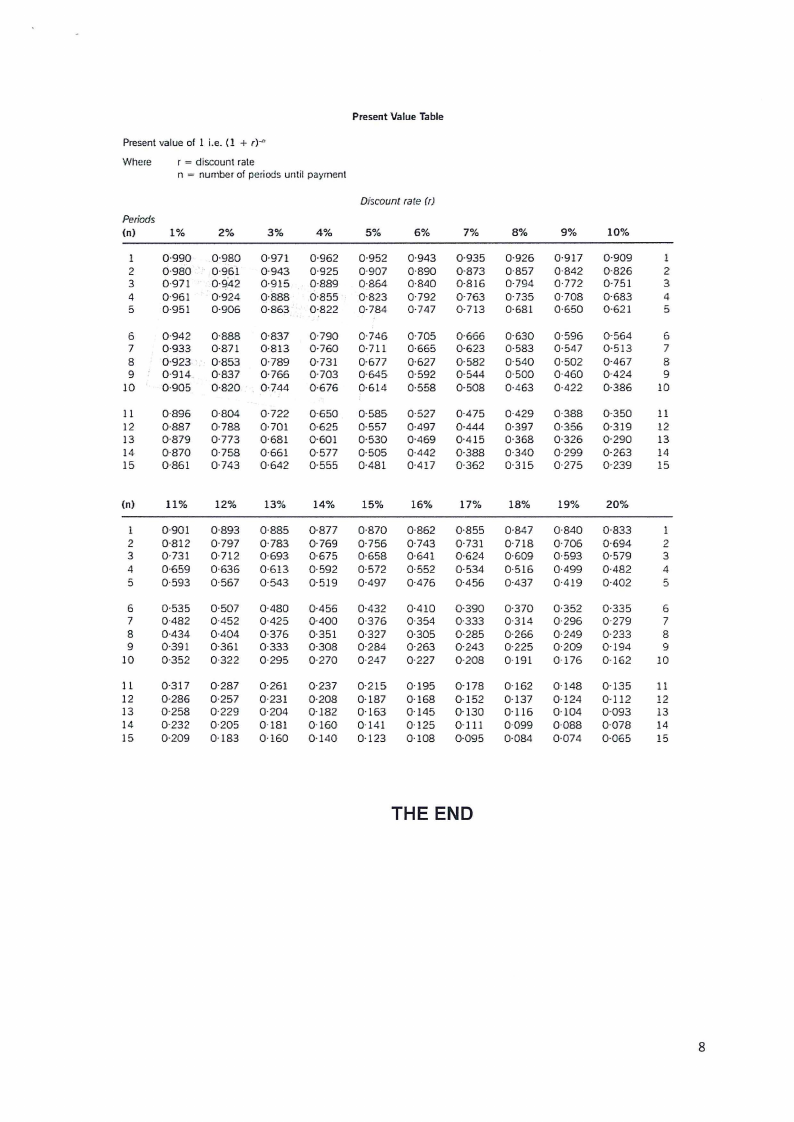
Present Value Table
Present value of l i.e. (l + r)·"
Where
r = discount rate
n = number of periCYJsuntil pa~menl
Discount rate (r)
Periods
(n)
1%
2%
3%
4%
5%
6%
7%
8%
9%
10%
1
0·990 0·980 0·971 0·962 0·952 0·943 0·935 0·926 0·917 0·909
l
2
0·980 0·961 0·943 0-925 0-907 0·890 0·873 0·857 0·842 0·826
2
3
0·971 0·942 0·915 0-889 0·864 0·840 0·816 0·794 0·772 0-751
3
4
0-961 0·924 0·888 0·855 0-823 0·792 0·763 0·735 0 708 0·683
4
5
0·951 0-906 0·863 0-822 0-784 0·747 0·713 0·681 0·650 0-621
5
6
0·942 0-888 0·837 0·790 0·746 0·705 0·666 0-630 0·596 0·564
6
7
0·933 0·871 0·8!3 0-760 0·711 0·665 0-623 0·583 0·547 0-513
7
8
0-923 0-853 0·789 0-731 0-677 0·627 0·582 0-540 0·502 0·467
8
9
0-914 0-837 0·766 0-703 0·645 0·592 0-544 0-500 0-460 0-424
9
10
0·905 0·820 0·744 0·676 0·614 0·558 0·508 0·463 0·422 0·386
10
11
0·896 0·804 0·722 0-650 0-585 0·527 0-475 0·429 0·388 0·350
11
12 0-887 0·788 0·701 0·625 0·557 0·497 0·444 0-397 0·356 0-319
12
13 0·879 0·773 0·681 0·601 0·530 0-469 0·415 0·368 0·326 0·290
13
14
0·870 0·758 0·661 0·577 0-505 0·442 0·388 0·340 0·299 0·263
14
15
0-861 0·743 0·642 0-555 0·4-81 0·417 0-362 0·315 0·275 0·239
15
(n)
11%
12%
13%
14%
15%
16%
17%
18%
19%
20%
1 0·901 0·893 0·885 0-877 0·870 0·862 0·855 0-847 0·840 0-833
1
2
0·812 0·797 0·783 0·769 0·756 0·743 0·731 0·718 0·706 0·694
2
3
0-731 0-712 0·693 0·675 0·658 0·641 0-624 0·609 0·593 0·579
3
4
0-659 0·636 0·613 0·592 0-572 0·552 0-534 0·516 0-499 0·482
4
5
0·593 0·567 0·543 0-519 0·497 0-476 0·456 0·437 0-419 0-402
5
6
0·535 0·507 0·480 0·456 0·432 0·410 0·390 0·370 0·352 0·335
6
7
0·482 0·452 0·425 0-400 0·376 0·354 0·333 0-314 0·296 0-279
7
8
0-434 0·404 0·376 0·351 0·327 0·305 0·285 0·266 0·249 0·233
8
9
0-391 0-361 0·333 0·308 0·284 0·263 0·243 0·225 0·209 0·194
9
10
0-352 0·322 0·295 0·270 0·247 0·227 0·208 0·191 0·176 0·162
10
11
0-317 0·287 0·261 0·237 0·215 0·195 0·178 0·162 0·148 0-135
11
12
0-286 0·257 0·231 0·208 0·187 0·!68 0·152 0·137 0·124 0-112
12
13
0·258 0·229 0·204 0·182 0·163 0·145 0·130 0·116 0·104 0·093
13
14
0·232 0·205 0·181 0-160 0-141 0·!25 0·111 0·099 0·088 0·078
14
15
0·209 0·183 0·160 0·140 0·123 0·108 0-095 0-084 0·074 0·065
!5
THE END
8