


 |
QMS620S - QUALITY MANAGEMENT SYSTEMS B - 1ST OPP - NOVEMBER 2025 |
|
|
1 Page 1 |
▲back to top |

r
nAmlBIA unlVERSITY
OF SCIEnCE Ano TECHnOLOGY
FACULTY OF COMMERCE, HUMAN SCIENCES AND EDUCATION
DEPARTMENT OF TECHNICAL AND VOCATIONAL EDUCATION AND TRAINING
QUALIFICATION : DIPLOMA IN TECHNICAL AND VOCATIONAL EDUCATION AND
TRAINING: MANAGEMENT
QUALIFICATION CODE: 06DTVM
LEVEL: 6
COURSE CODE: QMS620S
COURSE NAME: QUALITY MANAGEMENT
SYSTEMS B
SESSION: NOVEMBER 2025
DURATION: 3 HOURS
PAPER:1
MARKS: 100
FIRST OPPORTUNITY EXAMINATION QUESTION PAPER
EXAMINER(S) DR GODFREY M TUBAUNDULE
MODERATOR: DR NICO SISINYIZE
1. Answer ALL the questions .
INSTRUCTIONS
2. When writing take the following into account. The style should inform than
impress, it should be formal, in third person, paragraphs set out according to
ideas or issues and the paragraphs flowing in a logical order. Information
provided should be brief and accurate.
3. Please ensure that your writing is legible, neat and presentable.
THIS QUESTION PAPER CONSISTS OF _2_ PAGES (Including this front page)
I I Page
|
|
2 Page 2 |
▲back to top |
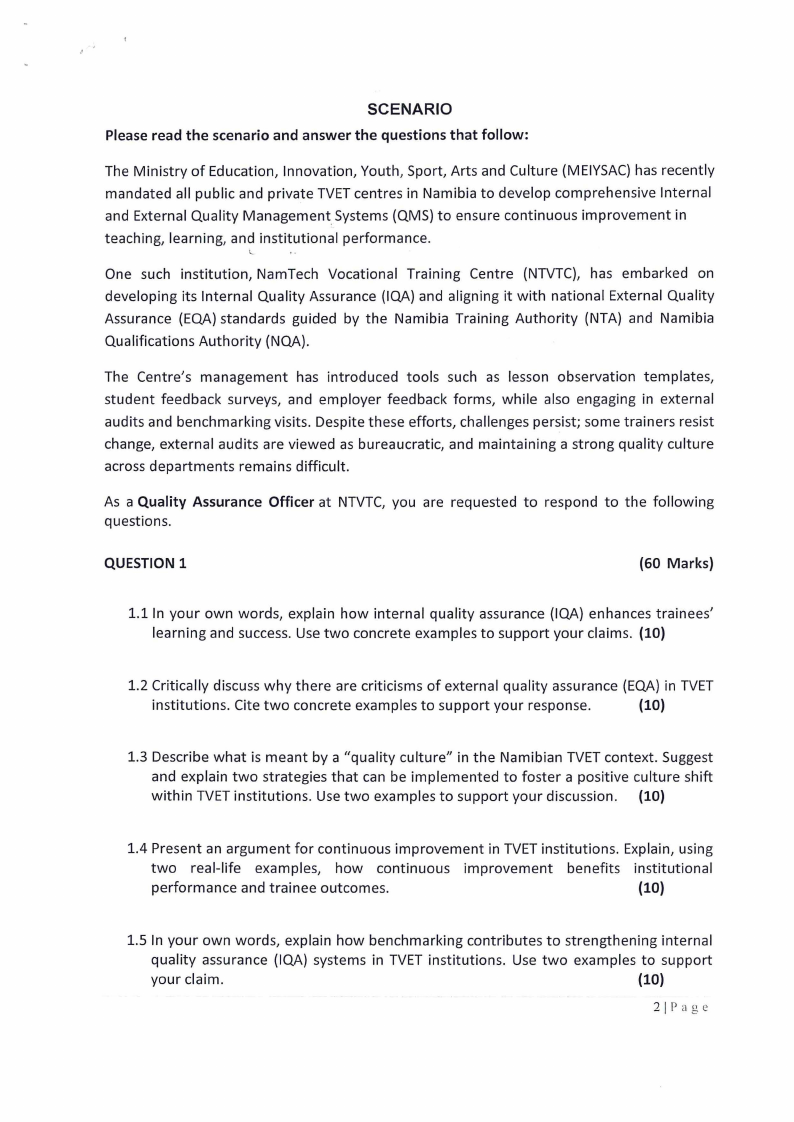
SCENARIO
Please read the scenario and answer the questions that follow:
The Ministry of Education, Innovation, Youth, Sport, Arts and Culture {MEIYSAC) has recently
mandated all public and private TVET centres in Namibia to develop comprehensive Internal
and External Quality Management_Systems (QMS) to ensure continuous improvement in
teaching, learning, and institutional performance.
L
One such institution, NamTech Vocational Training Centre (NTVTC), has embarked on
developing its Internal Quality Assurance (IQA) and aligning it with national External Quality
Assurance (EQA) standards guided by the Namibia Training Authority (NTA) and Namibia
Qualifications Authority (NQA).
The Centre's management has introduced tools such as lesson observation templates,
student feedback surveys, and employer feedback forms, while also engaging in external
audits and benchmarking visits. Despite these efforts, challenges persist; some trainers resist
change, external audits are viewed as bureaucratic, and maintaining a strong quality culture
across departments remains difficult.
As a Quality Assurance Officer at NTVTC, you are requested to respond to the following
questions.
QUESTION 1
{60 Marks)
1.1 In your own words, explain how internal quality assurance (IQA) enhances trainees'
learning and success. Use two concrete examples to support your claims. (10)
1.2 Critically discuss why there are criticisms of external quality assurance (EQA) in TVET
institutions. Cite two concrete examples to support your response.
(10)
1.3 Describe what is meant by a "quality culture" in the Namibian TVET context. Suggest
and explain two strategies that can be implemented to foster a positive culture shift
within TVET institutions. Use two examples to support your discussion. (10)
1.4 Present an argument for continuous improvement in TVET institutions. Explain, using
two real-life examples, how continuous improvement benefits institutional
performance and trainee outcomes.
(10)
1.5 In your own words, explain how benchmarking contributes to strengthening internal
quality assurance (IQA) systems in TVET institutions. Use two examples to support
your claim.
(10)
2J P age
|
|
3 Page 3 |
▲back to top |
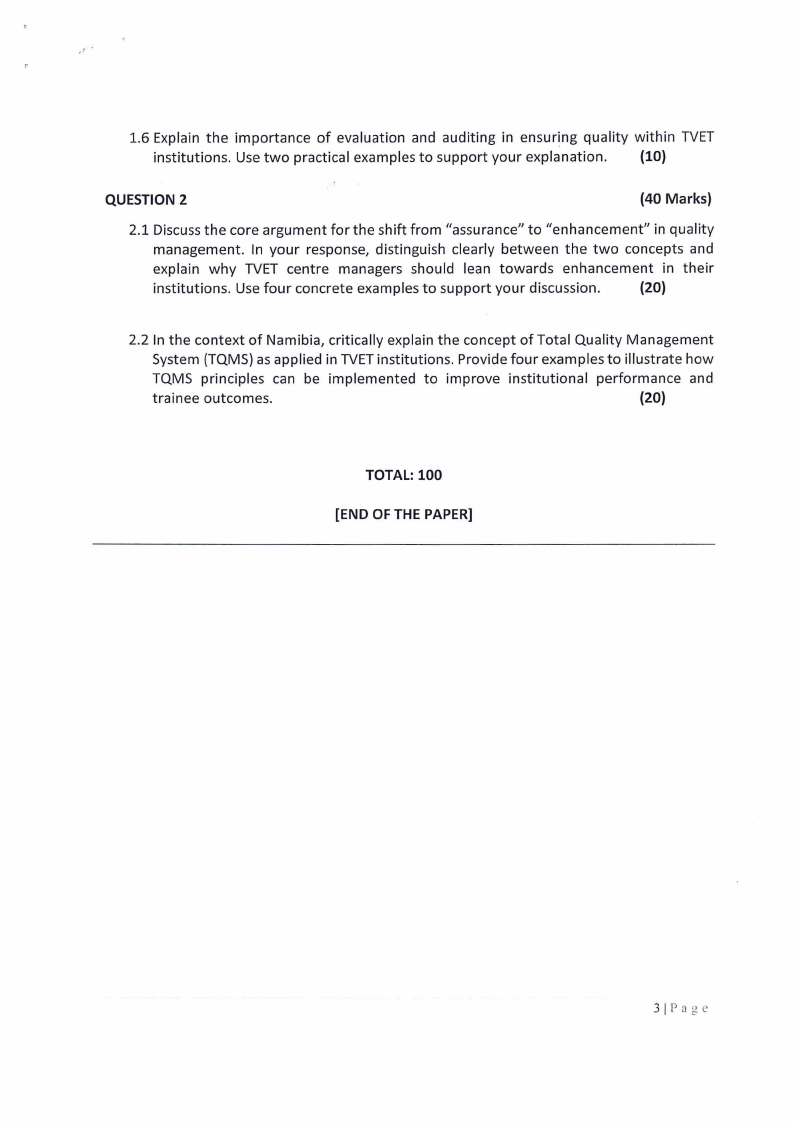
1.6 Explain the importance of evaluation and auditing in ensur\\ng quality within TVET
institutions. Use two practical examples to support your explanation. (10)
QUESTION 2
(40 Marks)
2.1 Discuss the core argument for the shift from "assurance" to "enhancement" in quality
management. In your response, distinguish clearly between the two concepts and
explain why TVET centre managers should lean towards enhancement in their
institutions. Use four concrete examples to support your discussion.
(20)
2.2 In the context of Namibia, critically explain the concept of Total Quality Management
System (TQMS) as applied in TVET institutions. Provide four examples to illustrate how
TQMS principles can be implemented to improve institutional performance and
trainee outcomes.
(20)
TOTAL: 100
[END OF THE PAPER]
3I Pag e