


 |
IBM511C-INTRODUCATION TO BUSINESS MANAGEMENT-1ST OPP- NOV 2025 |
|
|
1 Page 1 |
▲back to top |
nAmlBIA
UnlVERSITY
OF SCIEnCE Ano
TECHnOLOGY
HP-65B
HAROLD PUPKEWITZ
Graduate School of Business
FACULTY OF COMMERCE; HUMAN SCIENCES AND EDUCATION
HAROLD PUPKEWITZ GRADUATE SCHOOL OF BUSINESS
QUALIFICATION: DIPLOMA IN BUSINESS PROCESS MANAGEMENT
QUALIFICATION CODE: 0GDBPM
LEVEL: 6
COURSE CODE: IBMSllC
COURSE NAME: INTRODUCTION TO BUSINESS
MANAGEMENT
SESSION: NOVEMBER 2025
DURATION: 3 HOURS
PAPER: PAPER 1
MARKS: 100
FIRST OPPORTUNITY EXAMINATION - QUESTION PAPER
EXAMINER($)
MODERATOR:
Ms. 0. Kangandjo
Ms. J. Hambabi
INSTRUCTIONS
1. Answer ALL the questions.
2. Write clearly and neatly.
3. Number the answers clearly.
PERMISSIBLE MATERIALS
1. Examination paper
2. Examination script
3. Calculator
THIS QUESTION PAPER CONSISTS OF 8 PAGES (INCLUDING THIS FRONT PAGE)
|
|
2 Page 2 |
▲back to top |
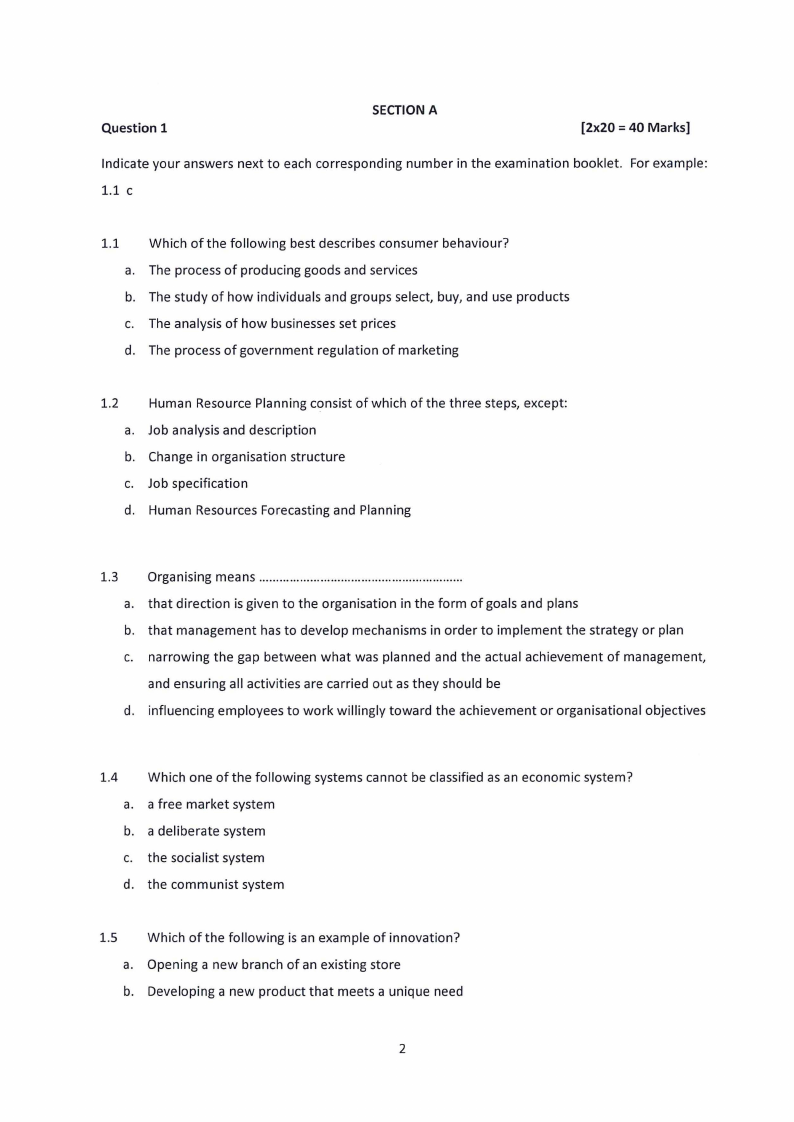
Question 1
SECTION A
[2x20 = 40 Marks]
Indicate your answers next to each corresponding number in the examination booklet. For example :
1.1 C
1.1 Which of the following best describes consumer behaviour?
a. The process of producing goods and services
b. The study of how individuals and groups select, buy, and use products
c. The analysis of how businesses set prices
d. The process of government regulat ion of marketing
1.2 Human Resource Planning consist of which of the three steps, except:
a. Job analysis and description
b. Change in organisation structure
c. Job specification
d. Human Resources Forecasting and Planning
1.3 Organising means ...... .................. ............... ... ..................
a. that direction is given to the organisation in the form of goals and plans
b. that management has to develop mechanisms in order to implement the strategy or plan
c. narrowing the gap between what was planned and the actual achievement of management,
and ensuring all activities are carried out as they should be
d. influencing employees to work willingly toward the achievement or organisational objectives
1.4 Which one of the following systems cannot be classified as an economic system?
a. a free market system
b. a deliberate system
C. the socialist system
d. the communist system
1.5 Which of the following is an example of innovation?
a. Opening a new branch of an existing store
b. Developing a new product that meets a unique need
2
|
|
3 Page 3 |
▲back to top |
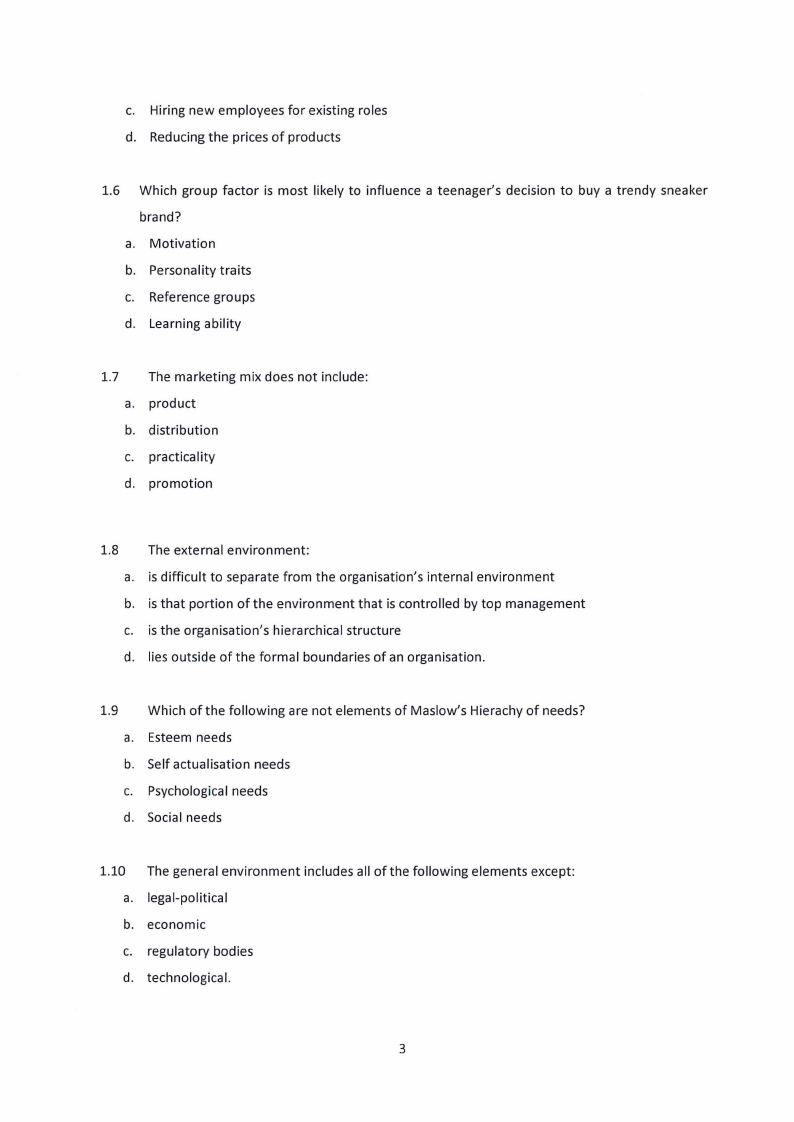
c. Hiring new employees for existing roles
d. Reducing the prices of products
1.6 Which group factor is most likely to influence a teenager' s decision to buy a trendy sneaker
brand?
a. Motivation
b. Personality traits
C. Reference groups
d. Learning ability
1.7 The marketing mix does not include:
a. product
b. distribution
C. practicality
d. promotion
1.8 The external environment:
a. is difficult to separate from the organisation's internal environment
b. is that portion of the environment that is controlled by top management
c. is the organisation's hierarchical structure
d. lies outside of the formal boundaries of an organisation.
1.9 Which of the following are not elements of Maslow's Hierachy of needs?
a. Esteem needs
b. Self actualisation needs
c. Psychological needs
d. Social needs
1.10 The general environment includes all of the following elements except:
a. legal-political
b. economic
c. regulatory bodies
d. technological.
3
|
|
4 Page 4 |
▲back to top |
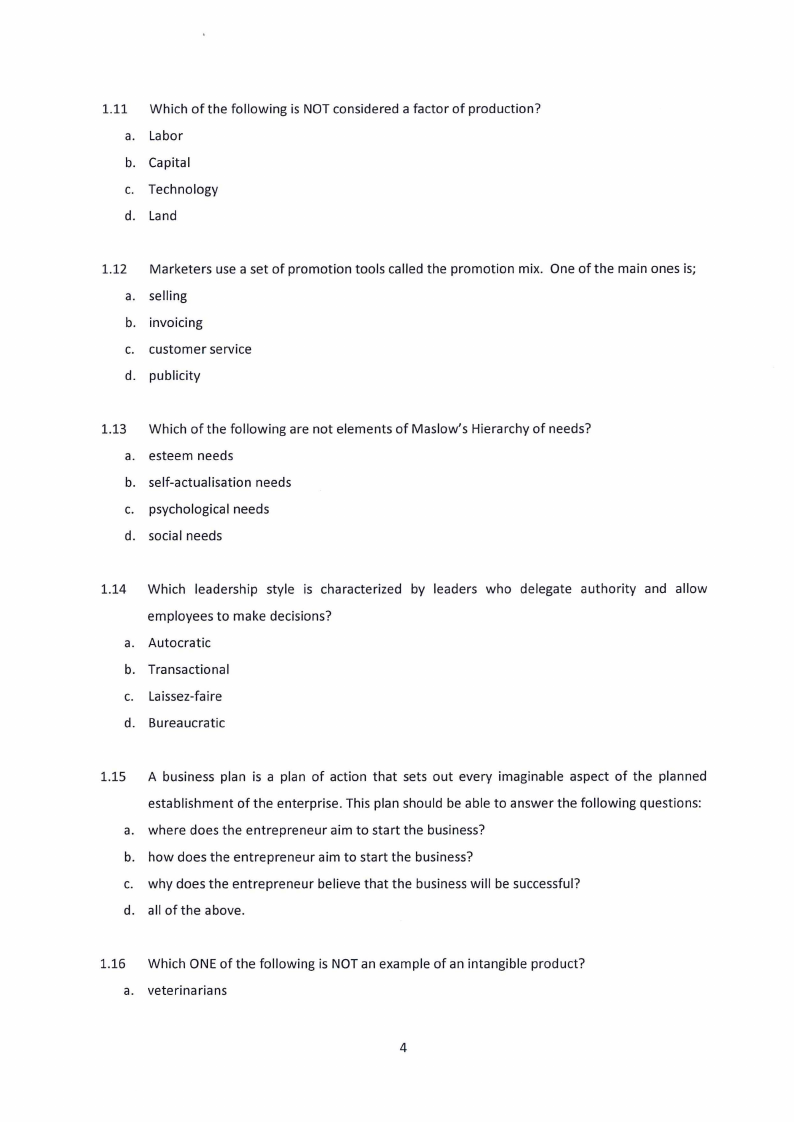
1.11 Which of the following is NOT considered a factor of production?
a. Labor
b. Capital
c. Technology
d. Land
1.12 Marketers use a set of promotion tools called the promotion mix. One of the main ones is;
a. selling
b. invoicing
c. customer service
d. publicity
1.13 Which of the following are not elements of Maslow's Hierarchy of needs?
a. esteem needs
b. self-actualisation needs
c. psychological needs
d. social needs
1.14 Which leadership style is characterized by leaders who delegate authority and allow
employees to make decisions?
a. Autocratic
b. Transactional
c. Laissez-faire
d. Bureaucratic
1.15 A business plan is a plan of action that sets out every imaginable aspect of the planned
establishment of the enterprise. This plan should be able to answer the following questions:
a. where does the entrepreneur aim to start the business?
b. how does the entrepreneur aim to start the business?
c. why does the entrepreneur believe that the business will be successful?
d. all of the above.
1.16 Which ONE of the following is NOT an example of an intangible product?
a. veterinarians
4
|
|
5 Page 5 |
▲back to top |
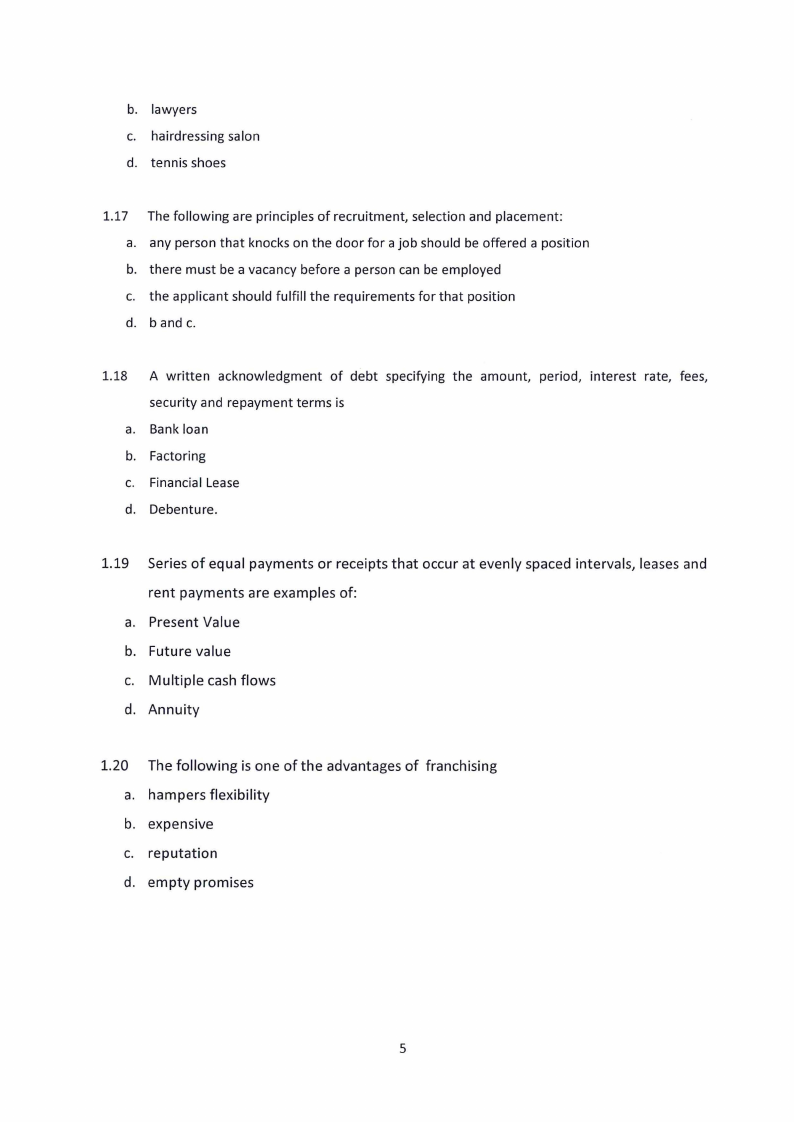
b. lawyers
c. hairdressing salon
d. tennis shoes
1.17 The following are principles of recruitment, selection and placement:
a. any person that knocks on the door for a job should be offered a position
b. there must be a vacancy before a person can be employed
c. the applicant should fulfill the requirements for that position
d. band c.
1.18 A written acknowledgment of debt specifying the amount, period, interest rate, fees,
security and repayment terms is
a. Bank loan
b. Factoring
c. Financial Lease
d. Debenture .
1.19 Series of equal payments or receipts that occur at evenly spaced intervals, leases and
rent payments are examples of:
a. Present Value
b. Future value
c. Multiple cash flows
d. Annuity
1.20 The following is one of the advantages of franchising
a. hampers flexibility
b. expensive
c. reputation
d. empty promises
5
|
|
6 Page 6 |
▲back to top |
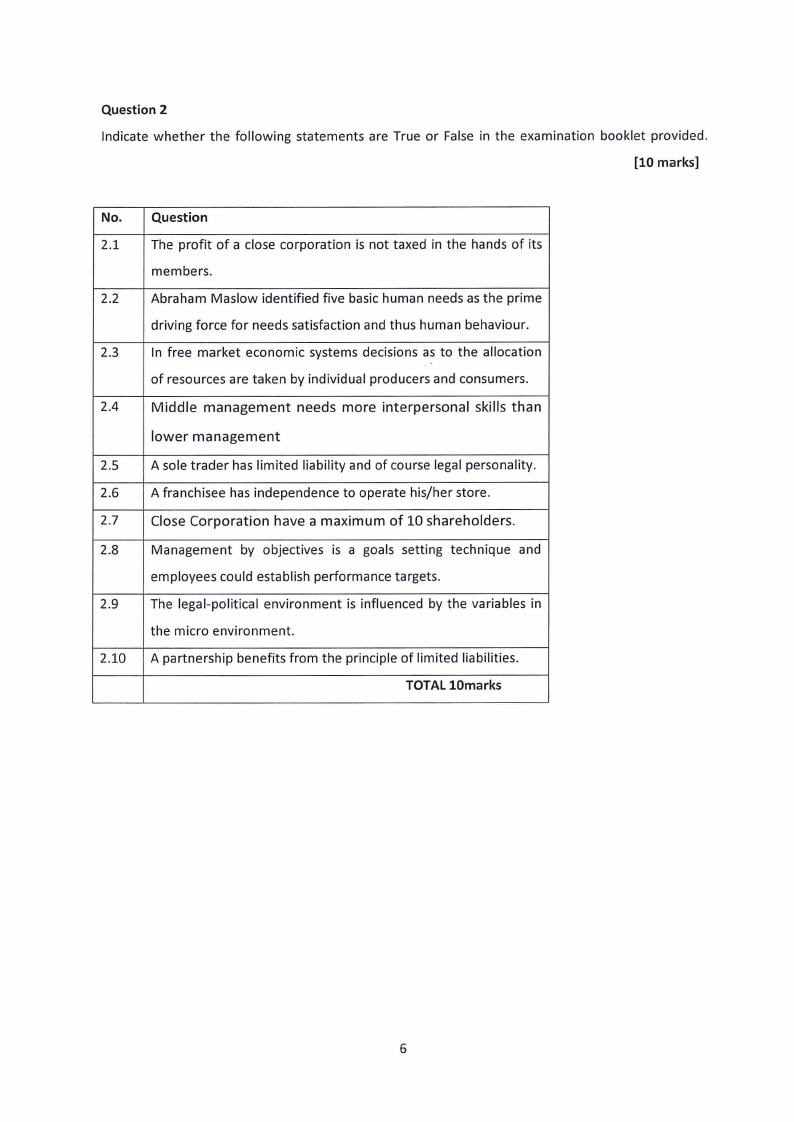
Question 2
Indicate whether the following statements are True or False in the examination booklet provided .
[10 marks]
No. Question
2.1 The profit of a close corporation is not taxed in the hands of its
members.
2.2 Abraham Maslow identified five basic human needs as the prime
driving force for needs satisfaction and thus human behaviour.
2.3 In free market economic systems decisions as to the allocation
of resources are taken by individual producers and consumers.
2.4 Middle management needs more interpersonal skills than
lower management
2.5 A sole trader has limited liability and of course legal personality.
2.6 A franchisee has independence to operate his/her store .
2.7 Close Corporation have a maximum of 10 shareholders.
2.8 Management by objectives is a goals setting technique and
employees could establish performance targets.
2.9 The legal-political environment is influenced by the variables in
the micro environment.
2.10 A partnership benefits from the principle of limited liabilities.
TOTAL 10marks
6
|
|
7 Page 7 |
▲back to top |
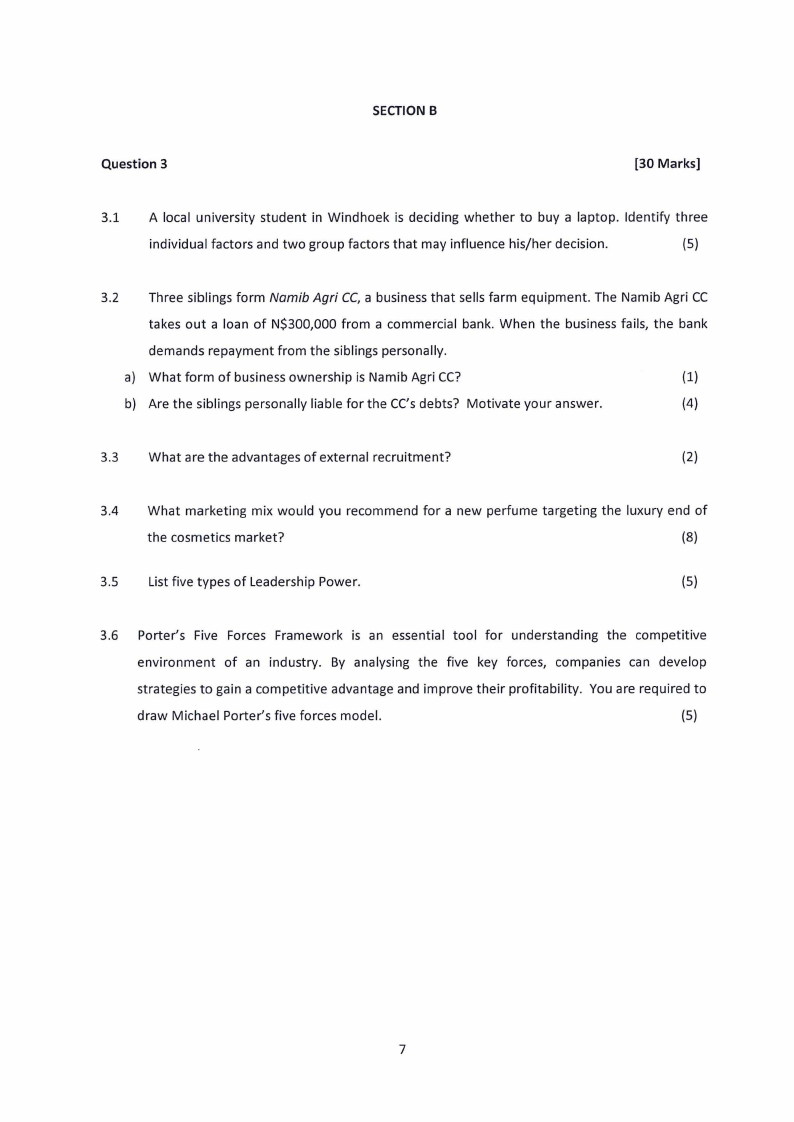
SECTION B
Question 3
[30 Marks]
3.1 A local university student in Windhoek is deciding whether to buy a laptop. Identify three
individual factors and two group factors that may influence his/her decision.
(5)
3.2 Three siblings form Namib Agri CC, a business that sells farm equipment. The Namib Agri CC
takes out a loan of N$300,000 from a commercial bank. When the business fails, the bank
demands repayment from the siblings personally.
a) What form of business ownership is Namib Agri CC?
(1)
b) Are the siblings personally liable for the CC's debts? Motivate your answer.
(4)
3.3 What are the advantages of external recruitment?
(2)
3.4 What marketing mix would you recommend for a new perfume targeting the luxury end of
the cosmetics market?
(8)
3.5 List five types of Leadership Power.
(5)
3.6 Porter's Five Forces Framework is an essential tool for understanding the competitive
environment of an industry. By analysing the five key forces, companies can develop
strategies to gain a competitive advantage and improve their profitability. You are required to
draw Michael Porter's five forces model.
(5)
7
|
|
8 Page 8 |
▲back to top |
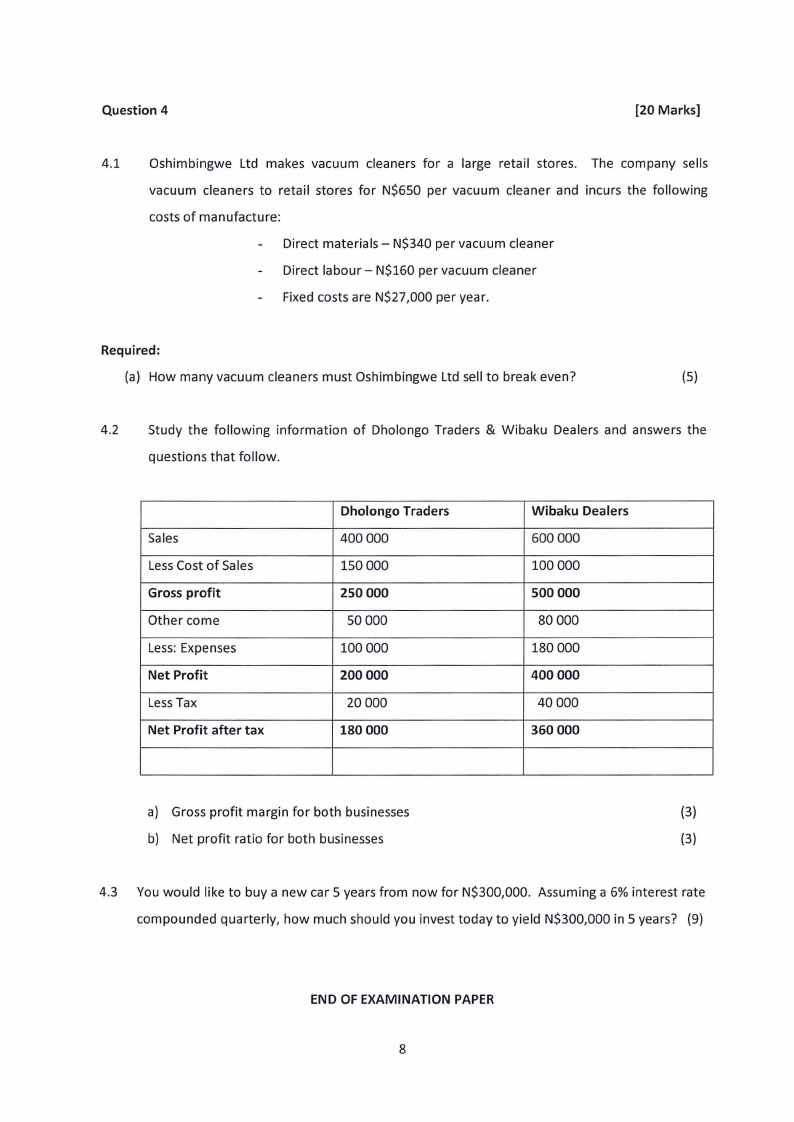
Question 4
[20 Marks]
4.1 Oshimbingwe Ltd makes vacuum cleaners for a large retail stores. The company sells
vacuum cleaners to retail stores for N$650 per vacuum cleaner and incurs the following
costs of manufacture:
Direct materials - N$340 per vacuum cleaner
Direct labour- N$160 per vacuum cleaner
Fixed costs are N$27,000 per year.
Required:
(a} How many vacuum cleaners must Oshimbingwe Ltd sell to break even?
(5}
4.2 Study the following information of Dholongo Traders & Wibaku Dealers and answers the
questions that follow.
Sales
Less Cost of Sales
Gross profit
Other come
Less: Expenses
Net Profit
Less Tax
Net Profit after tax
Dholongo Traders
400 000
150 000
250 000
50000
100 000
200 000
20000
180 000
Wibaku Dealers
600 000
100 000
500 000
80000
180 000
400 000
40000
360 000
a} Gross profit margin for both businesses
(3)
b) Net profit ratio for both businesses
(3}
4.3 You would like to buy a new car 5 years from now for N$300,000. Assuming a 6% interest rate
compounded quarterly, how much should you invest today to yield N$300,000 in 5 years? (9}
END OF EXAMINATION PAPER
8