


 |
EHL621S - Environmental And Humanitatian Logistics - 1st Opp - Nov 2025 |
|
|
1 Page 1 |
▲back to top |
n Am I BI A u n IVER s ITY
OF SCIEnCE Ano TECHnOLOGY
FACULTY OF COMMERCE, HUMAN SCIENCES AND EDUCATION
DEPARTMENT OF MARKETING, LOGISTICS AND SPORT MANAGEMENT
QUALIFICATION: BACHELOR OF LOGISTICS AND SUPPLY CHAIN MANAGEMENT
QUALIFICATION CODE: 07BLSC
COURSE CODE: EHL621S
LEVEL: 6
COURSE NAME: ENVIRONMENTAL AND
HUMANITARIAN LOGISTICS
SESSION: NOVEMBER 2025
DURATION: 3 HOURS
PAPER: THEORY
MARKS: 100
EXAMINER{S}
FIRST OPPORTUNITY EXAMINATION QUESTION PAPER
MR BETUEL NANGOMBE
MS. EJESAYA
MODERATOR:
INSTRUCTIONS
1. Answer ALL the questions.
2. Read all the questions carefully before answering.
3. Number the answers clearly
THIS EXAMINATION PAPER CONSISTS OF 8 PAGES (Including this front page)
|
|
2 Page 2 |
▲back to top |
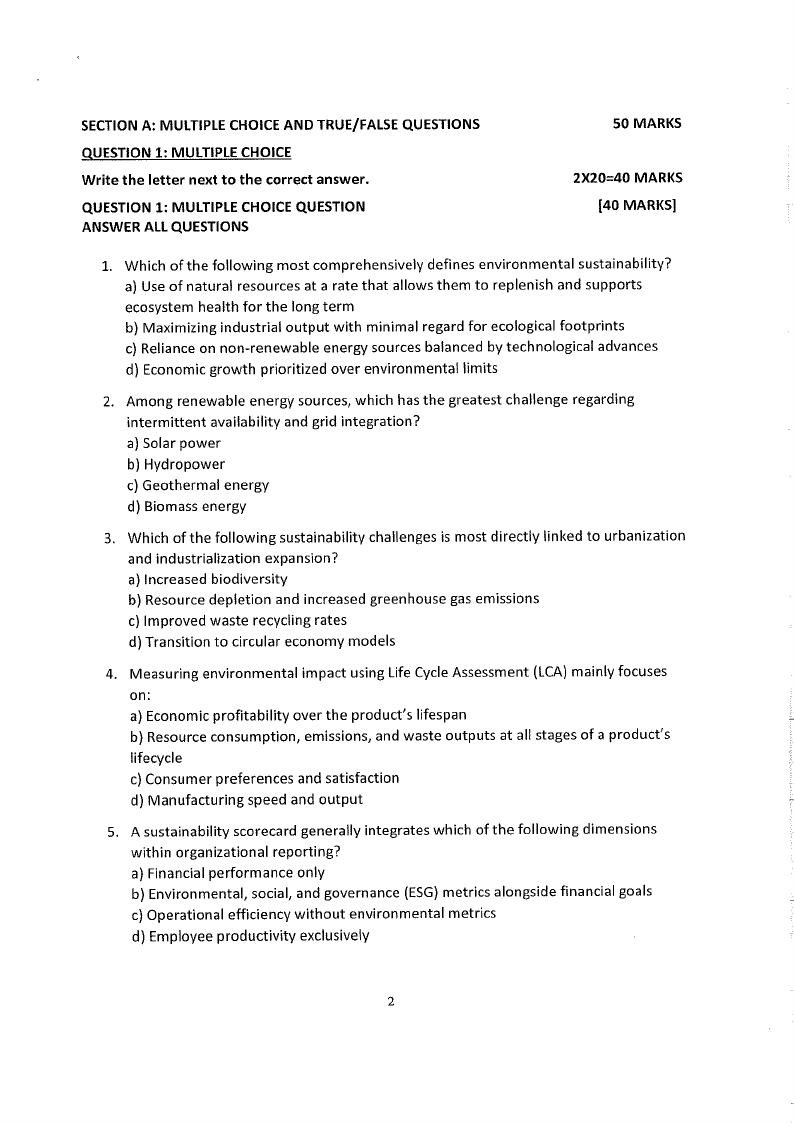
SECTION A: MULTIPLE CHOICE AND TRUE/FALSE QUESTIONS
QUESTION 1: MULTIPLE CHOICE
Write the letter next to the correct answer.
QUESTION 1: MULTIPLE CHOICE QUESTION
ANSWER ALL QUESTIONS
SO MARKS
2X20=40 MARKS
[40 MARKS]
1. Which of the following most comprehensively defines environmental sustainability?
a) Use of natural resources at a rate that allows them to replenish and supports
ecosystem health for the long term
b) Maximizing industrial output with minimal regard for ecological footprints
c) Reliance on non-renewable energy sources balanced by technological advances
d) Economic growth prioritized over environmental limits
2. Among renewable energy sources, which has the greatest challenge regarding
intermittent availability and grid integration?
a) Solar power
b) Hydropower
c) Geothermal energy
d) Biomass energy
3. Which of the following sustainability challenges is most directly linked to urbanization
and industrialization expansion?
a) Increased biodiversity
b) Resource depletion and increased greenhouse gas emissions
c) Improved waste recycling rates
d) Transition to circular economy models
4. Measuring environmental impact using Life Cycle Assessment (LCA) mainly focuses
on:
a) Economic profitability over the product's lifespan
b) Resource consumption, emissions, and waste outputs at all stages of a product's
lifecycle
c) Consumer preferences and satisfaction
d) Manufacturing speed and output
5. A sustainability scorecard generally integrates which of the following dimensions
within organizational reporting?
a) Financial performance only
b) Environmental, social, and governance (ESG) metrics alongside financial goals
c) Operational efficiency without environmental metrics
d) Employee productivity exclusively
2
|
|
3 Page 3 |
▲back to top |
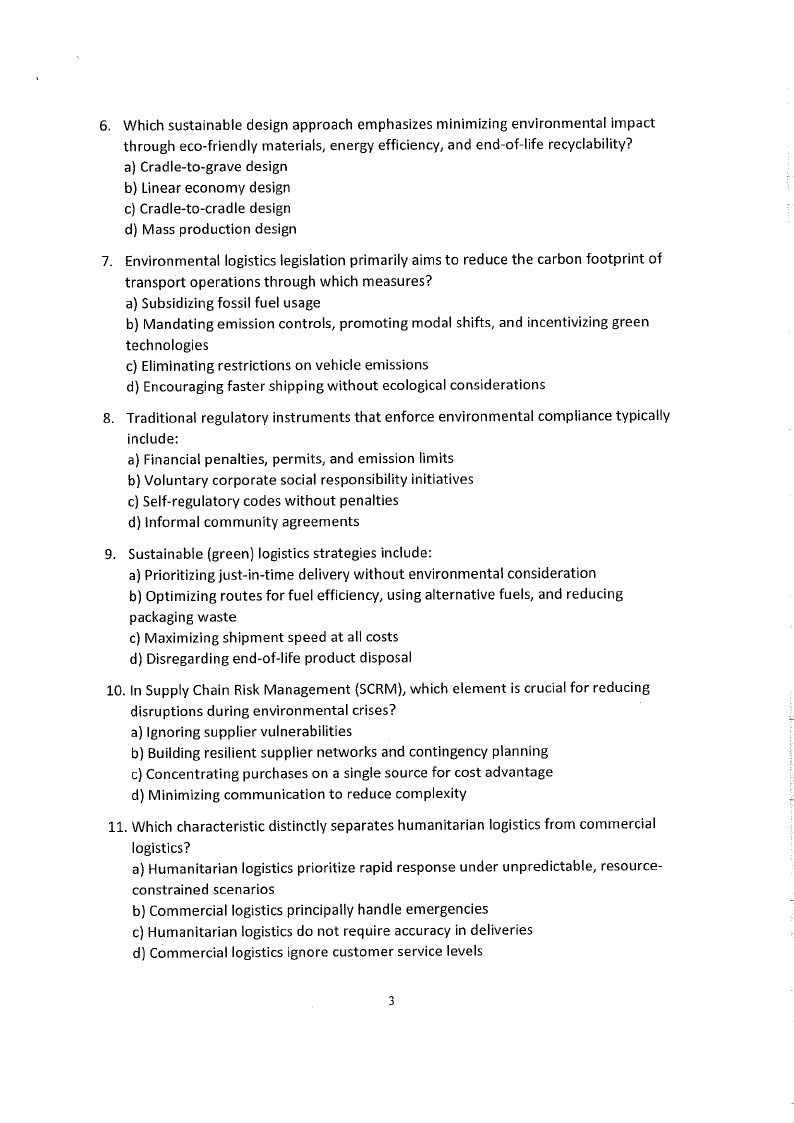
6. Which sustainable design approach emphasizes minimizing environmental impact
through eco-friendly materials, energy efficiency, and end-of-life recyclability?
a) Cradle-to-grave design
b) Linear economy design
c) Cradle-to-cradle design
d) Mass production design
7. Environmental logistics legislation primarily aims to reduce the carbon footprint of
transport operations through which measures?
a) Subsidizing fossil fuel usage
b) Mandating emission controls, promoting modal shifts, and incentivizing green
technologies
c) Eliminating restrictions on vehicle emissions
d) Encouraging faster shipping without ecological considerations
8. Traditional regulatory instruments that enforce environmental compliance typically
include:
a) Financial penalties, permits, and emission limits
b) Voluntary corporate social responsibility initiatives
c) Self-regulatory codes without penalties
d) Informal community agreements
9. Sustainable (green) logistics strategies include:
a) Prioritizing just-in-time delivery without environmental consideration
b) Optimizing routes for fuel efficiency, using alternative fuels, and reducing
packaging waste
c) Maximizing shipment speed at all costs
d) Disregarding end-of-life product disposal
10. In Supply Chain Risk Management (SCRM), which element is crucial for reducing
disruptions during environmental crises?
a) Ignoring supplier vulnerabilities
b) Building resilient supplier networks and contingency planning
c) Concentrating purchases on a single source for cost advantage
d) Minimizing communication to reduce complexity
11. Which characteristic distinctly separates humanitarian logistics from commercial
logistics?
a) Humanitarian logistics prioritize rapid response under unpredictable, resource-
constrained scenarios
b) Commercial logistics principally handle emergencies
c) Humanitarian logistics do not require accuracy in deliveries
d) Commercial logistics ignore customer service levels
3
|
|
4 Page 4 |
▲back to top |
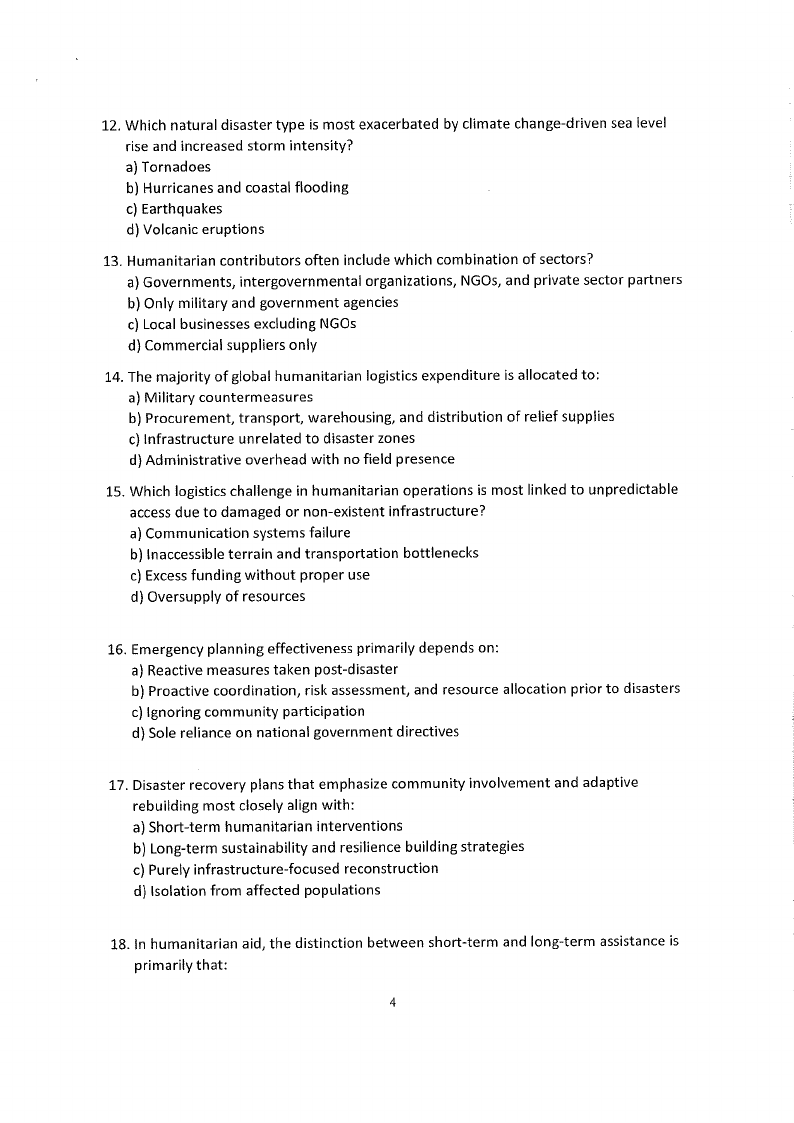
12. Which natural disaster type is most exacerbated by climate change-driven sea level
rise and increased storm intensity?
a) Tornadoes
b) Hurricanes and coastal flooding
c) Earthquakes
d) Volcanic eruptions
13. Humanitarian contributors often include which combination of sectors?
a) Governments, intergovernmental organizations, NGOs, and private sector partners
b) Only military and government agencies
c) Local businesses excluding NGOs
d) Commercial suppliers only
14. The majority of global humanitarian logistics expenditure is allocated to:
a) Military countermeasures
b) Procurement, transport, warehousing, and distribution of relief supplies
c) Infrastructure unrelated to disaster zones
d) Administrative overhead with no field presence
15. Which logistics challenge in humanitarian operations is most linked to unpredictable
access due to damaged or non-existent infrastructure?
a) Communication systems failure
b) Inaccessible terrain and transportation bottlenecks
c) Excess funding without proper use
d) Oversupply of resources
16. Emergency planning effectiveness primarily depends on:
a) Reactive measures taken post-disaster
b) Proactive coordination, risk assessment, and resource allocation prior to disasters
c) Ignoring community participation
d) Sole reliance on national government directives
17. Disaster recovery plans that emphasize community involvement and adaptive
rebuilding most closely align with:
a) Short-term humanitarian interventions
b) Long-term sustainability and resilience building strategies
c) Purely infrastructure-focused reconstruction
d) Isolation from affected populations
18. In humanitarian aid, the distinction between short-term and long-term assistance is
primarily that:
4
|
|
5 Page 5 |
▲back to top |
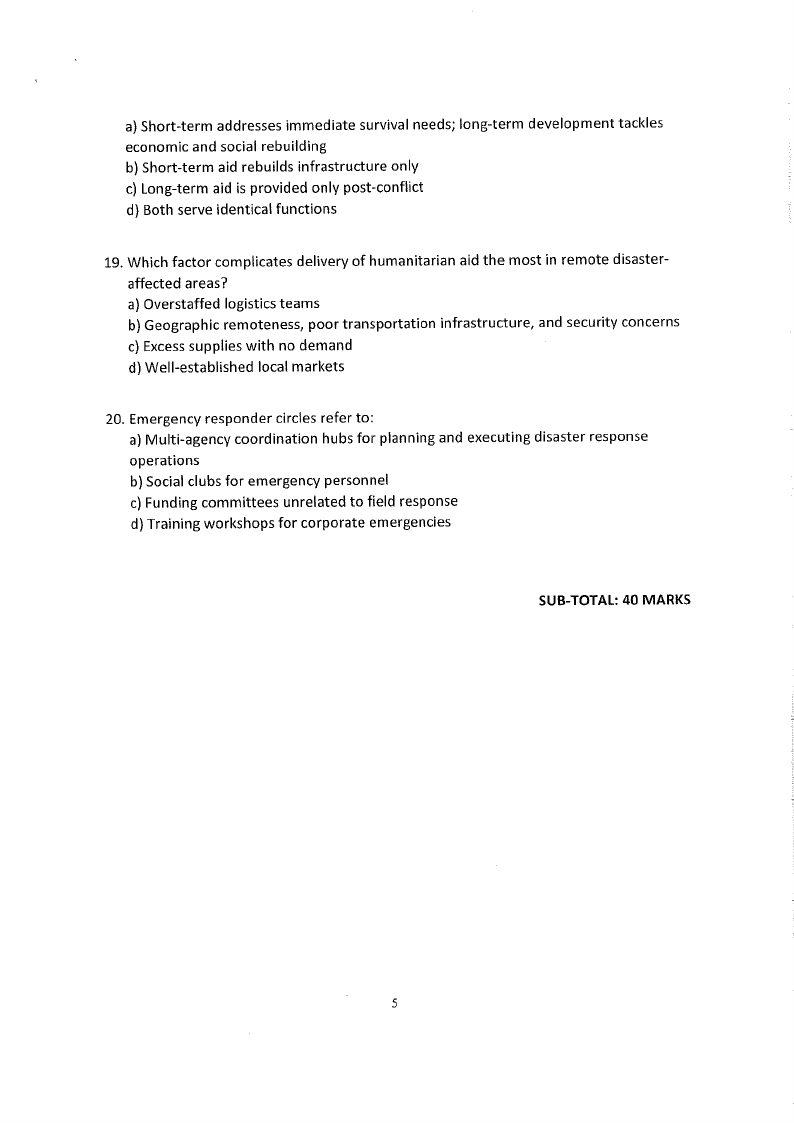
a) Short-term addresses immediate survival needs; long-term development tackles
economic and social rebuilding
b) Short-term aid rebuilds infrastructure only
c) Long-term aid is provided only post-conflict
d) Both serve identical functions
19. Which factor complicates delivery of humanitarian aid the most in remote disaster-
affected areas?
a) Overstaffed logistics teams
b) Geographic remoteness, poor transportation infrastructure, and security concerns
c) Excess supplies with no demand
d) Well-established local markets
20. Emergency responder circles refer to:
a) Multi-agency coordination hubs for planning and executing disaster response
operations
b) Social clubs for emergency personnel
c) Funding committees unrelated to field response
d) Training workshops for corporate emergencies
SUB-TOTAL: 40 MARKS
5
|
|
6 Page 6 |
▲back to top |
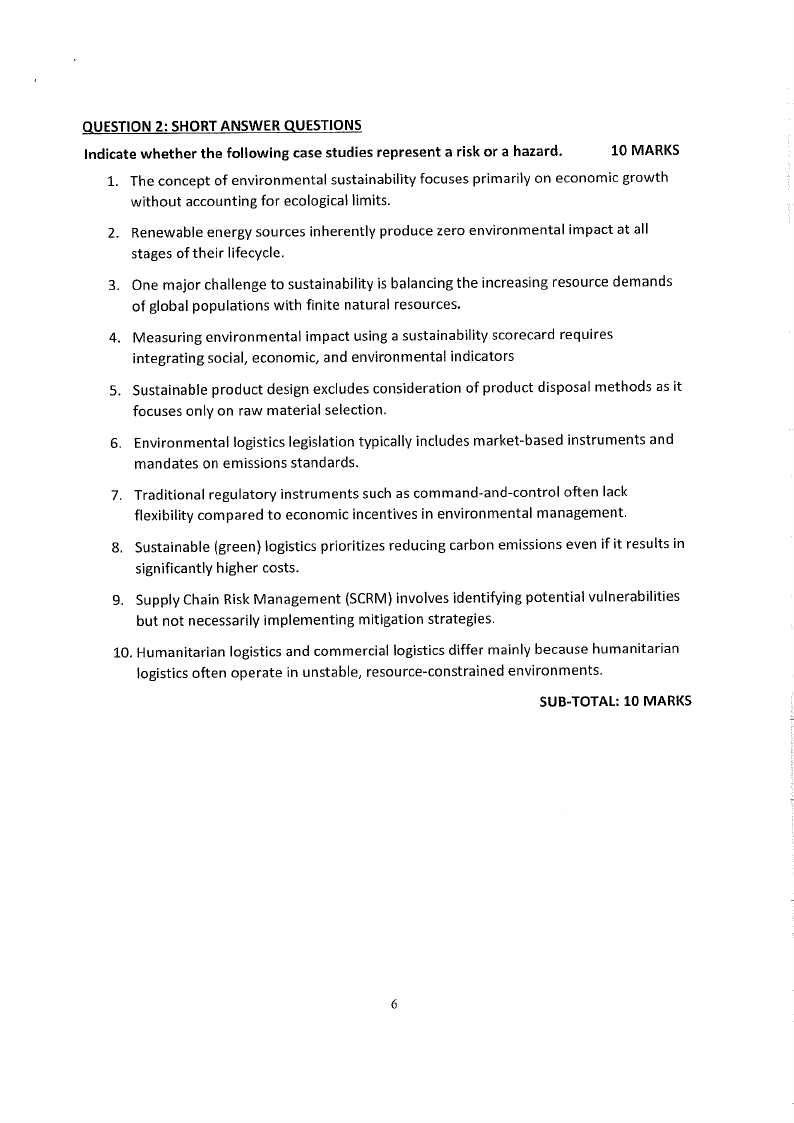
QUESTION 2: SHORT ANSWER QUESTIONS
Indicate whether the following case studies represent a risk or a hazard.
10 MARKS
1. The concept of environmental sustainability focuses primarily on economic growth
without accounting for ecological limits.
2. Renewable energy sources inherently produce zero environmental impact at all
stages of their lifecycle.
3. One major challenge to sustainability is balancing the increasing resource demands
of global populations with finite natural resources.
4. Measuring environmental impact using a sustainability scorecard requires
integrating social, economic, and environmental indicators
5. Sustainable product design excludes consideration of product disposal methods as it
focuses only on raw material selection.
6. Environmental logistics legislation typically includes market-based instruments and
mandates on emissions standards.
7. Traditional regulatory instruments such as command-and-control often lack
flexibility compared to economic incentives in environmental management.
8. Sustainable (green) logistics prioritizes reducing carbon emissions even if it results in
significantly higher costs.
9. Supply Chain Risk Management (SCRM) involves identifying potential vulnerabilities
but not necessarily implementing mitigation strategies.
10. Humanitarian logistics and commercial logistics differ mainly because humanitarian
logistics often operate in unstable, resource-constrained environments.
SUB-TOTAL: 10 MARKS
6
|
|
7 Page 7 |
▲back to top |
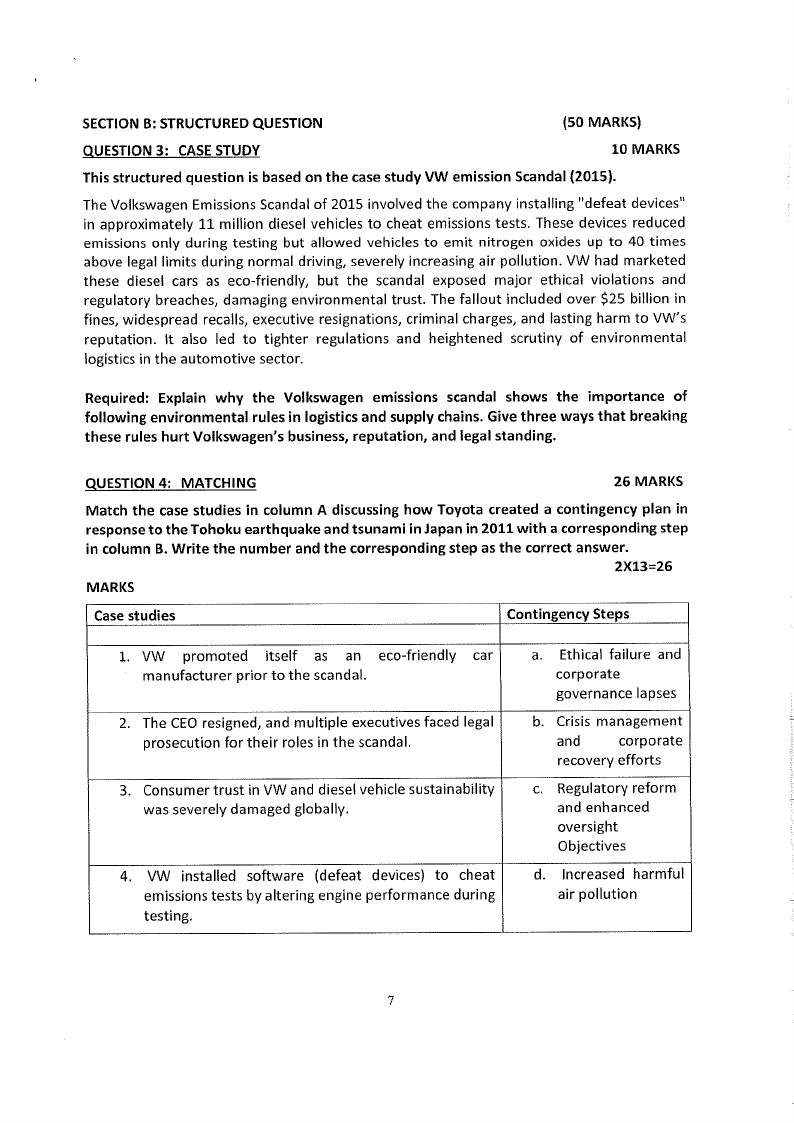
SECTION B: STRUCTURED QUESTION
(SO MARKS)
QUESTION 3: CASE STUDY
10 MARKS
This structured question is based on the case study VW emission Scandal (2015).
The Volkswagen Emissions Scandal of 2015 involved the company installing "defeat devices"
in approximately 11 million diesel vehicles to cheat emissions tests. These devices reduced
emissions only during testing but allowed vehicles to emit nitrogen oxides up to 40 times
above legal limits during normal driving, severely increasing air pollution. VW had marketed
these diesel cars as eco-friendly, but the scandal exposed major ethical violations and
regulatory breaches, damaging environmental trust. The fallout included over $25 billion in
fines, widespread recalls, executive resignations, criminal charges, and lasting harm to VW's
reputation. It also led to tighter regulations and heightened scrutiny of environmental
logistics in the automotive sector.
Required: Explain why the Volkswagen em1ss1ons scandal shows the importance of
following environmental rules in logistics and supply chains. Give three ways that breaking
these rules hurt Volkswagen's business, reputation, and legal standing.
QUESTION 4: MATCHING
26 MARKS
Match the case studies in column A discussing how Toyota created a contingency plan in
response to the Tohoku earthquake and tsunami in Japan in 2011 with a corresponding step
in column B. Write the number and the corresponding step as the correct answer.
2X13=26
MARKS
Case studies
Contingency Steps
1. vw promoted itself as an eco-friendly car
manufacturer prior to the scandal.
2. The CEO resigned, and multiple executives faced legal
prosecution for their roles in the scandal.
3. Consumer trust in VW and diesel vehicle sustainability
was severely damaged globally.
4. vw installed software (defeat devices) to cheat
emissions tests by altering engine performance during
testing.
a. Ethical failure and
corporate
governance lapses
b. Crisis management
and
corporate
recovery efforts
C. Regulatory reform
and enhanced
oversight
Objectives
d. Increased harmful
air pollution
7
|
|
8 Page 8 |
▲back to top |
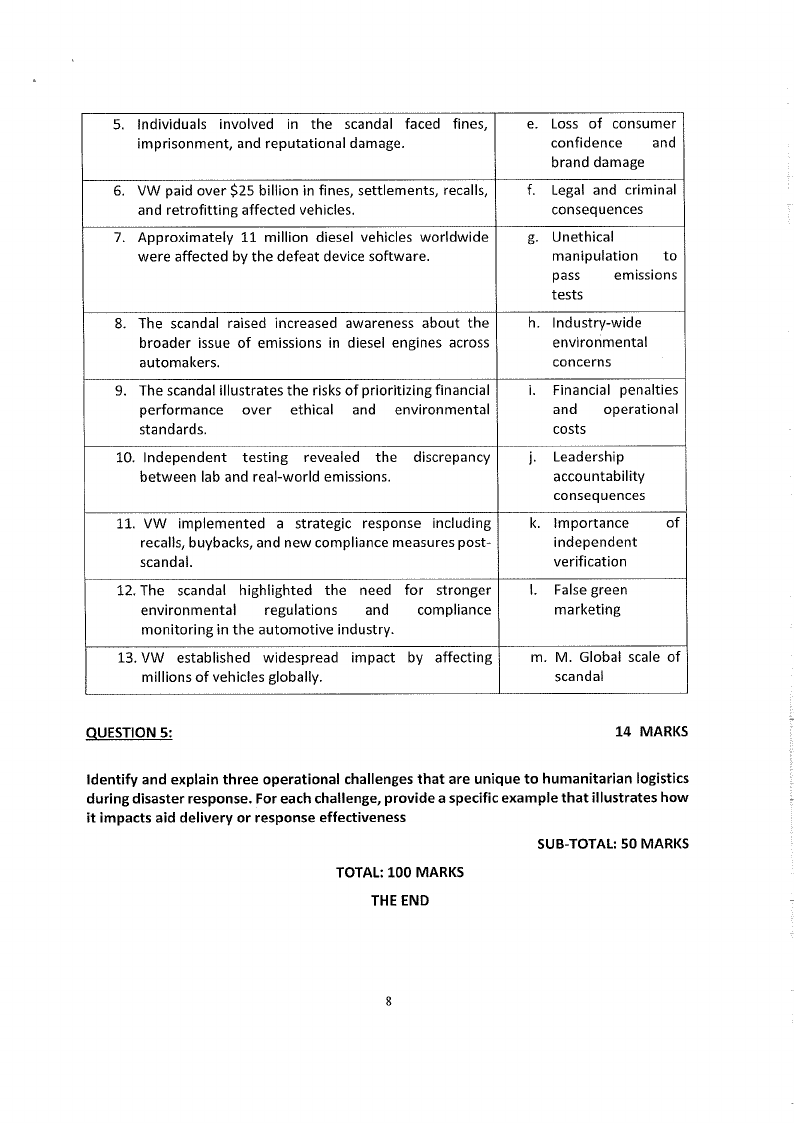
5. Individuals involved in the scandal faced fines,
imprisonment, and reputational damage.
6. VW paid over $25 billion in fines, settlements, recalls,
and retrofitting affected vehicles.
7. Approximately 11 million diesel vehicles worldwide
were affected by the defeat device software.
8. The scandal raised increased awareness about the
broader issue of emissions in diesel engines across
automakers.
9. The scandal illustrates the risks of prioritizing financial
performance over ethical and environmental
standards.
10. Independent testing revealed the discrepancy
between lab and real-world emissions.
11. vw implemented a strategic response including
recalls, buybacks, and new compliance measures post-
scandal.
12.The scandal highlighted the need for stronger
environmental regulations and compliance
monitoring in the automotive industry.
13.VW established widespread impact by affecting
millions of vehicles globally.
e. Loss of consumer
confidence and
brand damage
f. Legal and criminal
consequences
g. Unethical
manipulation to
pass emissions
tests
h. Industry-wide
environmental
concerns
i. Financial penalties
and operational
costs
j. Leadership
accountability
consequences
k. Importance
of
independent
verification
I. False green
marketing
m. M. Global scale of
scandal
QUESTION 5:
14 MARKS
Identify and explain three operational challenges that are unique to humanitarian logistics
during disaster response. For each challenge, provide a specific example that illustrates how
it impacts aid delivery or response effectiveness
SUB-TOTAL: 50 MARKS
TOTAL: 100 MARKS
THE END
8