


 |
EHL621S - Environmental And Humanitarian Logistics - 2nd Opp - Nov 2025 |
|
|
1 Page 1 |
▲back to top |
nAm I BI AunIVER sITY
OF SCI Enc E RnD TECH n OLOGY
FACULTY OF COMMERCE, HUMAN SCIENCES AND EDUCATION
DEPARTMENT OF MARKETING, LOGISTICS AND SPORT MANAGEMENT
QUALIFICATION: BACHELOR OF LOGISTICS AND SUPPLY CHAIN MANAGEMENT
QUALIFICATION CODE: 07BLSC
COURSE CODE: EHL621S
LEVEL: 6
COURSE NAME: ENVIRONMENTAL AND
HUMANITARIAN LOGISTICS
SESSION: JANUARY 2026
DURATION: 3 HOURS
PAPER: THEORY
MARKS: 100
SUPPLEMENTAL/SECOND OPPORTUNITY EXAMINATION QUESTION PAPER
EXAMINER(S) MR BETUEL NANGOMBE
MS. E JESAYA
MODERATOR:
INSTRUCTIONS
1. Answer ALL the questions.
2. Read all the questions carefully before answering.
3. Number the answers clearly
THIS MEMORANDUM PAPER CONSISTS OF 7 PAGES (Including thi s front pa ge)
|
|
2 Page 2 |
▲back to top |
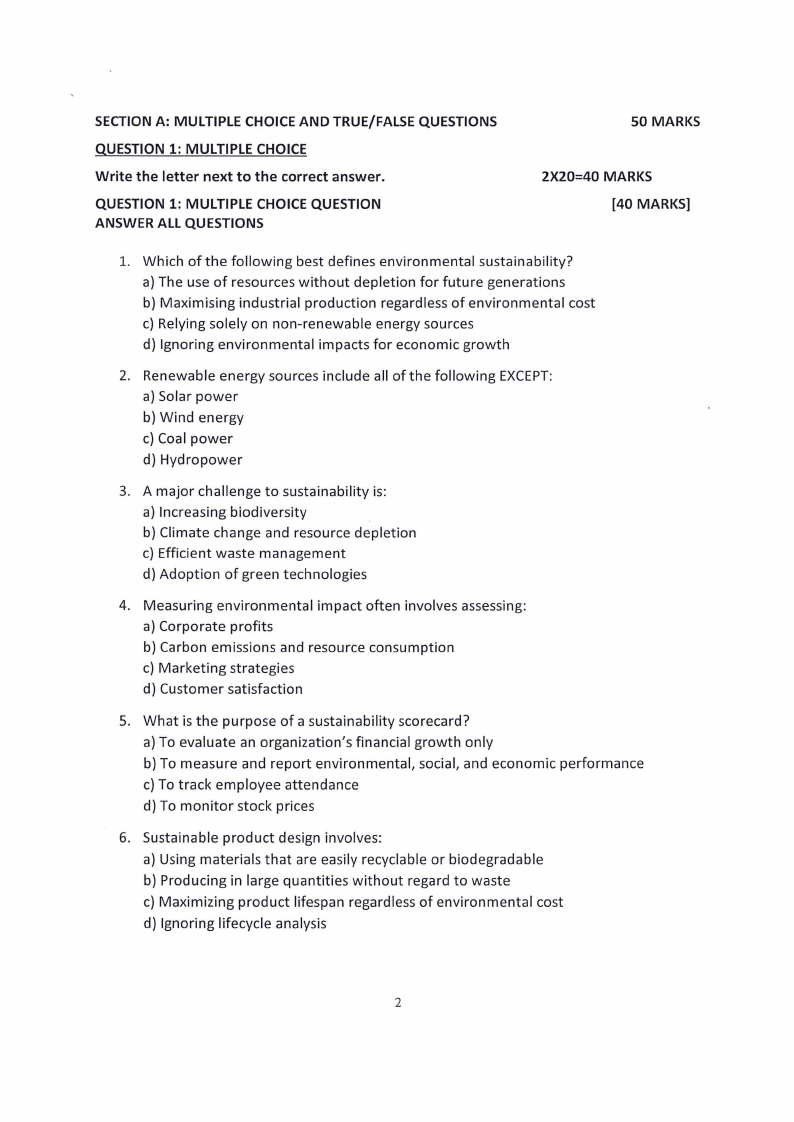
SECTION A: MULTIPLE CHOICE AND TRUE/FALSE QUESTIONS
QUESTION 1: MULTIPLE CHOICE
Write the letter next to the correct answer.
QUESTION 1: MULTIPLE CHOICE QUESTION
ANSWER ALL QUESTIONS
50 MARKS
2X20=40 MARKS
[40 MARKS]
1. Which of the following best defines environmental sustainability?
a) The use of resources without depletion for future generations
b) Maximising industrial production regardless of environmental cost
c) Relying solely on non-renewable energy sources
d) Ignoring environmental impacts for economic growth
2. Renewable energy sources include all of the following EXCEPT:
a) Solar power
b) Wind energy
c) Coal power
d) Hydropower
3. A major challenge to sustainability is:
a) Increasing biodiversity
b) Climate change and resource depletion
c) Efficient waste management
d) Adoption of green technologies
4. Measuring environmental impact often involves assessing:
a) Corporate profits
b) Carbon emissions and resource consumption
c) Marketing strategies
d) Customer satisfaction
5. What is the purpose of a sustainability scorecard?
a) To evaluate an organization's financial growth only
b) To measure and report environmental, social, and economic performance
c) To track employee attendance
d) To monitor stock prices
6. Sustainable product design involves:
a) Using materials that are easily recyclable or biodegradable
b) Producing in large quantities without regard to waste
c) Maximizing product lifespan regardless of environmental cost
d) Ignoring lifecycle analysis
2
|
|
3 Page 3 |
▲back to top |

7. Environmental logistics legislation is primarily intended to :
a) Regulate sustainable transport and reduce environmental harm
b) Promote faster shipping at any cost
c) Exempt transport from environmental laws
d) Prioritize cost over environmental concerns
8. Which of the following is NOT a traditional regulatory instrument?
a) Taxes and fines
b) Voluntary guidelines
c) Command-and-control regulations
d) Emission standards
9. Sustainable (green) logistics focuses on :
a) Minimizing environmental impact of supply chains
b) Increasing speed without regard to emissions
c) Reducing logistics costs by any means
d) Ignoring packaging material
10. Supply Chain Risk Management (SCRM) aims to :
a) Ignore potential risks to speed operations
b) Identify, assess, and mitigate risks in the supply chain
c) Increase inventory levels indefinitely
d) Reduce communication with suppliers
11. One key difference between commercial and humanitarian logistics is :
a) Humanitarian logistics focus on aid delivery in crisis situations
b) Commercial logistics operate only locally
c) Humanitarian logistics ignore efficiency
d) Commercial logistics do not manage inventory
12. Climate change causes which of the following natural disasters?
a) Earthquakes
b) Hurricanes and floods
c) Volcanic eruptions
d) Tsunami
13. Who are typical contributors in humanitarian logistics?
a) Governments, NGOs, and international organizations
b) Only government armies
c) Private corporations exclusively
d) Local businesses ignoring crises
14. Globally, money spent on humanitarian logistics is primarily used for:
a) Military equipment
b) Delivering aid and relief supplies during disasters
3
|
|
4 Page 4 |
▲back to top |

c) Tourism development
d) Corporate investments
15. Challenges affecting humanitarian logistics include all EXCEPT:
a) Difficult terrain and accessibility issues
b) Unpredictable demand and supply shortages
c) Stable and predictable infrastructure
d) Communication breakdowns
16. Emergency planning in humanitarian logistics involves:
a) Preparing coordinated responses for potential disasters
b) Waiting until a disaster occurs to start planning
c) Focusing only on urban areas
d) Ignoring logistics and supply issues
17. Disaster recovery planning focuses primarily on:
a) Short-term immediate aid only
b) Long-term rebuilding and resilience
c) Maximizing profits during crises
d) Ignoring affected communities
18. Short term aid differs from long term aid in that:
a) Short term aid addresses immediate needs; long term aid promotes development
b) Long term aid is for emergencies only
c) Short term aid rebuilds infrastructure
d) Both are identical in purpose
19. What is a key difficulty in delivering humanitarian aid?
a) Overabundance of funding
b) Remote locations and lack of accessibility
c) Lack of demand for aid
d) Excessive infrastructure
20. Emergency responder circles refer to :
a) Groups coordinating response activities in disaster zones
b) Entertainment programs for responders
c) Funding mechanisms for aid agencies
d) Training sessions for corporate staff
SUB-TOTAL: 40 MARKS
4
|
|
5 Page 5 |
▲back to top |
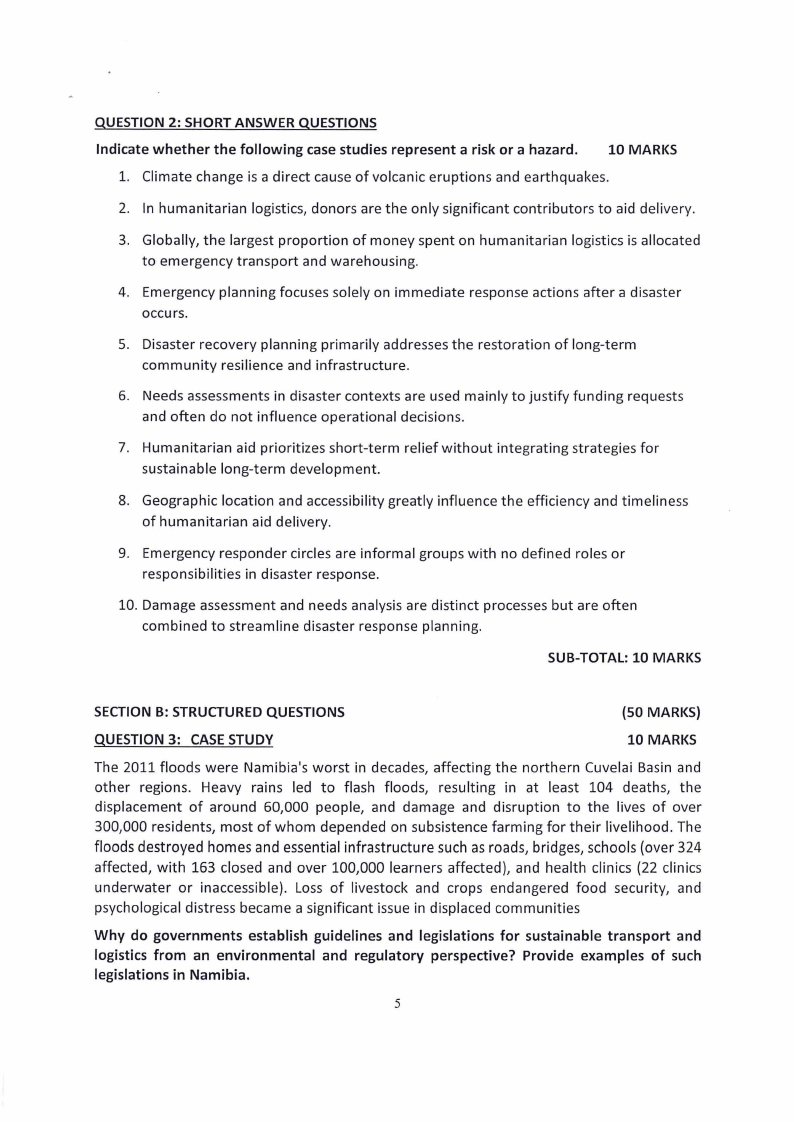
QUESTION 2: SHORT ANSWER QUESTIONS
Indicate whether the following case studies represent a risk or a hazard. 10 MARKS
1. Climate change is a direct cause of volcanic eruptions and earthquakes.
2. In humanitarian logistics, donors are the only significant contributors to aid delivery.
3. Globally, the largest proportion of money spent on humanitarian logistics is allocated
to emergency transport and warehousing.
4. Emergency planning focuses solely on immediate response actions after a disaster
occurs.
5. Disaster recovery planning primarily addresses the restoration of long-term
community resilience and infrastructure.
6. Needs assessments in disaster contexts are used mainly to justify funding requests
and often do not influence operational decisions.
7. Humanitarian aid prioritizes short-term relief without integrating strategies for
sustainable long-term development.
8. Geographic location and accessibility greatly influence the efficiency and timeliness
of humanitarian aid delivery.
9. Emergency responder circles are informal groups with no defined roles or
responsibilities in disaster response .
10. Damage assessment and needs analysis are distinct processes but are often
combined to streamline disaster response planning.
SUB-TOTAL: 10 MARKS
SECTION B: STRUCTURED QUESTIONS
(50 MARKS}
QUESTION 3: CASE STUDY
10 MARKS
The 2011 floods were Namibia's worst in decades, affecting the northern Cuvelai Basin and
other regions. Heavy rains led to flash floods, resulting in at least 104 deaths, the
displacement of around 60,000 people, and damage and disruption to the lives of over
300,000 residents, most of whom depended on subsistence farming for their livelihood. The
floods destroyed homes and essential infrastructure such as roads, bridges, schools (over 324
affected, with 163 closed and over 100,000 learners affected), and health clinics (22 clinics
underwater or inaccessible). Loss of livestock and crops endangered food security, and
psychological distress became a significant issue in displaced communities
Why do governments establish guidelines and legislations for sustainable transport and
logistics from an environmental and regulatory perspective? Provide examples of such
legislations in Namibia.
5
|
|
6 Page 6 |
▲back to top |
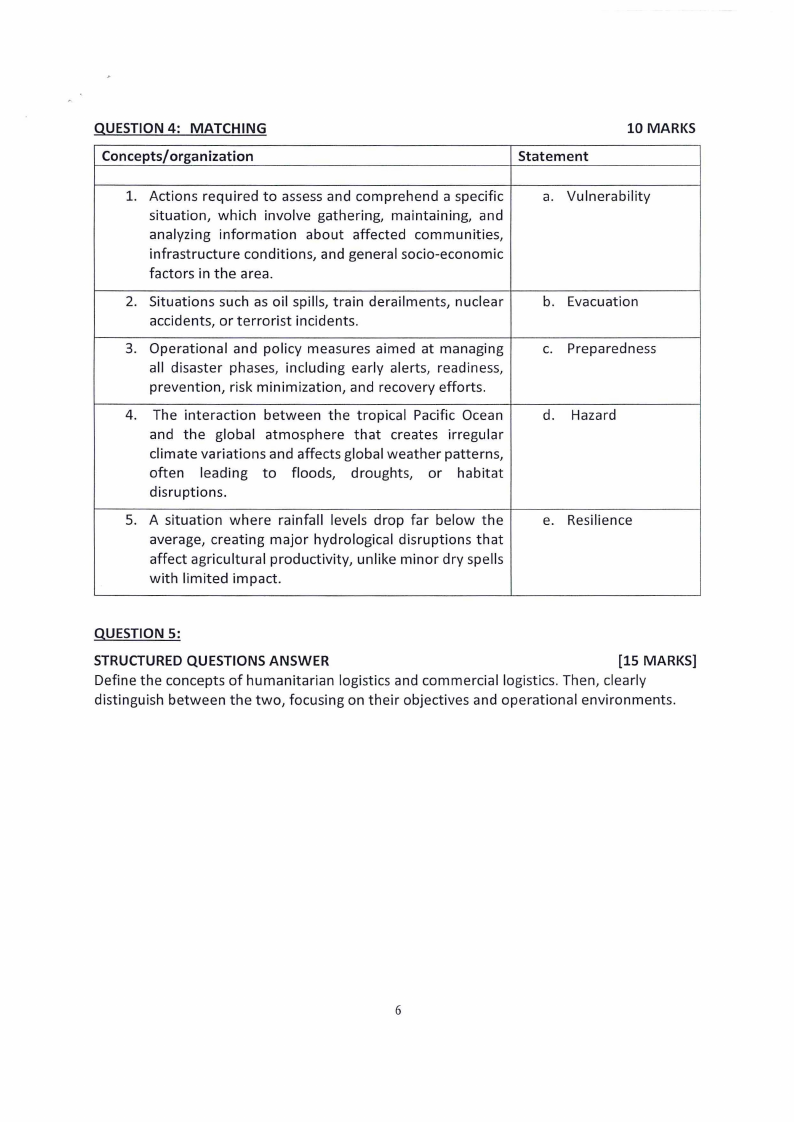
QUESTION 4: MATCHING
Concepts/ organization
Statement
10 MARKS
1. Actions required to assess and comprehend a specific
situation, which involve gathering, maintaining, and
analyzing information about affected communities,
infrastructure conditions, and general socio-economic
factors in the area .
2. Situations such as oil spills, train derailments, nuclear
accidents, or terrorist incidents.
3. Operational and policy measures aimed at managing
all disaster phases, including early alerts, readiness,
prevention, risk minimization, and recovery efforts.
4. The interaction between the tropical Pacific Ocean
and the global atmosphere that creates irregular
climate variations and affects global weather patterns,
often leading to floods, droughts, or habitat
disruptions.
5. A situation where rainfall levels drop far below the
average, creating major hydrological disruptions that
affect agricultural productivity, unlike minor dry spells
with limited impact.
a. Vulnerabil ity
b. Evacuation
C. Preparedness
d. Hazard
e. Resilience
QUESTION 5:
STRUCTURED QUESTIONS ANSWER
[15 MARKS]
Define the concepts of humanitarian logistics and commercial logistics. Then, clearly
distinguish between the two, focusing on their objectives and operational environments.
6
|
|
7 Page 7 |
▲back to top |
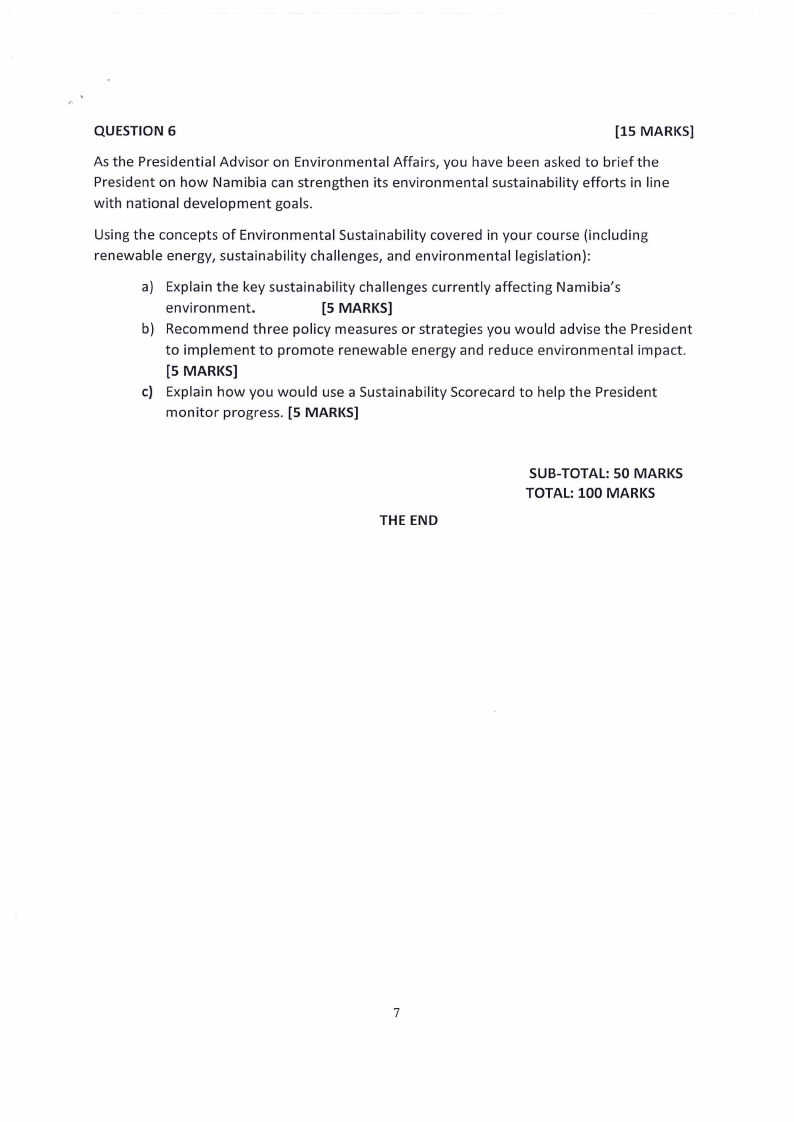
QUESTION 6
(15 MARKS]
As the Presidential Advisor on Environmental Affairs, you have been asked to brief the
President on how Namibia can strengthen its environmental sustainability efforts in line
with national development goals.
Using the concepts of Environmental Sustainability covered in your course (including
renewable energy, sustainability challenges, and environmental legislation):
a) Explain the key sustainability challenges currently affecting Namibia's
environment.
(5 MARKS]
b) Recommend three policy measures or strategies you would advise the President
to implement to promote renewable energy and reduce environmental impact.
(5 MARKS]
c) Explain how you would use a Sustainability Scorecard to help the President
monitor progress. (5 MARKS]
THE END
SUB-TOTAL: 50 MARKS
TOTAL: 100 MARKS
7