


 |
GBM811S - GLOBAL BUSINESS MANAGEMENT - 2ND OPP - JUNE 2025 |
|
|
1 Page 1 |
▲back to top |
nAm I BI A u n IVERSITY
OF SCIEnCE Ano TECHn OLOGY
FACULTYOF COMMERCE,HUMAN SCIENCESAND EDUCATION
DEPARTMENTOF GOVERNANCEAND MANAGEMENTSCIENCE
QUALIFICATION: BACHELOR OF BUSINESS MANAGEMENT HONOURS
QUALIFICATION CODE: 08HBBM
LEVEL: 8
COURSE CODE: GBM811S
COURSE NAME: GLOBALBUSINESSMANAGEMENT
SESSION: JUNE 2025
DURATION: 3 HOURS
PAPER: 1
MARKS: 100
EXAMINER(S)
SECOND OPPORTUNITY EXAMINATION QUESTION PAPER
Ms O.N Kangandjo
MODERATOR:
Mr MB Simasiku
THIS QUESTION PAPER CONSISTS OF 6 PAGES (Including this front page)
INSTRUCTIONS
1.
Answer all questions.
2.
Read all the questions carefully before answering.
3.
Marks for each question are indicated at the end of each question.
4.
Please ensure that your writing is legible, neat and presentable and start each Section on a
new page.
PERMISSIBLEMATERIALS
1. Examination question paper
2. Examination answer sheet
1
|
|
2 Page 2 |
▲back to top |
JsECTION
Question 1
[2 x 10=20 Marks]
Multiple choice questions from 1.1-1.10. Indicate the letter of the appropriate answer next
to the corresponding question number in the provided answer book. For example, 1.1 B.
1.1 Which of the following is NOT a way in which a company may internationalise its
business activity?
A. Using joint ventures with overseas firms
B. Indirect exporting
C. Direct exporting
D. Establishing a subsidiary in a different geographical region of the home country
1.2 Social stratification
A. Income level.
B. caste.
C. education.
D. any of the above.
is done on the basis of
1.3 The system of values and norms that are shared among a group of people and that when
taken together constitute a design for living best defines:
A.
society.
B. value systems.
C.
principles.
D. culture.
1.4 When a company, such as Coke, which is situated in the US, allows a foreign country
to package their product, this is called __ .
A. a joint venture
B. conventional exporting
C. a conglomerate
D. licensing
1.5 Which of the following is NOT a business opportunity generated by globalization?.
A. Access to low cost labour.
B. Cheap International transport.
C. Currency crises.
D. Lessstringent regulation of the business environment.
1.6 Interdependent political, economic, and legal systems of a country make up its:
A. administrative agenda.
B. socioeconomic fabric.
C. cultural environment.
D. political economy.
2
|
|
3 Page 3 |
▲back to top |
1.7 A political system that prioritizes the needs of the society over individual freedoms is
called
A. totalitarianism
B. collectivism
C. capitalism
D. egalitarianism
1.8 Which of the following has enabled globalization of markets?
A. Differentiation amongst national markets
B. Falling barriers to cross border trade
C. Reduced homogeneity of material culture across the world
D. Increased government ownership of factors of production
1.9 Expatriate managers may experience more than the usual degree of pressure to
violate their personal ethics because of all the following reasons EXCEPT:
A. they are away from their ordinary social context and supporting culture.
B. they are psychologically and geographically closer to the parent company.
C. they may be based in a culture that does not place the same value on ethical norms
important in the manager's home country.
D. they may be surrounded by local employees who have less rigorous ethical standards.
1.10 Which of the following statements about individualism is NOT true?
A.
Individualism promotes private entrepreneurship.
B. Individualism promotes free market economics.
C.
Individualism creates an anti-business environment.
D. Individualism advocates for a democratic political system.
3
|
|
4 Page 4 |
▲back to top |
Question 2
[58 Marks]
2.1 Consider whether the shift toward a more integrated and interdependent global
economy is a good thing. Discuss the shift from the eyes of a consumer, a worker, and
a company.
(6)
2.2 When a firm decides to enter into international business, it faces two major decision
problems. Ellaborate on those two decision problems.
(4)
2.3 Managers in multinational firms need to be sensitive to differences in ethical issues.
Identify ethical issues that are most relevant in the international business setting which
managers ought to be aware of.
(10}
2.4 International firms need to be responsive to various factors to navigate the
complexities of operating in global markets effectively. Discuss the factors that lead
to pressure for local responsiveness.
10)
2.5 To effectively navigate the complexities of international business, it's crucial to
understand the different strategic orientations a firm can adopt. Briefly describe the
four orientations of the EPRGModel.
(8)
2.6 What are the two types of competitive pressures that firms competing in the global
marketplace face? How do firms respond to these pressures?
(6)
2.7 Firms must choose among four main strategic positions when competing
internationally. Draw a matrix illustrating the conditions under which each of these
strategies is most appropriate.
(10)
2.8 Global Enterprises Namibia (GEN), a Namibian manufacturing company specialising in
solar energy solutions, has achieved remarkable success in the local market.
Encouraged by its growth, GEN is now considering expanding its operations to
Southeast Asia, a region with rising demand for sustainable energy solutions. However,
GEN's management is aware that operating in a distant market may present unique
challenges compared to managing its domestic operations.
Discuss whether managing GEN's international operations in Southeast Asia would be
different from managing its domestic operations in Namibia. Provide reasons to
support your answer.
(4)
4
|
|
5 Page 5 |
▲back to top |
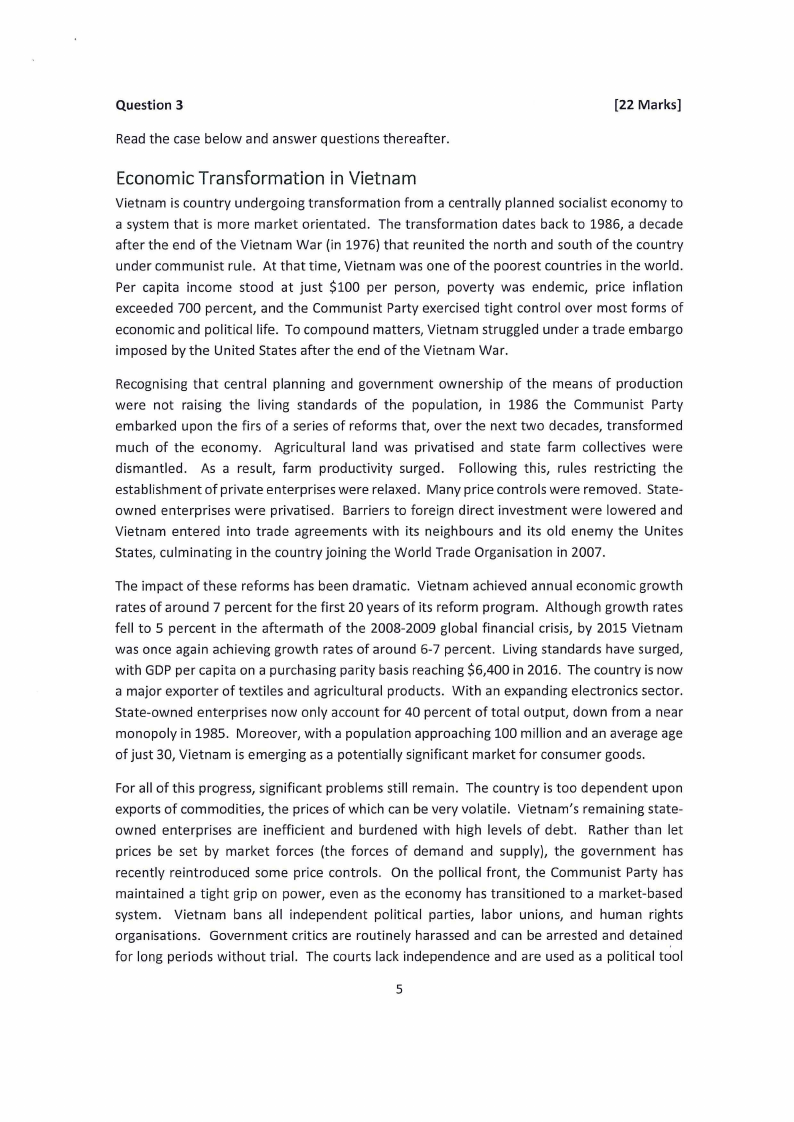
Question 3
Read the case below and answer questions thereafter.
[22 Marks]
Economic Transformation in Vietnam
Vietnam is country undergoing transformation from a centrally planned socialist economy to
a system that is more market orientated. The transformation dates back to 1986, a decade
after the end of the Vietnam War (in 1976) that reunited the north and south of the country
under communist rule. At that time, Vietnam was one of the poorest countries in the world.
Per capita income stood at just $100 per person, poverty was endemic, price inflation
exceeded 700 percent, and the Communist Party exercised tight control over most forms of
economic and political life. To compound matters, Vietnam struggled under a trade embargo
imposed by the United States after the end of the Vietnam War.
Recognising that central planning and government ownership of the means of production
were not raising the living standards of the population, in 1986 the Communist Party
embarked upon the firs of a series of reforms that, over the next two decades, transformed
much of the economy. Agricultural land was privatised and state farm collectives were
dismantled. As a result, farm productivity surged. Following this, rules restricting the
establishment of private enterprises were relaxed. Many price controls were removed. State-
owned enterprises were privatised. Barriers to foreign direct investment were lowered and
Vietnam entered into trade agreements with its neighbours and its old enemy the Unites
States, culminating in the country joining the World Trade Organisation in 2007.
The impact of these reforms has been dramatic. Vietnam achieved annual economic growth
rates of around 7 percent for the first 20 years of its reform program. Although growth rates
fell to 5 percent in the aftermath of the 2008-2009 global financial crisis, by 2015 Vietnam
was once again achieving growth rates of around 6-7 percent. Living standards have surged,
with GDP per capita on a purchasing parity basis reaching $6,400 in 2016. The country is now
a major exporter of textiles and agricultural products. With an expanding electronics sector.
State-owned enterprises now only account for 40 percent of total output, down from a near
monopoly in 1985. Moreover, with a population approaching 100 million and an average age
of just 30, Vietnam is emerging as a potentially significant market for consumer goods.
For all of this progress, significant problems still remain. The country is too dependent upon
exports of commodities, the prices of which can be very volatile. Vietnam's remaining state-
owned enterprises are inefficient and burdened with high levels of debt. Rather than let
prices be set by market forces (the forces of demand and supply), the government has
recently reintroduced some price controls. On the pollical front, the Communist Party has
maintained a tight grip on power, even as the economy has transitioned to a market-based
system. Vietnam bans all independent political parties, labor unions, and human rights
organisations. Government critics are routinely harassed and can be arrested and detained
for long periods without trial. The courts lack independence and are used as a political tool
5
|
|
6 Page 6 |
▲back to top |
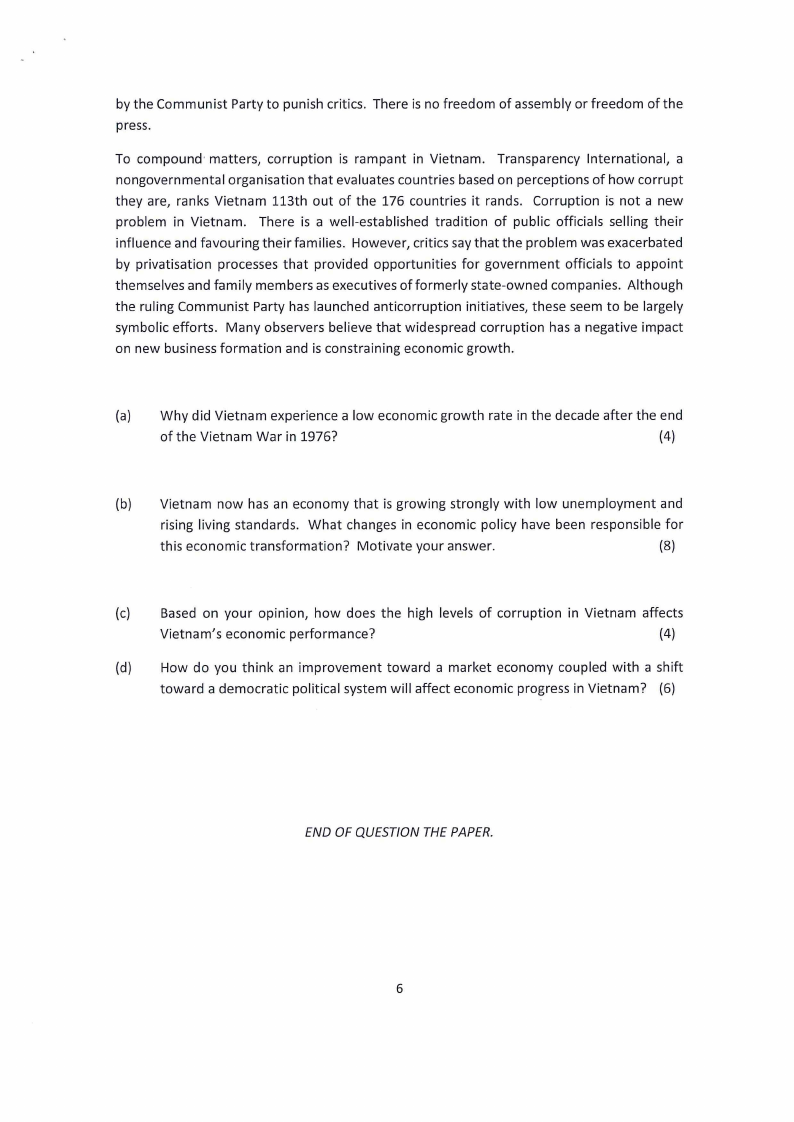
by the Communist Party to punish critics. There is no freedom of assembly or freedom of the
press.
To compound· matters, corruption is rampant in Vietnam. Transparency International, a
nongovernmental organisation that evaluates countries based on perceptions of how corrupt
they are, ranks Vietnam 113th out of the 176 countries it rands. Corruption is not a new
problem in Vietnam. There is a well-established tradition of public officials selling their
influence and favouring their families. However, critics say that the problem was exacerbated
by privatisation processes that provided opportunities for government officials to appoint
themselves and family members as executives of formerly state-owned companies. Although
the ruling Communist Party has launched anticorruption initiatives, these seem to be largely
symbolic efforts. Many observers believe that widespread corruption has a negative impact
on new business formation and is constraining economic growth.
(a) Why did Vietnam experience a low economic growth rate in the decade after the end
of the Vietnam War in 1976?
(4)
(b) Vietnam now has an economy that is growing strongly with low unemployment and
rising living standards. What changes in economic policy have been responsible for
this economic transformation? Motivate your answer.
(8)
(c) Based on your opinion, how does the high levels of corruption in Vietnam affects
Vietnam's economic performance?
(4)
(d) How do you think an improvement toward a market economy coupled with a shift
toward a democratic political system will affect economic progress in Vietnam? (6)
END OF QUESTIONTHE PAPER.
6