ITE411S-INTRODUCATION TO ECONOMICS-2ND OPP- JULY 2025


ITE411S-INTRODUCATION TO ECONOMICS-2ND OPP- JULY 2025


1 Pages 1-10

▲back to top


1.1 Page 1

▲back to top


nAmlBIA UnlVERSITY
OF SCIEnCE Ano TECHnOLOGY
FACULTY OF MANAGEMENT SCIENCES
DEPARTMENT OF ACCOUNTING, ECONOMICS AND FINANCE
DEPARTMENT OF ECONOMICS, ACCOUNTING AND FINANCE
QUALIFICATION : BRIDGING PROGRAMME - SOCIAL SCIENCES (04NBPR)
QUALIFICATION CODE:
O4NBPR
LEVEL: 4
COURSE CODE: ITE411S
COURSE NAME: INTRODUCTION TO
ECONOMICS
SESSION: JULY 2025
DURATION: 3 HOURS
PAPER:THEORY
MARKS: 100
SECOND OPPORTUNITY EXAMINATION QUESTION PAPER
EXAMINER(S) Mrs Precious Mwikanda
MODERA TOR: Ms Kasnath Kavezeri
INSTRUCTIONS
1. Answer ALL the questions.
2. Write clearly and neatly.
3. Number the answers clearly.
4. The use of a scientific pocket calculator is allowed.
5. This examination paper is divided into FOUR sections.
6. Section A and Section B should be answered on the enclosed answer
sheets. Complete and place it in your examination answer book.
7. Section C, D and E should be answered in your examination book.
THIS QUESTION PAPER CONSISTS OF 14 PAGES (Excluding this front page)

1.2 Page 2

▲back to top


1.3 Page 3

▲back to top


SECTION A
20MARKS
Instructions:
Read all questions carefully
Answer all questions
All answers should be on the answer sheet provided on page 13. Tear the page off
and place it inside your examination script.
QUESTION 1
[20 marks]
1.1. Economics is the study of:
[1]
(a) how to increase economic growth.
(b) how resources should be allocated.
(c) how to ensure resources are shared equally.
(d) how society allocates scare resources in order to maximize welfare.
1.2. Capital as a factor of production, includes:
[1]
(a) Money
(b) Computers
(c) An overdraft
(d) A mortgage.
1.3 All points on the production possibility curve show efficiency because [1]
(a) Output is distributed equally.
(b) the economy is producing the combination of output that the consumers demand.
(c) the economy has reached its full long-term potential.
(d) the economy is producing at full current capacity.
1

1.4 Page 4

▲back to top


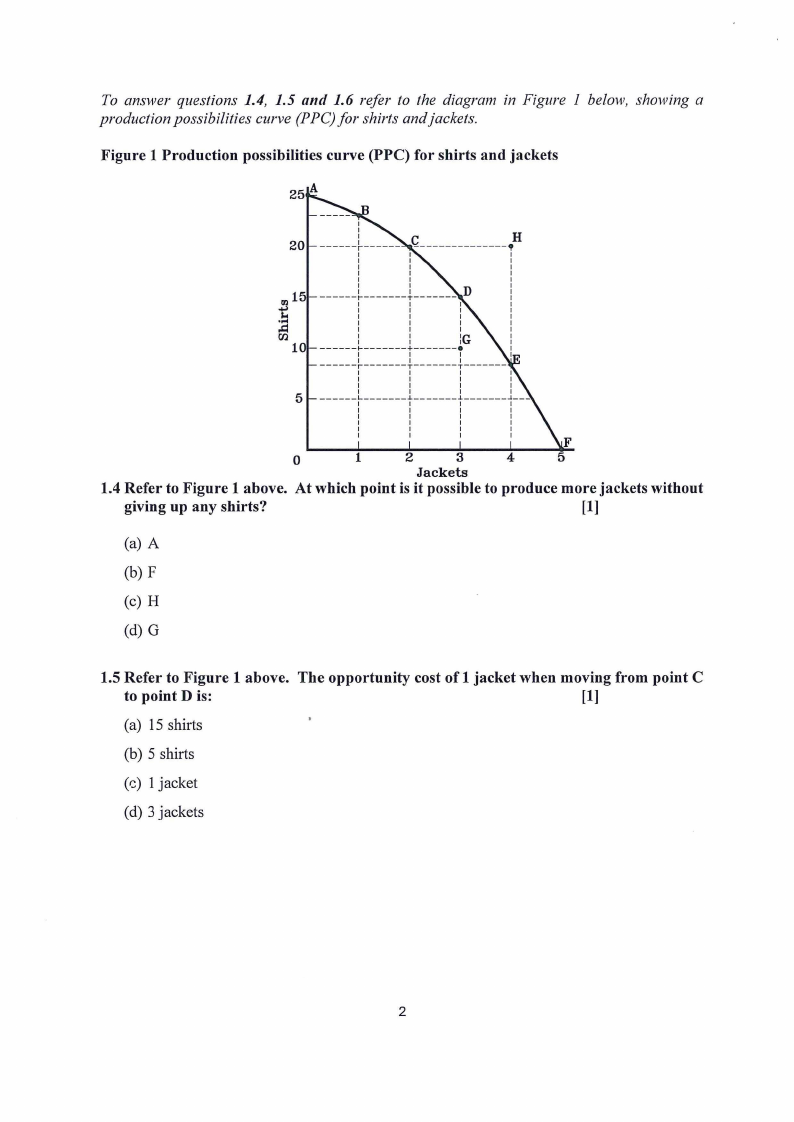
To answer questions 1.4, 1.5 and 1.6 refer to the diagram in Figure I below, showing a
production possibilities curve (PPC) for shirts and jackets.
Figure 1 Production possibilities curve (PPC) for shirts and jackets
20
11l 15
t....
.d
Cl.l
10
5
I
I
------r-----i-
C---------------~
H
I
I
I
I
I
I
I
I
I
I
I
I
I
I
I
------r-:------T--:----- D
:
r
I
I
I
I
l
I
l
I
I
I
I
I
I
l
I
l
------~I:I-------+--:JI -----•
:I G
I
:I
lI
------r-----I --T
I _______ TI ______ _
______
I
I
I
LI _______
I
I
I
iI _______
I
I
I
I _______
I
I
I
JI__ _
I
I
I
I
I
I
I
I
I
I
I
I
I
l
I
l
I
I
I
I
I
I
I
I
0
1
2
3
4
Jackets
1.4 Refer to Figure 1 above. At which point is it possible to produce more jackets without
giving up any shirts?
[1]
(a) A
(b) F
(c) H
(d) G
1.5 Refer to Figure 1 above. The opportunity cost of 1 jacket when moving from point C
to point D is:
[1]
(a) 15 shirts
(b) 5 shirts
(c) 1jacket
(d) 3 jackets
2

1.5 Page 5

▲back to top


1.6 Refer to Figure 1 above. If the company buys one more sewing machine and
employs one more seamstress, how will it affect the PPC?
[1]
(a) The PPC will shift to the right.
(b) The PPC will shift to the left.
(c) The PPC will not shift but the oppo1iunity cost will increase.
(d) The PPC will not shift but the opportunity cost will decrease.
1.7 When the price of coffee rises, the demand for tea __ .
[l ]
(a) falls.
(b) rises.
(c) stays the same.
(d) none of the above.
1.8 Which of the following statements is true about consumer behavior? [1]
(a) Consumer behavior is the study of microeconomics
(b) Consumer behavior is the study of macroeconomics
(c) CoP-sumerbehavior is predicted using income and expenditure analysis
(d) Consumer behavior is predictable
1.9 Which of the following best captures the idea of the fundamental economic
problem?
[1]
(a) limited wants and limited resources
(b) lack of demand for limited resources
(c) Unlimited resources and unlimited wants
(d) limited resources and unlimited wants
3

1.6 Page 6

▲back to top


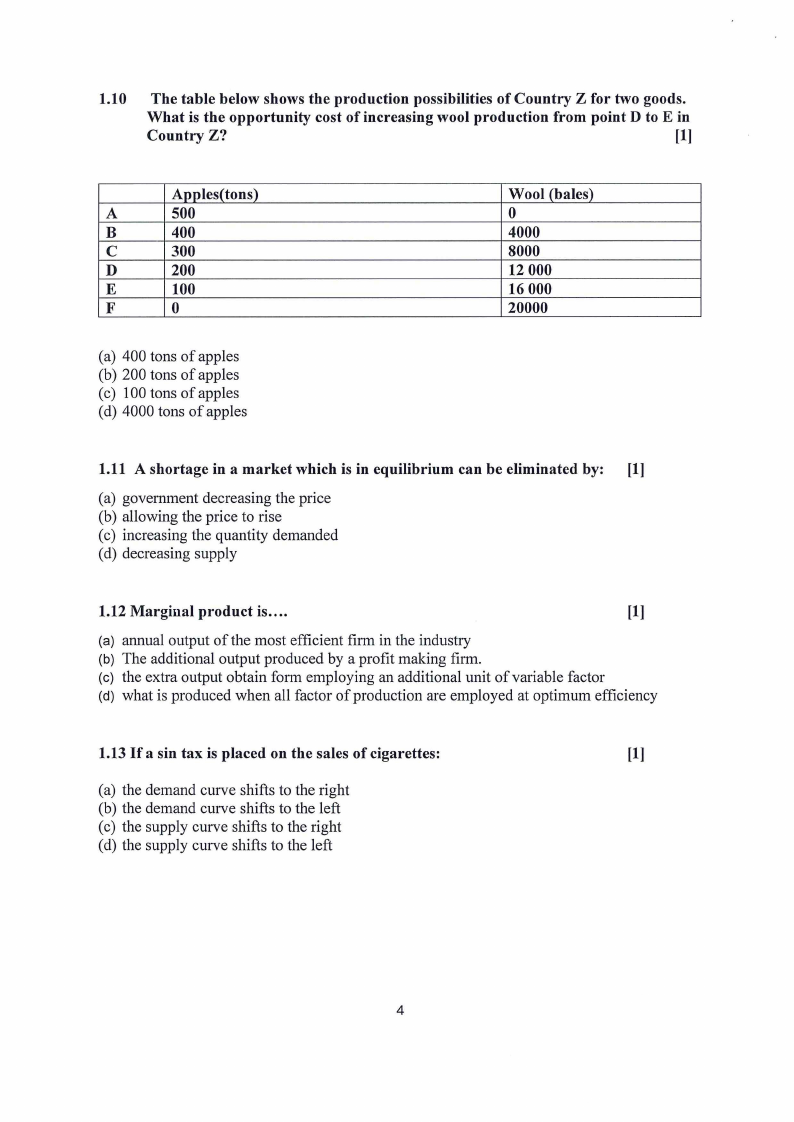
1.10 The table below shows the production possibilities of Country Z for two goods.
What is the opportunity cost of increasing wool production from point D to E in
Country Z?
[1]
Apples(tons)
A
500
B
400
C
300
D
200
E
100
F
0
(a) 400 tons of apples
(b) 200 tons of apples
(c) 100 tons of apples
(d) 4000 tons of apples
Wool (bales)
0
4000
8000
12 000
16 000
20000
1.11 A shortage in a market which is in equilibrium can be eliminated by: [1]
(a) government decreasing the price
(b) allowing the price to rise
(c) increasing the quantity demanded
(d) decreasing supply
1.12 Marginal product is ....
[1]
(a) annual output of the most efficient firm in the industry
(b) The additional output produced by a profit making firm.
(c) the extra output obtain form employing an additional unit of variable factor
(d) what is produced when all factor of production are employed at optimum efficiency
1.13 If a sin tax is placed on the sales of cigarettes:
[1]
(a) the demand curve shifts to the right
(b) the demand curve shifts to the left
(c) the supply curve shifts to the right
(d) the supply curve shifts to the left
4

1.7 Page 7

▲back to top


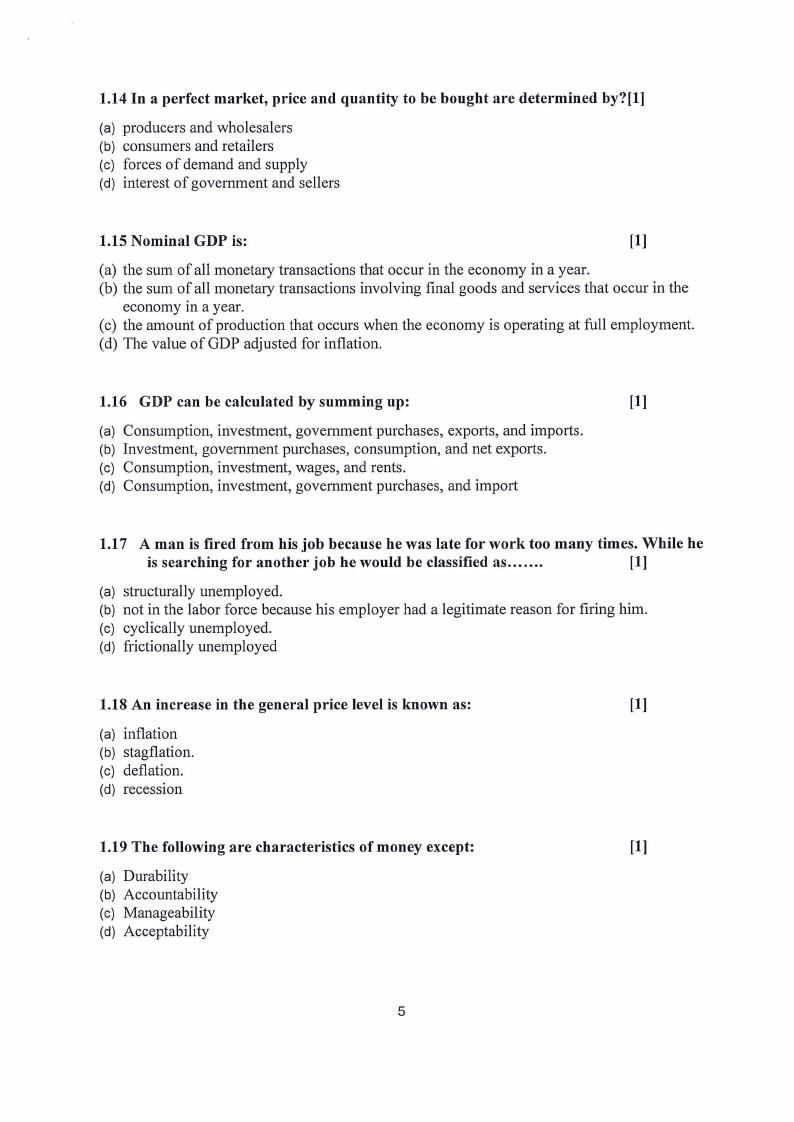
1.14 In a perfect market, price and quantity to be bought are determined by?[l]
(a) producers and wholesalers
(b) consumers and retailers
(c) forces of demand and supply
(d) interest of government and sellers
1.15 Nominal GDP is:
[1]
(a) the sum of all monetary transactions that occur in the economy in a year.
(b) the sum of all monetary transactions involving final goods and services that occur in the
economy m a year.
(c) the amount of production that occurs when the economy is operating at full employment.
(d) The value of GDP adjusted for inflation.
1.16 GDP can be calculated by summing up:
[1]
(a) Consumption, investment, government purchases, exports, and impmis.
(b) Investment, government purchases, consumption, and net exports.
(c) Consumption, investment, wages, and rents.
(d) Consumption, investment, government purchases, and import
1.17 A man is fired from his job because he was late for work too many times. While he
is searching for another job he would be classified as.......
[1]
(a) structurally unemployed.
(b) not in the labor force because his employer had a legitimate reason for firing him.
(c) cyclically unemployed.
(d) frictionally unemployed
1.18 An increase in the general price level is known as:
[1]
(a) inflation
(b) stagflation.
(c) deflation.
(d) recession
1.19 The following are characteristics of money except:
[1]
(a) Durability
(b) Accountability
(c) Manageability
(d) Acceptability
5

1.8 Page 8

▲back to top


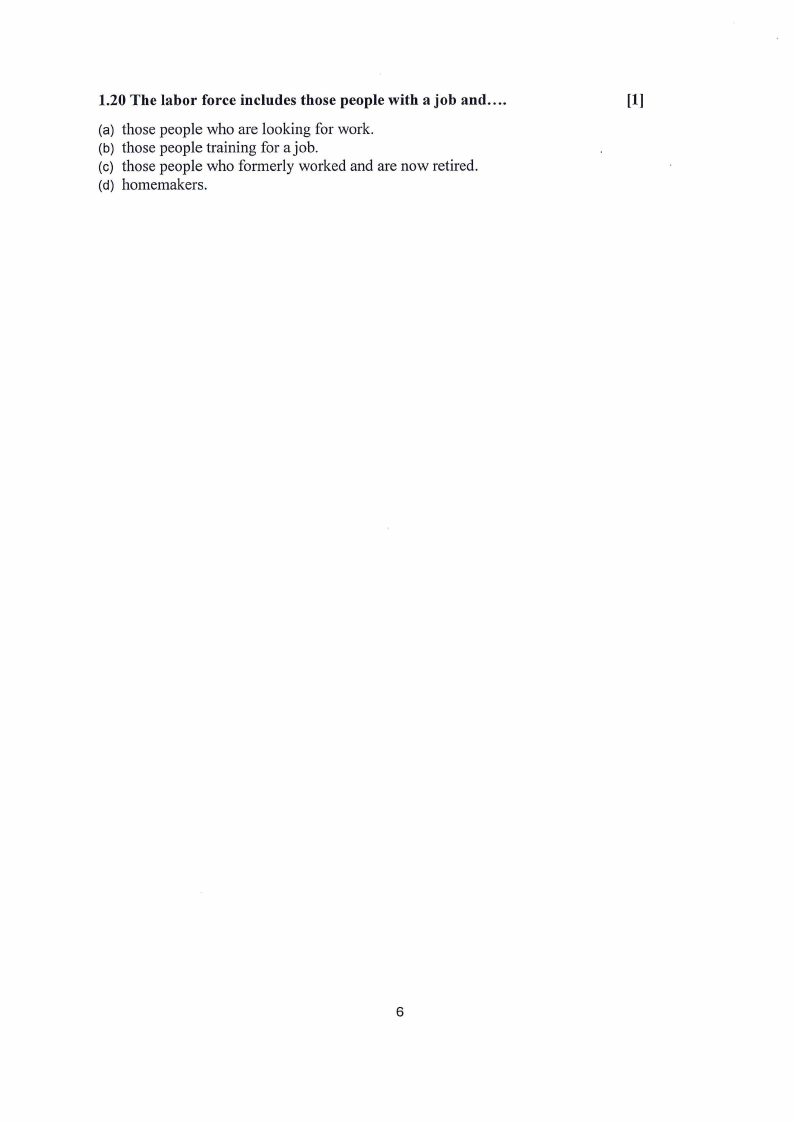
1.20 The labor force includes those people with a job and ....
[l]
(a) those people who are looking for work.
(b) those people training for a job.
(c) those people who formerly worked and are now retired.
(d) homemakers.
6

1.9 Page 9

▲back to top


SECTIONB
20MARKS
Instructions:
•Read all questions carefully
•Answer all questions
•All answers should be on the answer sheet provided on page 13. Tear the page off and place
it inside your examination script book.
QUESTION 1
[20 marks]
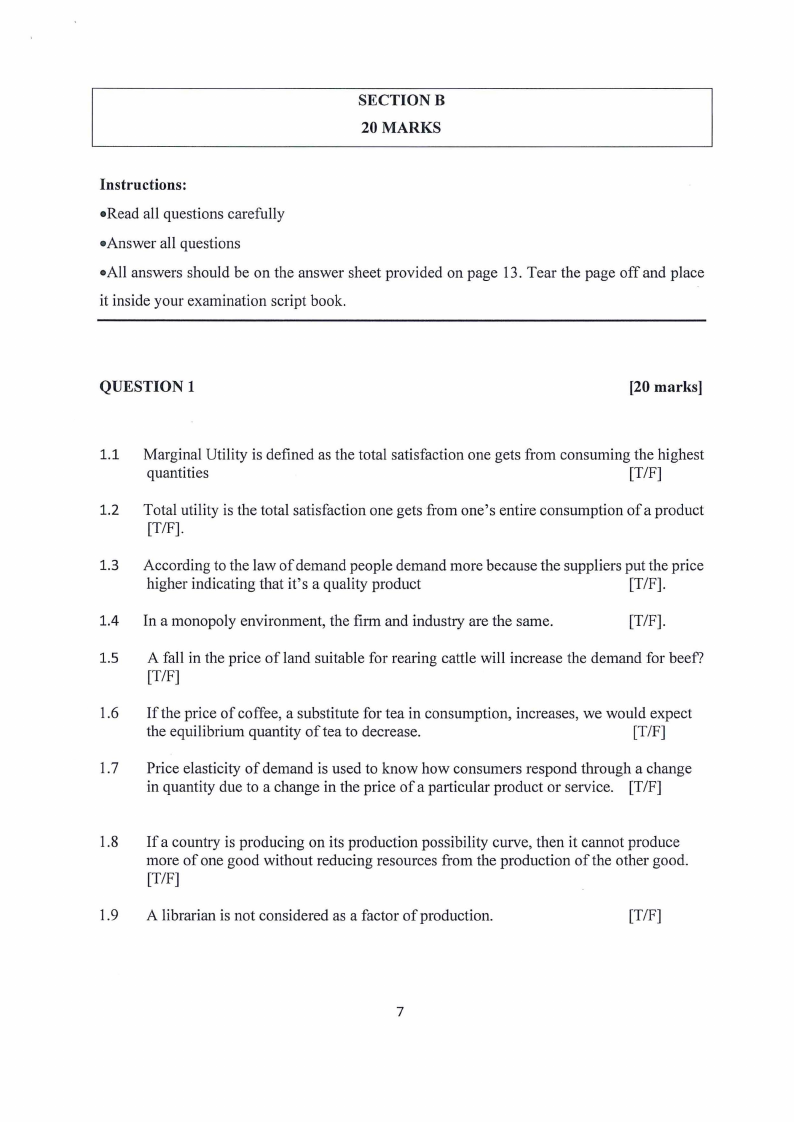
1.1 Marginal Utility is defined as the total satisfaction one gets from consuming the highest
quantities
[T/F]
1.2 Total utility is the total satisfaction one gets from one's entire consumption of a product
[T/F].
1.3 According to the law of demand people demand more because the suppliers put the price
higher indicating that it's a quality product
[T/F].
1.4 In a monopoly environment, the film and industry are the same.
[T/F].
1.5 A fall in the price of land suitable for rearing cattle will increase the demand for beef?
[T/F]
1.6 If the price of coffee, a substitute for tea in consumption, increases, we would expect
the equilibrium quantity of tea to decrease.
[T/F]
1.7 Price elasticity of demand is used to know how consumers respond through a change
in quantity due to a change in the price of a particular product or service. [T/F]
1.8 If a country is producing on its production possibility curve, then it cannot produce
more of one good without reducing resources from the production of the other good.
[T/F]
1.9 A librarian is not considered as a factor of production.
[T/F]
7

1.10 Page 10

▲back to top


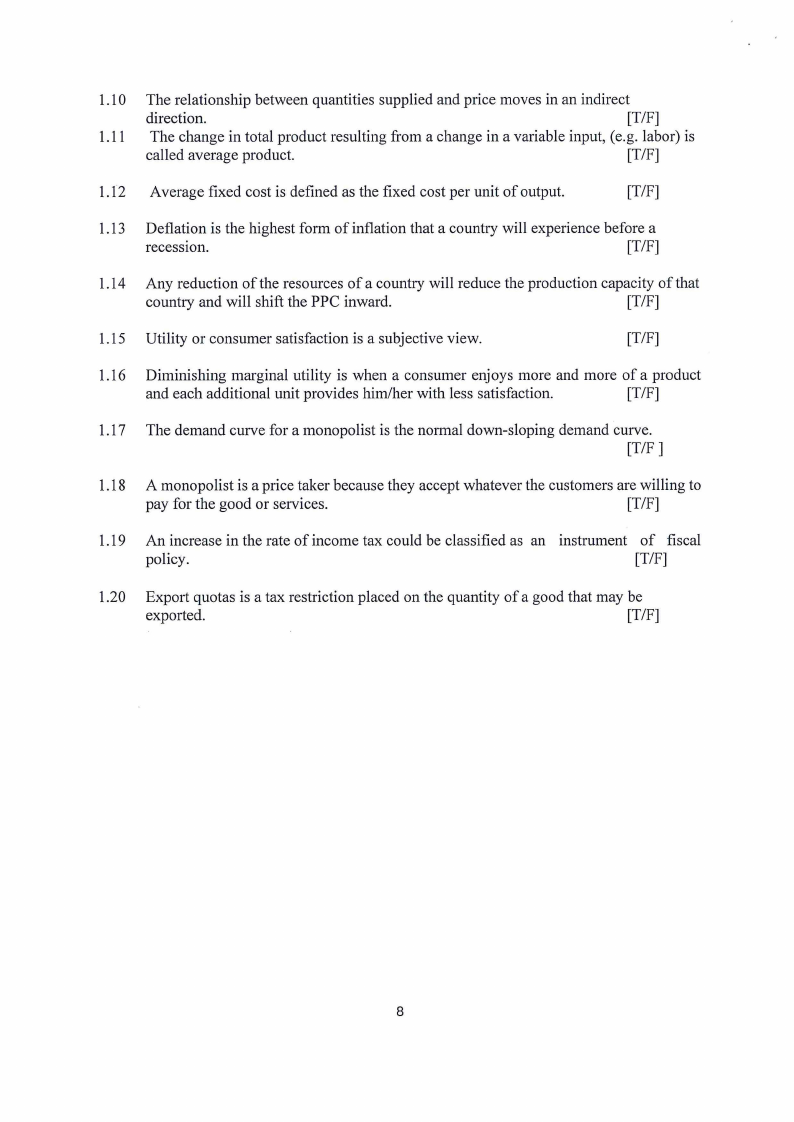
1.10 The relationship between quantities supplied and price moves in an indirect
direction.
[T/F]
1.11 The change in total product resulting from a change in a variable input, (e.g. labor) is
called average product.
[T/F]
1.l2 Average fixed cost is defined as the fixed cost per unit of output.
[T/F]
1.13 Deflation is the highest form of inflation that a country will experience before a
recession.
[T/F]
1.14 Any reduction of the resources of a country will reduce the production capacity of that
country and will shift the PPC inward.
[T/F]
1.15 Utility or consumer satisfaction is a subjective view.
[T/F]
1.16 Diminishing marginal utility is when a consumer enjoys more and more of a product
and each additional unit provides him/her with less satisfaction.
[T/F]
1.17 The demand curve for a monopolist is the normal down-sloping demand curve.
[T/F]
1.18 A monopolist is a price taker because they accept whatever the customers are willing to
pay for the good or services.
[T/F]
1.19 An increase in the rate of income tax could be classified as an instrument of fiscal
policy.
[T/F]
1.20 Export quotas is a tax restriction placed on the quantity of a good that may be
exported.
[TIF]
8

2 Pages 11-20

▲back to top


2.1 Page 11

▲back to top


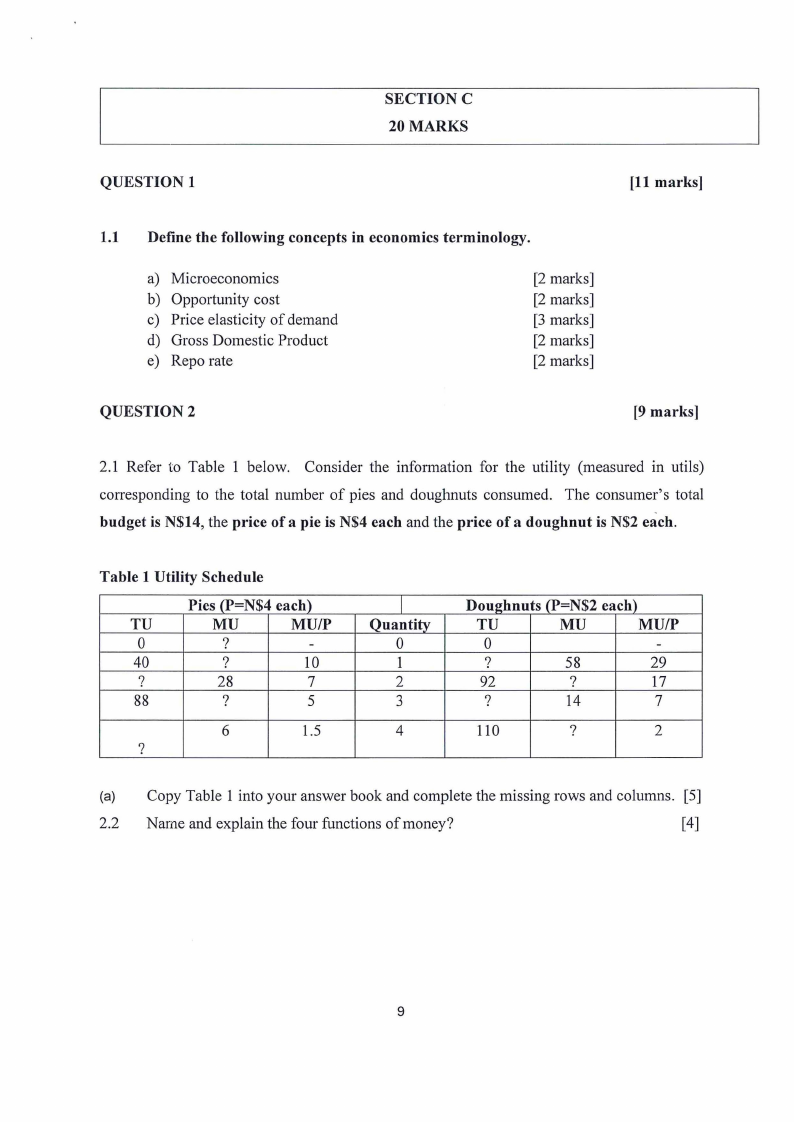
SECTION C
20MARKS
QUESTION 1
[11 marks]
1.1 Define the following concepts in economics terminology.
a) Microeconomics
b) Opportunity cost
c) Price elasticity of demand
d) Gross Domestic Product
e) Repo rate
[2 marks]
[2 marks]
[3 marks]
[2 marks]
[2 marks]
QUESTION2
[9 marks]
2.1 Refer to Table 1 below. Consider the information for the utility (measured in utils)
corresponding to the total number of pies and doughnuts consumed. The consumer's total
budget is N$14, the price of a pie is N$4 each and the price of a doughnut is N$2 each.
Table 1 Utility Schedule
Pies (P=N$4 each)
TU
MU
MU/P
0
?
-
40
?
10
?
28
7
88
?
5
6
1.5
?
I
Quantity
0
1
2
3
4
Doughnuts (P=N$2 each)
TU
MU
MU/P
0
-
?
58
29
92
?
17
?
14
7
110
?
2
(a) Copy Table 1 into your answer book and complete the missing rows and columns. [5]
2.2 Name and explain the four functions of money?
[4]
9

2.2 Page 12

▲back to top


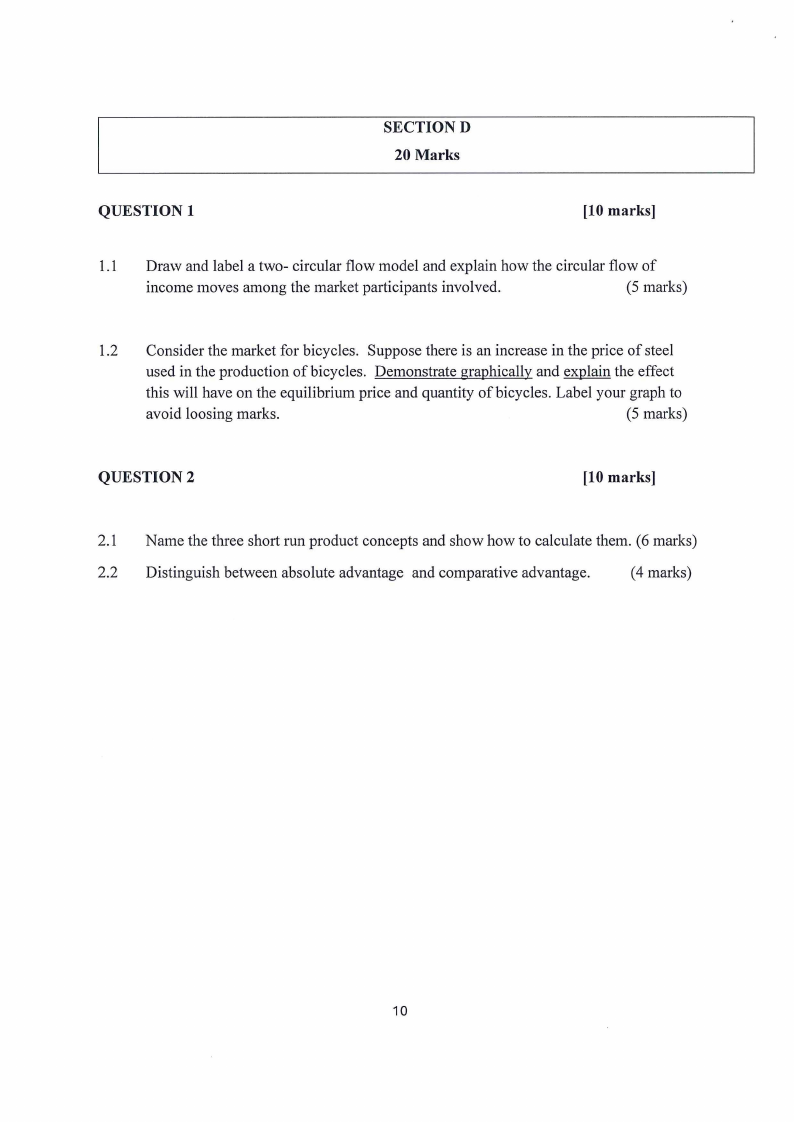
SECTIOND
20 Marks
QUESTION 1
[10 marks]
1.1 Draw and label a two- circular flow model and explain how the circular flow of
income moves among the market paiiicipants involved.
(5 marks)
1.2 Consider the market for bicycles. Suppose there is an increase in the price of steel
used in the production of bicycles. Demonstrate graphically and explain the effect
this will have on the equilibrium price and quantity of bicycles. Label your graph to
avoid loosing marks.
(5 marks)
QUESTION2
[10 marks]
2.1 Name the three short run product concepts and show how to calculate them. (6 marks)
2.2 Distinguish between absolute advantage and comparative advantage.
(4 marks)
10

2.3 Page 13

▲back to top


SECTIONE
20MARKS
QUESTION 1
[10 marks]
1.1 Describe how each of this type of unemployment affects the labour force.
a) frictional unemployment
(2 marks)
b) cyclical unemployment
(2 marks)
c) structural unemployment
(2 marks)
1.2 In each of the following situations, state whether discretionary fiscal policy is
expansionary or restrictive. Motivate your answer.
(a) The government increases tax rates for households and corporations.
(2 marks)
a) Government expenditures on food aid programs to help the poor are increased
by 5%.
(2 marks)
QUESTION2
[10 MARKS]
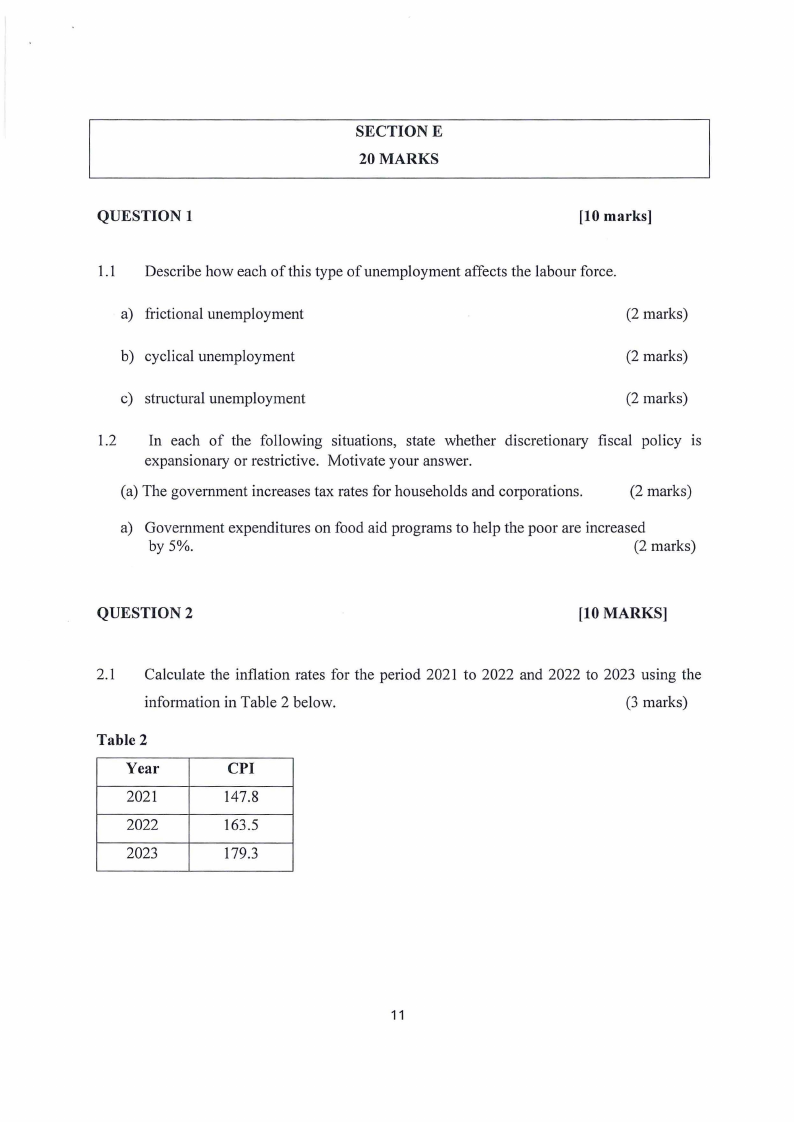
2.1 Calculate the inflation rates for the period 2021 to 2022 and 2022 to 2023 using the
information in Table 2 below.
(3 marks)
Table 2
Year
2021
2022
2023
CPI
147.8
163.5
179.3
11

2.4 Page 14

▲back to top


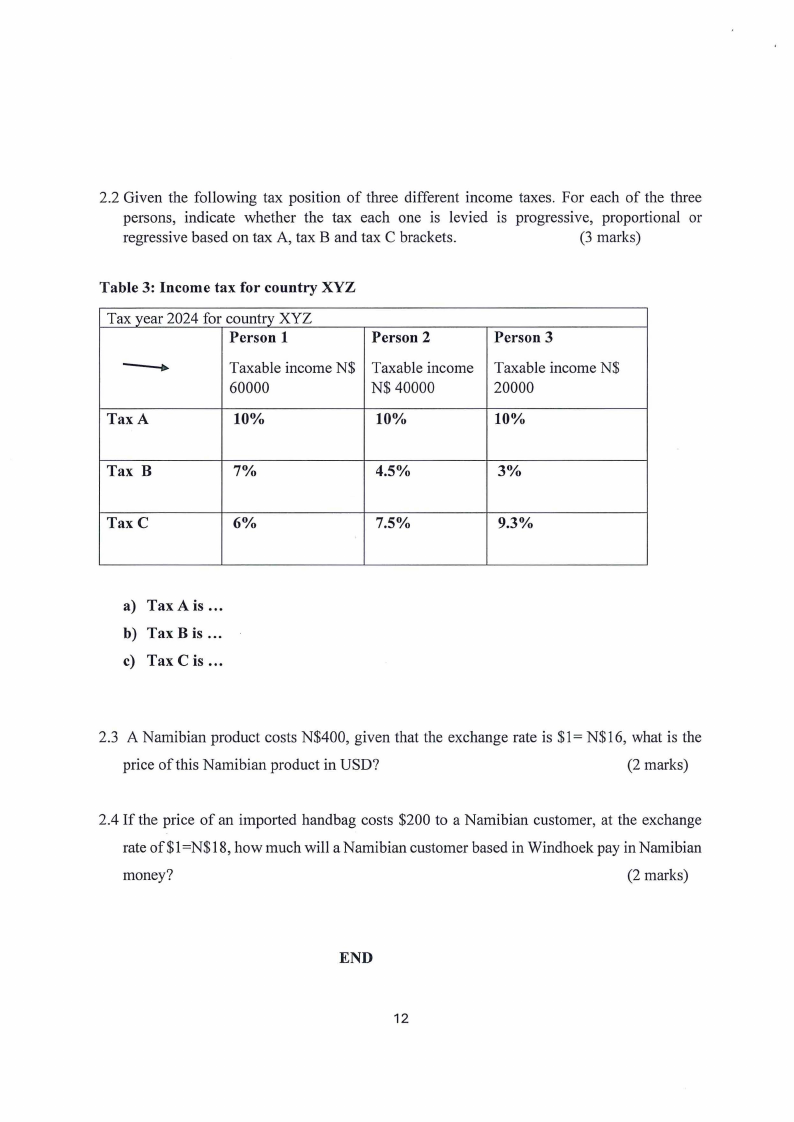
2.2 Given the following tax position of three different income taxes. For each of the three
persons, indicate whether the tax each one is levied 1s progressive, proportional or
regressive based on tax A, tax B and tax C brackets.
(3 marks)
Table 3: Income tax for country XYZ
Tax year 2024 for country XYZ
- ...
Person 1
Taxable income N$
60000
Person 2
Taxable income
N$ 40000
Person 3
Taxable income N$
20000
Tax A
10%
10%
10%
Tax B
7%
4.5%
3%
TaxC
6%
7.5%
9.3%
a) Tax A is .. .
b) Tax Bis .. .
c) Tax C is .. .
2.3 A Namibian product costs N$400, given that the exchange rate is $1= N$16, what is the
price of this Namibian product in USD?
(2 marks)
2.4 If the price of an imp01ted handbag costs $200 to a Namibian customer, at the exchange
rate of$1 =N$18, how much will a Namibian customer based in Windhoek pay in Namibian
money?
(2 marks)
END
12

2.5 Page 15

▲back to top


Student number: ......................................................
.
ANSWER SHEET FOR SECTION A
Mark the correct answer with an X.
A
B
C
D
1.1
1.2
1.3
1.4
1.5
1.6
1.7
1.8
1.9
1.10
1.11
1.12
1.13
1.14
1.15
1.16
1.17
1.18
1.19
1.20
13

2.6 Page 16

▲back to top


Student number: .....................................................
..
ANSWER SHEET FOR SECTION B
Mark the correct answer with an X.
TRUE
FALSE
1.1
1.2
1.3
1.4
1.5
1.6
1.7
1.8
1.9
1.10
1.11
1.12
1.13
1.14
1.15
1.16
1.17
1.18
1.19
1.20
14