POS611S - PRINCIPLES OF SELLING - 2ND OPP - JULY 2025


POS611S - PRINCIPLES OF SELLING - 2ND OPP - JULY 2025


1 Page 1

▲back to top


nAmlBIA UnlVERSITY
OF SCIEnCE Ano TECHnDLOGY
FACULTY OF COMMERCE, HUMAN SCIENCEAND EDUCATION
DEPARTMENT OF MARKETING, LOGISTICS AND SPORT MANAGEMENT
QUALIFICATION : BACHELOR OF MARKETING
QUALIFICATION CODE: 07BMAK
LEVEL: 6
COURSE CODE: POS611S
COURSE NAME: PRINCIPLESOF SELLING
SESSION: JUNE 2025
PAPER: THEORY
DURATION: 3 HOURS
MARKS: 100
SECOND OPPORTUNITY EXAMINATION QUESTION PAPER
EXAMINER
Mr. C. KAZONDOVI
MODERATOR: PROF. M. CHUFAMA
INSTRUCTIONS
1. Answer ALL the questions and Number the answers clearly.
2. This paper consists of two (2) sections (A & B).
3. Use the tables provided on [pages 09 & 10] to answer Section A,
Question One (1) AND Question Two (2) respectively: Detach and
insert it into your answer booklet.
4. Write as legible and as precise as possible.
THIS QUESTION PAPER CONSISTS OF 10 PAGES (Including this front page)
1

2 Page 2

▲back to top


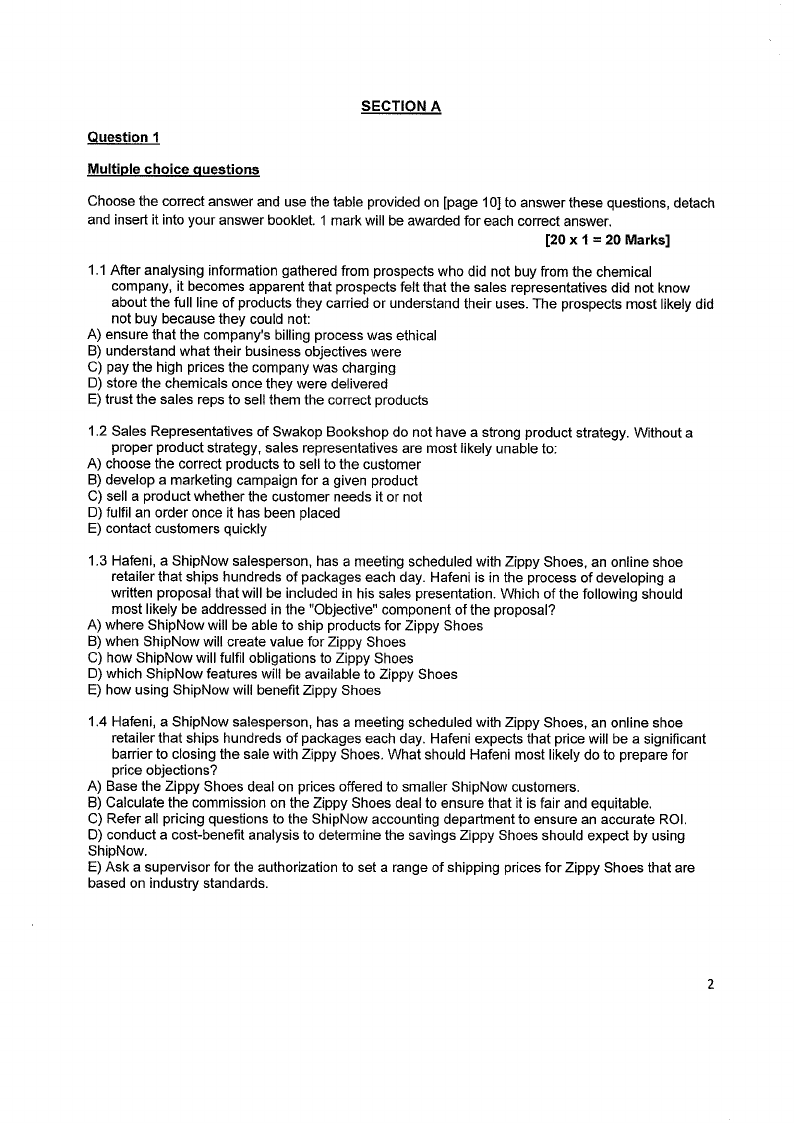
SECTION A_
Question 1
Multiple choice questions
Choose the correct answer and use the table provided on [page 1O]to answer these questions, detach
and insert it into your answer booklet. 1 mark will be awarded for each correct answer.
[20 x 1 = 20 Marks]
1.1 After analysing information gathered from prospects who did not buy from the chemical
company, it becomes apparent that prospects felt that the sales representatives did not know
about the full line of products they carried or understand their uses. The prospects most likely did
not buy because they could not:
A) ensure that the company's billing process was ethical
B) understand what their business objectives were
C) pay the high prices the company was charging
D) store the chemicals once they were delivered
E) trust the sales reps to sell them the correct products
1.2 Sales Representatives of Swakop Bookshop do not have a strong product strategy. Without a
proper product strategy, sales representatives are most likely unable to:
A) choose the correct products to sell to the customer
B) develop a marketing campaign for a given product
C) sell a product whether the customer needs it or not
D) fulfil an order once it has been placed
E) contact customers quickly
1.3 Hafeni, a ShipNow salesperson, has a meeting scheduled with Zippy Shoes, an online shoe
retailer that ships hundreds of packages each day. Hafeni is in the process of developing a
written proposal that will be included in his sales presentation. Which of the following should
most likely be addressed in the "Objective" component of the proposal?
A) where ShipNow will be able to ship products for Zippy Shoes
B) when ShipNow will create value for Zippy Shoes
C) how ShipNow will fulfil obligations to Zippy Shoes
D) which ShipNow features will be available to Zippy Shoes
E) how using ShipNow will benefit Zippy Shoes
1.4 Hafeni, a ShipNow salesperson, has a meeting scheduled with Zippy Shoes, an online shoe
retailer that ships hundreds of packages each day. Hafeni expects that price will be a significant
barrier to closing the sale with Zippy Shoes. What should Hafeni most likely do to prepare for
price objections?
A) Base the Zippy Shoes deal on prices offered to smaller ShipNow customers.
B) Calculate the commission on the Zippy Shoes deal to ensure that it is fair and equitable.
C) Refer all pricing questions to the ShipNow accounting department to ensure an accurate ROI.
D) conduct a cost-benefit analysis to determine the savings Zippy Shoes should expect by using
ShipNow.
E) Ask a supervisor for the authorization to set a range of shipping prices for Zippy Shoes that are
based on industry standards.
2

3 Page 3

▲back to top


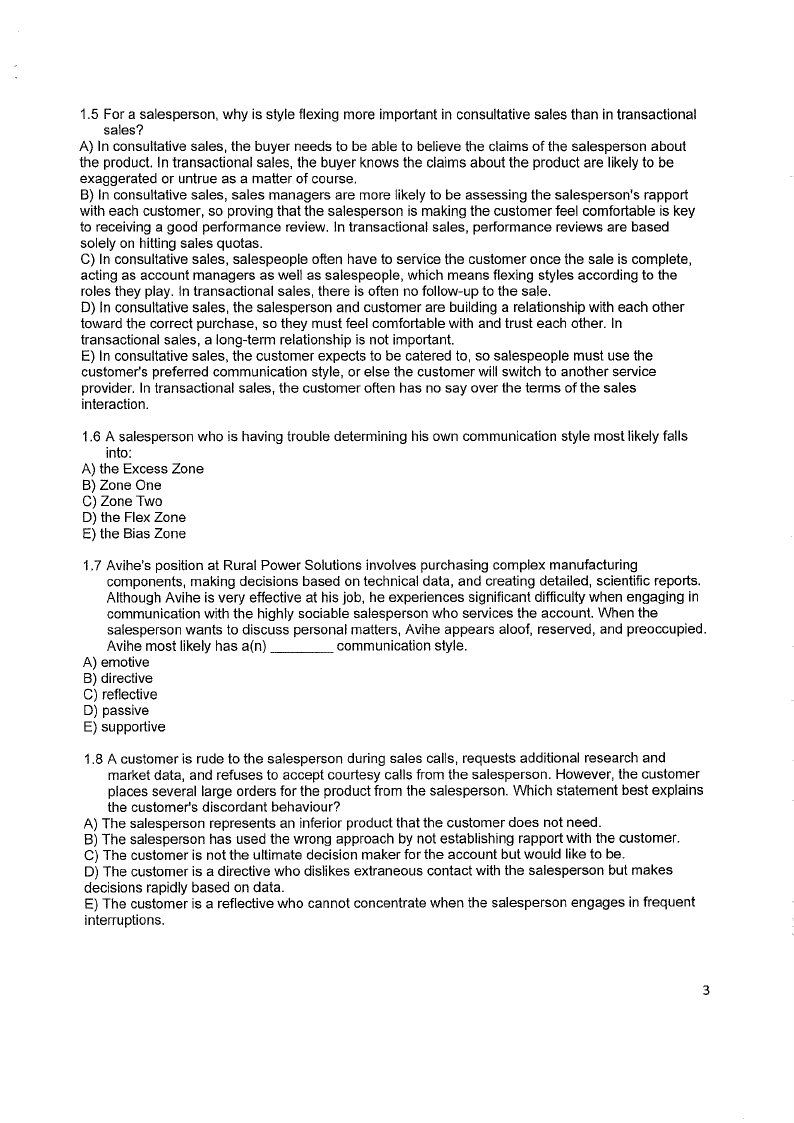
1.5 For a salesperson, why is style flexing more important in consultative sales than in transactional
sales?
A) In consultative sales, the buyer needs to be able to believe the claims of the salesperson about
the product. In transactional sales, the buyer knows the claims about the product are likely to be
exaggerated or untrue as a matter of course.
B) In consultative sales, sales managers are more likely to be assessing the salesperson's rapport
with each customer, so proving that the salesperson is making the customer feel comfortable is key
to receiving a good performance review. In transactional sales, performance reviews are based
solely on hitting sales quotas.
C) In consultative sales, salespeople often have to service the customer once the sale is complete,
acting as account managers as well as salespeople, which means flexing styles according to the
roles they play. In transactional sales, there is often no follow-up to the sale.
D) In consultative sales, the salesperson and customer are building a relationship with each other
toward the correct purchase, so they must feel comfortable with and trust each other. In
transactional sales, a long-term relationship is not important.
E) In consultative sales, the customer expects to be catered to, so salespeople must use the
customer's preferred communication style, or else the customer will switch to another service
provider. In transactional sales, the customer often has no say over the terms of the sales
interaction.
1.6 A salesperson who is having trouble determining his own communication style most likely falls
into:
A} the Excess Zone
B) Zone One
C) Zone Two
D) the Flex Zone
E) the Bias Zone
1.7 Avihe's position at Rural Power Solutions involves purchasing complex manufacturing
components, making decisions based on technical data, and creating detailed, scientific reports.
Although Avihe is very effective at his job, he experiences significant difficulty when engaging in
communication with the highly sociable salesperson who services the account. When the
salesperson wants to discuss personal matters, Avihe appears aloof, reserved, and preoccupied.
Avihe most likely has a(n) ____
communication style.
A} emotive
B) directive
C) reflective
D) passive
E) supportive
1.8 A customer is rude to the salesperson during sales calls, requests additional research and
market data, and refuses to accept courtesy calls from the salesperson. However, the customer
places several large orders for the product from the salesperson. Which statement best explains
the customer's discordant behaviour?
A) The salesperson represents an inferior product that the customer does not need.
B) The salesperson has used the wrong approach by not establishing rapport with the customer.
C) The customer is not the ultimate decision maker for the account but would like to be.
D) The customer is a directive who dislikes extraneous contact with the salesperson but makes
decisions rapidly based on data.
E) The customer is a reflective who cannot concentrate when the salesperson engages in frequent
interruptions.
3

4 Page 4

▲back to top


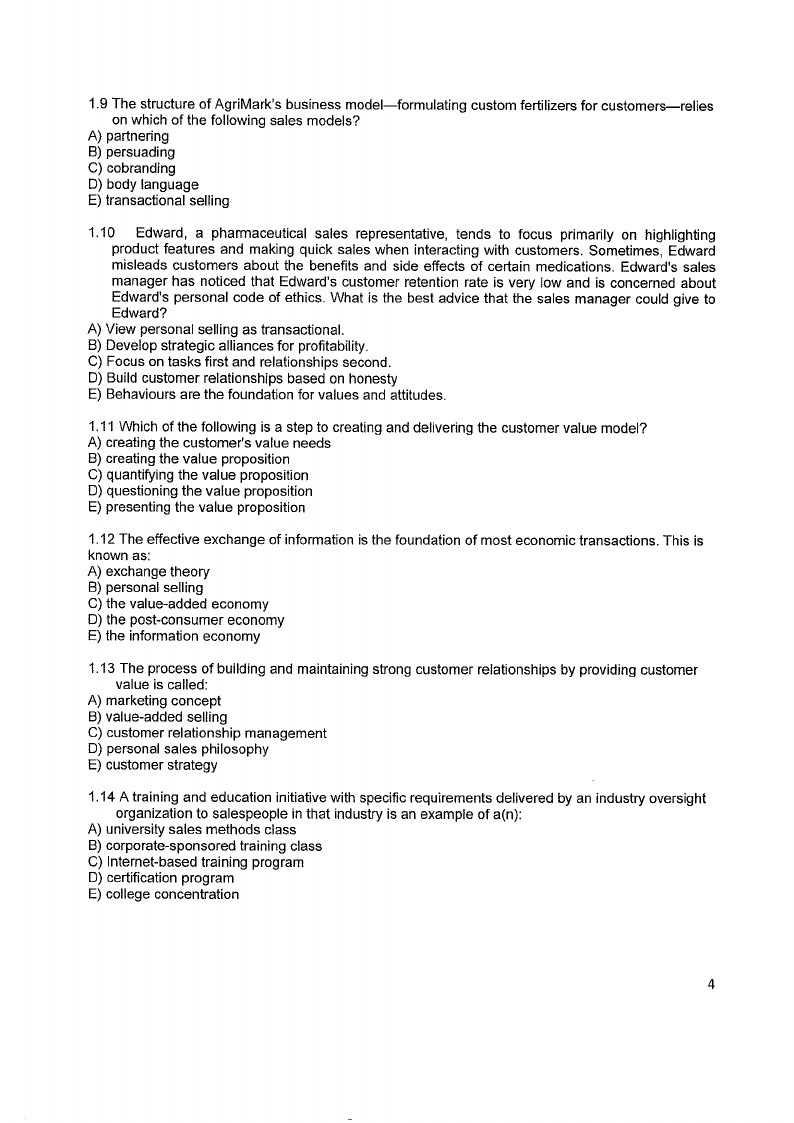
1.9 The structure of AgriMark's business model-formulating
on which of the following sales models?
A} partnering
B) persuading
C) cobranding
D) body language
E) transactional selling
custom fertilizers for customers-relies
1.10 Edward, a pharmaceutical sales representative, tends to focus primarily on highlighting
product features and making quick sales when interacting with customers. Sometimes, Edward
misleads customers about the benefits and side effects of certain medications. Edward's sales
manager has noticed that Edward's customer retention rate is very low and is concerned about
Edward's personal code of ethics. What is the best advice that the sales manager could give to
Edward?
A) View personal selling as transactional.
B) Develop strategic alliances for profitability.
C) Focus on tasks first and relationships second.
D) Build customer relationships based on honesty
E) Behaviours are the foundation for values and attitudes.
1.11 Which of the following is a step to creating and delivering the customer value model?
A) creating the customer's value needs
B) creating the value proposition
C) quantifying the value proposition
D) questioning the value proposition
E) presenting the value proposition
1.12 The effective exchange of information is the foundation of most economic transactions. This is
known as:
A} exchange theory
B) personal selling
C) the value-added economy
D) the post-consumer economy
E) the information economy
1.13 The process of building and maintaining strong customer relationships by providing customer
value is called:
A} marketing concept
B) value-added selling
C) customer relationship management
D) personal sales philosophy
E) customer strategy
1.14 A training and education initiative with specific requirements delivered by an industry oversight
organization to salespeople in that industry is an example of a(n):
A} university sales methods class
B) corporate-sponsored training class
C) Internet-based training program
D) certification program
E) college concentration
4

5 Page 5

▲back to top


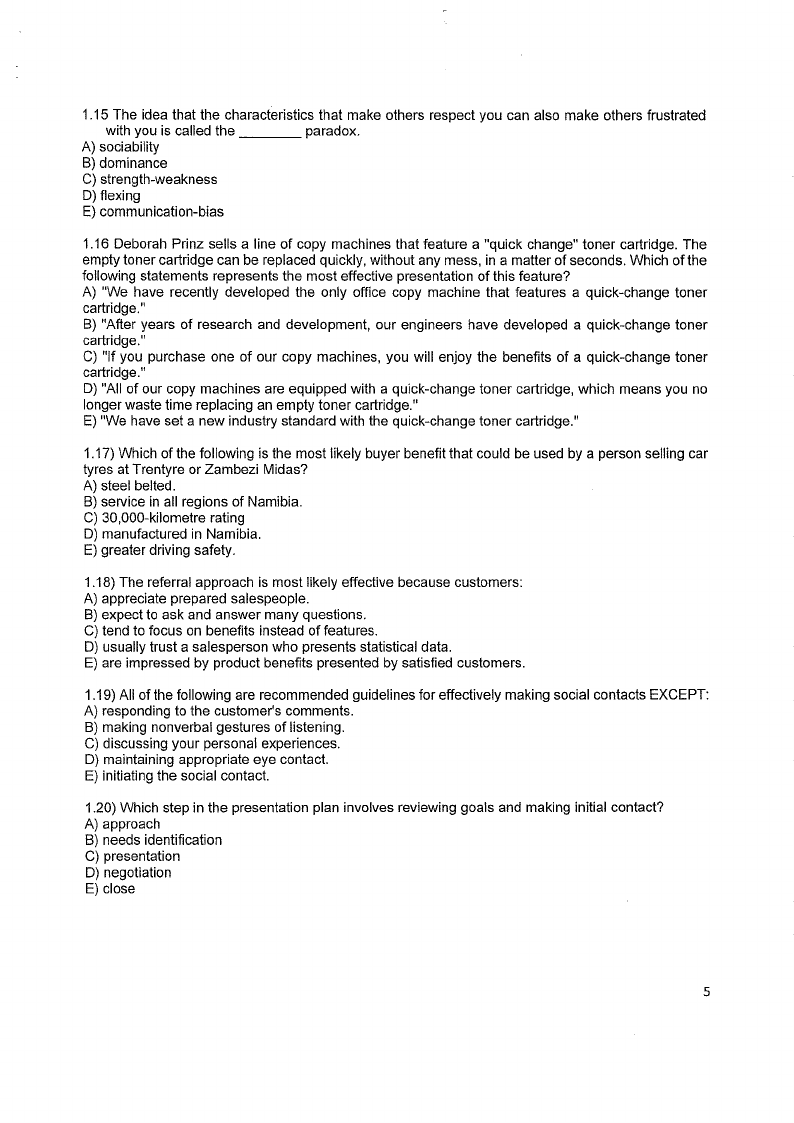
1.15 The idea that the characteristics that make others respect you can also make others frustrated
with you is called the ____
paradox.
A) sociability
B) dominance
C) strength-weakness
D) flexing
E) communication-bias
1.16 Deborah Prinz sells a line of copy machines that feature a "quick change" toner cartridge. The
empty toner cartridge can be replaced quickly, without any mess, in a matter of seconds. Which of the
following statements represents the most effective presentation of this feature?
A) "We have recently developed the only office copy machine that features a quick-change toner
cartridge."
B) "After years of research and development, our engineers have developed a quick-change toner
cartridge."
C) "If you purchase one of our copy machines, you will enjoy the benefits of a quick-change toner
cartridge."
D) "All of our copy machines are equipped with a quick-change toner cartridge, which means you no
longer waste time replacing an empty toner cartridge."
E) "We have set a new industry standard with the quick-change toner cartridge."
1.17) Which of the following is the most likely buyer benefit that could be used by a person selling car
tyres at Trentyre or Zambezi Midas?
A) steel belted.
B) service in all regions of Namibia.
C) 30,000-kilometre rating
D) manufactured in Namibia.
E) greater driving safety.
1.18) The referral approach is most likely effective because customers:
A) appreciate prepared salespeople.
B) expect to ask and answer many questions.
C) tend to focus on benefits instead of features.
D) usually trust a salesperson who presents statistical data.
E) are impressed by product benefits presented by satisfied customers.
1.19) All of the following are recommended guidelines for effectively making social contacts EXCEPT:
A) responding to the customer's comments.
B) making nonverbal gestures of listening.
C) discussing your personal experiences.
D) maintaining appropriate eye contact.
E) initiating the social contact.
1.20) Which step in the presentation plan involves reviewing goals and making initial contact?
A) approach
B) needs identification
C) presentation
D) negotiation
E) close
5

6 Page 6

▲back to top


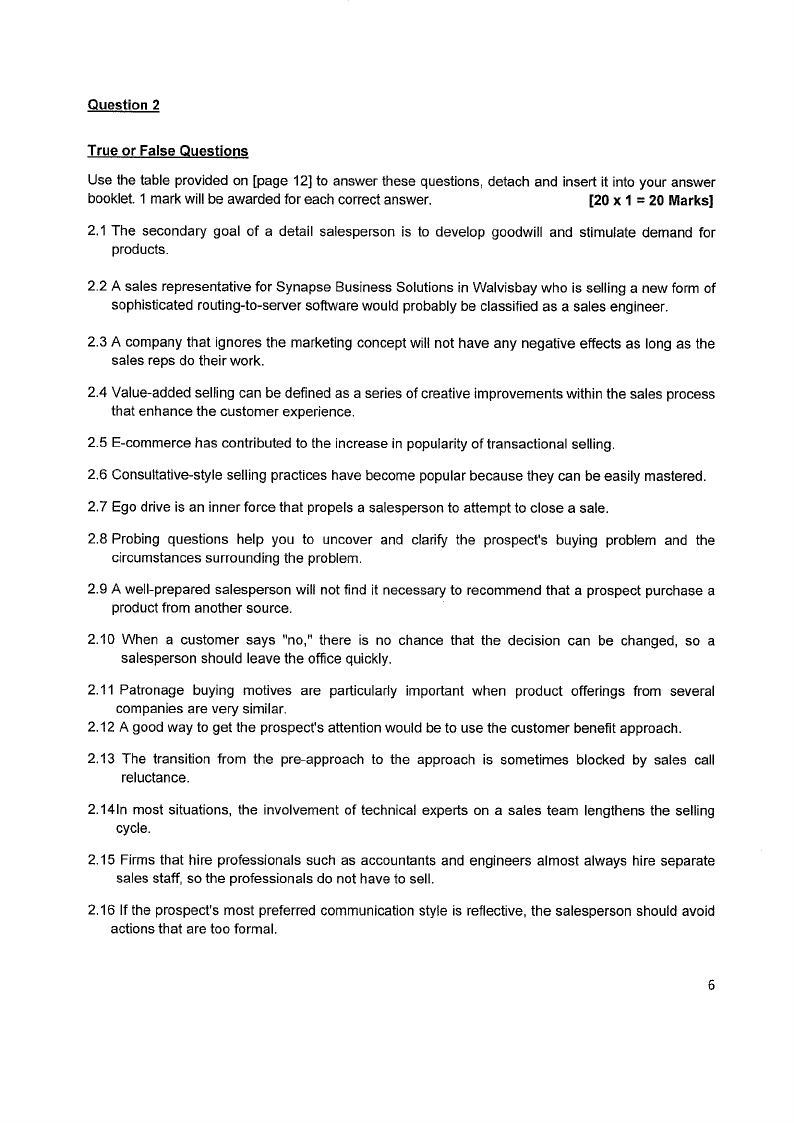
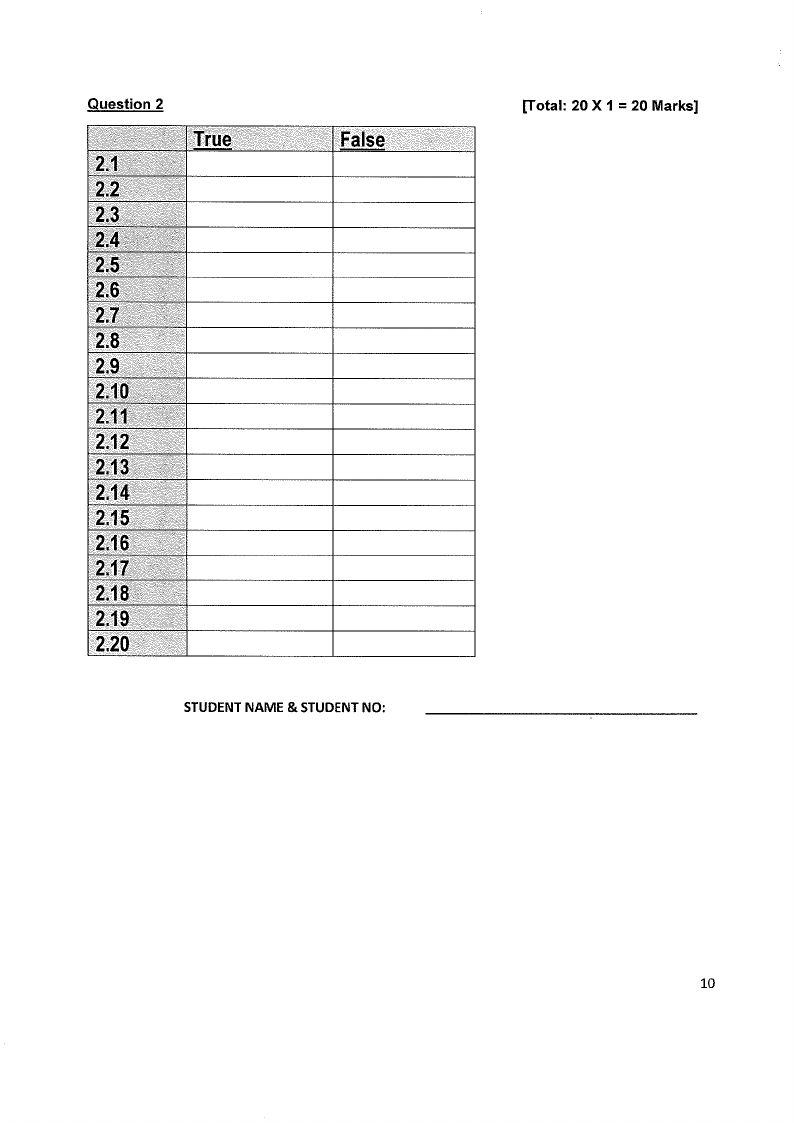
Question 2
True or False Questio11s
Use the table provided on [page 12] to answer these questions, detach and insert it into your answer
booklet. 1 mark will be awarded for each correct answer.
[20 x 1 = 20 Marks]
2.1 The secondary goal of a detail salesperson is to develop goodwill and stimulate demand for
products.
2.2 A sales representative for Synapse Business Solutions in Walvisbay who is selling a new form of
sophisticated routing-to-server software would probably be classified as a sales engineer.
2.3 A company that ignores the marketing concept will not have any negative effects as long as the
sales reps do their work.
2.4 Value-added selling can be defined as a series of creative improvements within the sales process
that enhance the customer experience.
2.5 E-commerce has contributed to the increase in popularity of transactional selling.
2.6 Consultative-style selling practices have become popular because they can be easily mastered.
2.7 Ego drive is an inner force that propels a salesperson to attempt to close a sale.
2.8 Probing questions help you to uncover and clarify the prospect's buying problem and the
circumstances surrounding the problem.
2.9 A well-prepared salesperson will not find it necessary to recommend that a prospect purchase a
product from another source.
2.10 When a customer says "no," there is no chance that the decision can be changed, so a
salesperson should leave the office quickly.
2.11 Patronage buying motives are particularly important when product offerings from several
companies are very similar.
2.12 A good way to get the prospect's attention would be to use the customer benefit approach.
2.13 The transition from the pre-approach to the approach is sometimes blocked by sales call
reluctance.
2.14In most situations, the involvement of technical experts on a sales team lengthens the selling
cycle.
2.15 Firms that hire professionals such as accountants and engineers almost always hire separate
sales staff, so the professionals do not have to sell.
2.16 If the prospect's most preferred communication style is reflective, the salesperson should avoid
actions that are too formal.
6

7 Page 7

▲back to top


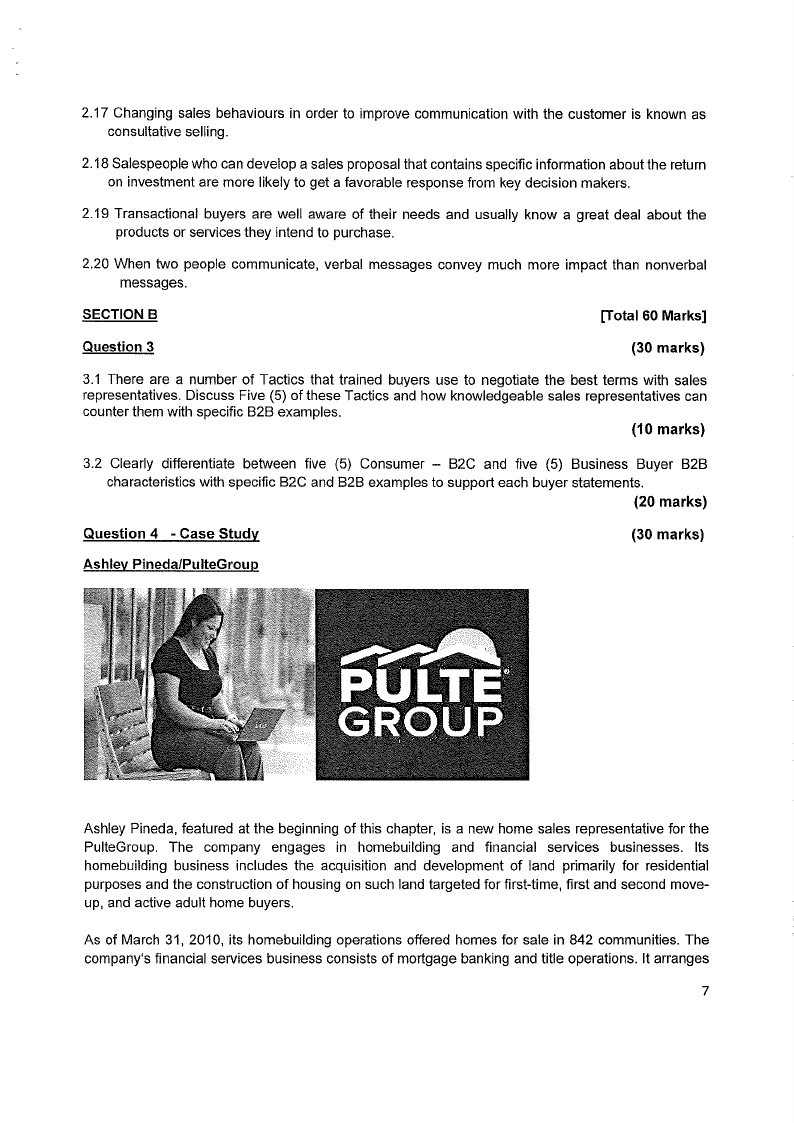
2.17 Changing sales behaviours in order to improve communication with the customer is known as
consultative selling.
2.18 Salespeople who can develop a sales proposal that contains specific information about the return
on investment are more likely to get a favorable response from key decision makers.
2.19 Transactional buyers are well aware of their needs and usually know a great deal about the
products or services they intend to purchase.
2.20 When two people communicate, verbal messages convey much more impact than nonverbal
messages.
SECTION B
Question 3
[Total 60 Marks]
(30 marks)
3.1 There are a number of Tactics that trained buyers use to negotiate the best terms with sales
representatives. Discuss Five (5) of these Tactics and how knowledgeable sales representatives can
counter them with specific B2B examples.
(10 marks)
3.2 Clearly differentiate between five (5) Consumer - B2C and five (5) Business Buyer B2B
characteristics with specific B2C and B2B examples to support each buyer statements.
(20 marks)
Question 4 - Case Study
Ashley Pineda/PulteGroup
(30 marks)
Ashley Pineda, featured at the beginning of this chapter, is a new horne sales representative for the
PulteGroup. The company engages in homebuilding and financial services businesses. Its
homebuilding business includes the acquisition and development of land primarily for residential
purposes and the construction of housing on such land targeted for first-time, first and second move-
up, and active adult home buyers.
As of March 31, 2010, its homebuilding operations offered homes for sale in 842 communities. The
company's financial services business consists of mortgage banking and title operations. It arranges
7

8 Page 8

▲back to top


financing through the origination of mortgage loans for its homebuyers, sells such loans and the related
servicing rights, provides title insurance policies as an agent, and provides examination and closing
services to its home buyers.
PulteGroup offers a one-stop shopping experience for prospective customers. Sales reps help clients
to finance their homes (with Pulte Mortgage) and to close their homes with PGP Title. One of
PulteGroup's key strengths is the ability to provide customers with an exceptional home buying
experience and, ultimately, satisfaction with their homes. Being able to offer everything under one roof
and walk the customers through each step of the entire home-buying process makes their home-
buying experience very comfortable.
Ashley Pineda sells the company's Centex product line, which is primarily geared towards first-time
home buyers by delivering quality homes at an affordable price. Ashley describes a typical selling
process as follows: When a customer walks into the door, she engages with them by welcoming them
and building rapport. The company provides its sales reps with a consultative questioning strategy that
allows the reps to smoothly walk the customer through the buying process.
The questions, for example, may ask the customers about their location preferences or what they
consider most important when they buy a home. Ashley asks these types of questions to help her
guide first-time home buyers through the variety of different homes available, ranging from one- to
two-story homes, from three to five bedrooms, from 1183 to 2600 square feet/metres, and a price
range from $95,000/N$1 000 000 to $150,000/N$2 500 000. Across various options, the customers
are asked how well the different options align with their needs and wants.
The customers are also given the opportunity to touch and feel their future homes. This process
typically involves a car tour through the neighborhood, where they are shown the different homes'
features and colors, and walk-th roughs of both completed homes and homes under construction. The
latter type helps to demonstrate the quality of Pulte's workmanship, the insulation, and the energy
efficiency of a home. Altogether, this allows potential customers to feel comfortable with the
construction of the homes and the home-buying process.
In the next step, Ashley typically talks about financing issues with first-time home-buyers such as the
amounts of their monthly payments and potential down payments. PulteGroup equips Ashley with the
knowledge to be able to professionally provide that information and make customers feel comfortable
with the financial scenario involved in owning their first home. Once the customer is comfortable with
the financial scenario, Ashley and her customer can move forward toward opening the agreement to
buy a home. Generally, when you sign a contract, you are opening the agreement to take the next
steps. These steps include financing, completing construction, and ultimately closing on the home and
moving in. That entire process typically lasts from 45 days to approximately four months.
Questions
1.) Which of the prescriptions of the Strategic/Consultative Selling Model does Ashley Pineda follow?
Discuss any three (3) with examples.
(10 marks)
8

9 Page 9

▲back to top


2.) Outline a typical buying process that a middle-class couple with two young kids goes through in a
first-time home buy. What questions and problems might arise at different stages of the buying
process? Discuss five (5) different possibilities.
(1O marks}
3.) What might be key influencing factors for the couple's home-buying decisions? To what extent are
rational and emotional buying motives important?
(5 marks)
4. Put yourself in the position of Ashley Pineda. How can she create value at different stages of the
young couple's buying process? Give examples.
(5 marks)
Total 100 marks
(END)
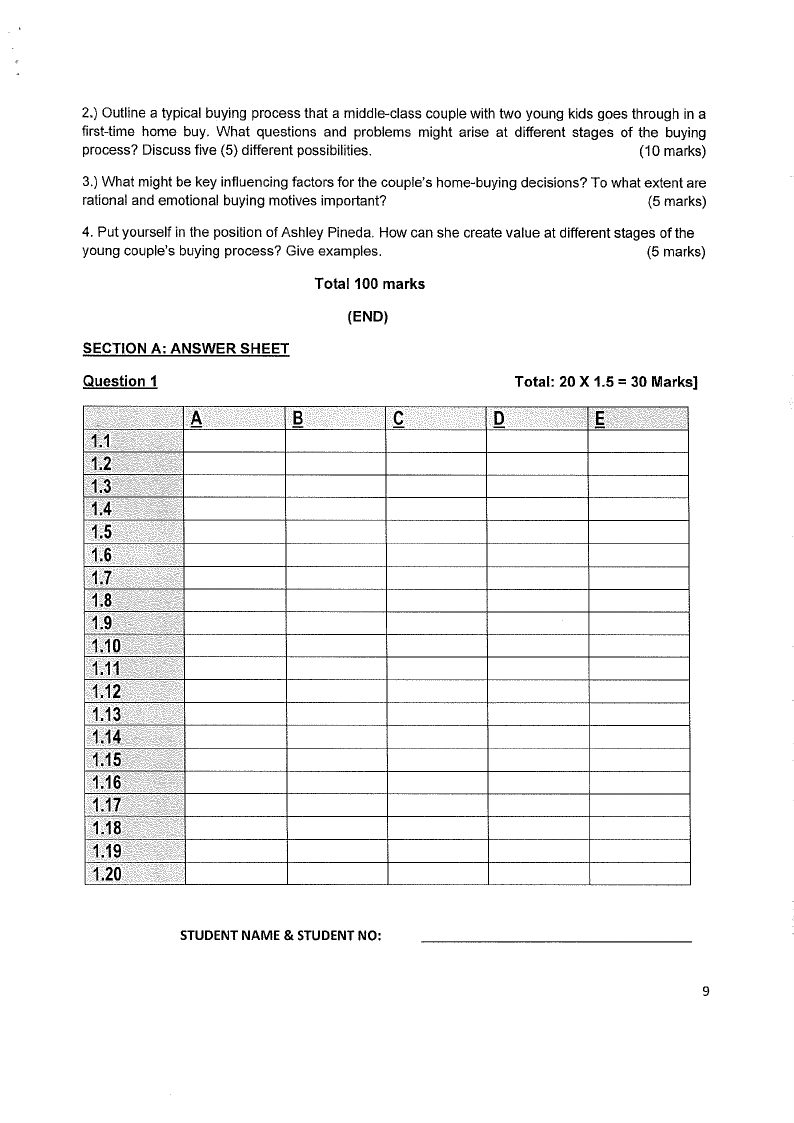
SECTION A: ANSWER SHEET
Question 1
Total: 20 X 1.5 = 30 Marks]
-.-
A
8
C
D
E.
1.1
.
1.2
1.. 3
. ......·... .
-.>-
1.4
1.5
·•··.
1.6
.
1.7
1.8
.
1.9
1.10 . .
1.11 .. .
1.12
1.13
1.14 . ·.
-.-
1.15
1.16 .
1.17
1.18
1.19 .
1.20
STUDENTNAME& STUDENTNO:
9

10 Page 10

▲back to top


QlJestion 2
'True
False
[Total: 20 X 1 = 20 Marks]
2.6\\
2··.7.c·• :-: -. <~;\\',-
2:8 .
2.9
2.10,
2.11',i
2:12
2.13>
2.14'.)
2.15
2.1Gc··
2.17{<
2.18§
2.19
2;20>
STUDENT NAME & STUDENT NO:
10