


 |
LEC812S - LABOUR ECONOMICS - 1ST OPP - NOV 2025 |
|
|
1 Page 1 |
▲back to top |

nAm I BIA unlVERSITY
OF SCIEnCE Ano TECHnOLOGY
FACULTY OF COMMERCE, HUMAN SCIENCES, AND EDUCATION
DEPARTMENT OF GOVERNANCE AND MANAGEMENT SCIENCES
QUALIFICATION: BACHELOR OF EMPLOYMENT AND LABOUR RELATIONS DEGREE
QUALIFICATION CODE: 0SBERLH
LEVEL: 8
COURSE CODE: LEC812S
COURSE NAME: LABOUR ECONOMICS
SESSION: November 2025
DURATION: 3 HOURS
PAPER: THEORY
MARKS: 100
EXAMINER
1st OPPORTUNITY EXAMINATION QUESTION PAPER
Ms Martha Namutuwa
MODERATOR:
Mr. Elias Amunyela
INSTRUCTIONS
1. Answer ALL the questions.
2. Write clearly and neatly.
3. Number the answers clearly.
THIS EXAMINATION QUESTION PAPER CONSISTS OF 5 PAGES INCLUDING THE COVER
PAGE.
|
|
2 Page 2 |
▲back to top |
READ THE QUESTIONS BELOW CAREFULLY AND ANSWER THEM ALL.
SECTION A
40 Marks
1.1 Explain the importance the Namibia's Labour Force Surveys with examples? 10 Marks
1.2 Discuss the why productivity and labour should be considered together?
10 Marks
1.3 Discuss factors that can determine the supply and demand for labour in the Namibian
labour market
10 Marks
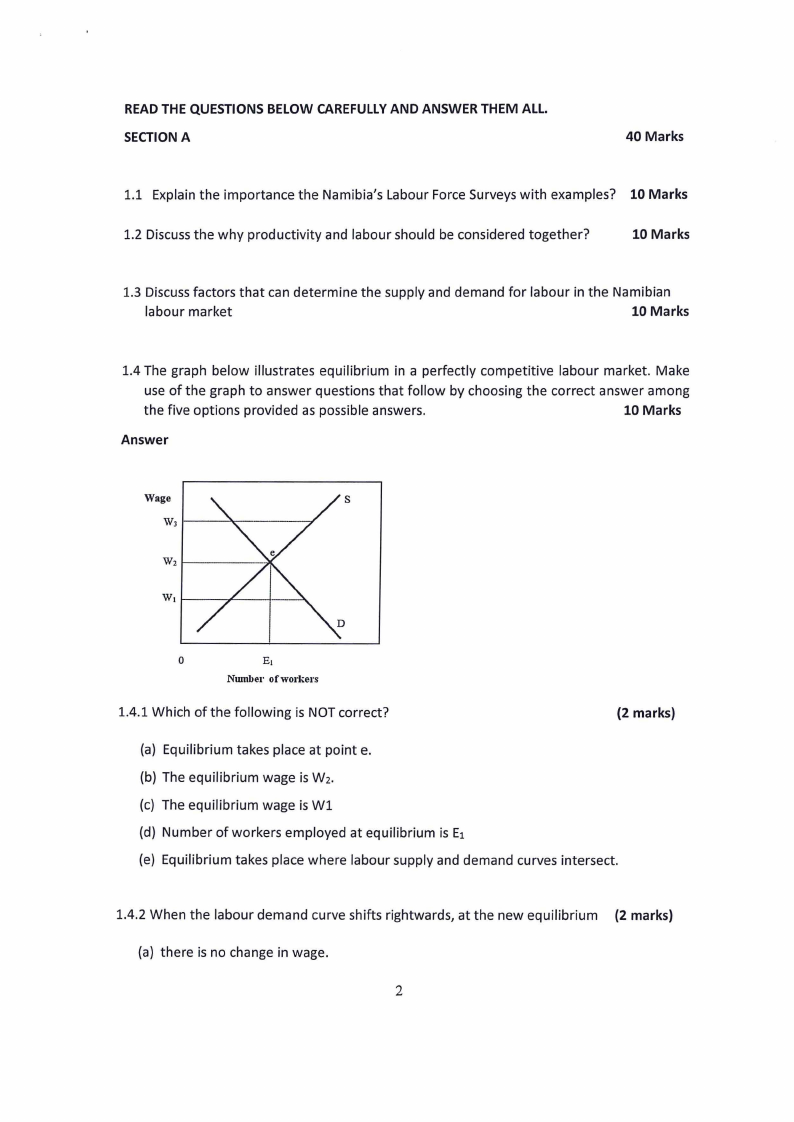
1.4 The graph below illustrates equilibrium in a perfectly competitive labour market. Make
use of the graph to answer questions that follow by choosing the correct answer among
the five options provided as possible answers.
10 Marks
Answer
0
E1
Nwnber ofworkers
1.4.1 Which of the following is NOT correct?
(2 marks)
(a) Equilibrium takes place at point e.
(b) The equilibrium wage is W2.
(c) The equilibrium wage is Wl
(d) Number of workers employed at equilibrium is E1
(e) Equilibrium takes place where labour supply and demand curves intersect.
1.4.2 When the labour demand curve shifts rightwards, at the new equilibrium (2 marks)
(a) there is no change in wage.
2
|
|
3 Page 3 |
▲back to top |
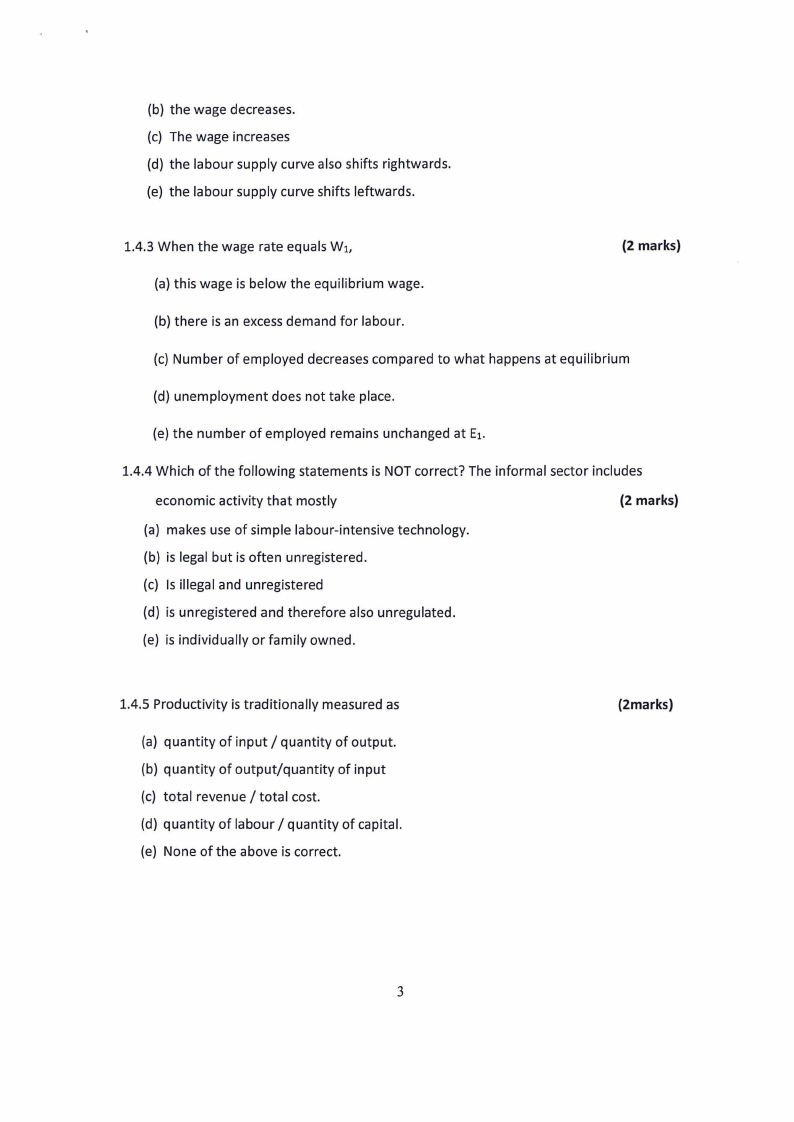
(b) the wage decreases.
(c) The wage increases
(d) the labour supply curve also shifts rightwards.
(e) the labour supply curve shifts leftwards.
1.4.3 When the wage rate equals W1,
(2 marks}
(a) this wage is below the equilibrium wage.
(b) there is an excess demand for labour.
(c) Number of employed decreases compared to what happens at equilibrium
(d) unemployment does not take place.
(e) the number of employed remains unchanged at E1.
1.4.4 Which of the following statements is NOT correct? The informal sector includes
economic activity that mostly
(2 marks}
(a) makes use of simple labour-intensive technology.
(b) is legal but is often unregistered.
(c) Is illegal and unregistered
(d) is unregistered and therefore also unregulated.
(e) is individually or family owned.
1.4.5 Productivity is traditionally measured as
(a) quantity of input/ quantity of output.
(b) quantity of output/quantity of input
(c) total revenue/ total cost.
(d) quantity of labour/ quantity of capital.
(e) None of the above is correct.
(2marks}
3
|
|
4 Page 4 |
▲back to top |
SECTION B
60 Marks
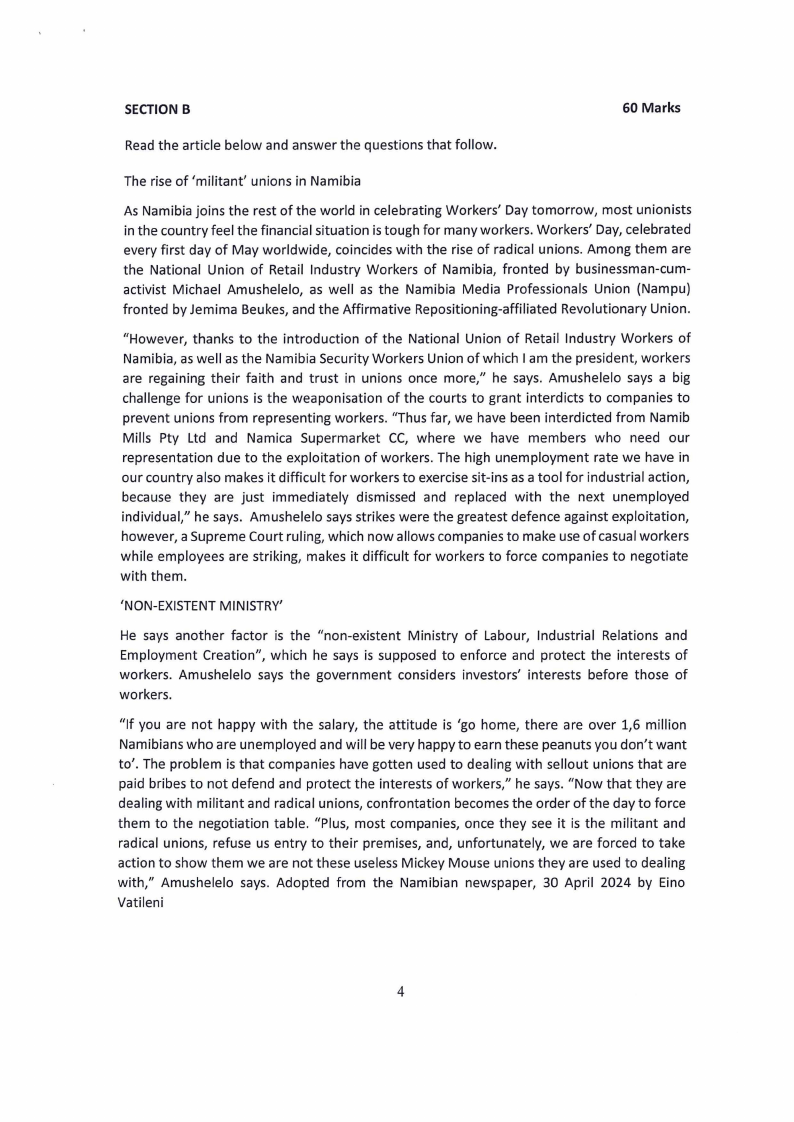
Read the article below and answer the questions that follow.
The rise of 'militant' unions in Namibia
As Namibia joins the rest of the world in celebrating Workers' Day tomorrow, most unionists
in the country feel the financial situation is tough for many workers. Workers' Day, celebrated
every first day of May worldwide, coincides with the rise of radical unions. Among them are
the National Union of Retail Industry Workers of Namibia, fronted by businessman-cum-
activist Michael Amushelelo, as well as the Namibia Media Professionals Union {Nampu)
fronted by Jemima Beukes, and the Affirmative Repositioning-affiliated Revolutionary Union.
"However, thanks to the introduction of the National Union of Retail Industry Workers of
Namibia, as well as the Namibia Security Workers Union of which I am the president, workers
are regaining their faith and trust in unions once more," he says. Amushelelo says a big
challenge for unions is the weaponisation of the courts to grant interdicts to companies to
prevent unions from representing workers. "Thus far, we have been interdicted from Namib
Mills Pty Ltd and Namica Supermarket CC, where we have members who need our
representation due to the exploitation of workers. The high unemployment rate we have in
our country also makes it difficult for workers to exercise sit-ins as a tool for industrial action,
because they are just immediately dismissed and replaced with the next unemployed
individual," he says. Amushelelo says strikes were the greatest defence against exploitation,
however, a Supreme Court ruling, which now allows companies to make use of casual workers
while employees are striking, makes it difficult for workers to force companies to negotiate
with them.
'NON-EXISTENT MINISTRY'
He says another factor is the "non-existent Ministry of Labour, Industrial Relations and
Employment Creation", which he says is supposed to enforce and protect the interests of
workers. Amushelelo says the government considers investors' interests before those of
workers.
"If you are not happy with the salary, the attitude is 'go home, there are over 1,6 million
Namibians who are unemployed and will be very happy to earn these peanuts you don't want
to'. The problem is that companies have gotten used to dealing with sellout unions that are
paid bribes to not defend and protect the interests of workers," he says. "Now that they are
dealing with militant and radical unions, confrontation becomes the order of the day to force
them to the negotiation table. "Plus, most companies, once they see it is the militant and
radical unions, refuse us entry to their premises, and, unfortunately, we are forced to take
action to show them we are not these useless Mickey Mouse unions they are used to dealing
with," Amushelelo says. Adopted from the Namibian newspaper, 30 April 2024 by Eino
Vatileni
4
|
|
5 Page 5 |
▲back to top |
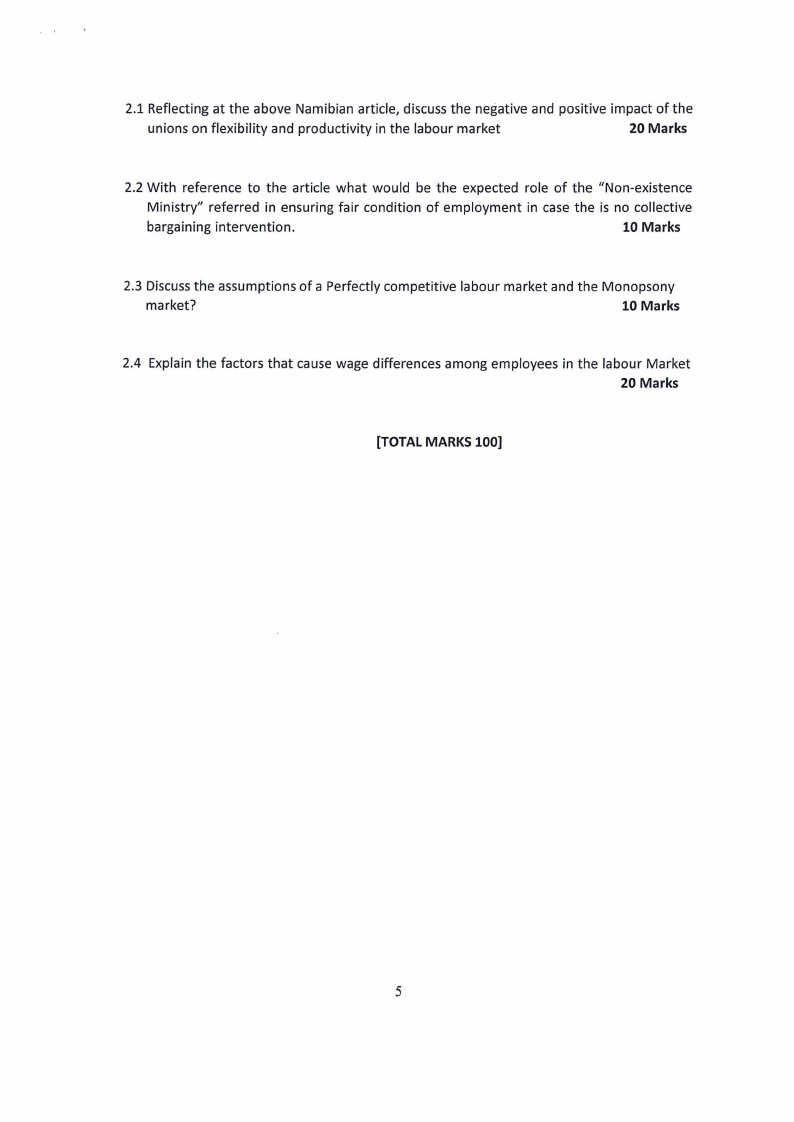
2.1 Reflecting at the above Namibian article, discuss the negative and positive impact of the
unions on flexibility and productivity in the labour market
20 Marks
2.2 With reference to the article what would be the expected role of the "Non-existence
Ministry" referred in ensuring fair condition of employment in case the is no collective
bargaining intervention.
10 Marks
2.3 Discuss the assumptions of a Perfectly competitive labour market and the Monopsony
market?
10 Marks
2.4 Explain the factors that cause wage differences among employees in the labour Market
20 Marks
[TOTAL MARKS 100)
5