


 |
CMD812S - CAREER MANAGEMENT AND DEVELOPMENT - 2ND OPP - NOV 2025 |
|
|
1 Page 1 |
▲back to top |

nAmlBIA unlVERSITY
OF SCIEnCE AnD TECHnOLOGY
FACULTY OF COMMERCE, HUMAN SCIENCES AND EDUCATION
DEPARTMENT OF GOVERNANCE
QUALIFICATION: BACHELOR OF HUMAN RESOURCES MANAGEMENT HONOURS
QUALIFICATION CODE: 08BHRH LEVEL: 8
COURSE CODE: CMD812S
COURSE NAME: CAREER MANAGEMENT AND
DEVELOPMENT
SESSION: DECEMBER 2025
PAPER: THEORY
DURATION: 3 HOURS
MARKS: 100
SECOND OPPORTUNITY EXAMINATION PAPER
EXAMINER{S) Ms. Fiina Shimaneni
Prof Wesley Pieters
MODERATOR:
INSTRUCTIONS
1. Write clearly and neatly.
2. ALL questions are compulsory
THIS PAPER CONSISTS OF 6 PAGES {Including this front page)
1
|
|
2 Page 2 |
▲back to top |
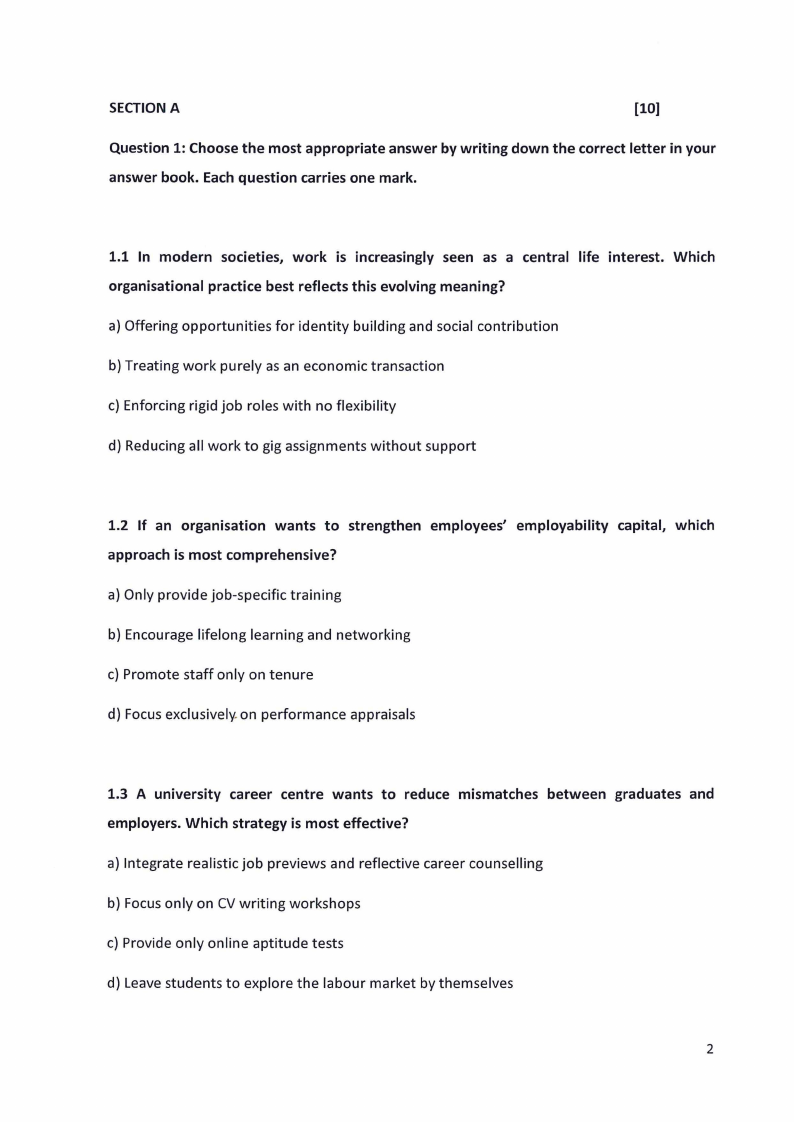
SECTION A
[10)
Question 1: Choose the most appropriate answer by writing down the correct letter in your
answer book. Each question carries one mark.
1.1 In modern societies, work is increasingly seen as a central life interest. Which
organisational practice best reflects this evolving meaning?
a) Offering opportunities for identity building and social contribution
b) Treating work purely as an economic transaction
c) Enforcing rigid job roles with no flexibility
d) Reducing all work to gig assignments without support
1.2 If an organisation wants to strengthen employees' employability capital, which
approach is most comprehensive?
a) Only provide job-specific training
b) Encourage lifelong learning and networking
c) Promote staff only on tenure
d) Focus exclusively-on performance appraisals
1.3 A university career centre wants to reduce mismatches between graduates and
employers. Which strategy is most effective?
a) Integrate realistic job previews and reflective career counselling
b) Focus only on CV writing workshops
c) Provide only online aptitude tests
d) Leave students to explore the labour market by themselves
2
|
|
3 Page 3 |
▲back to top |
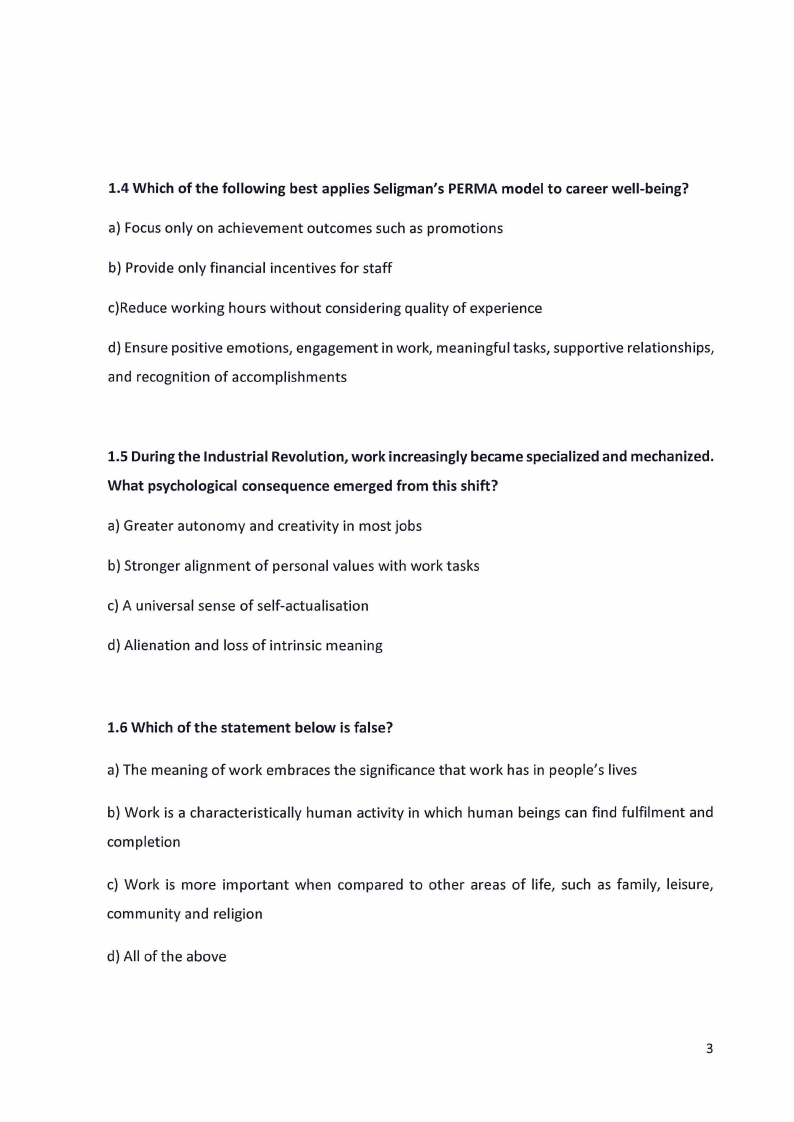
1.4 Which of the following best applies Seligman's PERMA model to career well-being?
a) Focus only on achievement outcomes such as promotions
b) Provide only financial incentives for staff
c)Reduce working hours without considering quality of experience
d) Ensure positive emotions, engagement in work, meaningful tasks, supportive relationships,
and recognition of accomplishments
1.5 During the Industrial Revolution, work increasingly became specialized and mechanized.
What psychological consequence emerged from this shift?
a) Greater autonomy and creativity in most jobs
b) Stronger alignment of personal values with work tasks
c) A universal sense of self-actualisation
d) Alienation and loss of intrinsic meaning
1.6 Which of the statement below is false?
a) The meaning of work embraces the significance that work has in people's lives
b) Work is a characteristically human activity in which human beings can find fulfilment and
completion
c) Work is more important when compared to other areas of life, such as family, leisure,
community and religion
d) All of the above
3
|
|
4 Page 4 |
▲back to top |
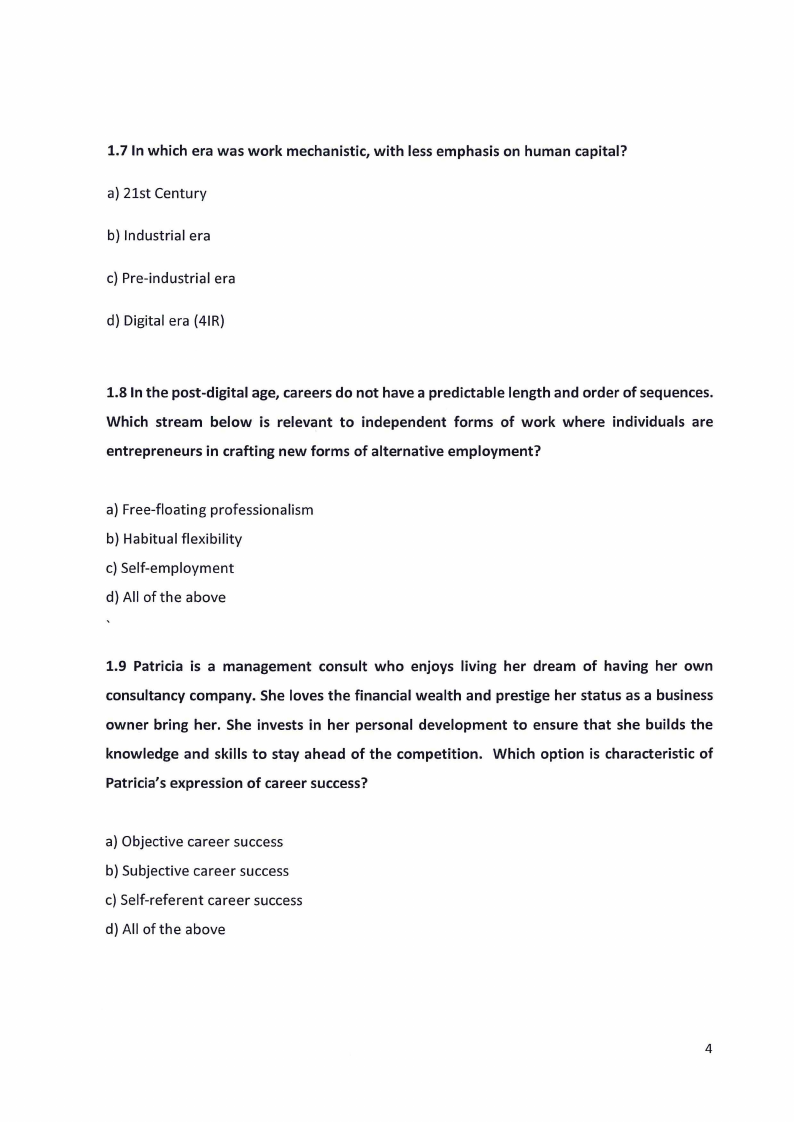
1.7 In which era was work mechanistic, with less emphasis on human capital?
a) 21st Century
b) Industrial era
c) Pre-industrial era
d) Digital era (41R)
1.8 In the post-digital age, careers do not have a predictable length and order of sequences.
Which stream below is relevant to independent forms of work where individuals are
entrepreneurs in crafting new forms of alternative employment?
a) Free-floating professionalism
b) Habitual flexibility
c) Self-employment
d) All of the above
1.9 Patricia is a management consult who enjoys living her dream of having her own
consultancy company. She loves the financial wealth and prestige her status as a business
owner bring her. She invests in her personal development to ensure that she builds the
knowledge and skills to stay ahead of the competition. Which option is characteristic of
Patricia's expression of career success?
a) Objective career success
b) Subjective career success
c) Self-referent career success
d) All of the above
4
|
|
5 Page 5 |
▲back to top |
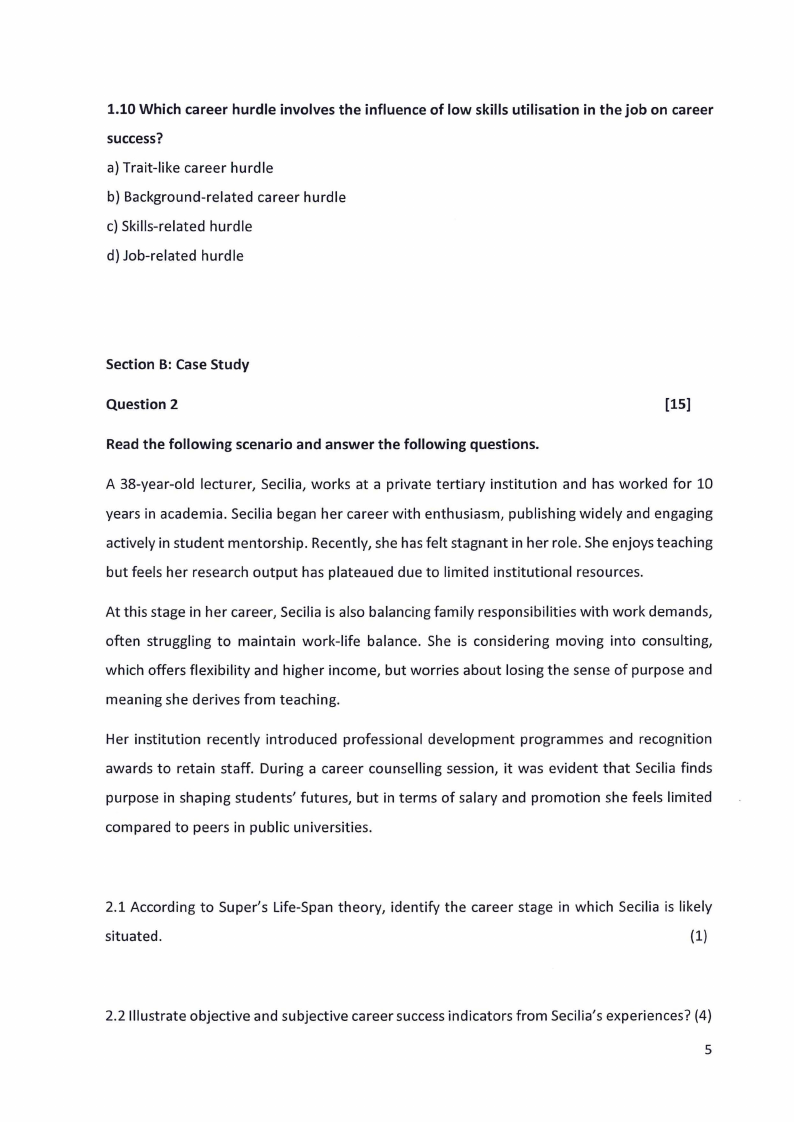
1.10 Which career hurdle involves the influence of low skills utilisation in the job on career
success?
a) Trait-like career hurdle
b) Background-related career hurdle
c) Skills-related hurdle
d) Job-related hurdle
Section B: Case Study
Question 2
[15]
Read the following scenario and answer the following questions.
A 38-year-old lecturer, Secilia, works at a private tertiary institution and has worked for 10
years in academia. Secilia began her career with enthusiasm, publishing widely and engaging
actively in student mentorship. Recently, she has felt stagnant in her role. She enjoys teaching
but feels her research output has plateaued due to limited institutional resources.
At this stage in her career, Secilia is also balancing family responsibilities with work demands,
often struggling to maintain work-life balance. She is considering moving into consulting,
which offers flexibility and higher income, but worries about losing the sense of purpose and
meaning she derives from teaching.
Her institution recently introduced professional development programmes and recognition
awards to retain staff. During a career counselling session, it was evident that Secilia finds
purpose in shaping students' futures, but in terms of salary and promotion she feels limited
compared to peers in public universities.
2.1 According to Super's Life-Span theory, identify the career stage in which Secilia is likely
situated.
(1)
2.2 Illustrate objective and subjective career success indicators from Secilia's experiences? (4)
5
|
|
6 Page 6 |
▲back to top |
2.3 Using PERMA career well-being approach, which aspects of career well-being are strong,
and which are weak for Secilia?
(4)
2.4 As a career counsellor, what advice would you give Secilia to sustain her career well-being?
{6)
Section C: Structured questions
[75)
Question 3
3.1 When describing the post-digital workplace compared to the other meanings of work,
what characteristics stand out more?
{15)
3.2 Name and discuss Super's career developmental life stages
{20)
3.3 Name and discuss the various services that a career counsellor can make use of when
using the Diagnostic framework.
{20)
3.4 Name and briefly discuss organisational interventions that may be used to promote well-
being and flourishing at work.
{20)
End of examination paper!
6