


 |
FLM511C-FUNDAMENTALS OF LOGISTICS MANAGEMENT-1ST OPP-NOV 2025 |
|
|
1 Page 1 |
▲back to top |
n Am I BI A u n IVER s I TY
OF SCIEnCE Ano TECHnOLOGY
FACULTY OF COMMERCE, HUMAN SCIENCES AND EDUCATION
HAROLD PUPKEWITZ GRADUATE SCHOOL OF BUSINESS
QUALIFICATION: DIPLOMA IN BUSINESS PROCESS MANAGEMENT
QUALIFICATION CODE: 06DBPM
LEVEL: 7
COURSE CODE: FLM511C
COURSE NAME: FUNDAMENTALS OF
LOGISTICS MANAGEMENT
SESSION: OCTOBER 2025/ NOVEMBER PAPER: THEORY (PAPER 1)
2025
DURATION: 3 HOURS
MARKS: 100
FIRST OPPORTUNITY EXAMINATION QUESTION PAPER
EXAMINER(S) DR. GLORIA TSHOOPARA
MODERATOR: MS. HILMA NUUYANDJA
INSTRUCTIONS
1. Answer ALL the questions .
2. Read all the questions carefully before answering.
3. Number the answers clearly
THIS QUESTION PAPER CONSISTS OF _5_ PAGES (Including this front page)
|
|
2 Page 2 |
▲back to top |
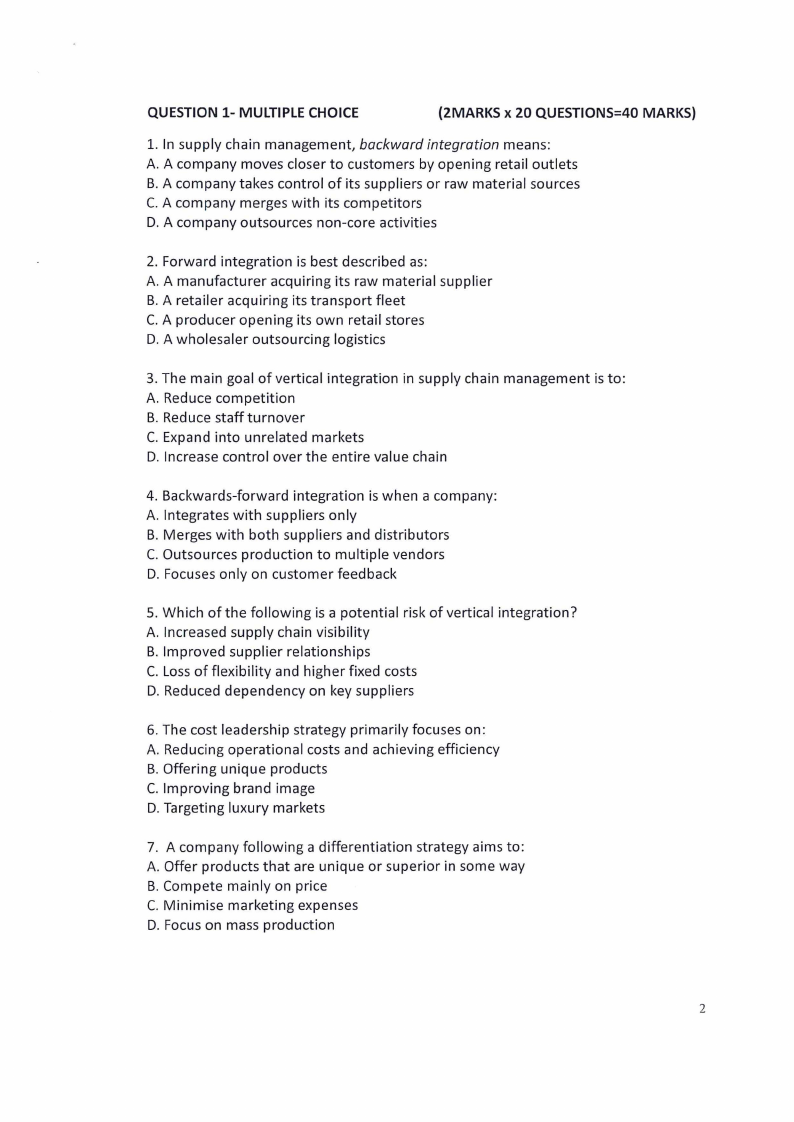
QUESTION 1- MULTIPLE CHOICE
(2MARKS x 20 QUESTIONS=40 MARKS)
1. In supply chain management, backward integration means:
A. A company moves closer to customers by opening retail outlets
B. A company takes control of its suppliers or raw material sources
C. A company merges with its competitors
D. A company outsources non-core activities
2. Forward integration is best described as:
A. A manufacturer acquiring its raw material supplier
B. A retailer acquiring its transport fleet
C. A producer opening its own retail stores
D. A wholesaler outsourcing logistics
3. The main goal of vertical integration in supply chain management is to:
A. Reduce competition
B. Reduce staff turnover
C. Expand into unrelated markets
D. Increase control over the entire value chain
4. Backwards-forward integration is when a company:
A. Integrates with suppliers only
B. Merges with both suppliers and distributors
C. Outsources production to multiple vendors
D. Focuses only on customer feedback
5. Which of the following is a potential risk of vertical integration?
A. Increased supply chain visibility
B. Improved supplier relationships
C. Loss of flexibility and higher fixed costs
D. Reduced dependency on key suppliers
6. The cost leadership strategy primarily focuses on:
A. Reducing operational costs and achieving efficiency
B. Offering unique products
C. Improving brand image
D. Targeting luxury markets
7. A company following a differentiation strategy aims to :
A. Offer products that are unique or superior in some way
B. Compete mainly on price
C. Minimise marketing expenses
D. Focus on mass production
2
|
|
3 Page 3 |
▲back to top |
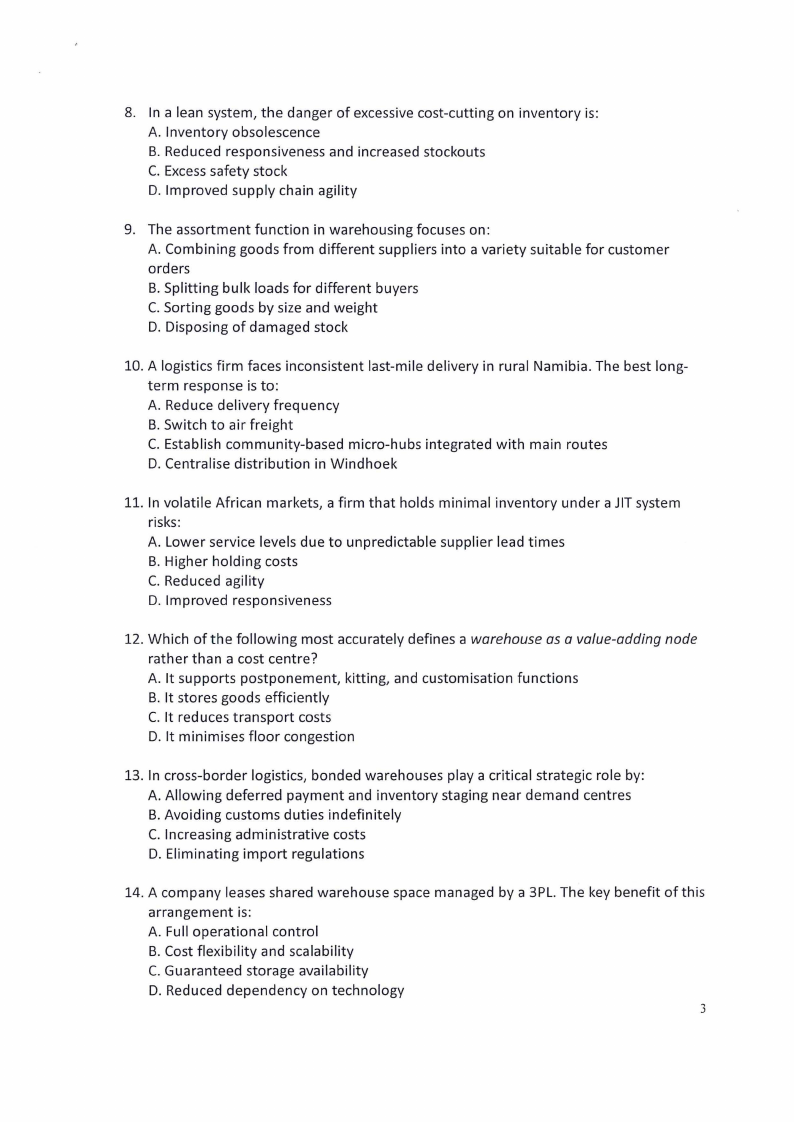
8. In a lean system, the danger of excessive cost-cutting on inventory is :
A. Inventory obsolescence
B. Reduced responsiveness and increased stockouts
C. Excess safety stock
D. Improved supply chain agility
9. The assortment function in warehousing focuses on:
A. Combining goods from different suppliers into a variety suitable for customer
orders
B. Splitting bulk loads for different buyers
C. Sorting goods by size and weight
D. Disposing of damaged stock
10. A logistics firm faces inconsistent last-mile delivery in rural Namibia . The best long-
term response is to:
A. Reduce delivery frequency
B. Switch to air freight
C. Establish community-based micro-hubs integrated with main routes
D. Centralise distribution in Windhoek
11. In volatile African markets, a firm that holds minimal inventory under a JIT system
risks:
A. Lower service levels due to unpredictable supplier lead times
B. Higher holding costs
C. Reduced agility
D. Improved responsiveness
12. Which of the following most accurately defines a warehouse as a value-adding node
rather than a cost centre?
A. It supports postponement, kitting, and customisation functions
B. It stores goods efficiently
C. It reduces transport costs
D. It minimises floor congestion
13. In cross-border logistics, bonded warehouses play a critical strategic role by:
A. Allowing deferred payment and inventory staging near demand centres
B. Avoiding customs duties indefinitely
C. Increasing administrative costs
D. Eliminating import regulations
14. A company leases shared warehouse space managed by a 3PL. The key benefit of this
arrangement is:
A. Full operational control
B. Cost flexibility and scalability
C. Guaranteed storage availability
D. Reduced dependency on technology
3
|
|
4 Page 4 |
▲back to top |
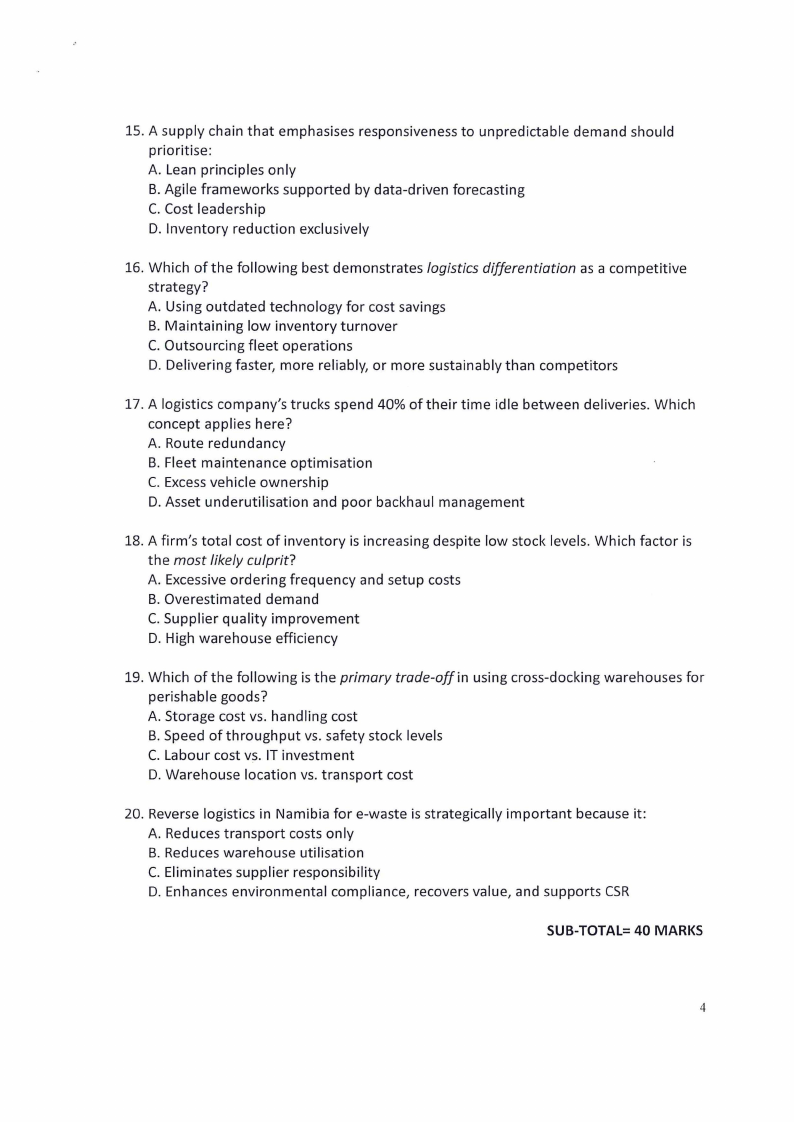
15. A supply chain that emphasises responsiveness to unpredictable demand should
prioritise:
A. Lean principles only
B. Agile frameworks supported by data-driven forecasting
C. Cost leadership
D. Inventory reduction exclusively
16. Which of the following best demonstrates logistics differentiation as a competitive
strategy?
A. Using outdated technology for cost savings
B. Maintaining low inventory turnover
C. Outsourcing fleet operations
D. Delivering faster, more reliably, or more sustainably than competitors
17. A logistics company's trucks spend 40% of their time idle between deliveries. Which
concept applies here?
A. Route redundancy
B. Fleet maintenance optimisation
C. Excess vehicle ownership
D. Asset underutilisation and poor backhaul management
18. A firm's total cost of inventory is increasing despite low stock levels. Which factor is
the most likely culprit?
A. Excessive ordering frequency and setup costs
B. Overestimated demand
C. Supplier quality improvement
D. High warehouse efficiency
19. Which of the following is the primary trade-off in using cross-docking warehouses for
perishable goods?
A. Storage cost vs. handling cost
B. Speed of throughput vs. safety stock levels
C. Labour cost vs. IT investment
D. Warehouse location vs. transport cost
20. Reverse logistics in Namibia fore-waste is strategically important because it:
A. Reduces transport costs only
B. Reduces warehouse utilisation
C. Eliminates supplier responsibility
D. Enhances environmental compliance, recovers value, and supports CSR
SUB-TOTAL= 40 MARKS
4
|
|
5 Page 5 |
▲back to top |
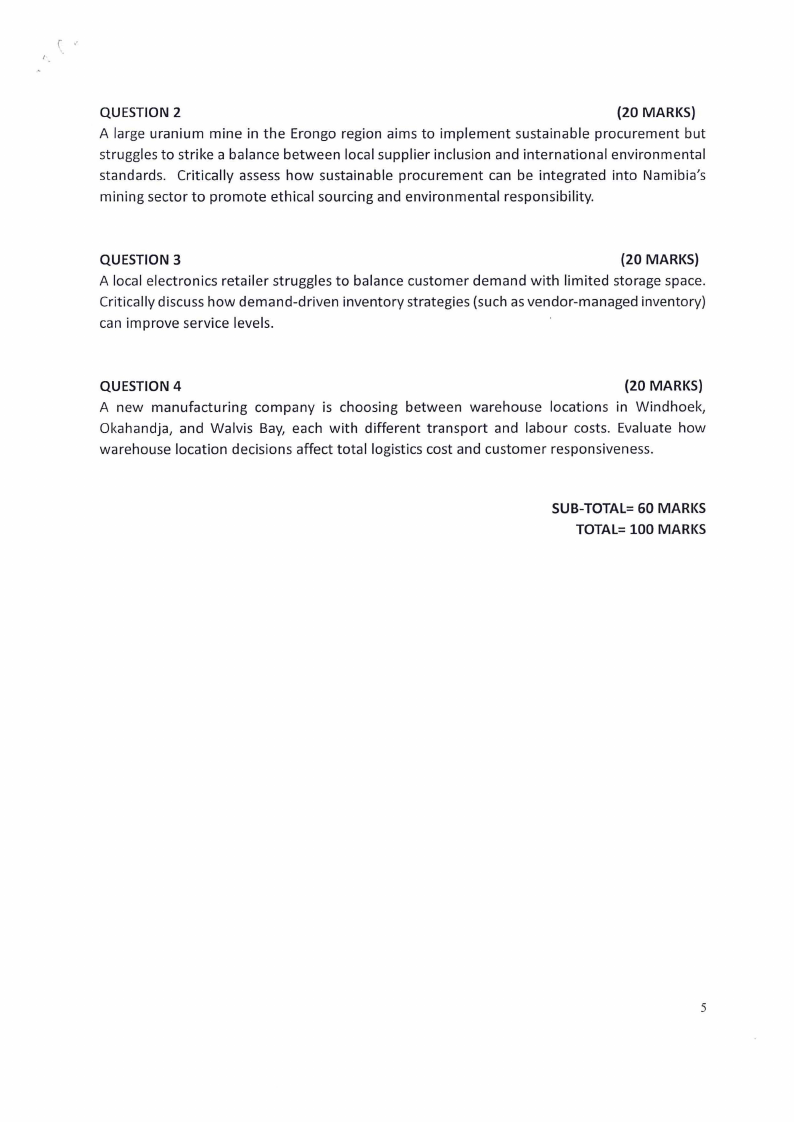
QUESTION 2
(20 MARKS)
A large uranium mine in the Erongo region aims to implement sustainable procurement but
struggles to strike a balance between local supplier inclusion and international environmental
standards. Critically assess how sustainable procurement can be integrated into Namibia's
mining sector to promote ethical sourcing and environmental responsibility.
QUESTION 3
(20 MARKS)
A local electronics retailer struggles to balance customer demand with limited storage space.
Critically discuss how demand-driven inventory strategies (such as vendor-managed inventory)
can improve service levels.
QUESTION 4
(20 MARKS)
A new manufacturing company is choosing between warehouse locations in Windhoek,
Okahandja, and Walvis Bay, each with different transport and labour costs . Evaluate how
warehouse location decisions affect total logistics cost and customer responsiveness .
SUB-TOTAL= 60 MARKS
TOTAL= 100 MARKS
5