


 |
PCO611S - PROFESSIONAL COMMUNICATION - 1ST OPP - JUNE 2025 |
|
|
1 Page 1 |
▲back to top |
n Am I BI A u n IVER s I TY
OF SCIEn CE Ano TECHn OLOGY
FACULTY OF COMMERCE, HUMAN SCIENCES AND EDUCATION
DEPARTMENT OF COMMUNICATION AND LANGUAGES
QUALIFICATION: VARIOUS
QUALIFICATION CODE: VARIOUS
COURSE CODE: PCO611S
DATE: JUNE 2025
DURATION: 3 HOURS
LEVEL: 6
COURSE NAME: PROFESSIONALCOMMUNICATION
PAPER: THEORY
MARKS: 100
EXAMINERS:
FIRST OPPORTUNITY EXAMINATION QUESTION PAPER
Dr. C. Sibalatani
MODERATOR: Ms J. Mungenga
1. Answer ALL the questions.
2. Write clearly and neatly.
3. Number the answers clearly.
INSTRUCTIONS
PERMISSIBLE MATERIALS
1. Examination paper
2. Examination script
THIS QUESTION PAPER CONSISTS OF 7 PAGES (INCLUDING THIS FRONT PAGE)
1
|
|
2 Page 2 |
▲back to top |
Question 1
[15]
1.1 Lasswell'scommunication model has 5 questions; name them:
(5)
1.2 Read the passage below; find and provide the answers to the questions you gave for
question 1.
(10}
Following the highly anticipated parliamentary announcement of the newly appointed
members, the prime minister announced a new economic stimulus package to boost job and
economic recovery. This announcement received echoes of cheers from the members of the
parliament. This reaction must have been the same for the citizens who watched the
proceedings via their televisions and those who were listening to the radio, especially the
unemployed youths of the nation. The prime minister closed by informing the public about
the debate among MPs, media coverage, and potential public support or opposition and
promised that a lot of jobs would be advertised in the following weeks.
Question 2
[20]
2.1 Read the passage below and provide an example of each of the types of communication
that follow:
(14}
In a meeting where a number of investors gathered, Mr. Musk, a CEO of an investment firm,
delivered a public statement about an upcoming IPO through a televised press conference. He
said that his company is excited to announce its initial public offering, opening new investment
opportunities. He further highlighted that the strategic move would fuel innovation and long-
term growth. In his presentation, Mr. Musk used Al-driven software to analyze market trends
and make data-driven investment decisions. He instructed Al to analyze the stock
performance of renewable energy companies in the last five years. Al responded that the
average growth rate was 15%, with Company X leading the sector.
On the other hand, the other business investor contemplated whether to invest in
cryptocurrency. "Is this the right time to invest in Bitcoin? The market is volatile, but the long-
term potential is huge. Maybe I should diversify first." Another senior investor suggested
meeting with a startup founder to discuss potential funding of his business. He stated that the
business model of the founder was innovative, but he preferred to see a stronger revenue
projection before making a decision. Of which the founder replied that they projected a 200%
growth in the next two years. He concluded by offering to share detailed financials with the
senior investor.
The senior investor subtly nodded and smiled while signaling approval of the offer. A group of
upcoming investors stood close to a startup founder, showing interest while maintaining a
professional distance. Other investors remained silent after hearing a startup's valuation,
2
|
|
3 Page 3 |
▲back to top |
creating tension that forces the founder to justify their numbers. The investors shook hands
firmly with a startup founder after finalizing a deal.
• Interpersonal communication
o Visual Semiology-Kinesics
(2)
o Visual semiology-proxemics
(2)
o Acoustic Semiology-Silence
(2)
o Tacesics
(2)
• Mass Communication
(2)
• Extra-personal communication
(2)
• lntrapersonal communication
(2)
2.2 The art of listening is one of the businessperson's most important communication skills
and is crucial for successful and effective business communication. Give the purpose of the
following types of listening:
(6)
2.1.1. Information listening
2.1.2. Critical listening
2.1.3. Empathic listening
Question 3
[Sx2=10]
Match the following intercultural contexts of intercultural communication to the correct
scenarios. Just write the letter next to the context, e.g., 3.1. Cultural Context= G.
3.1. Environmental Context
3.2. Cultural Context
3.3. Microcultural Context
3.4. Sociorelational Context
3.5. Perceptual Context
A. The minister of health (from Zambezi Region) holds a formal leadership role but prefers
a consensus-driven approach. The minister of agriculture (from the Oshikoto Region),
who is used to flat hierarchies, speaks candidly with the manager, while the minister of
education (from Hardap Region) tends to defer more to authority, reflecting both
professional hierarchy and cultural norms.
B. The Zulu manager emphasizes group harmony and indirect communication, which aligns
with South Africa's high-context culture. In contrast, the Australian developer values
directness and individual contributions, consistent with a low-context culture like that of
Australia.
3
|
|
4 Page 4 |
▲back to top |
C. The American intern perceives silence as a sign of respect and careful thought, while the
Angolan developer interprets silence as uncertainty or a lack of opinion. As a result,
these differing perceptions lead to misunderstanding in feedback sessions.
D. The Namibian marketing specialist is part of the younger urban Namibian demographic
that blends traditional values with global digital culture. Though part of a collectivist
society, he tends to adopt more individualistic tones in digital communication,
influenced by the global tech environment.
E. The American developers in India do not see the reason why they should not work on
their project during the week of Ramadan. On the other hand, their Indian coworkers
regard the week of Ramadan as a holiday, which the Japanese manager may interpret as
disengagement.
Question 4
[20]
4.1 Name the type of meeting for the following scenarios.
(Sx2=10)
4.1.1. The secretary sent out an email to all the staff members inviting them to the meeting
to deliberate how to allocate the department's quarterly budget among key initiatives.
4.1.2. The team leader invites his team, including product designers and brand strategists, for
an urgent meeting to generate ideas for branding a new product line.
4.1.3. At the beginning of the year, HR representatives and department heads met to inform
employees about updates to the company's remote work policy.
4.1.4. The dean called a meeting on Teams to sync up remote team members at the Eehnana
and Rietfontein campuses on weekly priorities.
4.1.5. The whole marketing department had a social retreat to encourage and energize the
sales team at the start of a new quarter.
4.2 Explain the meaning of the following meeting terminologies.
4.2.1. Ad hoc
4.2.2. Articles of association
4.2.3. Consensus
4.2.4. Other business
4.2.5. Proxy
(5x2=10)
4
|
|
5 Page 5 |
▲back to top |
Question 5
[15]
5.1. When conflict happens, it can be treated as a series of events occurring in stages. Name
and explain the five stages of conflict
(5x2=10}
5.1.1 Latent conflict
5.1.2 Perceived conflict
5.1.3 During the "Felt Stage"
5.1.4 "Manifest Stage,"
5.1.5 Conflict aftermath
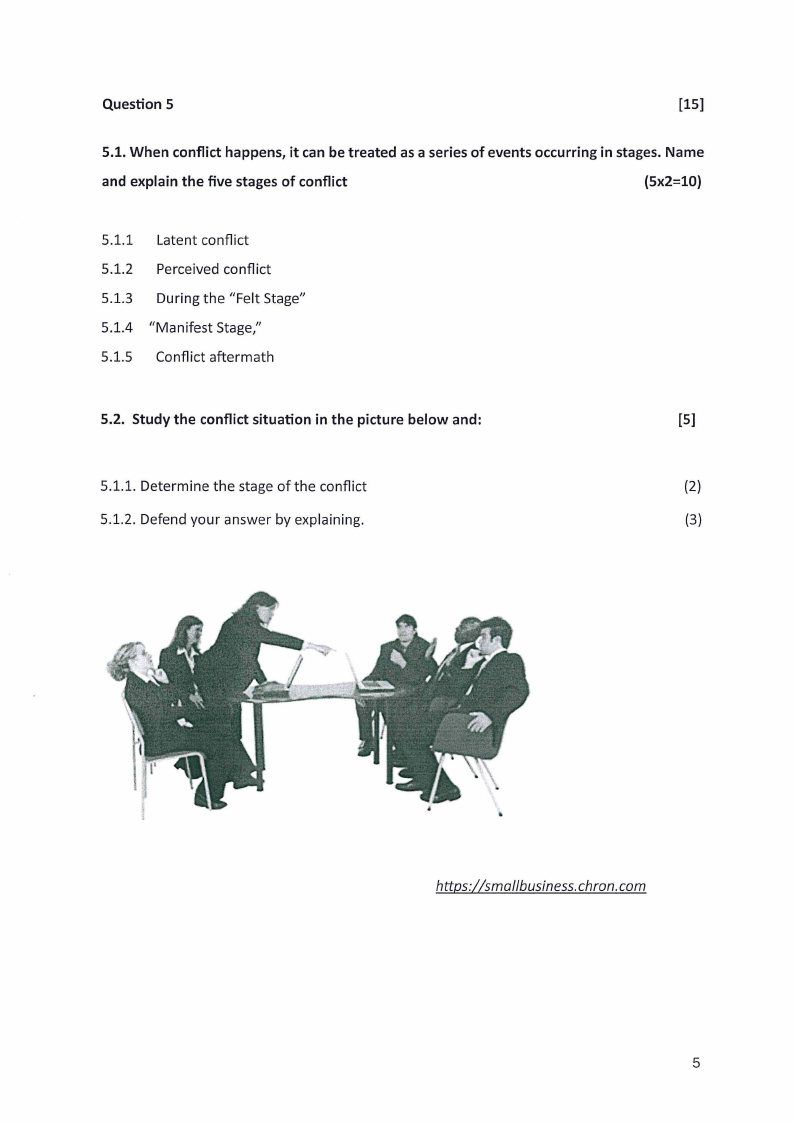
5.2. Study the conflict situation in the picture below and:
[5]
5.1.1. Determine the stage of the conflict
(2)
5.1.2. Defend your answer by explaining.
(3)
https:1/smal/business. chron. com
5
|
|
6 Page 6 |
▲back to top |
Question 6
[10]
Read the passage beloaw and answer the quesrtions that follow:
A cross-functional team at a mid-sized tech company has been formed to launch a new digital
platform within three months. The team includes members from marketing, product
development, design, and customer success. As the launch deadline approaches, the design
team is delayed, waiting on final product specs from the product development team.
Meanwhile, marketing cannot finalize its campaign assets without the finished designs. (A)
Team members grow frustrated, blaming each other for slow progress. Marketing argues they
can't move forward unless designs are delivered on time. Design defends itself, saying they
can't design features that aren't clearly defined yet. The project has two co-leads: Alicia, a
collaborative leader who prefers consensus-building, and Mark, a directive leader who
emphasizes speed and control. As a result, (B) Alicia wants more team input before decisions
are made, while Mark often makes quick calls without consultation. The team includes
members from varied cultural backgrounds. During meetings, Liu from the design team tends
to be reserved and avoids interrupting others, while Jake from marketing is more assertive
and frequently dominates discussions.(() Liu feels her ideas are overlooked, and Jake
perceives her as disengaged or lacking initiative. On the other hand, two team members, Priya
and Daniel, often clash over tone and attitude. Priya is detail-oriented and cautious,
constantly flagging risks. Daniel is optimistic and tends to brush off concerns as "negative
thinking." (D)Daniel accuses Priya of slowing down momentum, while Priya accuses Daniel of
ignoring red flags. While Emma from product prefers a fast-paced, agile approach with
minimal documentation, focusing on iteration, onn the other hand, Raj from customer
success prefers a structured, documentation-heavy style to ensure nothing is missed during
implementation and client onboarding. Consenquncially, (E) Emma sees Raj's approach as
bureaucratic and slow, while Raj feels Emma is being reckless and skipping crucial details.
There are different types of conflict that may arise in a professional work environment. Based
on the passage above, identify the examples of each of the type of conflict given below. Just
write the letter next to the question. For example: Excellent leadership style - C
6
|
|
7 Page 7 |
▲back to top |
Question 7
[10]
Good language usage is commended in professional work environments. Read the
paragraph very attentively; then, rewrite the paragraph, identifying and correcting 10
subject-verb agreement errors. Underline the corrections.
In today's highly competitive market, it is essential for businesses to adopt to rapidly changing
trends in order to remain relevant. Many companies, however, fails to understand the
importance of innovation and relies on outdated strategies that no longer produce effective
results. Moreover, poor communication between departments often lead to confusion and
delays, especially when it involve cross-functional teams. Managers must ensure that
employees are helded accountable for their performance, while also providing them with the
tools and support they needs to succeed. Furthermore, the company should of developed a
more agile response system to address client concerns in a timely manner. Failing to do so
could results in a loss of trust and customer loyalty. Lastly, regular training sessions and
feedback loops was not prioritized, which have limited opportunities for professional growth
among staff members.
END OF QUESTIONPAPER
7