


 |
PCO611S - PROFESSIONAL COMMUNICATION - 2ND OPP - JULY 2025 |
|
|
1 Page 1 |
▲back to top |
n Am I BI A u n IVER s ITY
OF SCIEnCE Ano TECHnOLOGY
FACULTY OF COMMERCE, HUMAN SCIENCES AND EDUCATION
DEPARTMENT OF COMMUNICATION AND LANGUAGES
QUALIFICATION: VARIOUS
QUALIFICATION CODE: VARIOUS
COURSE CODE: PCO611S
DATE: JULY 2025
DURATION: 3 HOURS
LEVEL: 6
COURSE NAME: PROFESSIONAL COMMUNICATION
PAPER: THEORY
MARKS: 100
SECOND OPPORTUNITY/ SUPPLEMENTARY EXAMINATION QUESTION PAPER
EXAMINERS:
Dr. C. Sibalatani
MODERATOR: Ms J. Mungenga
1. Answer ALL the questions.
2. Write clearly and neatly.
3. Number the answers clearly.
INSTRUCTIONS
PERMISSIBLE MATERIALS
1. Examination paper
2. Examination script
THIS QUESTION PAPER CONSISTS OF 6 PAGES {INCLUDING THIS FRONT PAGE)
1
|
|
2 Page 2 |
▲back to top |
Question 1
[15]
1.1. The Lasswell's communication model has 5 questions. Name them.
(5)
1.2. Read the passage below; find and provide the answers to the questions you gave for
question 1.
(10}
During the press conference held by the members of the parliament, the leader of the
opposition party criticized the government's handling of healthcare funding and proposed an
alternative plan. This followed the healthcare professionals and the general public's
complaints on how the health funding was handled. The opposition leader's criticism caused
an immediate increase in public scrutiny of the government and media analysis and also put
potential political pressure on the ruling party.
Question 2
[18]
2.1 Read the passage below and indicate what type of communication the underlined
communications are (your answers must adopt the numbering given in the passage) (14}
A minister delivers {1} a televised speech on a new national policy in Parliament. He stated
that the government is committed to improving healthcare access. "This bill will allocate $5
billion to modernize public hospitals across the country." (2) Another MP debates internally
whether to support or oppose a controversial bill: "Should I vote in favor? My party supports
it, but my constituents have concerns. Maybe I should propose an amendment first."
senior MP pulled aside the junior MPs who were talking too much to advise them on how to
approach a parliamentary debate. He told them to stay firm on their points but acknowledge
opposing views because it shows strength, not weakness. The junior MPs thanked the senior
MP for the advice and promised to adjust their comments accordingly. {4} The opposition MP
raises an eyebrow and crosses their arms in skepticism while listening to a minister's speech.
During a parliamentary discussion, {5} members of the same party sit close together to show
unity, while opposition MPs sit on the opposite side of the chamber. During a parliamentary
vote, {6} the Speaker of the House pauses for a few seconds after announcing the results,
2
|
|
3 Page 3 |
▲back to top |
allowing the tension in the chamber to build. After a bipartisan agreement is reached, (7) two
MPs from opposing parties shake hands in front of the media as an indication that they had
reached consensus.
2.2 What do you call the situation where the discussant shifts the discussion to another
topic?
(2)
2.3 What do you call the situation where the discussant paraphrases back to the speaker
what has been said?
(2)
Question 3
[12]
3.1 List any four benefits of intercultural communication in the global world.
(4)
3.2 Name and explain any four barriers to effective communication.
(8)
Question 4
[15]
4.1 Identify and match a suitable type of meeting for the given scenarios.
[5]
1. Decision-making meeting
A. Intergovernmental Coordination Meeting via Zoom
2. Informational meeting
3. Creative meeting
4. Virtual meeting
5. Motivational meeting
B. A meeting to inspire a group of volunteers and local
organizers before a big voter outreach push.
C. A meeting to apprise the public about a new environmental
bill and address community concerns.
D. A Cabinet Meeting on National Security Policy to make final
resolutins on proposed changes to the national security
strategy.
E. A meeting to generate innovative ideas for a political
campaign theme, slogans, and events.
4.2 Explain the meaning of the following meeting terminologies.
4.2.1. Mover
4.2.2. Shelve
4.2.3. Table
(2x5=10)
3
|
|
4 Page 4 |
▲back to top |
4.2.4. Unanimous
4.2.5. Opposer
Question 5
[15]
5.1. When conflict happens, it can be treated as a series of events occurring in stages. Name
and explain the five stages of conflict
(2x5=10)
5.1.1 Latent conflict
5.1.2 Perceived conflict
5.1.3 Felt Stage
5.1.4 Manifest Stage
5.1.5 Conflict aftermath
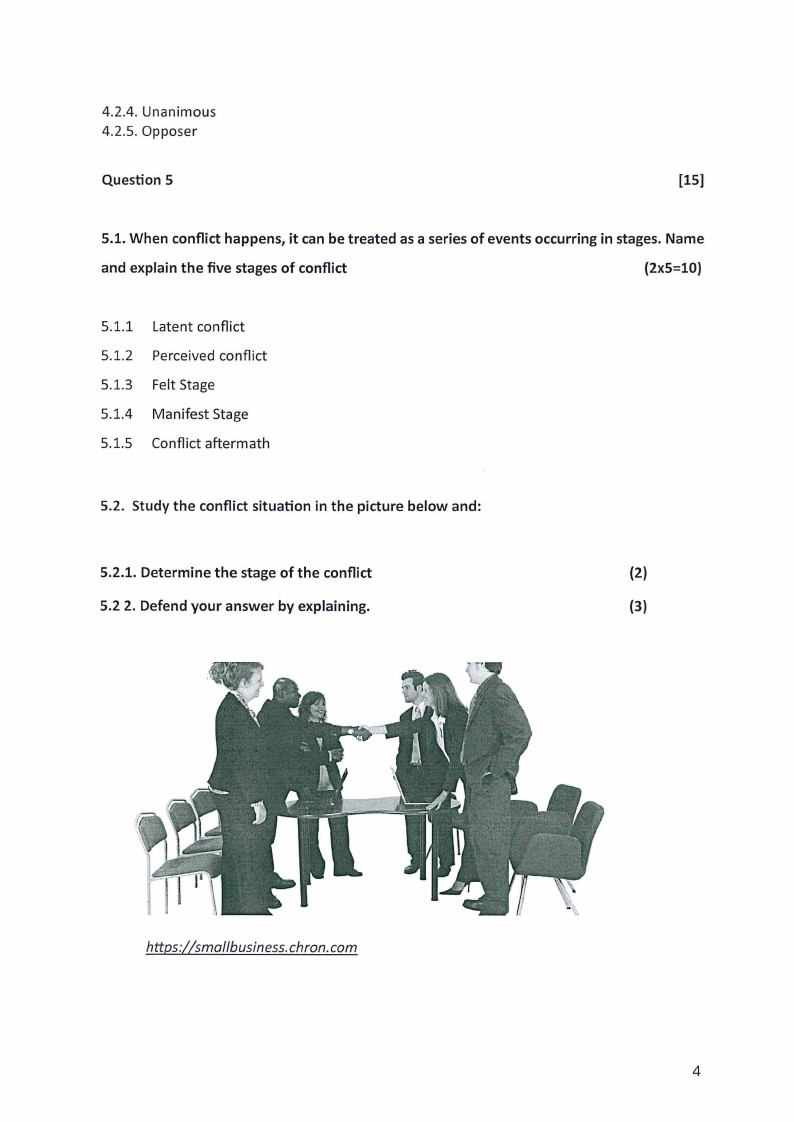
5.2. Study the conflict situation in the picture below and:
5.2.1. Determine the stage of the conflict
(2)
5.2 2. Defend your answer by explaining.
(3)
https://smallbusiness. chron. com
4
|
|
5 Page 5 |
▲back to top |
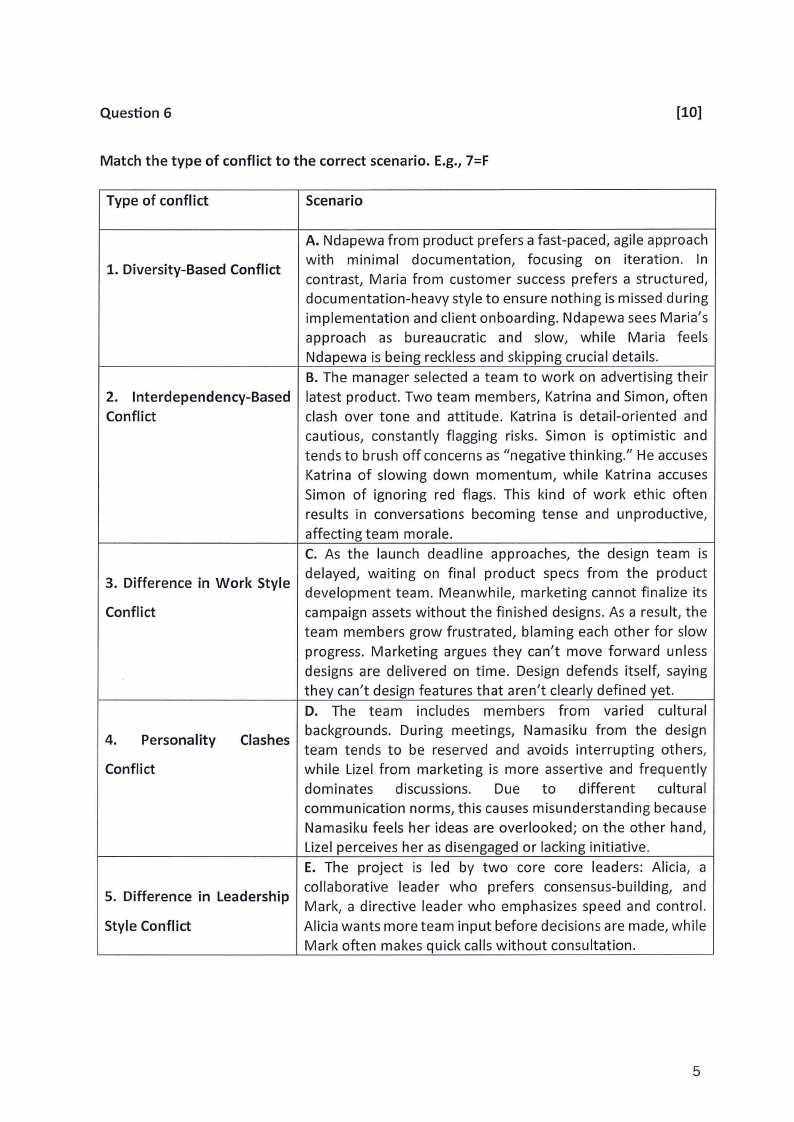
Question 6
[10]
Match the type of conflict to the correct scenario. E.g., 7=F
Type of conflict
Scenario
1. Diversity-Based Conflict
2. Interdependency-Based
Conflict
3. Difference in Work Style
Conflict
4. Personality
Conflict
Clashes
5. Difference in Leadership
Style Conflict
A. Ndapewa from product prefers a fast-paced, agile approach
with minimal documentation, focusing on iteration. In
contrast, Maria from customer success prefers a structured,
documentation-heavy style to ensure nothing is missed during
implementation and client onboarding. Ndapewa sees Maria's
approach as bureaucratic and slow, while Maria feels
Ndapewa is being reckless and skipping crucial details.
B. The manager selected a team to work on advertising their
latest product. Two team members, Katrina and Simon, often
clash over tone and attitude. Katrina is detail-oriented and
cautious, constantly flagging risks. Simon is optimistic and
tends to brush off concerns as "negative thinking." He accuses
Katrina of slowing down momentum, while Katrina accuses
Simon of ignoring red flags. This kind of work ethic often
results in conversations becoming tense and unproductive,
affecting team morale.
C. As the launch deadline approaches, the design team is
delayed, waiting on final product specs from the product
development team. Meanwhile, marketing cannot finalize its
campaign assets without the finished designs. As a result, the
team members grow frustrated, blaming each other for slow
progress. Marketing argues they can't move forward unless
designs are delivered on time. Design defends itself, saying
they can't design features that aren't clearly defined yet.
D. The team includes members from varied cultural
backgrounds. During meetings, Namasiku from the design
team tends to be reserved and avoids interrupting others,
while Lizel from marketing is more assertive and frequently
dominates discussions. Due to different cultural
communication norms, this causes misunderstanding because
Namasiku feels her ideas are overlooked; on the other hand,
Lizel perceives her as disengaged or lacking initiative.
E. The project is led by two core core leaders: Alicia, a
collaborative leader who prefers consensus-building, and
Mark, a directive leader who emphasizes speed and control.
Alicia wants more team input before decisions are made, while
Mark often makes quick calls without consultation.
5
|
|
6 Page 6 |
▲back to top |
Question 7
[5]
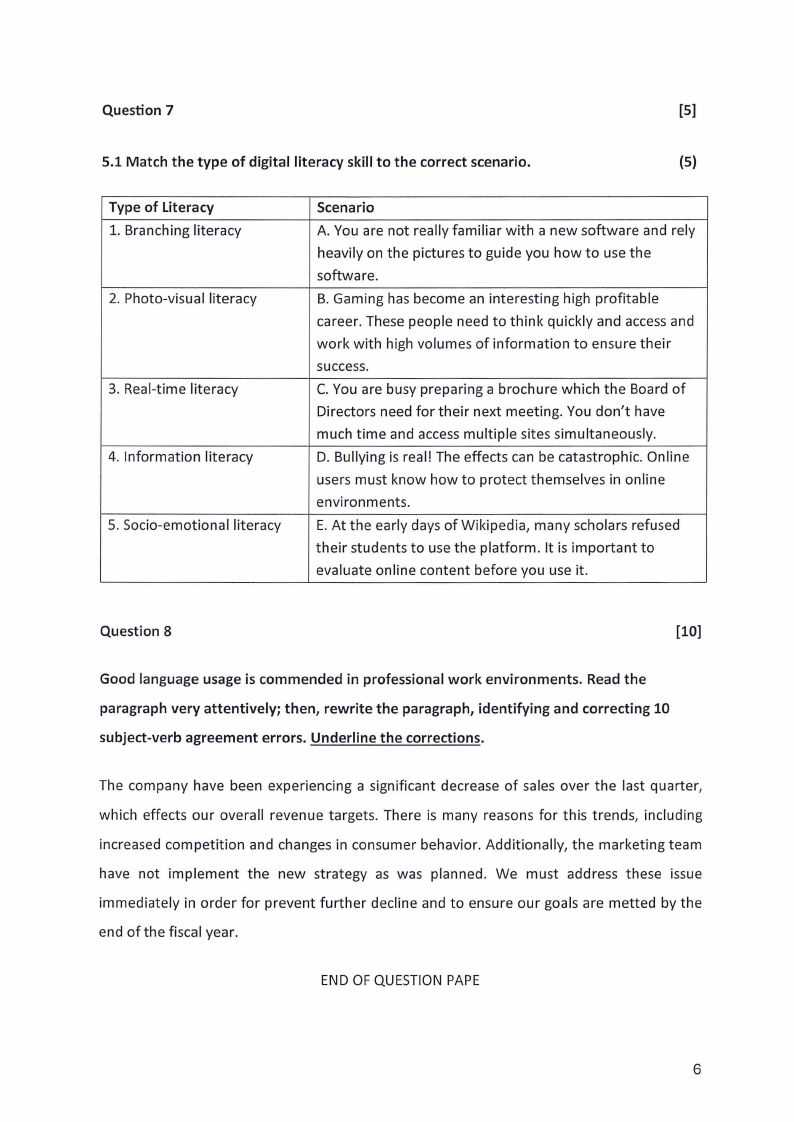
5.1 Match the type of digital literacy skill to the correct scenario.
(5)
Type of Literacy
1. Branching literacy
2. Photo-visual literacy
3. Real-time literacy
4. Information literacy
5. Socio-emotional literacy
Scenario
A. You are not really familiar with a new software and rely
heavily on the pictures to guide you how to use the
software.
B. Gaming has become an interesting high profitable
career. These people need to think quickly and access and
work with high volumes of information to ensure their
success.
C. You are busy preparing a brochure which the Board of
Directors need for their next meeting. You don't have
much time and access multiple sites simultaneously.
D. Bullying is real! The effects can be catastrophic. Online
users must know how to protect themselves in online
environments.
E. At the early days of Wikipedia, many scholars refused
their students to use the platform. It is important to
evaluate online content before you use it.
Question 8
[10]
Good language usage is commended in professional work environments. Read the
paragraph very attentively; then, rewrite the paragraph, identifying and correcting 10
subject-verb agreement errors. Underline the corrections.
The company have been experiencing a significant decrease of sales over the last quarter,
which effects our overall revenue targets. There is many reasons for this trends, including
increased competition and changes in consumer behavior. Additionally, the marketing team
have not implement the new strategy as was planned. We must address these issue
immediately in order for prevent further decline and to ensure our goals are metted by the
end of the fiscal year.
END OF QUESTION PAPE
6