


 |
BMT620S - BUDGET AND ASSETS MANAGEMENT - 1ST OPP - NOVEMBER 2025 |
|
|
1 Page 1 |
▲back to top |
n Am I 8 I A Un IVE RS ITV
OF SCIEnCE Ano TECHnOLOGY
FACULTY OF COMMERCE, HUMAN SCIENCES AND EDUCATION
DEPARTMENT OF TECHNICAL AND VOCATIONAL EDUCATION AND TRAINING
QUALIFICATION : DIPLOMA IN TECHNICAL AND VOCATIONAL EDUCATION AND TRAINING :
MANAGEMENT
QUALIFICATION CODE: 06DTVM
LEVEL: 6
COURSE CODE: BMT620S
COURSE NAME: BUDGET AND ASSET MANAGEMENT
SESSION: NOVEMBER 2025
PAPER: PAPER 1
DURATION: 3 HOURS
MARKS: 100
FIRST OPPORTUNITY EXAMINATION PAPER
EXAMINER(S}: Mr. Benhardt U Kauteza
MODERATOR: Dr. Godfrey M Tubaundule
INSTRUCTIONS
1. Answer all questions.
2. Read all the questions carefully before answering.
3. This paper consists of Sections A and B with a total of six questions.
4. Make sure your name and surname, question number and the date appear on
the answer script.
5. Number the answers clearly.
6. Please ensure that your writing is legible, neat and presentable
THIS MEMORANDUM CONSISTS OF _7_ PAGES (Including this front page)
|
|
2 Page 2 |
▲back to top |
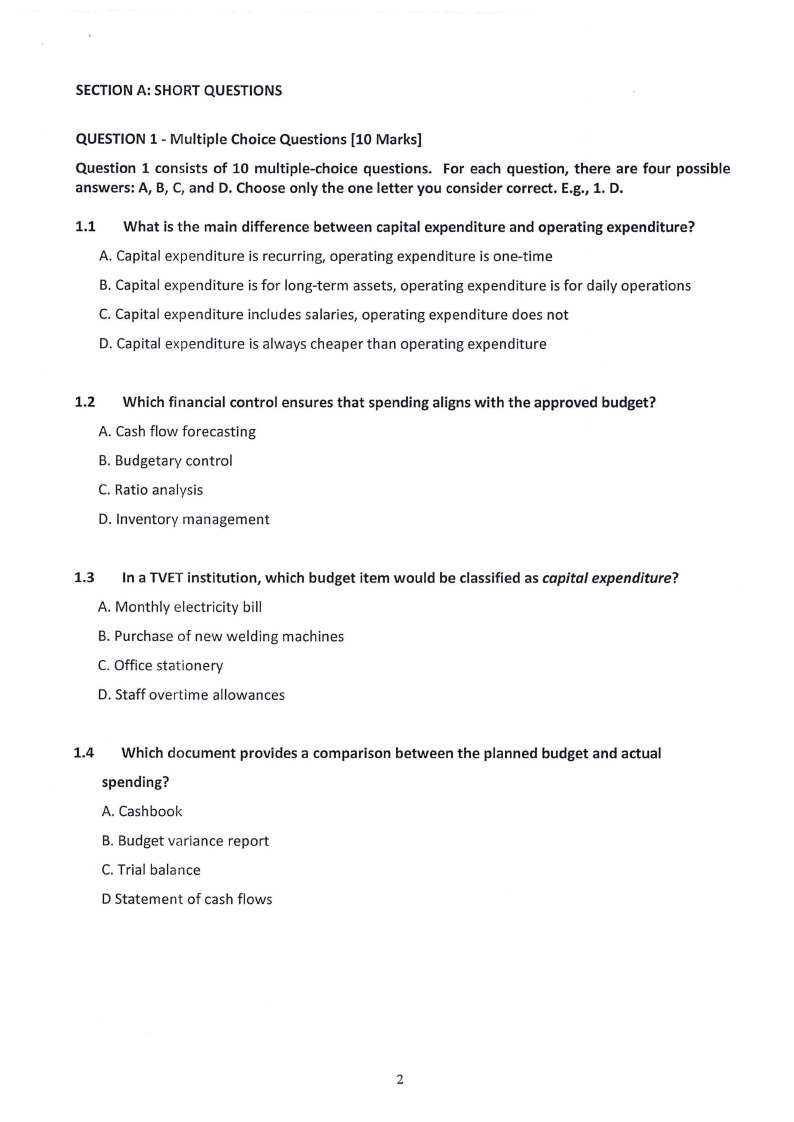
SECTION A: SHORT QUESTIONS
QUESTION 1 - Multiple Choice Questions [10 Marks]
Question 1 consists of 10 multiple-choice questions. For each question, there are four possible
answers: A, B, C, and D. Choose only the one letter you consider correct. E.g., 1. D.
1.1 What is the main difference between capital expenditure and operating expenditure?
A. Capital expenditure is recurring, operating expenditure is one-time
B. Capital expenditure is for long-term assets, operating expenditure is for daily operations
C. Capital expenditure includes salaries, operating expenditure does not
D. Capital expenditure is always cheaper than operating expenditure
1.2 Which financial control ensures that spending aligns with the approved budget?
A. Cash flow forecasting
B. Budgetary control
C. Ratio analysis
D. Inventory management
1.3 In a TVET institution, which budget item would be classified as capital expenditure?
A. Monthly electricity bill
B. Purchase of new welding machines
C. Office stationery
D. Staff overtime allowances
1.4 Which document provides a comparison between the planned budget and actual
spending?
A. Cashbook
B. Budget variance report
C. Trial balance
D Statement of cash flows
2
|
|
3 Page 3 |
▲back to top |
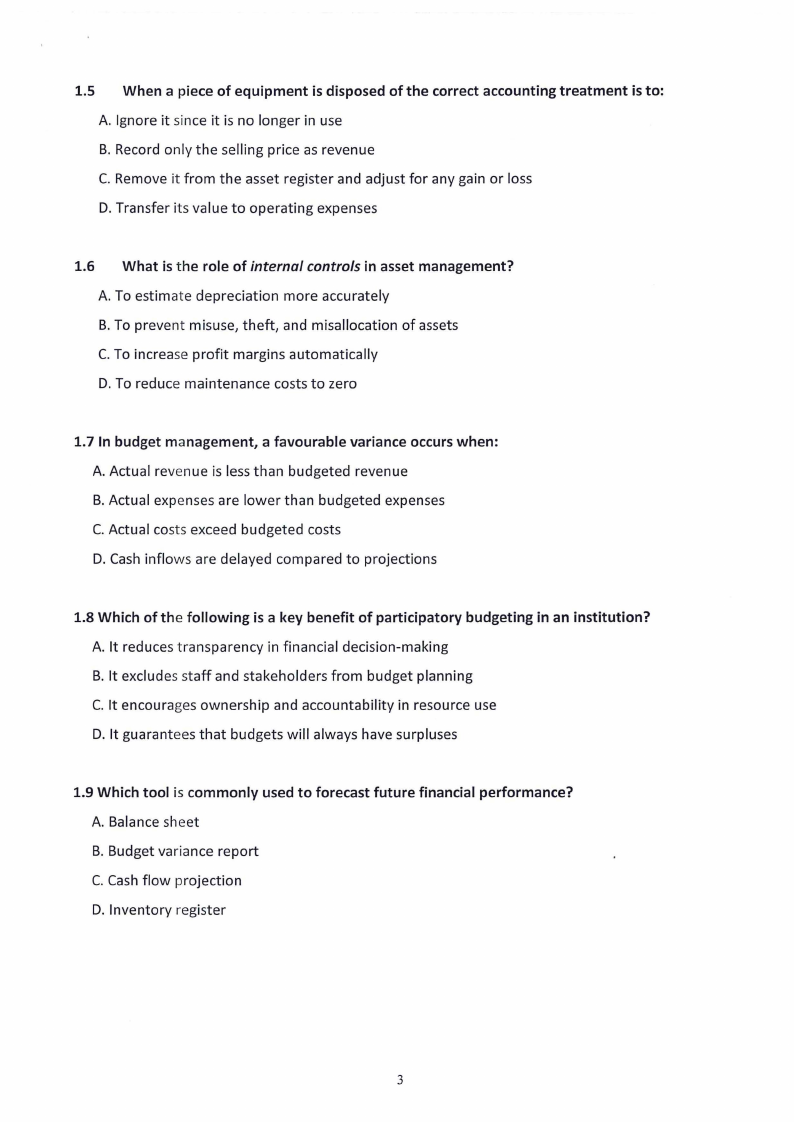
1.5 When a piece of equipment is disposed of the correct accounting treatment is to:
A. Ignore it since it is no longer in use
B. Record only the selling price as revenue
C. Remove it from the asset register and adjust for any gain or loss
D. Transfer its value to operating expenses
1.6 What is the role of internal controls in asset management?
A. To estimate depreciation more accurately
B. To prevent misuse, theft, and misallocation of assets
C. To increase profit margins automatically
D. To reduce maintenance costs to zero
1.7 In budget management, a favourable variance occurs when:
A. Actual revenue is less than budgeted revenue
B. Actual expenses are lower than budgeted expenses
C. Actual costs exceed budgeted costs
D. Cash inflows are delayed compared to projections
1.8 Which of the following is a key benefit of participatory budgeting in an institution?
A. It reduces transparency in financial decision-making
B. It excludes staff and stakeholders from budget planning
C. It encoura ges ownership and accountab ility in resource use
D. It guarantees that budgets will always have surpluses
1.9 Which tool is commonly used to forecast future financial performance?
A. Balance sheet
B. Budget variance report
C. Cash flow projection
D. Inventory register
3
|
|
4 Page 4 |
▲back to top |
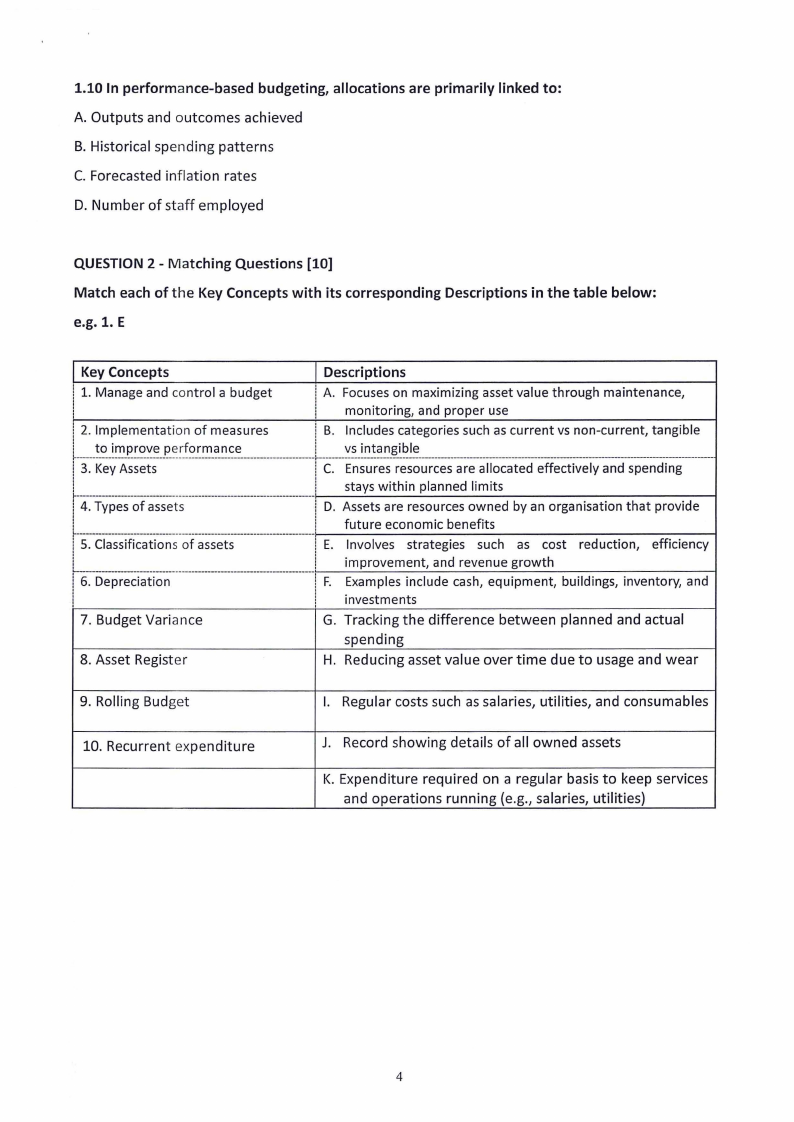
1.10 In performance-based budgeting, allocations are primarily linked to:
A. Outputs and outcomes achieved
B. Historical spending patterns
C. Forecasted inflation rates
D. Number of staff employed
QUESTION 2 - Matching Questions [10)
Match each of the Key Concepts with its corresponding Descriptions in the table below:
e.g.1. E
Key Concepts
1. Manage and control a budget
2. Implementation of measures
to improve pe..rformance
3. Key Assets
------
4. Types of assets
5. Classifications of assets
------------
6. Depreciation
7. Budget Variance
8. Asset Register
Descriptions
! A. Focuses on maximizing asset value through maintenance,
! monitoring, and proper use
:i B. Includes categories such as current vs non-current, tangible
------! vs intangible
! C. Ensures resources are allocated effectively and spending
:
I
stays within planned limits
D. Assets are resources owned by an organisation that provide
future economic benefits
E. Involves strategies such as cost reduction, efficiency
improvement, and revenue growth
F. Examples include cash, equipment, buildings, inventory, and
investments
G. Tracking the difference between planned and actual
spending
H. Reducing asset value over time due to usage and wear
9. Rolling Budget
I. Regular costs such as salaries, utilities, and consumables
10. Recurrent expenditure
J. Record showing details of all owned assets
K. Expenditure required on a regular basis to keep services
and operations running (e.g., salaries, utilities)
4
|
|
5 Page 5 |
▲back to top |
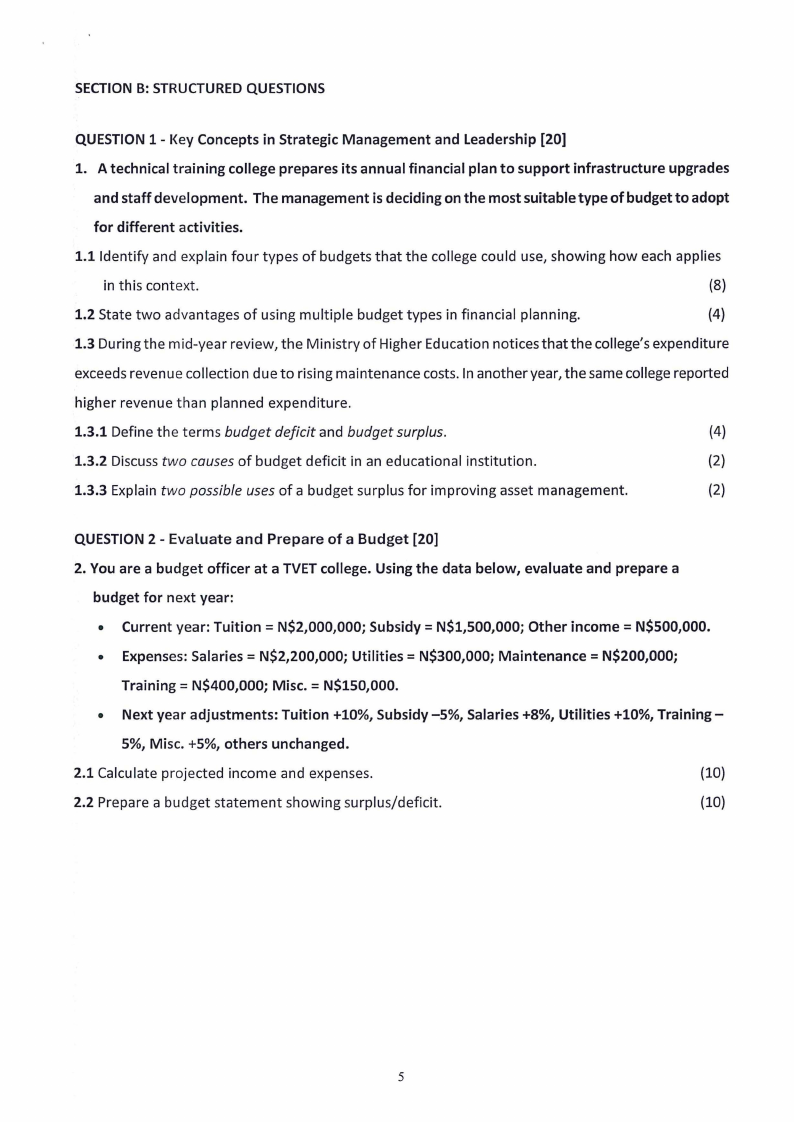
SECTION B: STRUCTURED QUESTIONS
QUESTION 1 - Key Concepts in Strategic Management and Leadership [20]
1. A technical training college prepares its annual financial plan to support infrastructure upgrades
and staff development. The management is deciding on the most suitable type of budget to adopt
for different activities.
1.1 Identify and explain four types of budgets that the college could use, showing how each applies
in this context.
(8)
1.2 State two advantages of using multiple budget types in financial planning.
(4)
1.3 During the mid-year review, the Ministry of Higher Education notices that the college's expenditure
exceeds revenue collection due to rising maintenance costs. In another year, the same college reported
higher revenue than planned expenditure.
1.3.1 Define the terms budget deficit and budget surplus.
(4)
1.3.2 Discuss two causes of budget deficit in an educational institution.
(2)
1.3.3 Explain two possible uses of a budget surplus for improving asset management.
(2)
QUESTION 2 - Evaluate and Prepare of a Budget [20]
2. You are a budget officer at a TVET college. Using the data below, evaluate and prepare a
budget for next year:
• Current year: Tuition = N$2,000,000; Subsidy= N$1,S00,00O; Other income= N$500,000.
• Expenses: Salaries= N$2,200,000; Utilities= N$300,000; Maintenance= N$200,000;
Training= N$400,000; Misc. = N$150,000.
• Next year adjustments: Tuition +10%, Subsidy-5%, Salaries +8%, Utilities +10%, Training-
5%, Misc. +5%, others unchanged.
2.1 Calculate projected income and expenses.
(10)
2.2 Prepare a budget statement showing surplus/deficit.
(10)
5
|
|
6 Page 6 |
▲back to top |
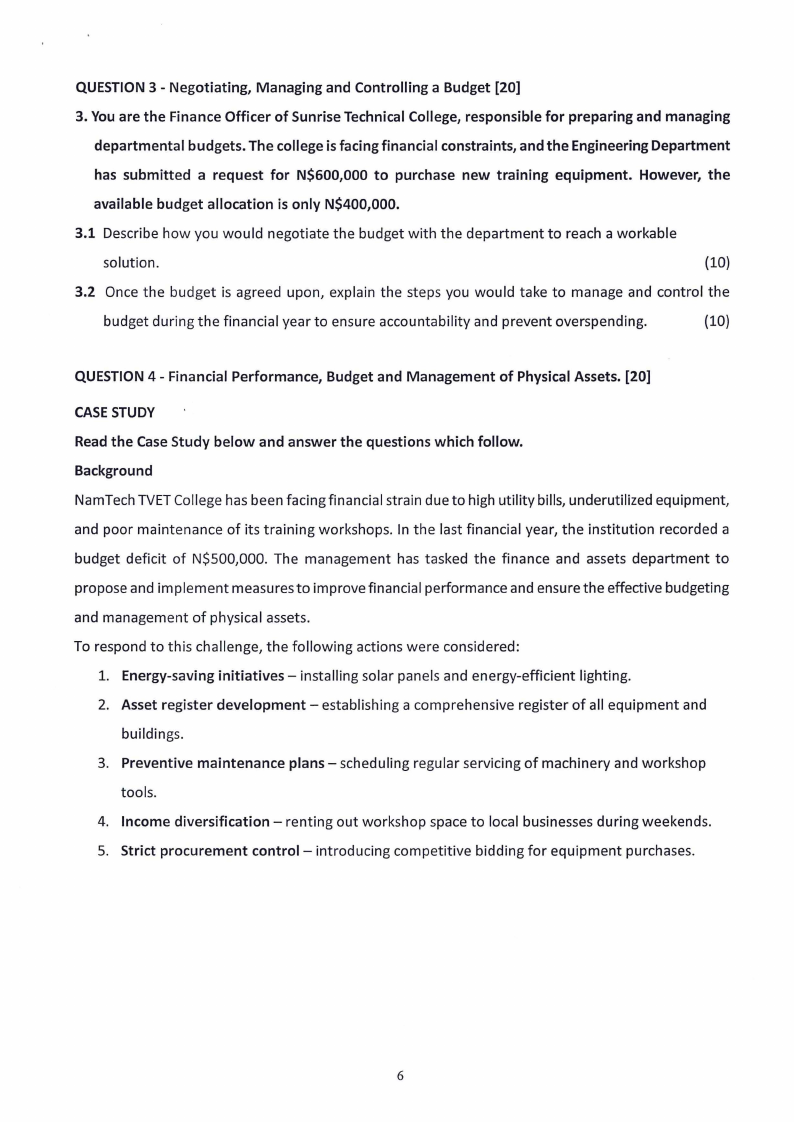
QUESTION 3 - Negotiating, Managing and Controlling a Budget [20]
3. You are the Finance Officer of Sunrise Technical College, responsible for preparing and managing
departmental budgets. The college is facing financial constraints, and the Engineering Department
has submitted a request for N$600,000 to purchase new training equipment. However, the
available budget allocation is only N$400,000.
3.1 Describe how you would negotiate the budget with the department to reach a workable
solution.
(10)
3.2 Once the budget is agreed upon, explain the steps you would take to manage and control the
budget during the financial year to ensure accountability and prevent overspending.
(10)
QUESTION 4 - Financial Performance, Budget and Management of Physical Assets. [20]
CASE STUDY
Read the Case Study below and answer the questions which follow.
Background
NamTech TVET College has been facing financial strain due to high utility bills, underutilized equipment,
and poor maintenance of its training workshops. In the last financial year, the institution recorded a
budget deficit of N$500,000. The management has tasked the finance and assets department to
propose and implement measures to improve financial performance and ensure the effective budgeting
and management of physical assets.
To respond to this challenge, the following actions were considered:
1. Energy-saving initiatives - installing solar panels and energy-efficient lighting.
2. Asset register development - establishing a comprehensive register of all equipment and
buildings.
3. Preventive maintenance plans - scheduling regular servicing of machinery and workshop
tools.
4. Income diversification - renting out workshop space to local businesses during weekends.
5. Strict procurement control - introducing competitive bidding for equipment purchases.
6
|
|
7 Page 7 |
▲back to top |
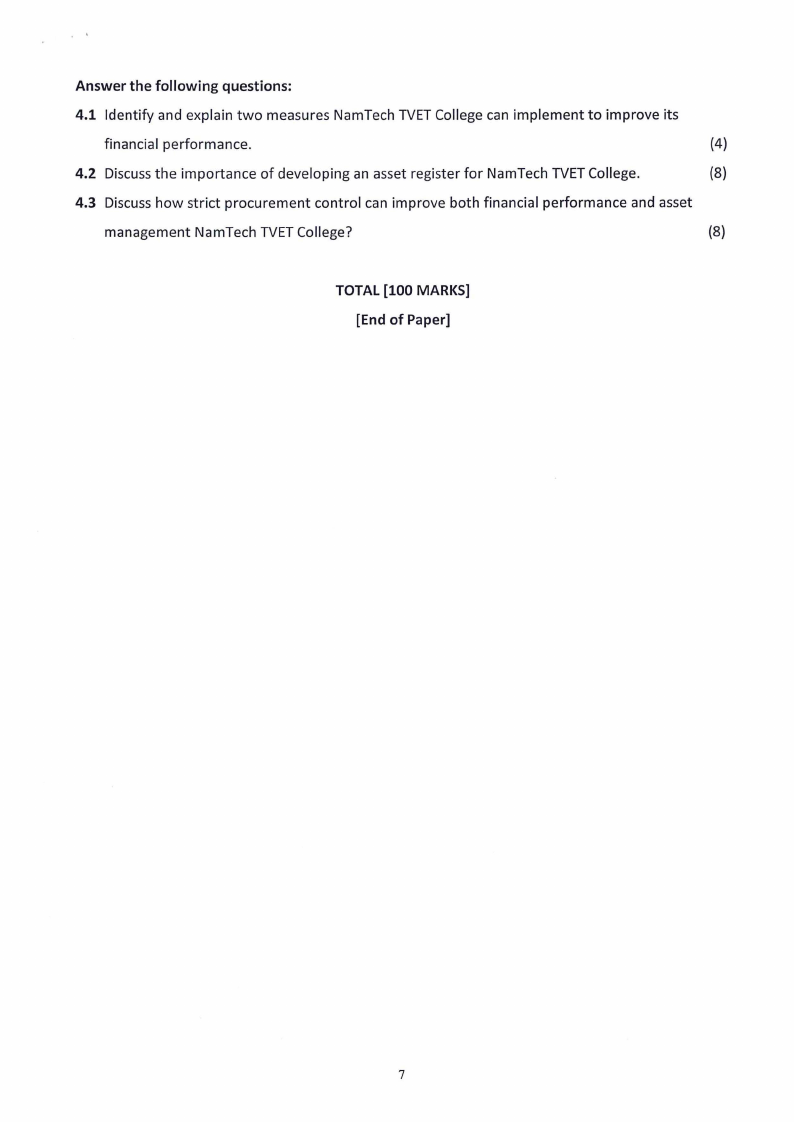
Answer the following questions:
4.1 Identify and explain two measures NamTech TVET College can implement to improve its
financial performance.
(4)
4.2 Discuss the importance of developing an asset register for NamTech TVET College.
(8)
4.3 Discuss how strict procurement control can improve both financial performance and asset
management NamTech TVET College?
(8)
TOTAL [100 MARKS]
[End of Paper]
7