


 |
SPM802S - Strategic Procurement Management - 1st Opp - Nov 2025 |
|
|
1 Page 1 |
▲back to top |
nAm IBI A un IVE RS ITV
OF SCIEncE Ano TECHnOLOGY
FACULTY OF COMMERCE, HUMAN SCIENCES AND EDUCATION
DEPARTMENT OF MARKETING, SPORT MANAGEMENT AND LOGISTICS
QUALIFICATION: POST GRADUATE DIPLOMA: PROCUREMENT MANAGEMENT
BACHELOR OF LOGISTICS AND SUPPLY CHAIN MANAGEMENT
HONOURS
QUALIFICATION CODE: 08PDPM LEVEL: 8
08LSCH
COURSE CODE: SPM802S
COURSE NAME: STRATEGIC PROCUREMENT
MANAGEMENT
SESSION: NOVEMBER 2025
PAPER: THEORY
DURATION: 3 HOURS
MARKS: 100
FIRST OPPORTUNITY EXAMINATION QUESTION PAPER
EXAMINER
MS. PAULINA SHINANA (Post-Graduate Diploma)
DR. HELVI PETRUS (Honours)
MODERATOR: MR. TANGINEPOLO
INSTRUCTIONS
1. Answer all questions.
2. Read all the questions carefully before answering.
3. Make sure your name and surname, question number and the date
appears in the Header and Footer.
4. Give special attention to the manuscript instructions.
THIS EXAMINATION QUESTION PAPER CONSISTS OF 3 PAGES (Including this
front page)
Page 1 of3
|
|
2 Page 2 |
▲back to top |
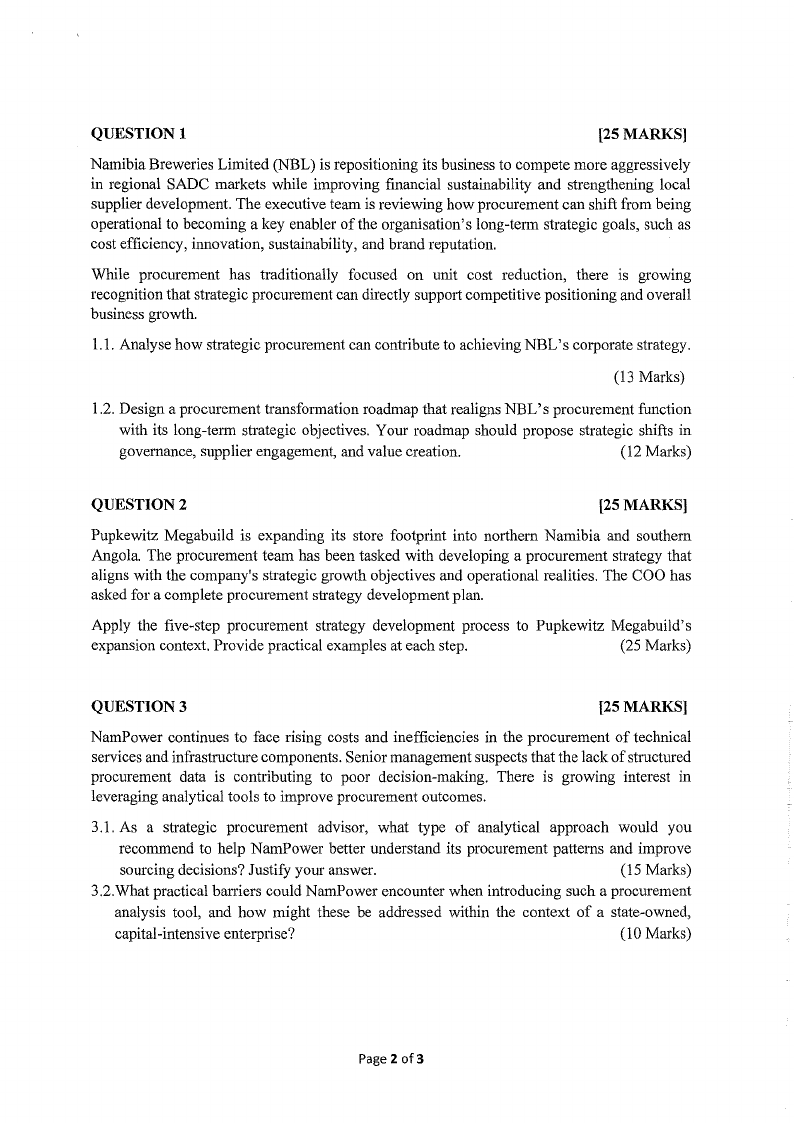
QUESTION!
[25MARKS]
Namibia Breweries Limited (NBL) is repositioning its business to compete more aggressively
in regional SADC markets while improving financial sustainability and strengthening local
supplier development. The executive team is reviewing how procurement can shift from being
operational to becoming a key enabler of the organisation's long-tenn strategic goals, such as
cost efficiency, innovation, sustainability, and brand reputation.
While procurement has traditionally focused on unit cost reduction, there is growing
recognition that strategic procurement can directly suppoti competitive positioning and overall
business growth.
1.1. Analyse how strategic procurement can contribute to achieving NBL's corporate strategy.
(13 Marks)
1.2. Design a procurement transformation roadmap that realigns NBL's procurement function
with its long-term strategic objectives. Your roadmap should propose strategic shifts in
governance, supplier engagement, and value creation.
(12 Marks)
QUESTION2
[25MARKS]
Pupkewitz Megabuild is expanding its store footprint into northern Namibia and southern
Angola. The procurement team has been tasked with developing a procurement strategy that
aligns with the company's strategic growth objectives and operational realities. The COO has
asked for a complete procurement strategy development plan.
Apply the five-step procurement strategy development process to Pupkewitz Megabuild's
expansion context. Provide practical examples at each step.
(25 Marks)
QUESTION3
[25MARKS]
NamPower continues to face rising costs and inefficiencies in the procurement of technical
services and infrastructure components. Senior management suspects that the lack of structured
procurement data is contributing to poor decision-making. There is growing interest in
leveraging analytical tools to improve procurement outcomes.
3.1. As a strategic procurement advisor, what type of analytical approach would you
recommend to help NamPower better understand its procurement patterns and improve
sourcing decisions? Justify your answer.
(15 Marks)
3.2.What practical baniers could NamPower encounter when introducing such a procurement
analysis tool, and how might these be addressed within the context of a state-owned,
capital-intensive enterprise?
(10 Marks)
Page 2 of3
|
|
3 Page 3 |
▲back to top |
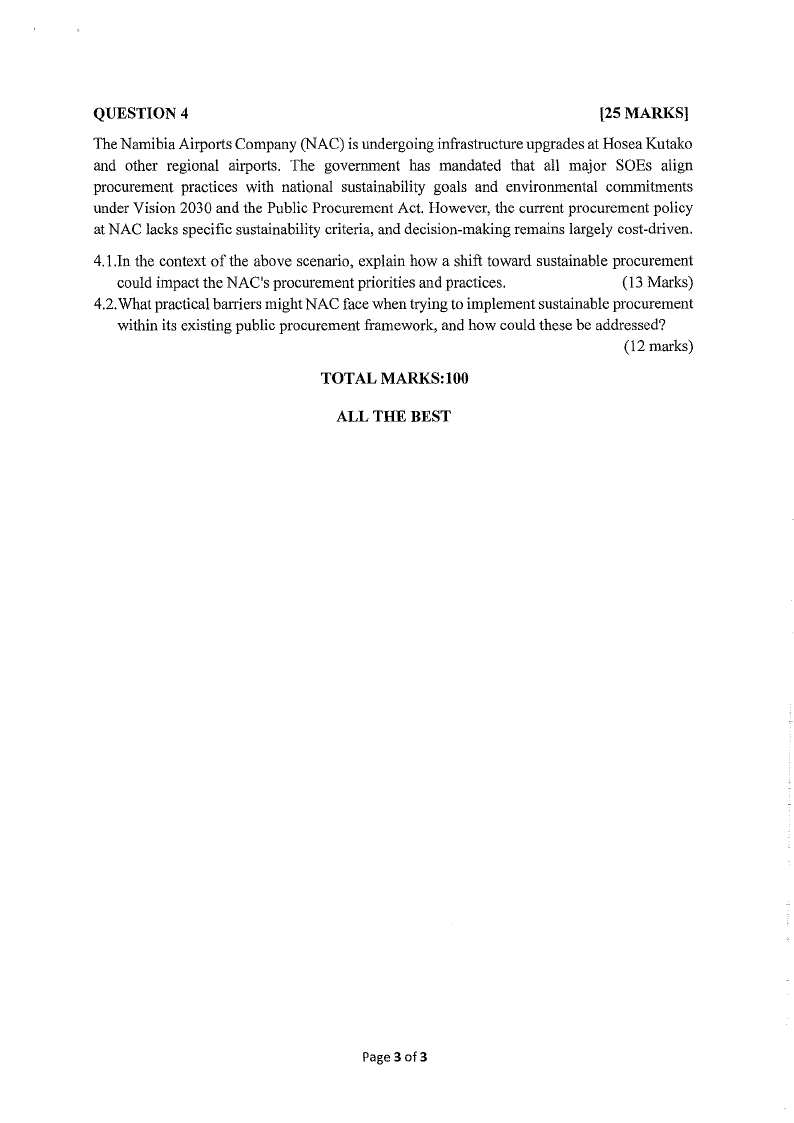
QUESTION 4
[25MARKS]
The Namibia Airports Company (NAC) is undergoing infrastructure upgrades at Hosea Kutako
and other regional airports. The government has mandated that all major SOEs align
procurement practices with national sustainability goals and environmental commitments
under Vision 2030 and the Public Procurement Act. However, the current procurement policy
at NAC lacks specific sustainability criteria, and decision-making remains largely cost-driven.
4.1.In the context of the above scenario, explain how a shift toward sustainable procurement
could impact the NAC's procurement priorities and practices.
(13 Marks)
4.2.What practical baniers might NAC face when trying to implement sustainable procurement
within its existing public procurement framework, and how could these be addressed?
(12 marks)
TOTAL MARKS:100
ALL THE BEST
Page 3 of3