


 |
BAC521C-BUSINESS ACCOUNTING 1B-2ND OPP-JULY 2025 |
|
|
1 Page 1 |
▲back to top |
nAmlBIA
UnlVERSITY
OF SCIEnCE
TECHnOLOGY
HAROLDPUPKEWITZ
GraduateSchoolof Business
FACULTY OF COMMERCE, HUMAN SCIENCESAND EDUCATION
HAROLD PUPKEWITZ GRADUATE SCHOOL OF BUSINESS
QUALIFICATION: DIPLOMA IN BUSINESSPROCESSMANAGEMENT
QUALIFICATION CODE: 06DBPM LEVEL: 6
COURSE CODE: BAC521C
COURSE NAME: BUSINESSACCOUNTING lB
SESSION: JUNE 2025
PAPER: PAPER2
DURATION: 3 HOURS
MARKS: 100
SECOND OPPORTUNITY EXAMINATION QUESTION PAPER
EXAMINER
Lameck Odada
MODERATOR Hendrina Kangala
INSTRUCTIONS
1. This question paper comprises FOUR (4) questions.
2. Answer ALL the questions in blue or black ink. NO pencil
3. Start each question on a new page in your answer booklet and show all your workings.
4. Unless otherwise stated, round off only final answers to two (2) decimal places where
necessary.
5. Questions relating to this examination may be raised in the initial 30 minutes after the
start of the paper. Thereafter, candidates must use their initiative to deal with any
perceived error or ambiguity & any assumption made by the candidate should be clearly
stated.
PERMISSIBLE MATERIALS
1. Silent, non-programmable calculators
THIS QUESTION PAPER CONSISTS OF 7 PAGES (including this front page)
|
|
2 Page 2 |
▲back to top |
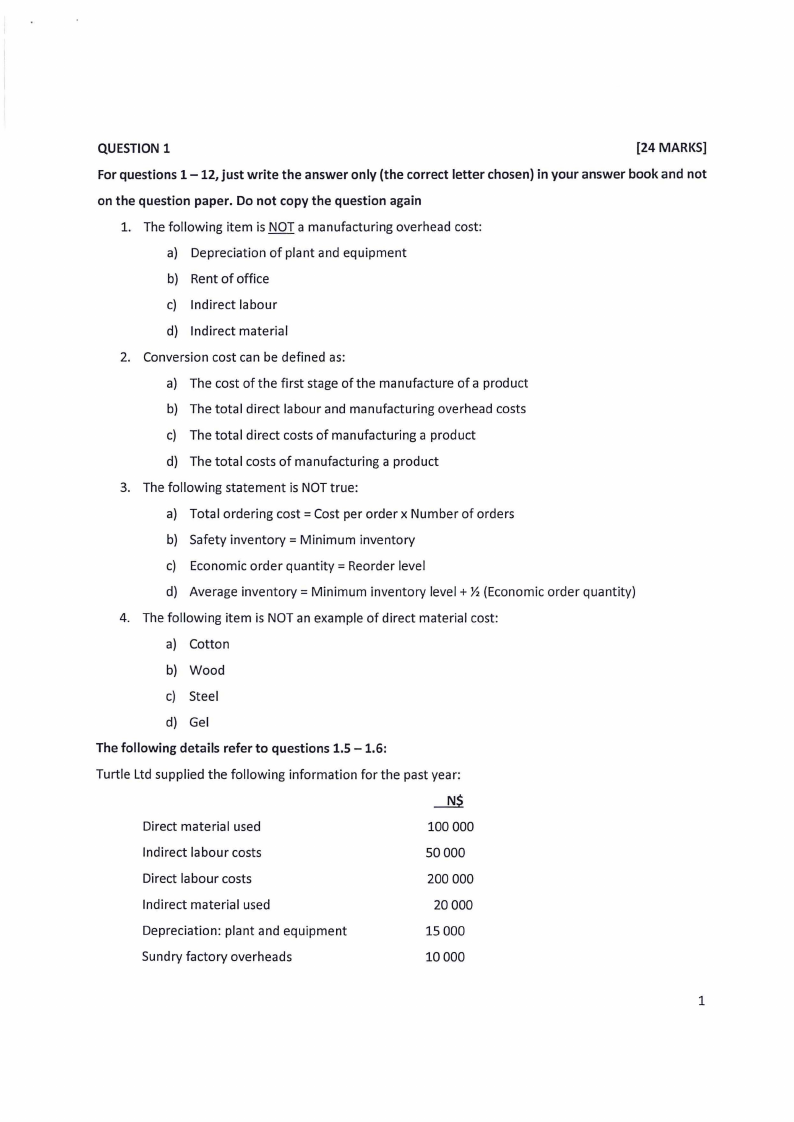
QUESTION 1
[24 MARKS]
For questions 1-12, just write the answer only (the correct letter chosen) in your answer book and not
on the question paper. Do not copy the question again
1. The following item is NOT a manufacturing overhead cost:
a) Depreciation of plant and equipment
b) Rent of office
c) Indirect labour
d) Indirect material
2. Conversion cost can be defined as:
a) The cost of the first stage of the manufacture of a product
b) The total direct labour and manufacturing overhead costs
c) The total direct costs of manufacturing a product
d) The total costs of manufacturing a product
3. The following statement is NOT true:
a) Total ordering cost= Cost per order x Number of orders
b) Safety inventory= Minimum inventory
c) Economic order quantity= Reorder level
d) Average inventory= Minimum inventory level+½ (Economic order quantity)
4. The following item is NOT an example of direct material cost:
a) Cotton
b) Wood
c) Steel
d) Gel
The following details refer to questions 1.5 - 1.6:
Turtle Ltd supplied the following information for the past year:
Direct material used
Indirect labour costs
Direct labour costs
Indirect material used
Depreciation: plant and equipment
Sundry factory overheads
100 000
50000
200 000
20 000
15 000
10 000
1
|
|
3 Page 3 |
▲back to top |
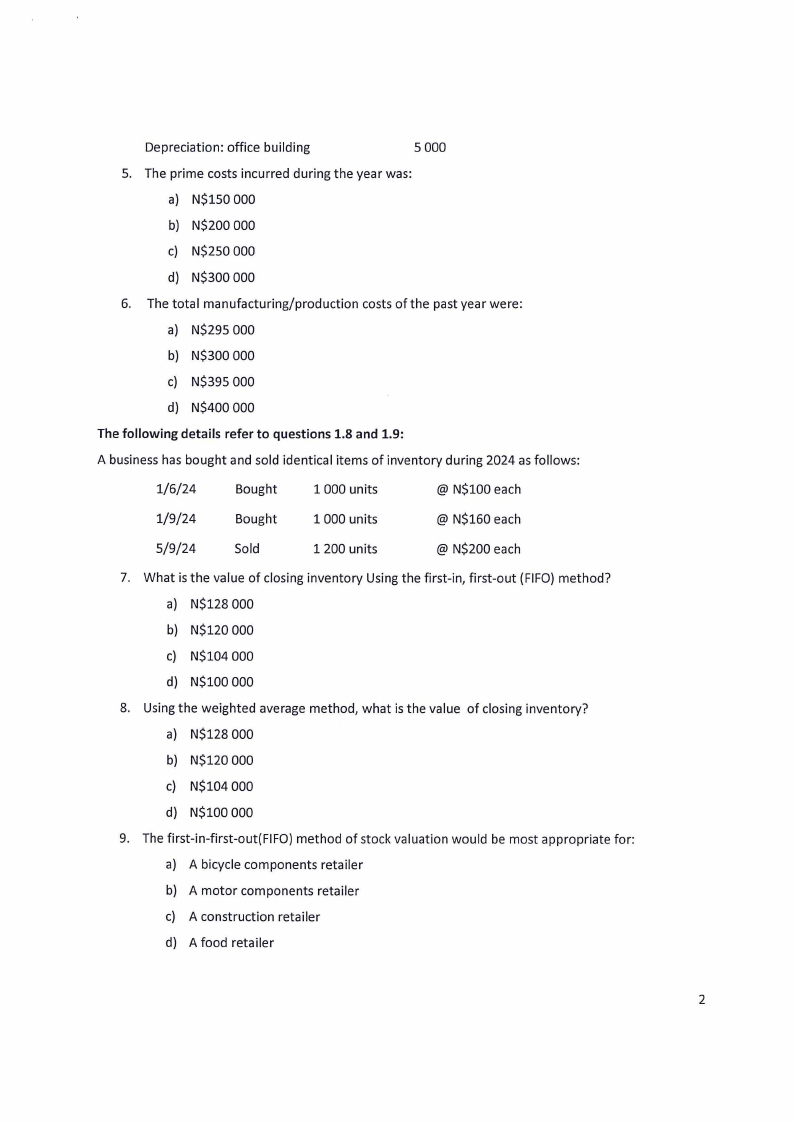
Depreciation: office building
5 000
5. The prime costs incurred during the year was:
a) N$150 000
b) N$200 000
c) N$250 000
d) N$300 000
6. The total manufacturing/production costs of the past year were:
a) N$295 000
b) N$300 000
c) N$395 000
d) N$400 000
The following details refer to questions 1.8 and 1.9:
A business has bought and sold identical items of inventory during 2024 as follows:
1/6/24
Bought
1000 units
@ N$100 each
1/9/24
Bought
1000 units
@ N$160 each
5/9/24
Sold
1200 units
@ N$200 each
7. What is the value of closing inventory Using the first-in, first-out (FIFO)method?
a) N$128 000
b) N$120 000
c) N$104 000
d) N$100 000
8. Using the weighted average method, what is the value of closing inventory?
a) N$128 000
b) N$120 000
c) N$104 000
d) N$100 000
9. The first-in-first-out(FIFO) method of stock valuation would be most appropriate for:
a) A bicycle components retailer
b) A motor components retailer
c) A construction retailer
d) A food retailer
2
|
|
4 Page 4 |
▲back to top |
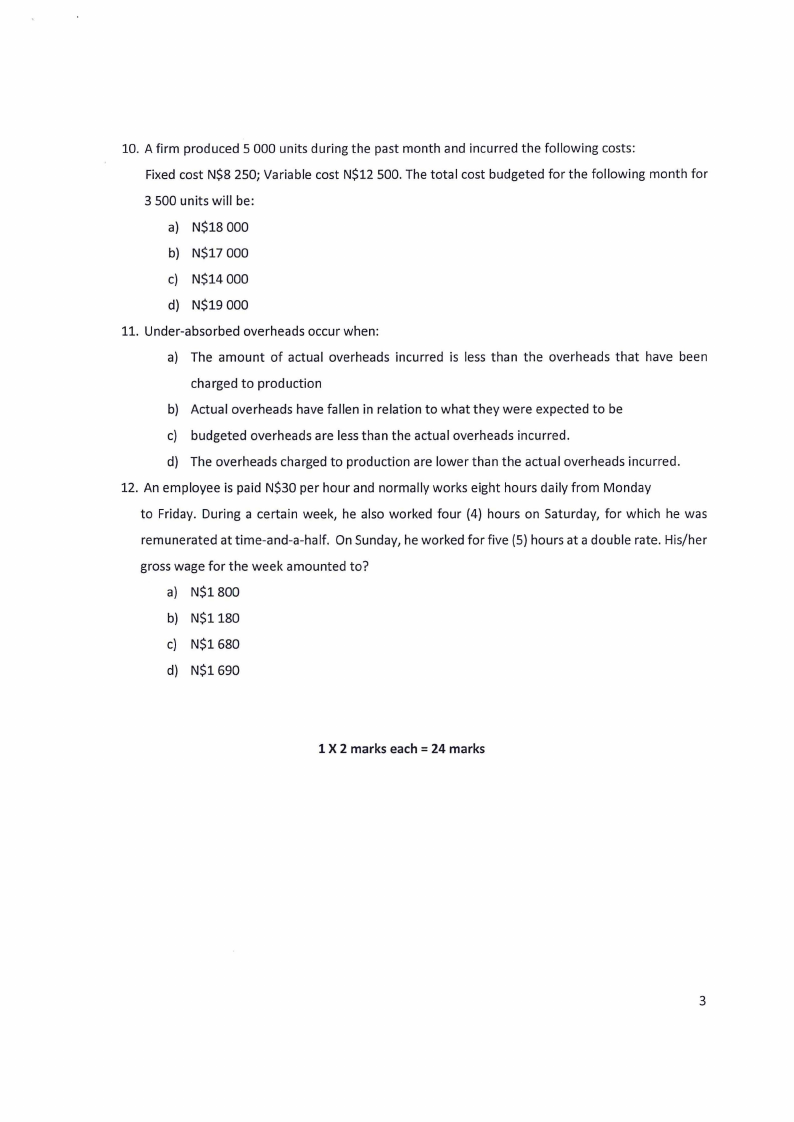
10. A firm produced 5 000 units during the past month and incurred the following costs:
Fixed cost N$8 250; Variable cost N$12 500. The total cost budgeted for the following month for
3 500 units will be:
a) N$18 000
b) N$17 000
c) N$14 000
d) N$19 000
11. Under-absorbed overheads occur when:
a) The amount of actual overheads incurred is less than the overheads that have been
charged to production
b) Actual overheads have fallen in relation to what they were expected to be
c) budgeted overheads are less than the actual overheads incurred.
d) The overheads charged to production are lower than the actual overheads incurred.
12. An employee is paid N$30 per hour and normally works eight hours daily from Monday
to Friday. During a certain week, he also worked four (4) hours on Saturday, for which he was
remunerated at time-and-a-half. On Sunday, he worked for five (5) hours at a double rate. His/her
gross wage for the week amounted to?
a) N$1800
b) N$1180
c) N$1680
d) N$1690
1 X 2 marks each = 24 marks
3
|
|
5 Page 5 |
▲back to top |
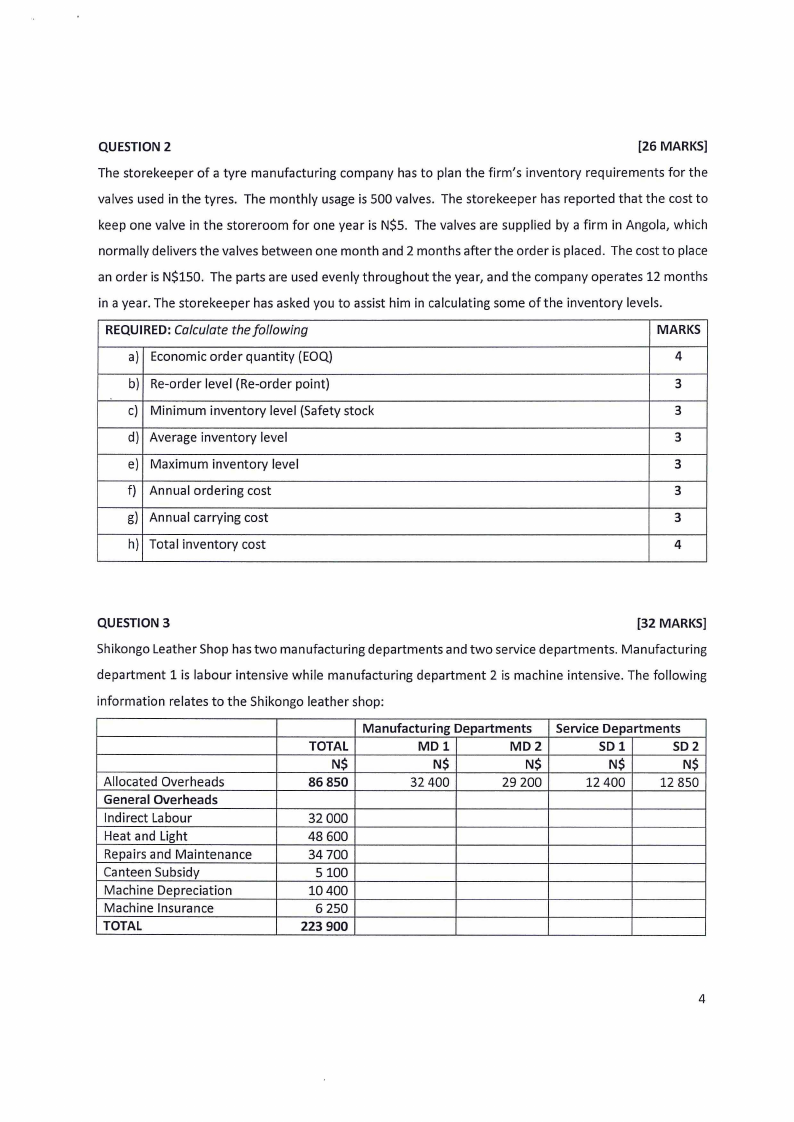
QUESTION 2
[26 MARKS]
The storekeeper of a tyre manufacturing company has to plan the firm's inventory requirements for the
valves used in the tyres. The monthly usage is 500 valves. The storekeeper has reported that the cost to
keep one valve in the storeroom for one year is N$5. The valves are supplied by a firm in Angola, which
normally delivers the valves between one month and 2 months after the order is placed. The cost to place
an order is N$150. The parts are used evenly throughout the year, and the company operates 12 months
in a year. The storekeeper has asked you to assist him in calculating some ofthe inventory levels.
REQUIRED: Calculate the following
MARKS
a) Economic order quantity (EOQ)
4
b) Re-order level (Re-order point)
3
c) Minimum inventory level (Safety stock
3
d) Average inventory level
3
e) Maximum inventory level
3
f) Annual ordering cost
3
g) Annual carrying cost
3
h) Total inventory cost
4
QUESTION 3
[32 MARKS]
Shikongo Leather Shop has two manufacturing departments and two service departments. Manufacturing
department 1 is labour intensive while manufacturing department 2 is machine intensive. The following
information relates to the Shikongo leather shop:
Allocated Overheads
General Overheads
Indirect Labour
Heat and Light
Repairs and Maintenance
Canteen Subsidy
Machine Depreciation
Machine Insurance
TOTAL
TOTAL
N$
86 850
Manufacturing Departments
MDl
MD2
N$
N$
32 400
29 200
Service Departments
SD 1
SD 2
N$
N$
12 400
12 850
32 000
48 600
34 700
5100
10400
6 250
223 900
4
|
|
6 Page 6 |
▲back to top |
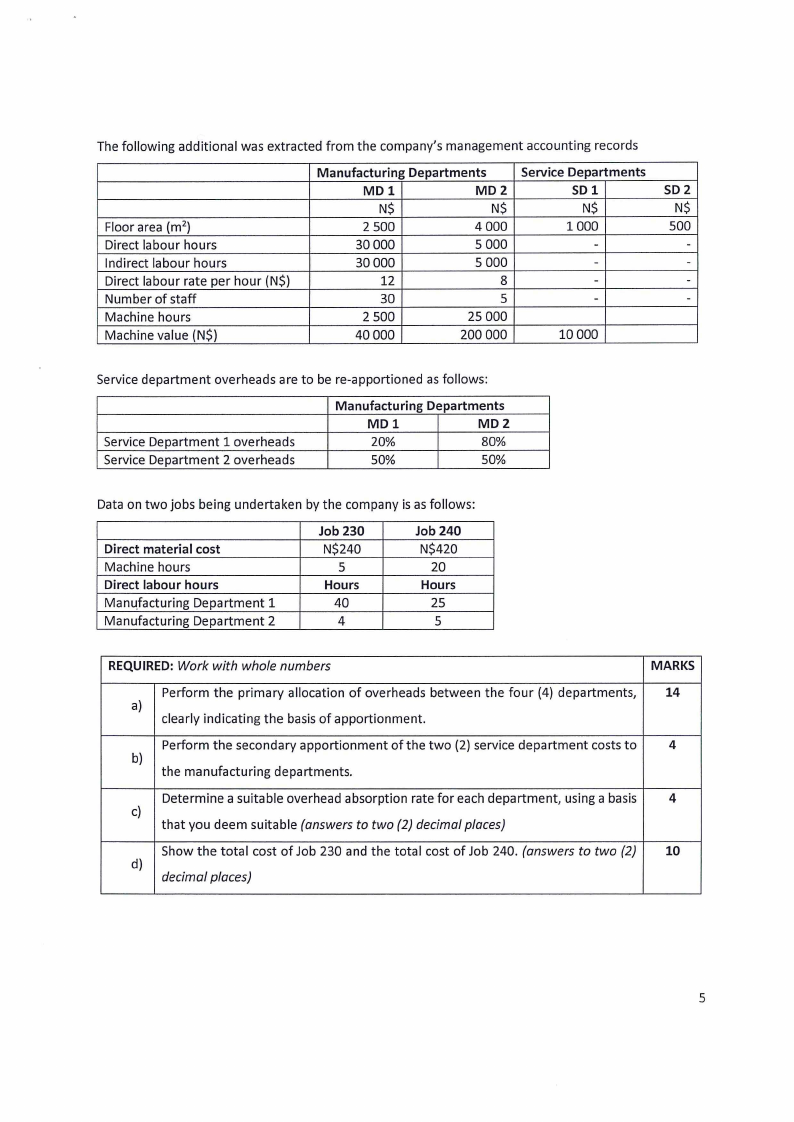
The following additional was extracted from the company's management accounting records
Floor area (m2)
Direct labour hours
Indirect labour hours
Direct labour rate per hour (N$)
Number of staff
Machine hours
Machine value (N$)
Manufacturing Departments
MDl
MD2
N$
N$
2 500
4000
30000
5 000
30000
5 000
12
8
30
5
2 500
25 000
40000
200 000
Service Departments
SD 1
N$
1000
-
-
-
-
10000
SD 2
N$
500
-
-
-
-
Service department overheads are to be re-apportioned as follows:
Service Department 1 overheads
Service Department 2 overheads
Manufacturing Departments
MDl
MD2
20%
80%
50%
50%
Data on two jobs being undertaken by the company is as follows:
Direct material cost
Machine hours
Direct labour hours
Manu_facturing Department 1
Manufacturing Department 2
Job 230
N$240
5
Hours
40
4
Job 240
N$420
20
Hours
25
5
REQUIRED:Work with whole numbers
MARKS
Perform the primary allocation of overheads between the four (4) departments,
14
a)
clearly indicating the basis of apportionment.
Perform the secondary apportionment of the two (2) service department costs to
4
b)
the manufacturing departments.
Determine a suitable overhead absorption rate for each department, using a basis 4
c)
that you deem suitable (answers to two (2) decimal places)
Show the total cost of Job 230 and the total cost of Job 240. (answers to two (2) 10
d)
decimal places)
5
|
|
7 Page 7 |
▲back to top |
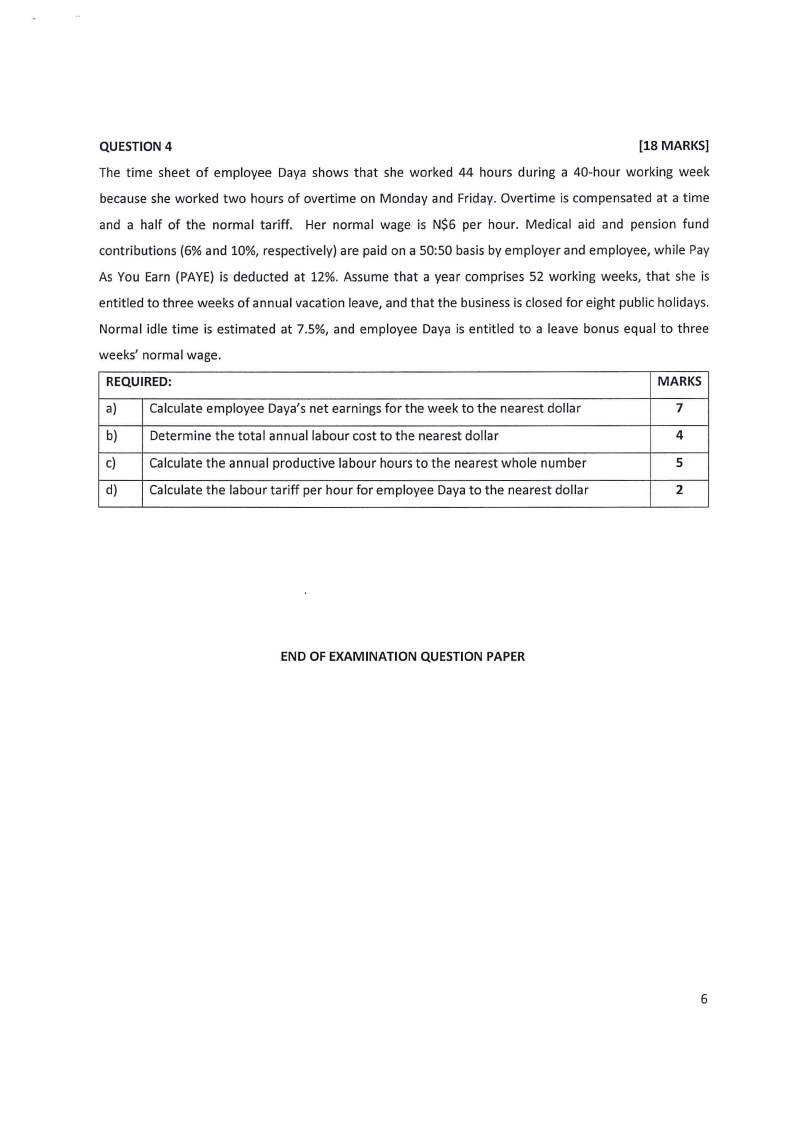
QUESTION 4
[18 MARKS]
The time sheet of employee Daya shows that she worked 44 hours during a 40-hour working week
because she worked two hours of overtime on Monday and Friday. Overtime is compensated at a time
and a half of the normal tariff. Her normal wage is N$6 per hour. Medical aid and pension fund
contributions (6% and 10%, respectively) are paid on a 50:50 basis by employer and employee, while Pay
As You Earn (PAYE) is deducted at 12%. Assume that a year comprises 52 working weeks, that she is
entitled to three weeks of annual vacation leave, and that the business is closed for eight public holidays.
Normal idle time is estimated at 7.5%, and employee Daya is entitled to a leave bonus equal to three
weeks' normal wage.
REQUIRED:
MARKS
a)
Calculate employee Daya's net earnings for the week to the nearest dollar
7
b)
Determine the total annual labour cost to the nearest dollar
4
c)
Calculate the annual productive labour hours to the nearest whole number
5
d)
Calculate the labour tariff per hour for employee Daya to the nearest dollar
2
END OF EXAMINATION QUESTION PAPER
6