


 |
CMN620S - COMMUNICATION NETWORKS - 2ND OPP - DEC 2025 |
|
|
1 Page 1 |
▲back to top |
nAm IB IA UnlVERSITY
OF SC IEnCE Ano TECHn □ LOGY
FACULTY OF COMPUTING AND INFORMATICS
DEPARTMENT OF COMPUTER SCIENCE
QUALIFICATION: BACHELOR OF COMPUTER SCIENCE, BACHELOR OF CYBER SECURITY
QUALIFICATION CODE: 07BACS, 07BCCS
Level: 6
Course Name: Communication Networks
Course code: CMN620S
Date: January 2026
Paper: Theory
Duration: 3 hours
Marks: 70
Examiners
Moderator
Second Opportunity/Supplementary Examination Question Paper
Ms. Albertina Shilongo
Mr. Edward Nepolo
THIS QUESTION PAPER CONSISTS OF 6 PAGES (Including this front page)
INSTRUCTIONS
1. Answer ALL the questions on the answer scripts provided.
2. Write clearly and neatly.
3. Be guided by the number of marks allocated when answering the questions.
4. Show all your calculations.
5. Number your questions clearly.
Permissible Material
Calculators.
1
|
|
2 Page 2 |
▲back to top |
Question 1: Multiple Choice and True/False.
Write the question number and the correct answer next to it.
Indicate whether the following statements are true or false.
a) In addition to its security filtering duties, the Next-Generation Firewall (NGFW) can also perform basic
routing functionalities.
b) The main disadvantage of Static routing is that it consumes more CPU and memory resources than dynamic
routing.
c) 802.lq is the main type of encapsulation trucking protocol that is an IEEE standard.
d) In the routing decision process, where three routes have the same prefix length, the route with the highest
Administrative Distance (AD).
e) Routing primarily takes place at Layer 2 of the OSI model.
f) In a classful addressing system, an organisation with 1000 hosts, a Class C network would be the most
efficient fit without any IP address wastage.
g) With BGP configurations, neighbors are automatically discovered by other routers.
h) The administrative distance for a route learned via eBGP is 200.
i) A VLAN creates a single, large broadcast domain that spans across an entire switched network.
j) RIP can function only with a minimum of 15 routers.
Multiple choice:
k) A data packet with a destination IP address of 192.168.10.50 arrives at this router. Which route will I packet
forward to and why?
a) Route B, because it has a better (lower) Administrative Distance.
b) Route A, because it has a longer prefix match.
c) Route B, because EIGRP is a more intelligent protocol than OSPF.
ct) Route A, because it has a better (higher) Administrative Distance.
I) Which of the following statements clearly differentiate Distance Vector from Link state routing protocols?
a) Distance Vector protocols use LSAs, while Link-State protocols use hop count to select the best route.
b) Distance Vector protocols use hop count, Link-State protocols use complete network topology to
select the best route.
c) Distance Vector protocols are configured between Autonomous Systems, Link-State protocols are
configured inside AS.
d) Distance Vector protocols usually have a higher AD than Link-State protocols.
m) Why would route learned from OSPF(AD=ll0) be preferred over the one learned from RIP (AD=120) to the
same destination network?
a) OSPF has a better metric than RIP as it counts the number of routers.
b) OSPF has a lower Administrative Distance.
c) OSPF functions with longer prefix matches as compared to RIP.
ct) OSPF is an IGP, RIP is an EGP.
2
|
|
3 Page 3 |
▲back to top |
n) An AD of 255 signifies that:
a) The network rout is directly connected
b) The network route is highly trustworthy
c) The network route is highly untrustworthy route
d) The network route is invalid and will never be used.
o) A host is configured with the IP address 132.70.198.41 and a subnet mask of 255.255.192.0. Determine the
network address that this host belongs to.
a) 132.70.0.0
b) 132.70.192.0
c) 132.70.198.0
d) 132.70.255.0
p) Which BGP table contains only the best routes to forward traffic?
a) Neighbor Table
b) BGP Database Table
c) Routing Table
d) Topology Table
q) What is the main function of a Designated Router (DR) in an OSPF multi-access network?
a) To increase the number of OSPF areas.
b) To act as a central point where LSAs are exchanged.
c) To encrypt data in routing tables for security.
d) To assign IP addresses to all other routers on the network.
r) If two routers have the same OSPF priority on a multi-access network, which option will be used as the
breaker for electing the DR?
a) The router with the lowest IP address
b) The router with the fastest link speed.
c) The router with the highest Router ID.
d) The router that was the highest IP address.
s) What type of port should the network engineer configure when he needs the switch port to carry traffic for
multiple VLANS.
a) Access Port
b) Routed Port
c) Trunk Port
d) Dynamic Port
t) Which of the following protocols is used to dynamically negotiate and manage VLAN information from
multiple VLANs between switches?
a) OSPF
b) STP
3
|
|
4 Page 4 |
▲back to top |
c) ARP
d) UDP
Question 2: Define the following concepts.
[10)
a) Area Boundary router
b) OSPF (Open Shortest Path First)
c) Autonomous System (AS)
d) The Longest Prefix Match Rule
e) Hop Count .
Question 3: Long Questions
[20)
1. NUST is in the process of acquiring a new satellite campus located 20km away from the main campus.
The two campuses are connected via a dedicated high-speed fiber link. As the network administrator,
you are tasked with implementing a dynamic routing protocol within this network that will route traffic
between the two campuses, given these conditions:
• The Main Campus has over 50 interconnected routers and multiple paths for redundancy.
• The Satellite Campus is small for now, with only 10 routers with greater potential to grow soon .
• The Link between the campus has high bandwidth, but it is recommended that it should not be
flooded with unnecessary traffic.
a) Which routing protocol would be the most appropriate given the case and conditions above? Justify your
answer with at least three specific reasons.
(7)
b) The implementation of the routing protocols you suggest in A was successful and the university's
leadership is quite impressed with the network's reliability and stability. To build on this robust
foundation, the management made a strategic decision to extend its connection to the global Internet
by purchasing Internet transit services from two separate ISPs (Telecom and Paratus), for redundancy
and have an option of better performance.
To establish and manage the redundant Internet connections, which routing protocol will you configure
on the core router? Justify your selection by explaining its key advantages in this multi-homed ISP
scenario.
(10)
c) Explain the difference between eBGP and IBGP
4
|
|
5 Page 5 |
▲back to top |
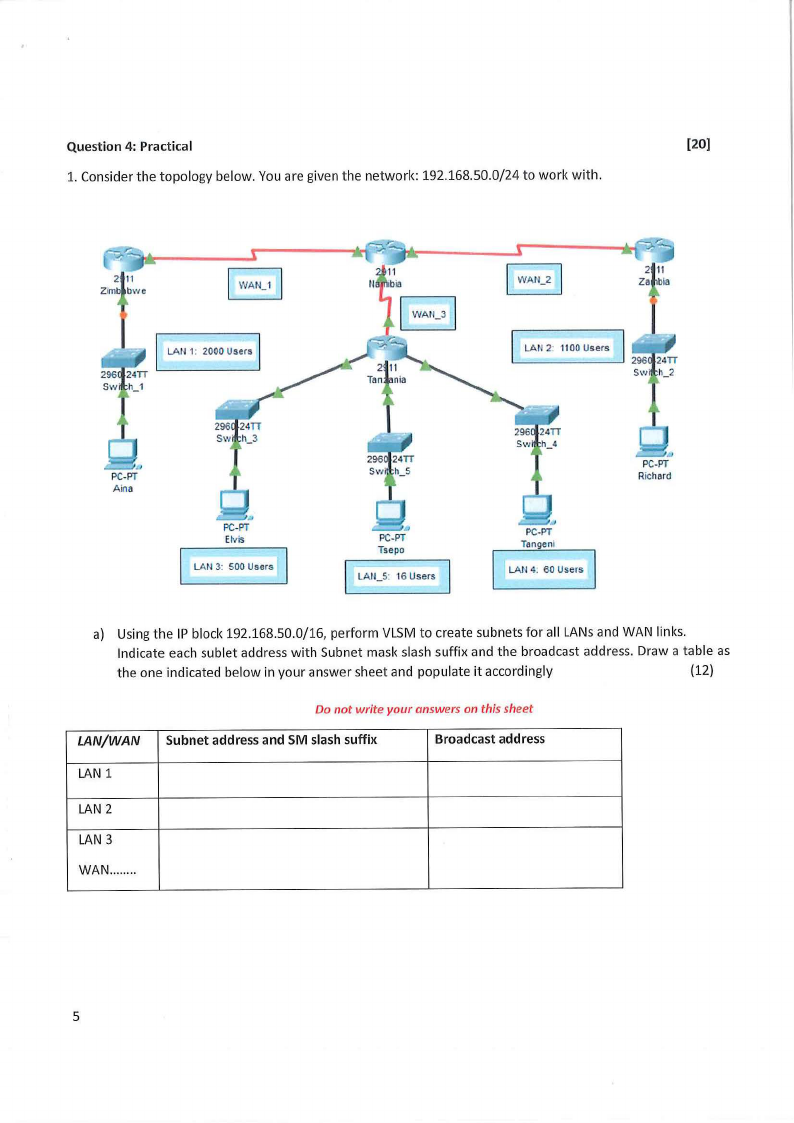
Question 4: Practical
[20)
1. Consider the topology below. You are given the network: 192.168.50.0/24 to work with.
\\
LAN 1; 2000 Users
2 11
Za bla
LAN 2: 1100 Users
,,
PC-PT
Aina
~...
PC-PT
Elvis
LAIi 3: 500 Users
Tsepo
LAN_S: 16 Users
t---1.,
PC-PT
Richard
Tangent
LAN 4. 60 Users
a) Using the IP block 192.168.50.0/16, perform VLSM to create subnets for all LANs and WAN links.
Indicate each sublet address with Subnet mask slash suffix and the broadcast address. Draw a table as
the one indicated below in your answer sheet and populate it accordingly
(12)
LAN/WAN
LAN 1
Do not write your answers on this sheet
Subnet address and SM slash suffix
Broadcast address
LAN 2
LAN 3
WAN ........
s
|
|
6 Page 6 |
▲back to top |
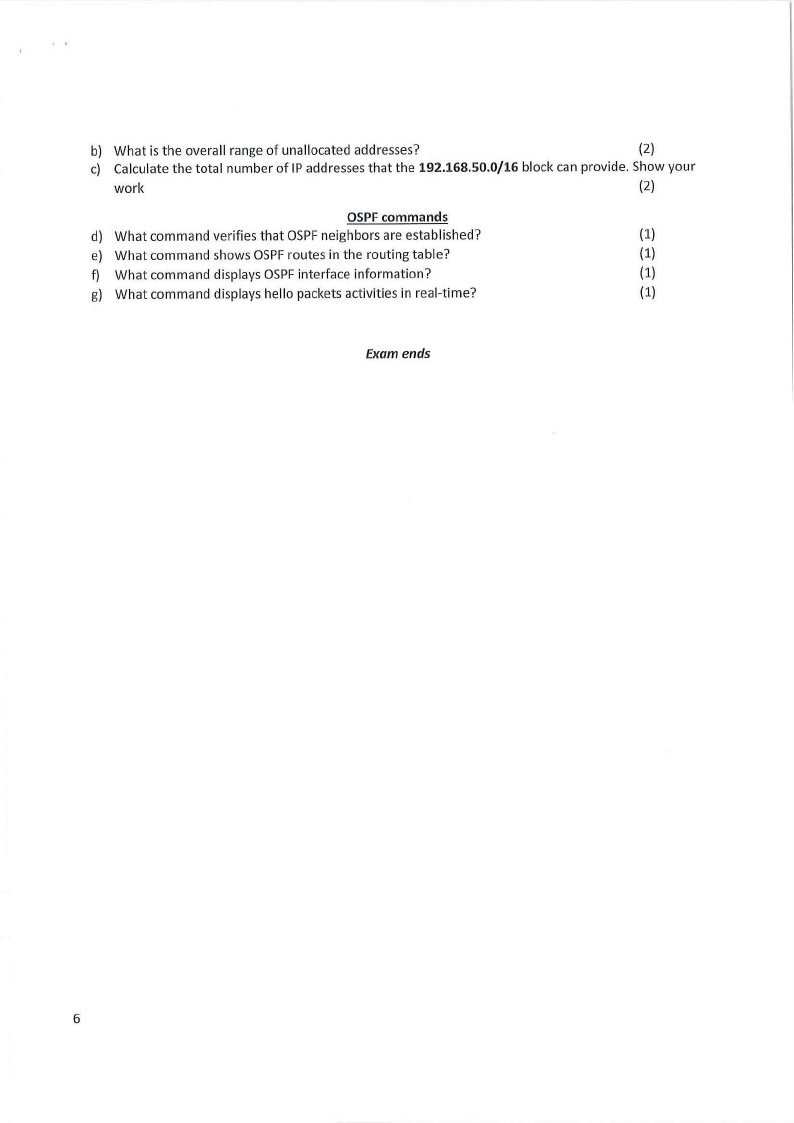
b) What is the overall range of unallocated addresses?
(2)
c) Calculate the total number of IP addresses that the 192.168.50.0/16 block can provide. Show your
work
(2)
OSPF commands
d) What command verifies that OSPF neighbors are established?
(1)
e) What command shows OSPF routes in the routing table?
(1)
f) What command displays OSPF interface information?
(1)
g) What command displays hello packets activities in real-time?
(1)
Exam ends
6