


 |
HTL510S - Hospitality And Tourism Law - 2nd Opp - Nov 2025 |
|
|
1 Page 1 |
▲back to top |
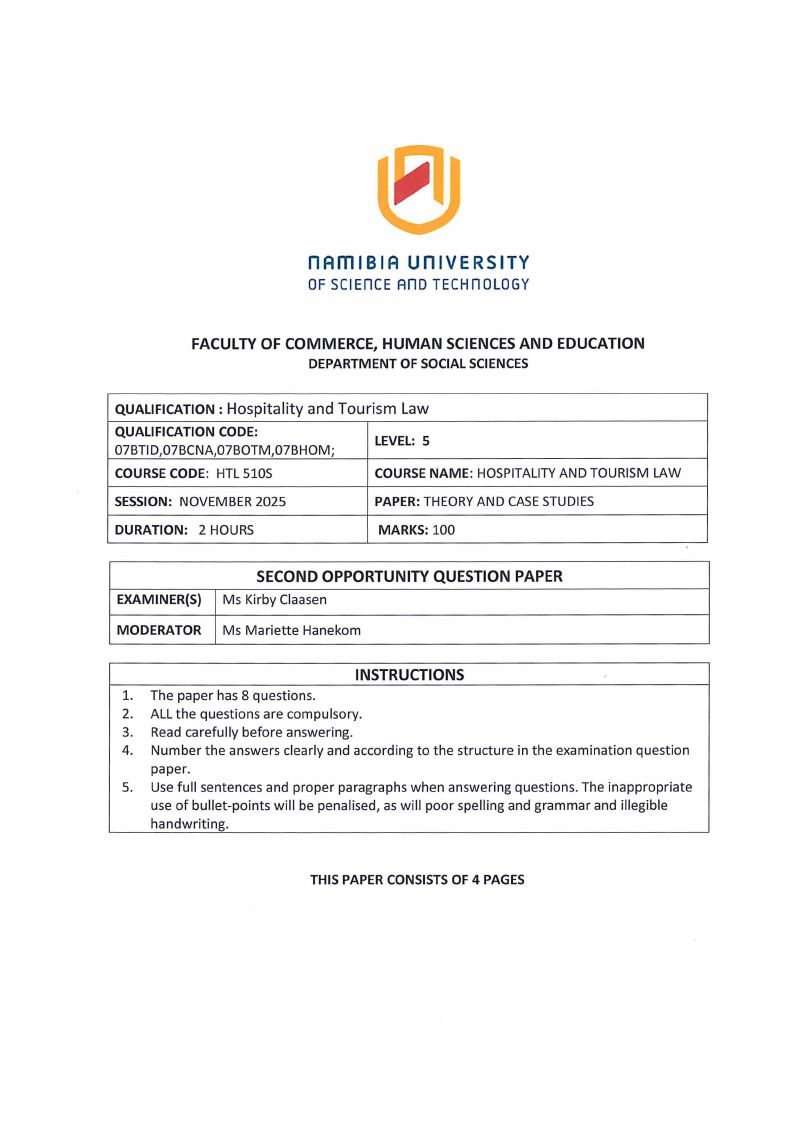
nAm l BIA unlVERSITY
OF SCIEnCE Ano TECHn □ LOGY
FACULTY OF COMMERCE, HUMAN SCIENCES AND EDUCATION
DEPARTMENT OF SOCIAL SCIENCES
QUALIFICATION: Hospitality and Tourism Law
QUALIFICATION CODE:
07BTI D,07BCNA,07BOTM,07BHOM;
LEVEL: 5
COURSE CODE: HTL 5105
COURSE NAME: HOSPITALITY AND TOURISM LAW
SESSION: NOVEMBER 2025
PAPER: THEORY AND CASE STUDIES
DURATION: 2 HOURS
MARKS: 100
SECOND OPPORTUNITY QUESTION PAPER
EXAMINER(S) Ms Kirby Claasen
MODERATOR Ms Mariette Hanekom
INSTRUCTIONS
1. The paper has 8 questions.
2. ALL the questions are compulsory.
3. Read carefully before answering.
4. Number the answers clearly and according to the structure in the examination question
paper.
5. Use full sentences and proper paragraphs when answering questions. The inappropriate
use of bullet-points will be penalised, as will poor spelling and grammar and illegible
handwriting.
THIS PAPER CONSISTS OF 4 PAGES
|
|
2 Page 2 |
▲back to top |
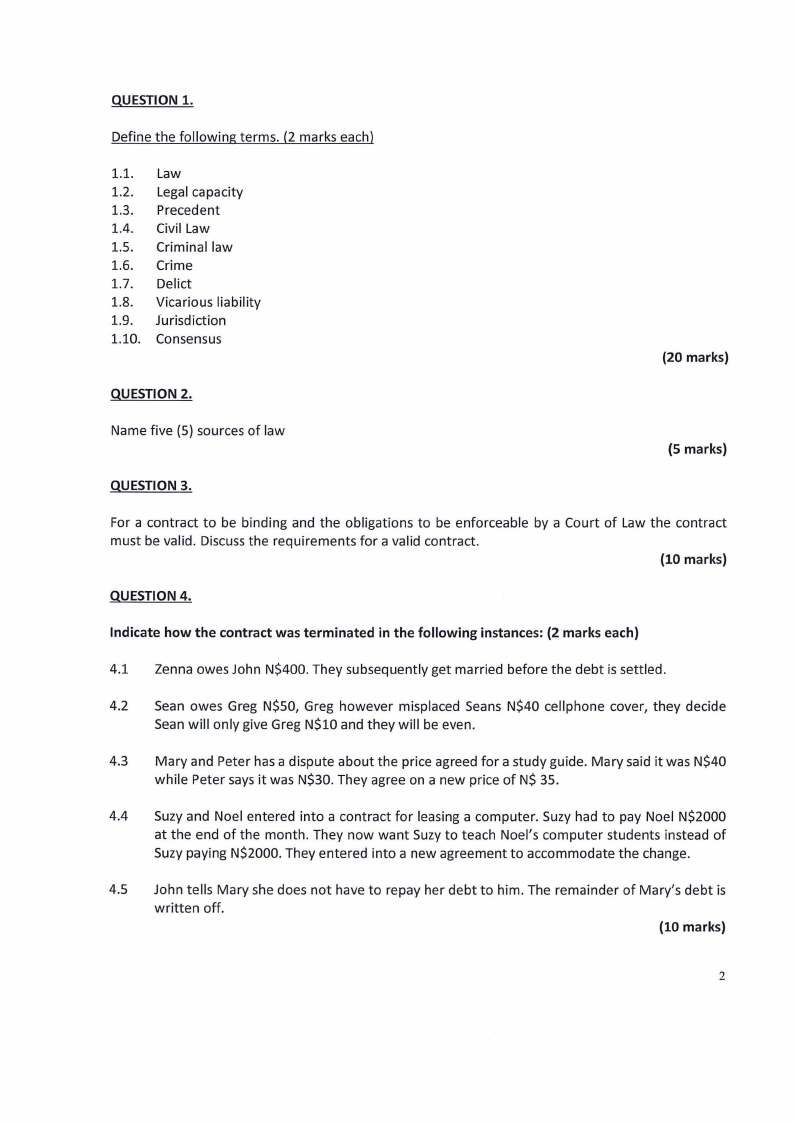
QUESTION 1.
Define the following terms. (2 marks each)
1.1.
1.2.
1.3.
1.4.
1.5.
1.6.
1.7.
1.8.
1.9.
1.10.
Law
Legal capacity
Precedent
Civil Law
Criminal law
Crime
Delict
Vicarious liability
Jurisdiction
Consensus
(20 marks)
QUESTION 2.
Name five (5) sources of law
(5 marks)
QUESTION 3.
For a contract to be binding and the obligations to be enforceable by a Court of Law the contract
must be valid. Discuss the requirements for a valid contract.
(10 marks)
QUESTION 4.
Indicate how the contract was terminated in the following instances: (2 marks each)
4.1 Zenna owes John N$400. They subsequently get married before the debt is settled.
4.2 Sean owes Greg N$50, Greg however misplaced Seans N$40 cellphone cover, they decide
Sean will only give Greg N$10 and they will be even.
4.3 Mary and Peter has a dispute about the price agreed for a study guide. Mary said it was N$40
while Peter says it was N$30. They agree on a new price of N$ 35.
4.4 Suzy and Noel entered into a contract for leasing a computer. Suzy had to pay Noel N$2000
at the end of the month. They now want Suzy to teach Noel's computer students instead of
Suzy paying N$2000. They entered into a new agreement to accommodate the change.
4.5 John tells Mary she does not have to repay her debt to him. The remainder of Mary's debt is
written off.
(10 marks)
2
|
|
3 Page 3 |
▲back to top |
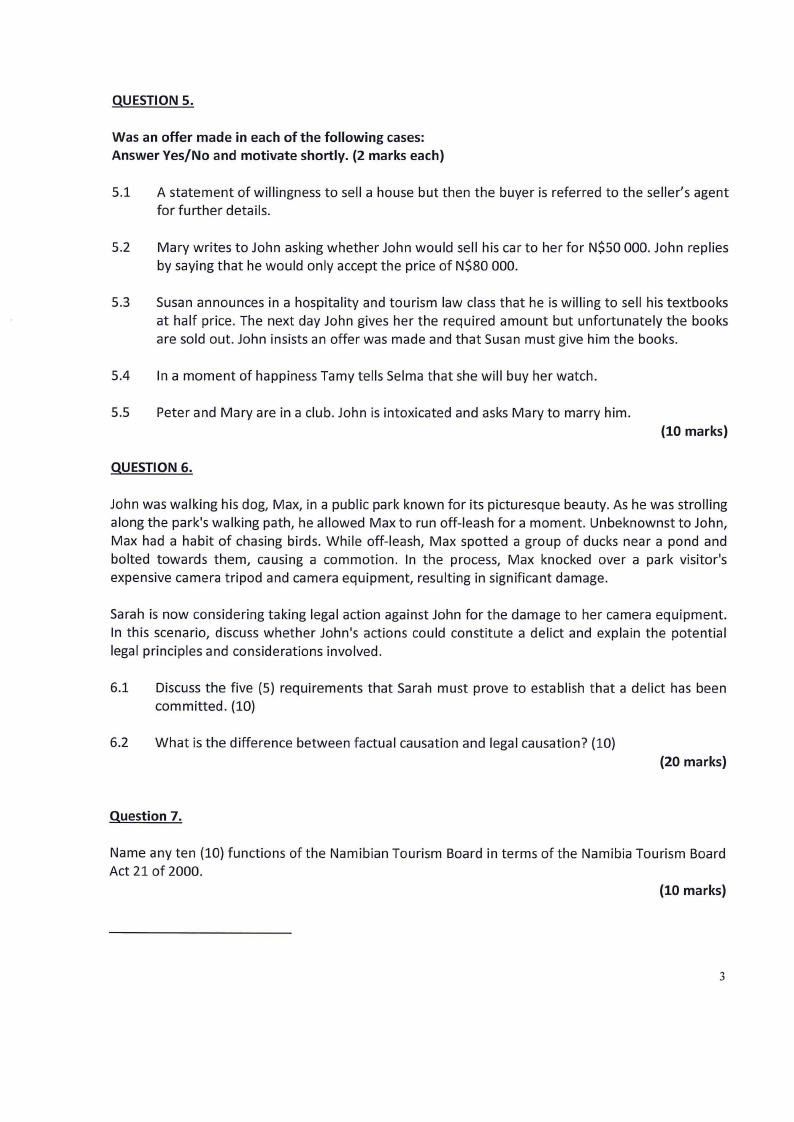
QUESTION 5.
Was an offer made in each of the following cases:
Answer Yes/No and motivate shortly. (2 marks each)
5.1 A statement of willingness to sell a house but then the buyer is referred to the seller's agent
for further details.
5.2 Mary writes to John asking whether John would sell his car to her for N$50 000. John replies
by saying that he would only accept the price of N$80 000.
5.3 Susan announces in a hospitality and tourism law class that he is willing to sell his textbooks
at half price. The next day John gives her the required amount but unfortunately the books
are sold out. John insists an offer was made and that Susan must give him the books.
5.4 In a moment of happiness Tamy tells Selma that she will buy her watch .
5.5 Peter and Mary are in a club. John is intoxicated and asks Mary to marry him.
{10 marks)
QUESTION 6.
John was walking his dog, Max, in a public park known for its picturesque beauty. As he was strolling
along the park's walking path, he allowed Max to run off-leash for a moment. Unbeknownst to John,
Max had a habit of chasing birds. While off-leash, Max spotted a group of ducks near a pond and
bolted towards them, causing a commotion. In the process, Max knocked over a park visitor's
expensive camera tripod and camera equipment, resulting in significant damage.
Sarah is now considering taking legal action against John for the damage to her camera equipment.
In this scenario, discuss whether John's actions could constitute a delict and explain the potential
legal principles and considerations involved.
6.1 Discuss the five {5) requirements that Sarah must prove to establish that a delict has been
committed. (10)
6.2 What is the difference between factual causation and legal causation? (10)
(20 marks)
Question 7.
Name any ten (10) functions of the Namibian Tourism Board in terms of the Namibia Tourism Board
Act 21 of 2000.
{10 marks)
3
|
|
4 Page 4 |
▲back to top |
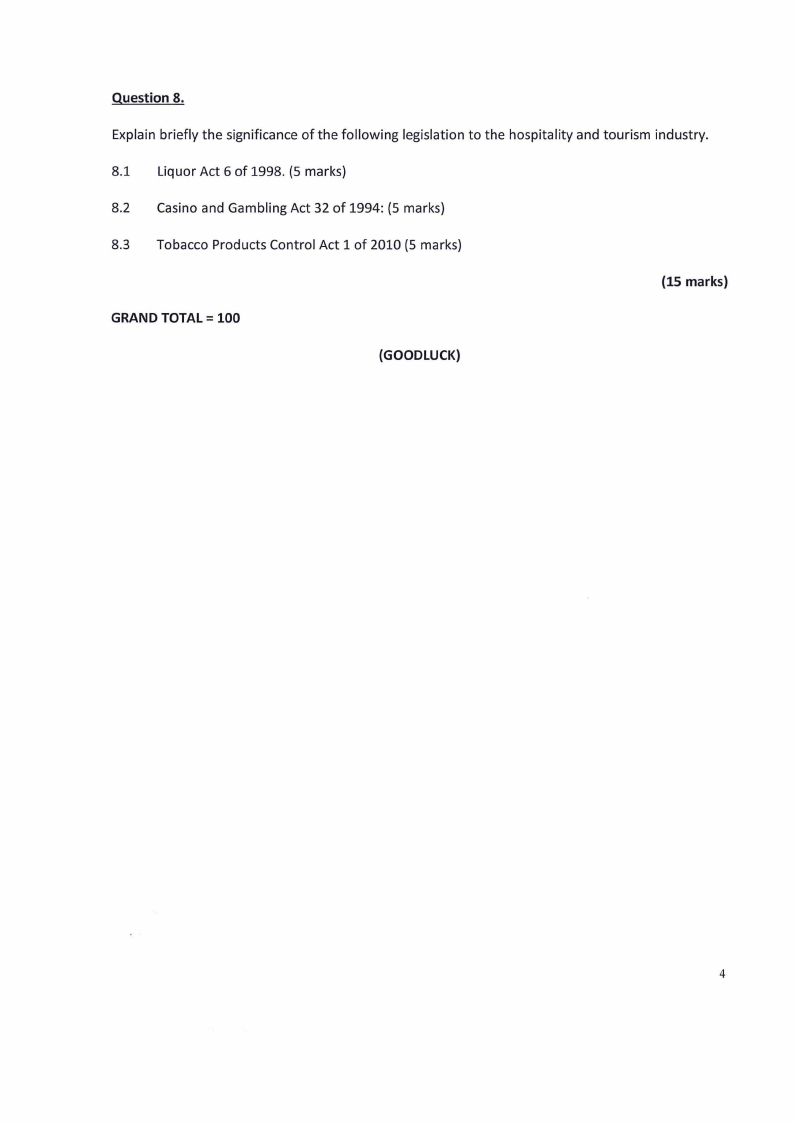
Question 8.
Explain briefly the significance of the following legislation to the hospitality and tourism industry.
8.1 Liquor Act 6 of 1998. (5 marks)
8.2 Casino and Gambling Act 32 of 1994: (5 marks)
8.3 Tobacco Products Control Act 1 of 2010 (5 marks)
{15 marks)
GRAND TOTAL= 100
{GOODLUCK)
4