


 |
PCC811S - PUBLIC COMMUNICATION - 1ST OPP - JUNE 2025 |
|
|
1 Page 1 |
▲back to top |
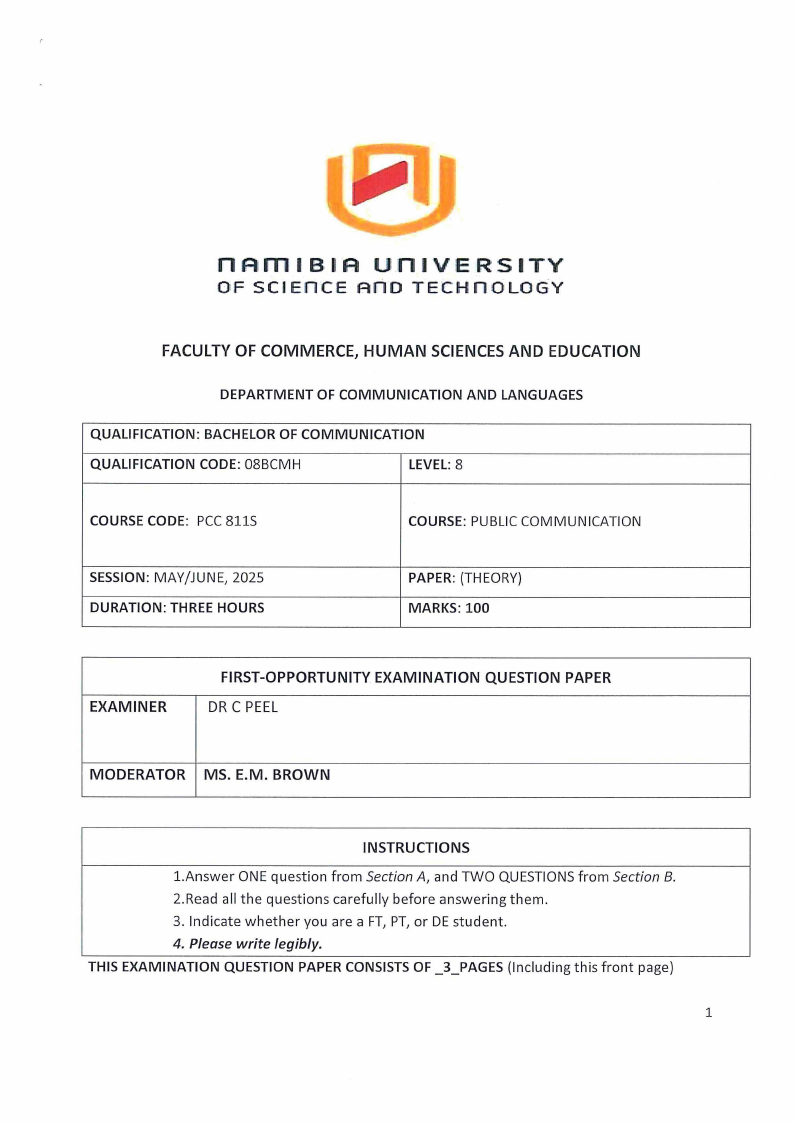
n Am I BI A u11nI VE RS ITY
OF SCIEnCE Ario TECHnOLOG:v
FACULTY OF COMMERCE, HUMAN SCIENCESAND EDUCATION
DEPARTMENT OF COMMUNICATION AND LANGUAGES
QUALIFICATION: BACHELOR OF COMMUNICATION
QUALIFICATION CODE: 08BCMH
LEVEL: 8
COURSE CODE: PCC8115
COURSE: PUBLIC COMMUNICATION
SESSION: MAY/JUNE, 2025
DURATION: THREE HOURS
PAPER: (THEORY)
MARKS: 100
EXAMINER
FIRST-OPPORTUNITY EXAMINATION QUESTION PAPER
DR C PEEL
MODERATOR MS. E.M. BROWN
INSTRUCTIONS
1.Answer ONE question from Section A, and TWO QUESTIONS from Section B.
2.Read all the questions carefully before answering them.
3. Indicate whether you are a FT, PT, or DE student.
4. Please write legibly.
THIS EXAMINATION QUESTION PAPER CONSISTS OF _3_PAGES (Including this front page)
1
|
|
2 Page 2 |
▲back to top |
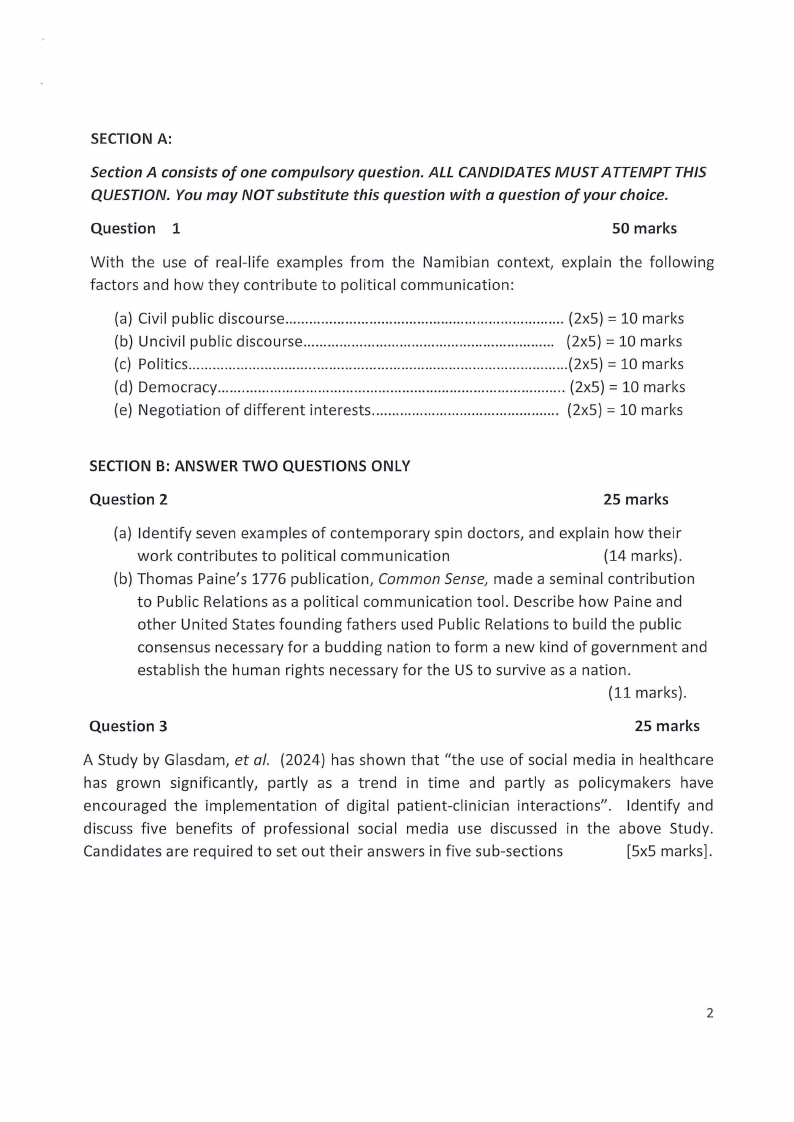
SECTION A:
Section A consists of one compulsory question. ALL CANDIDA TES MUST ATTEMPT THIS
QUESTION. You may NOT substitute this question with a question of your choice.
Question 1
50 marks
With the use of real-life examples from the Namibian context, explain the following
factors and how they contribute to political communication:
(a) Civil public discourse ......................................................................(2x5} = 10 marks
(b) Uncivil public discourse............................................................... (2x5) = 10 marks
(c) Politics ...............................................................................................(2x5} = 10 marks
(d) Democracy .......................................................................................(2x5} = 10 marks
(e) Negotiation of different interests ............................................... (2x5} = 10 marks
SECTION B: ANSWER TWO QUESTIONS ONLY
Question 2
25 marks
(a) Identify seven examples of contemporary spin doctors, and explain how their
work contributes to political communication
(14 marks).
(b) Thomas Paine's 1776 publication, Common Sense, made a seminal contribution
to Public Relations as a political communication tool. Describe how Paine and
other United States founding fathers used Public Relations to build the public
consensus necessary for a budding nation to form a new kind of government and
establish the human rights necessary for the US to survive as a nation.
(11 marks).
Question 3
25 marks
A Study by Glasdam, et al. (2024} has shown that "the use of social media in healthcare
has grown significantly, partly as a trend in time and partly as policymakers have
encouraged the implementation of digital patient-clinician interactions". Identify and
discuss five benefits of professional social media use discussed in the above Study.
Candidates are required to set out their answers in five sub-sections
[SxS marks].
2
|
|
3 Page 3 |
▲back to top |
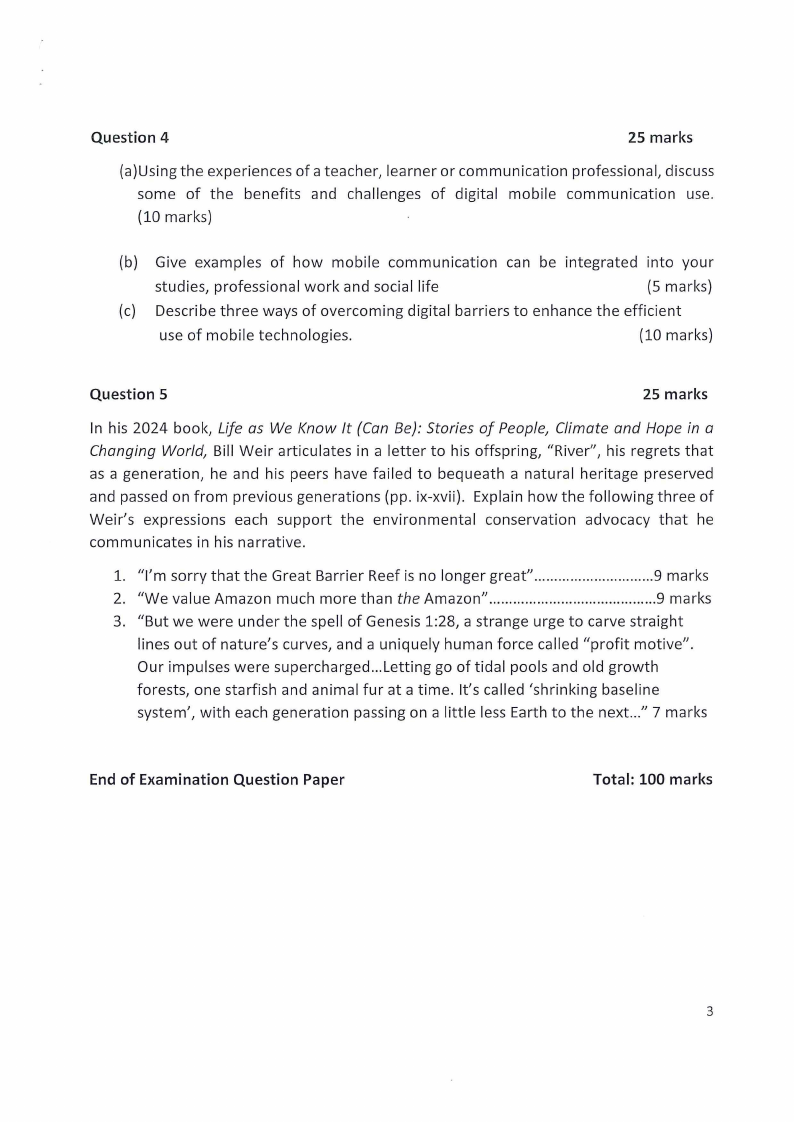
Question 4
25 marks
(a}Using the experiences of a teacher, learner or communication professional, discuss
some of the benefits and challenges of digital mobile communication use.
(10 marks)
(b) Give examples of how mobile communication can be integrated into your
studies, professional work and social life
(5 marks)
(c) Describe three ways of overcoming digital barriers to enhance the efficient
use of mobile technologies.
(10 marks)
Question 5
25 marks
In his 2024 book, Life as We Know It (Can Be): Stories of People, Climate and Hope in a
Changing World, Bill Weir articulates in a letter to his offspring, "River", his regrets that
as a generation, he and his peers have failed to bequeath a natural heritage preserved
and passed on from previous generations (pp. ix-xvii}. Explain how the following three of
Weir's expressions each support the environmental conservation advocacy that he
communicates in his narrative.
1. "I'm sorry that the Great Barrier Reef is no longer great" ..............................9 marks
2. "We value Amazon much more than the Amazon" .........................................9. marks
3. "But we were under the spell of Genesis 1:28, a strange urge to carve straight
lines out of nature's curves, and a uniquely human force called "profit motive".
Our impulses were supercharged ...Letting go of tidal pools and old growth
forests, one starfish and animal fur at a time. It's called 'shrinking baseline
system', with each generation passing on a little less Earth to the next ..." 7 marks
End of Examination Question Paper
Total: 100 marks
3