PMA512S-PRINCIPLES OF MACROECONOMICS-2ND OPP-DEC 2025


PMA512S-PRINCIPLES OF MACROECONOMICS-2ND OPP-DEC 2025


1 Pages 1-10

▲back to top


1.1 Page 1

▲back to top


~
nAmlBIA UnlVERSITY
OF SCI En CE Ano TEC HnOLOGY
FACULTY OF COMMERCE, HUMAN SCIENCES AND EDUCATION
DEPARTMENT OF ECONOMICS, ACCOUNTING AND FINANCE
QUALIFICATION: VARI OUS (SERVICE COURSE)
QUALIFICATION CODE: VARIOUS CODES LEVEL: 7
COURSE CODE: PMA512S
COURSE NAME: PRINCIPLES OF
MACROECONOMICS
SESSION: DECEMBER 2025
DURATION : 3 HOURS
SESSION: PAPER THEORY
MARKS: 100
SECOND OPPORTUNITY EXAMINATION QUESTION PAPER
EXAMINER(S) MS. PRECIOUS MWIKANDA
MODERATOR: Mr. ESLON NGEENDEPI
INSTRUCTIONS
1. Answer all questions in this question paper.
2. Read all the questions carefully before answering.
3. Section A and B should be answered on the attached sheets provided at the end of
the question paper found on page 16 and 17 (detach them now) .
4. Question 1 to 6 of Sections: C, D, and Eshould be answered in the answer book.
5. Ensure to eclose the Multiple Choice and True and False Answer Sheet in your
Examination Answer Book.
PERMISSIBLE ITEMS:
Ruler
Calculator
Pencil
Pen (blue or black)
THIS QUESTION PAPER CONSISTS OF _17_ PAGES (Including this front page)
1

1.2 Page 2

▲back to top


SECTION A
20MARKS
Instructions:
Select one correct answer and write your answers on the answer sheet provided on page 16.
Tear the page off and place it inside your examination script.
1.1 The supply of money is mainly influenced by:
a) Depositors, commercial banks, foreigners.
b) Foreign trade, International capita l flows, government transactions.
c) Depositors, government, demanders for money.
d) Both a and b.
[1 mark]
1.2 The supply of money is determined by:
a) the demand for money.
b) the supply curve.
c) the interest rates.
d) The monetary authority.
[1 mark]
1.3 In the open market operations, when the central bank decreases the price of securities
this will cause..........
[1 mark]
a) Money supply to increase.
b) Interest rate to increase.
c) Interest rate to decrease.
d) None of the above
1.4 Which of the following is not classified as indirect tax:
a) Customs duties.
b) Excise duties.
c) Value added tax.
d) Income tax.
[1 mark]
2

1.3 Page 3

▲back to top


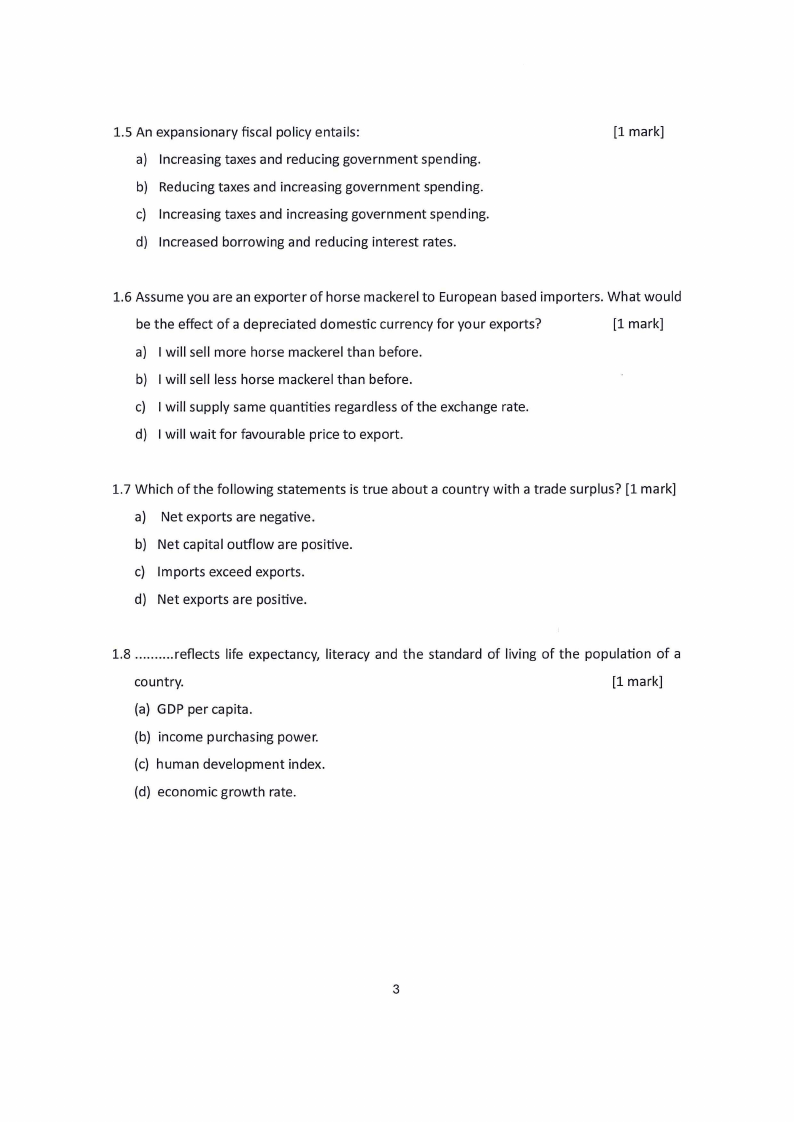
1.5 An expansionary fiscal policy entails:
a) Increasing taxes and reducing government spending.
b) Reducing taxes and increasing government spending.
c) Increasing taxes and increasing government spending.
d) Increased borrowing and reducing interest rates.
[1 mark]
1.6 Assume you are an exporter of horse mackerel to European based importers. What would
be the effect of a depreciated domestic currency for your exports?
[1 mark]
a) I will sell more horse mackerel than before.
b) I will sell less horse mackerel than before.
c) I will supply same quantities regardless of the exchange rate.
d) I will wait for favourable price to export.
1.7 Which ofthe following statements is true about a country with a trade surplus? [1 mark]
a) Net exports are negative.
b) Net capital outflow are positive.
c) Imports exceed exports.
d) Net exports are positive.
1.8 .......... reflects life expectancy, literacy and the standard of living of the population of a
country.
[1 mark]
(a) GDP per capita.
(b) income purchasing power.
(c) human development index.
(d) economic growth rate.
3

1.4 Page 4

▲back to top


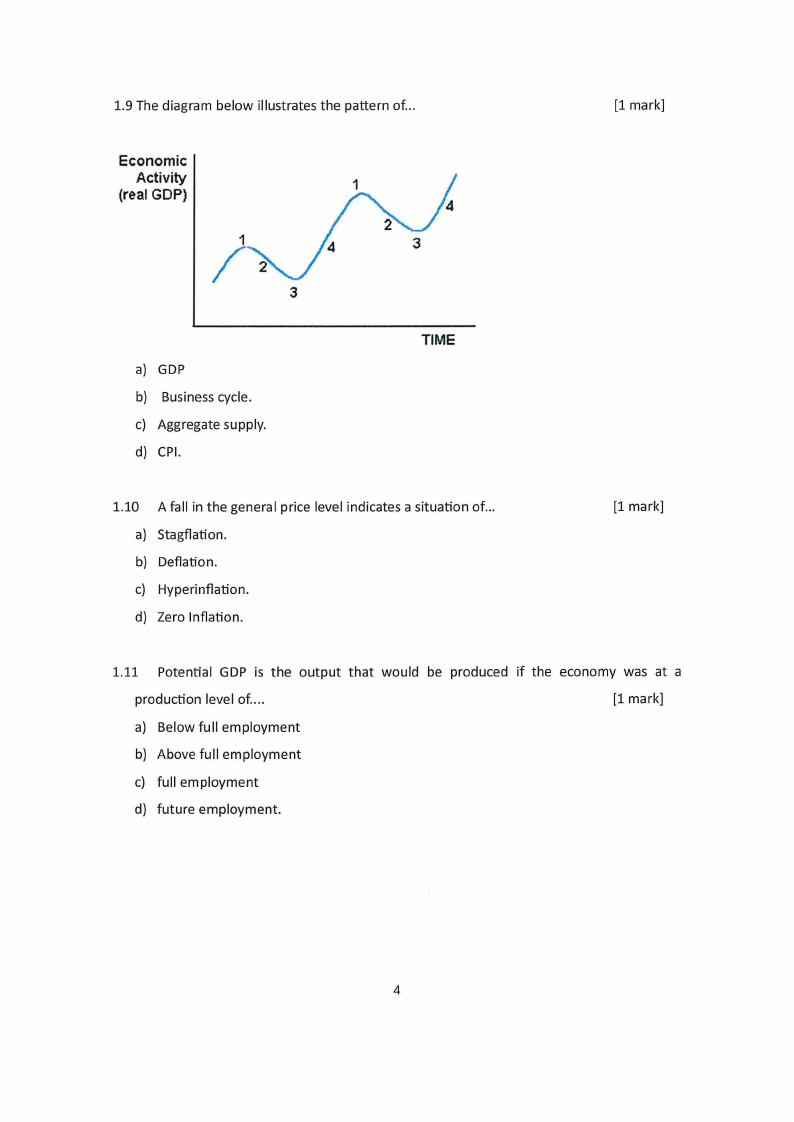
1.9 The diagram below illustrates the pattern of...
Economic
Activity
(real GDP)
(1 mark]
3
a) GDP
b) Business cycle .
c) Aggregate supply.
d) CPI.
TIME
1.10 A fall in the general price level indicates a situation of...
a) Stagflation.
b) Deflation.
c) Hyperinflation.
d) Zero Inflation.
[1 mark]
1.11 Potential GDP is the output that would be produced if the economy was at a
production level of.. ..
[1 mark]
a) Below full employment
b) Above full employment
c) full employment
d) future employment.
4

1.5 Page 5

▲back to top


1.12 Which of the following explains why the demand curve slopes downward. [1 mark]
a) world economy fluctuations.
b) preferences of consumers.
c) wealth effect.
d) money wage effect.
1.13 A ...... ...... believes that the economy is self-regulating and that it will normally operate at
full employment, provided that monetary policy is not erratic and that the pace of money
growth is kept steady.
[1 mark]
a) Keynesian
b) Capitalist
c) Monetarist
d) New Monetarists.
1.14 If a rise in the expected inflation rate makes buying goods cheaper today, then
aggregate demand would .....
[1 mark]
a) Decrease.
b) Increase.
c) No effect.
d) None of the above.
1.15 ... .is an example of a proportional tax.
a) Income tax
b) Company tax.
c) VAT.
d) Sin tax.
[1 mark]
1.16 The government borrows when they are faced with :
a) Balanced budget.
b) Surplus budget.
c) Actual budget.
d) Deficit budget.
5
[1 mark]

1.6 Page 6

▲back to top


1.17 Increasing tax rates is a policy option associated with ....
a) Contractionary fiscal policy.
b) expansionary fiscal policy.
c) restrictive monetary policy.
d) expansionary monetary policy.
[1 mark]
1.18 Economic growth can be caused by....
a) Increase in physical capital.
b) Increase in price level.
c) Increase in icome.
d) Increase in profits.
[1 mark]
1.19 In 2019 Real GDP for country X was $30500 and by 2020 it was $39800. By how much
did the country's economy grow or decline?
[1 mark]
a) Declined by 30.5%
b) Grew by 30.5%
c) Declined by 23.4%
d) Grew by 23.4%
1.20 Given that MPC is 0.65, what is the change in income of an investment amount of
N$100000.
[1 mark]
a) N$200 000.00
b) N$285714.29
c) 153 846.15
d) 253846.15
6

1.7 Page 7

▲back to top


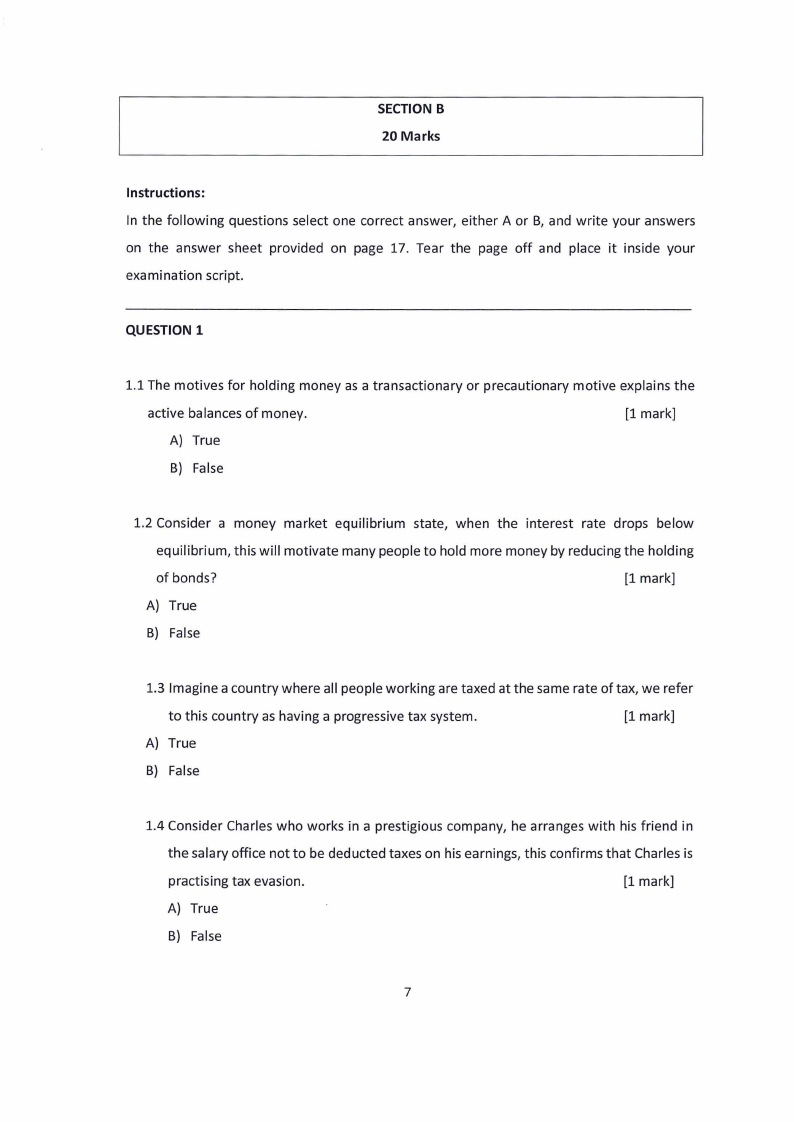
SECTION B
20 Marks
Instructions:
In the following questions select one correct answer, either A or B, and write your answers
on the answer sheet provided on page 17. Tear the page off and place it inside your
examination script.
QUESTION 1
1.1 The motives for holding money as a transactionary or precautionary motive explains the
active balances of money.
[1 mark]
A) True
B) False
1.2 Consider a money market equilibrium state, when the interest rate drops below
equilibrium, this will motivate many people to hold more money by reducing the holding
of bonds?
[1 mark]
A) True
B) False
1.3 Imagine a country where all people working are taxed at the same rate of tax, we refer
to this country as having a progressive tax system.
[1 mark]
A) True
B) False
1.4 Consider Charles who works in a prestigious company, he arranges with his friend in
the salary office not to be deducted taxes on his earnings, this confirms that Charles is
practising tax evasion .
[1 mark]
A) True
B) False
7

1.8 Page 8

▲back to top


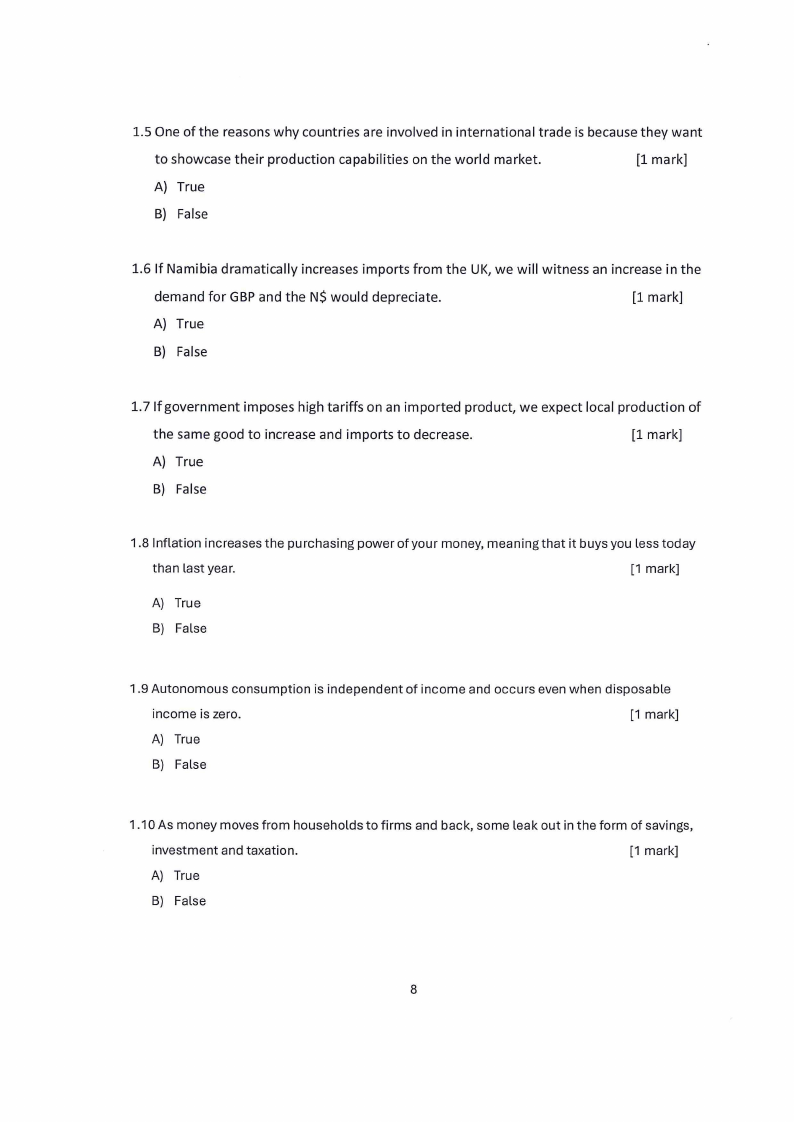
1.5 One of the reasons why countries are involved in international trade is because they want
to showcase their production capabilities on the world market.
[1 mark]
A) True
B) False
1.6 If Namibia dramatically increases imports from the UK, we will witness an increase in the
demand for GBP and the N$ would depreciate.
[1 mark]
A) True
B) False
1.7 If government imposes high tariffs on an imported product, we expect local production of
the same good to increase and imports to decrease.
[1 mark]
A) True
B) False
1.8 Inflation increases the purchasing power of your money, meaning that it buys you less today
than last year.
[1 mark]
A) True
B) False
1.9 Autonomous consumption is independent of income and occurs even when disposable
income is zero.
[1 mark]
A) True
B) False
1.10 As money moves from households to firms and back, some leak out in the form of savings,
investment and taxation.
[1 mark]
A) True
B) False
8

1.9 Page 9

▲back to top


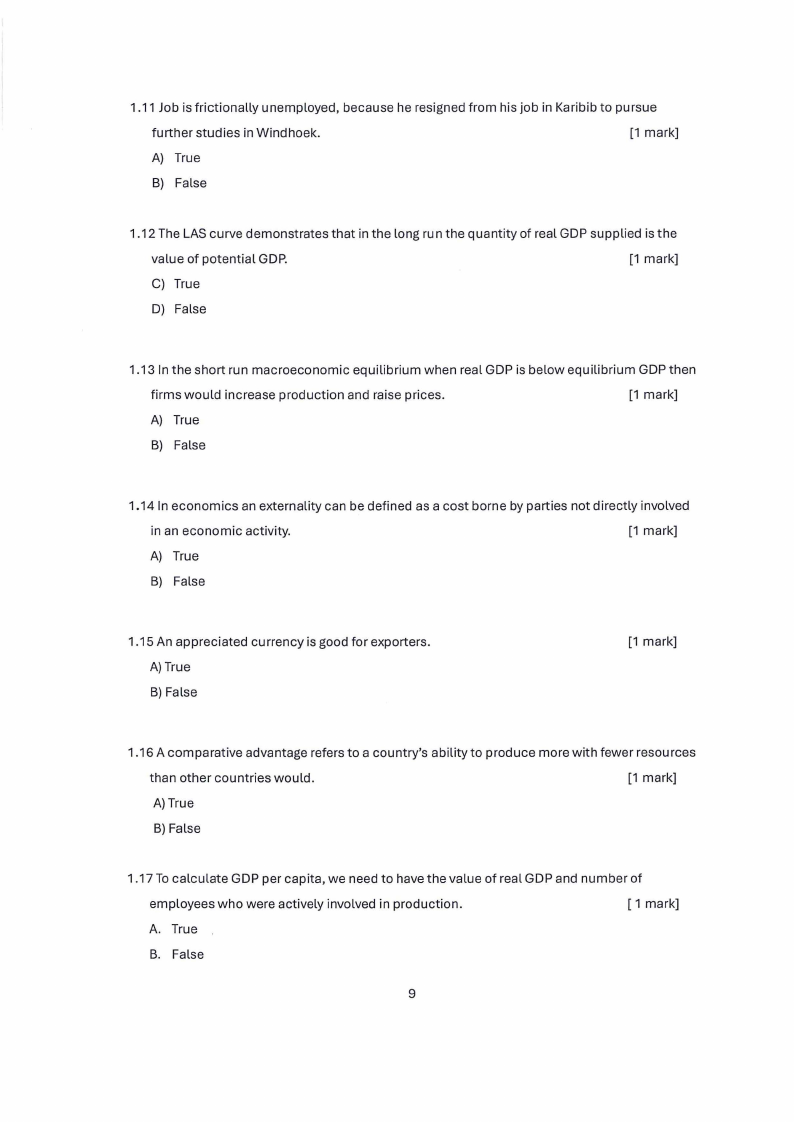
1.11 Job is frictionally unemployed, because he resigned from his job in Karibib to pursue
further studies in Windhoek.
[1 mark]
A} True
B} False
1.12 The LAS curve demonstrates that in the long run the quantity of real GDP supplied is the
value of potential GDP.
[1 mark]
C} True
D} False
1.13 In the short run macroeconomic equilibrium when real GDP is below equilibrium GDP then
firms would increase production and raise prices.
[1 mark]
A} True
B} False
1.14 In economics an externality can be defined as a cost borne by parties not directly involved
in an economic activity.
[1 mark]
A} True
B} False
1.15 An appreciated currency is good for exporters.
A} True
B} False
[1 mark]
1.16 A comparative advantage refers to a country's ability to produce more with fewer resources
than other countries would.
[1 mark]
A} True
B} False
1.17 To calculate GDP per capita, we need to have the value of real GDP and number of
employees who were actively involved in production.
[ 1 mark]
A. True
B. False
9

1.10 Page 10

▲back to top


1.18 Equilibrium in a two- sector economy is shown by the equation Y= C + I +G.
A. True
B. False
[1 mark]
1.19 According to the Keynesian Model, dissaving occurs when consumption expenditure is
greater than disposable income.
[1 mark]
A. True
B. False
1.20 If the world price of a product is lower than the domestic price, a country does not have a
comparative advantage and wouldn't become an exporter of that product
[1 mark]
A. True
B. False
10

2 Pages 11-20

▲back to top


2.1 Page 11

▲back to top


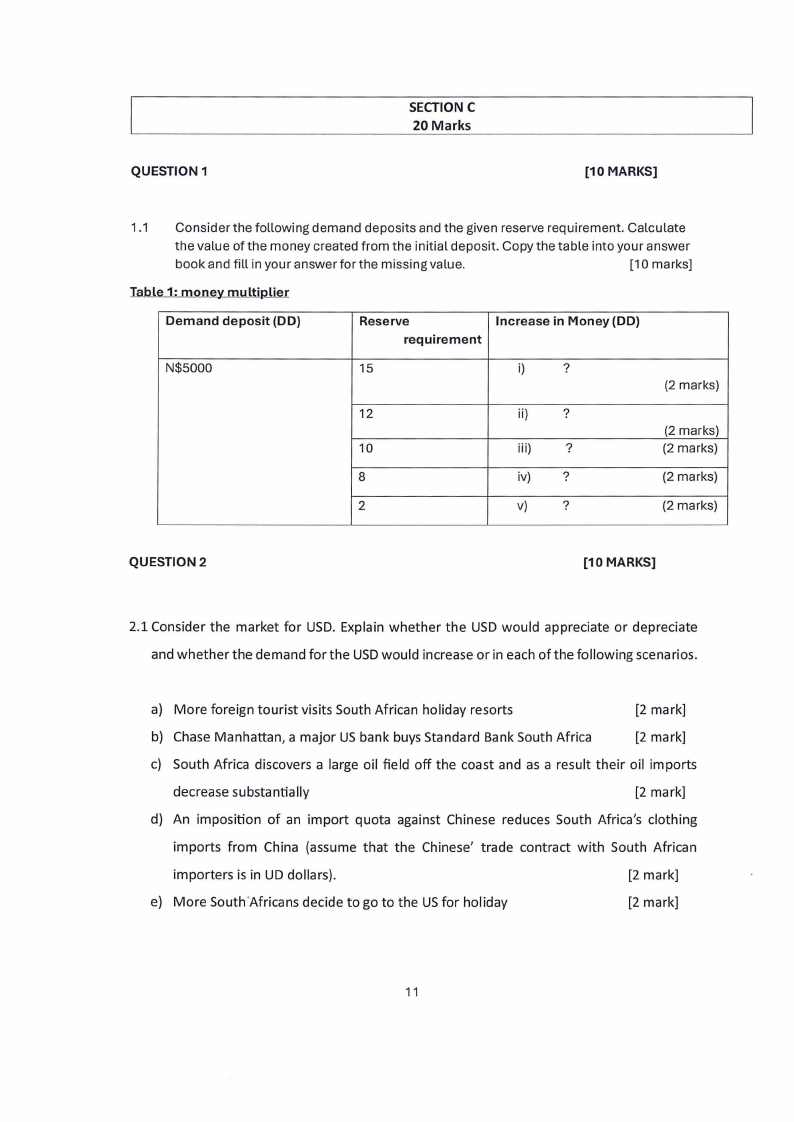
QUESTION 1
SECTION C
20 Marks
[10 MARKS]
1.1 Consider the following demand deposits and the given reserve requirement. Calculate
the value of the money created from the initial deposit. Copy the table into your answer
book and fill in your answer for the missing value.
[10 marks]
Table 1: money multiplie.r
Demand deposit (DD)
Reserve
Increase in Money (DD)
requirement
N$5000
15
i)
?
(2 marks)
12
ii)
?
(2 marks)
10
iii)
?
(2 marks)
8
iv) ?
(2 marks)
2
v)
?
(2 marks)
QUESTION2
[10 MARKS]
2.1 Consider the market for USO. Explain whether the USD would appreciate or depreciate
and whether the demand for the USD would increase or in each of the following scenarios.
a) More foreign tourist visits South African holiday resorts
[2 mark]
b) Chase Manhattan, a major US bank buys Standard Bank South Africa
[2 mark]
c) South Africa discovers a large oil field off the coast and as a result their oil imports
decrease substantially
[2 mark]
d) An imposition of an import quota against Chinese reduces South Africa's clothing
imports from China (assume that the Chinese' trade contract with South African
importers is in UD dollars).
[2 mark]
e) More South "Africans decide to go to the US for holiday
[2 mark]
11

2.2 Page 12

▲back to top


QUESTION3
SECTION D
20 Marks
10 MARKS
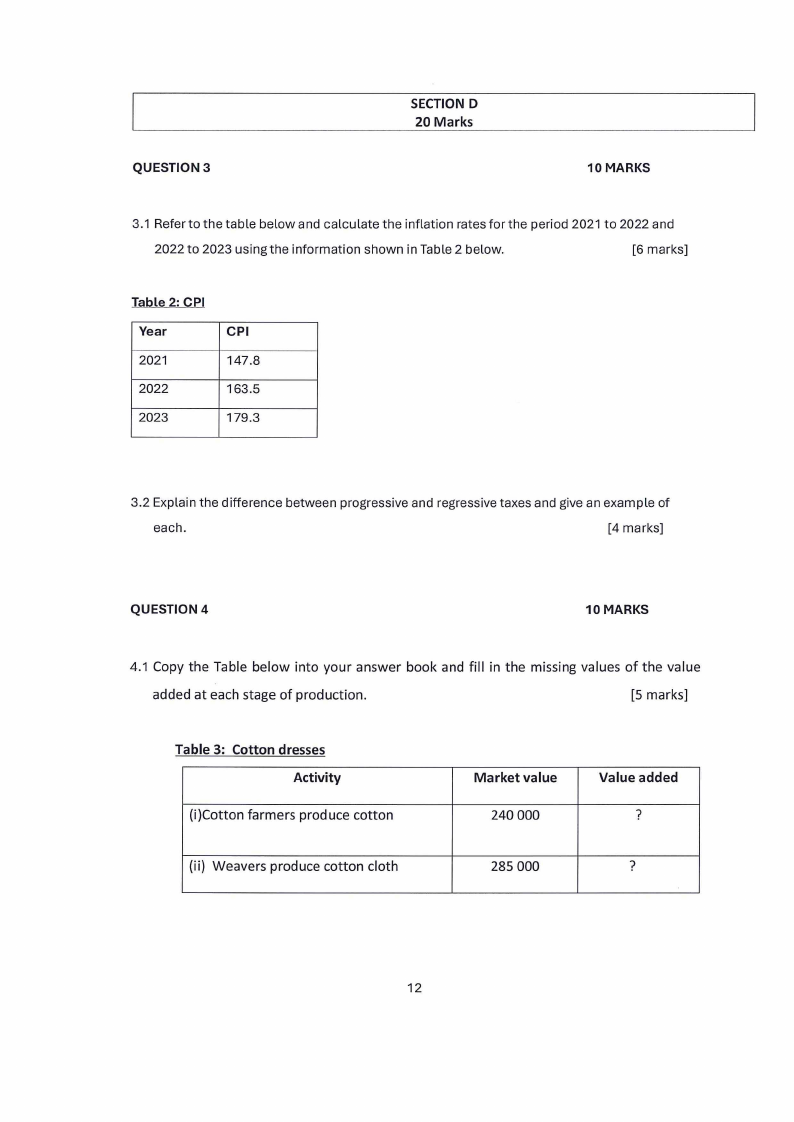
3.1 Refer to the table below and calculate the inflation rates for the period 2021 to 2022 and
2022 to 2023 using the information shown in Table 2 below.
[6 marks]
Table 2: CPI
Year
2021
2022
2023
CPI
147.8
163.5
179.3
3.2 Explain the difference between progressive and regressive taxes and give an example of
each.
[4 marks]
QUESTION4
10 MARKS
4. 1 Copy the Table below into your answer book and fill in the missing values of the value
added at each stage of production.
[S marks]
Table 3: Cotton dresses
Activity
(i)Cotton farmers produce cotton
(ii) Weavers produce cotton cloth
Market value
240 000
Value added
?
285 000
?
12

2.3 Page 13

▲back to top


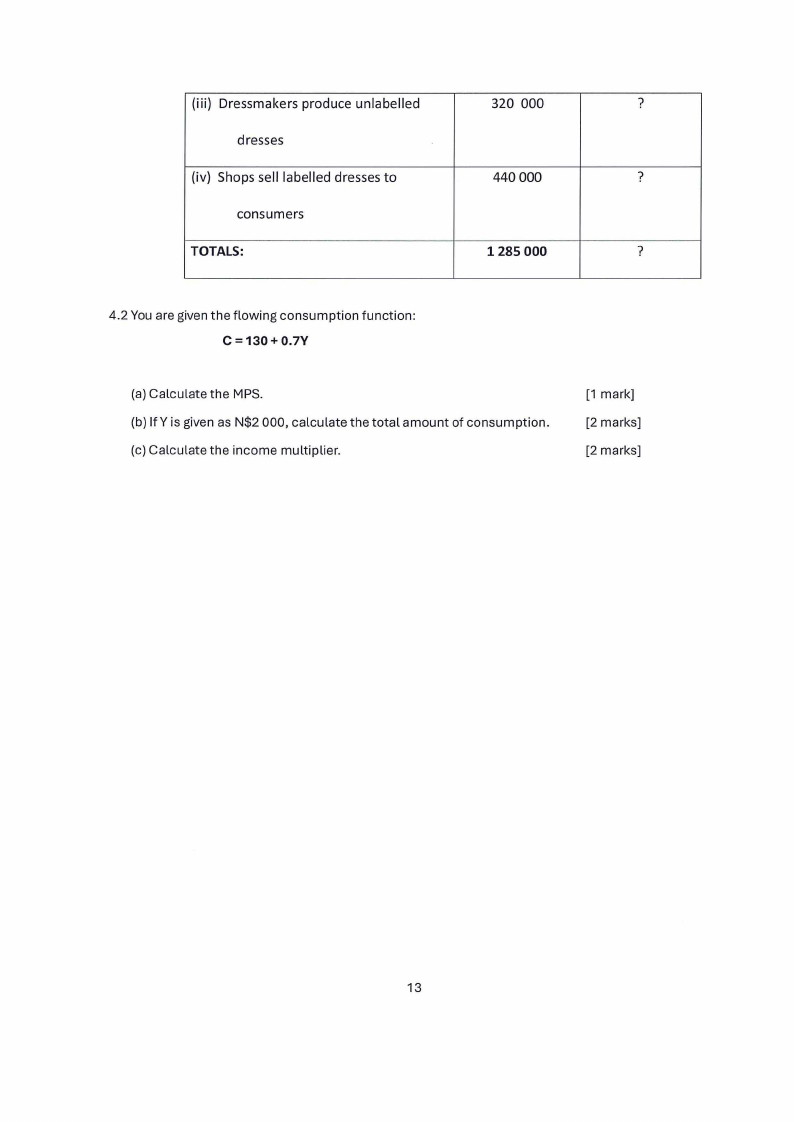
{iii) Dressmakers produce unlabelled
320 000
?
dresses
{iv) Shops sell labelled dresses to
440 000
?
consumers
TOTALS:
1285 000
?
4.2 You are given the flowing consumption function :
C = 130 + 0.7V
(a) Calculate the MPS.
(b) lfY is given as N$2 000, calculate the total amount of consumption .
(c) Calculate the income multiplier.
[1 mark]
[2 marks]
[2 marks]
13

2.4 Page 14

▲back to top


QUESTIONS
SECTION E
20 Marks
10 MARKS
5.1 Trade barriers, mainly import tariffs, are evident when countries are dealing in
international trade. What are the two arguments against import tariffs? [2 marks]
5.2 Refer to the picture below and mention two factors of production by listing the factor and
the example of object that represents that factor.
[2 marks]
5.3 Explain how future expectations and government regulation in the form of monetary policy
can affect aggregate demand .
[4 marks]
5.4 Explain how restrictive monetary policy can be used by the central bank to combat inflation.
[2 marks]
14

2.5 Page 15

▲back to top


QUESTIONS
10 MARKS
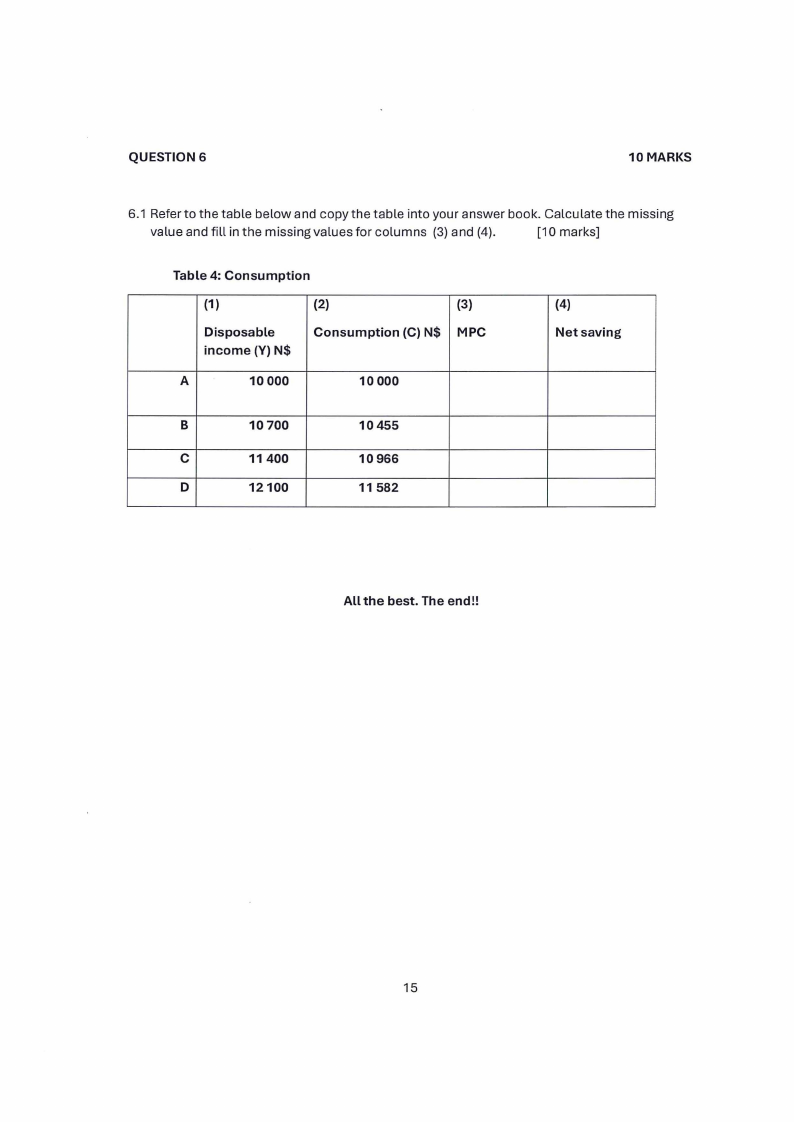
6.1 Refer to the table below and copy the table into your answer book. Calculate the missing
value and fill in the missing values for columns (3) and (4).
[10 marks]
Table 4: Consumption
(1)
Disposable
income (Y) N$
(2)
(3)
Consumption (C) N$ MPC
A
10 000
10 000
(4)
Net saving
B
10 700
C
11 400
D
12100
10455
10966
11 582
All the best. The end!!
15