


 |
WHE721S - EMPLOYEE WELLNESS%2C HEALTH AND ERGONOMIC - 2ND OPP - NOV 2025 |
|
|
1 Page 1 |
▲back to top |
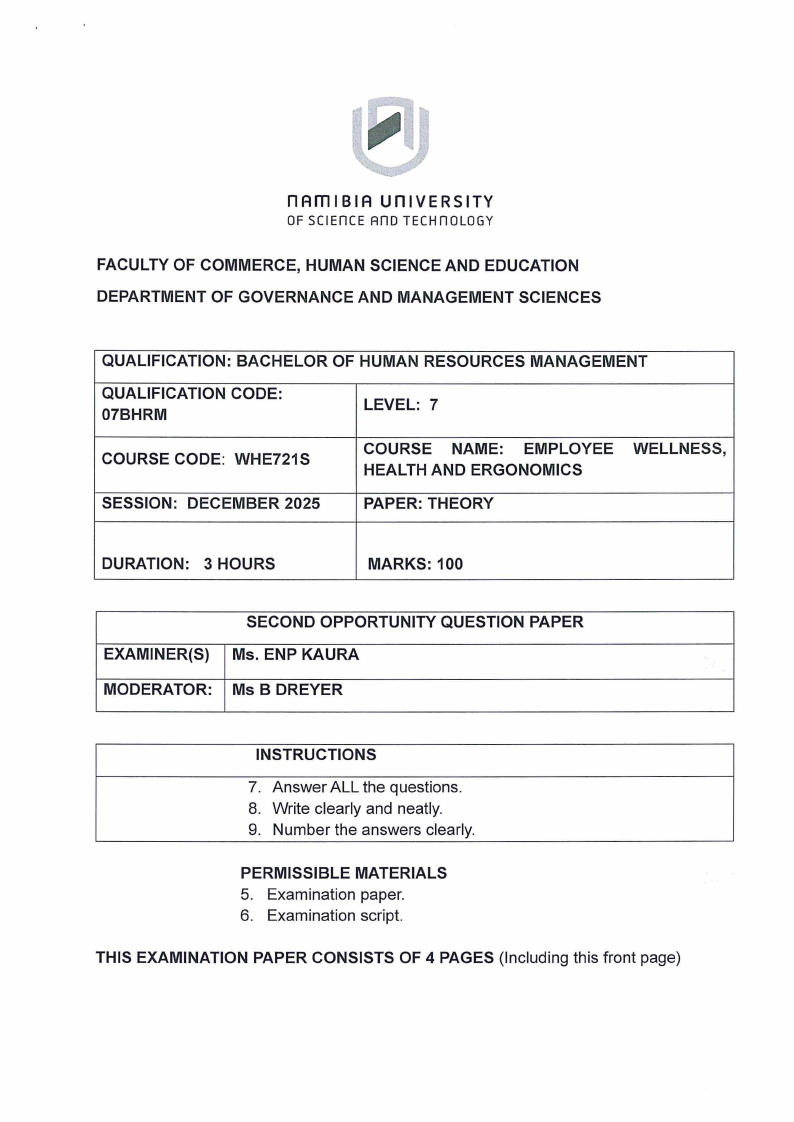
n Am I B I A u n IVE Rs ITY
OF SCI En CE Ano TECH n OLOGY
FACULTY OF COMMERCE, HUMAN SCIENCE AND EDUCATION
DEPARTMENT OF GOVERNANCE AND MANAGEMENT SCIENCES
QUALIFICATION: BACHELOR OF HUMAN RESOURCES MANAGEMENT
QUALIFICATION CODE:
07BHRM
LEVEL: 7
COURSE CODE: WHE721 S
COURSE NAME: EMPLOYEE WELLNESS,
HEALTH AND ERGONOMICS
SESSION: DECEMBER 2025
PAPER: THEORY
DURATION: 3 HOURS
MARKS: 100
SECOND OPPORTUNITY QUESTION PAPER
EXAMINER(S) Ms. ENP KAURA
MODERATOR: Ms B DREYER
INSTRUCTIONS
7. Answer ALL the questions.
8. Write clearly and neatly.
9. Number the answers clearly.
PERMISSIBLE MATERIALS
5. Examination paper.
6. Examination script.
THIS EXAMINATION PAPER CONSISTS OF 4 PAGES (Including this front page)
|
|
2 Page 2 |
▲back to top |
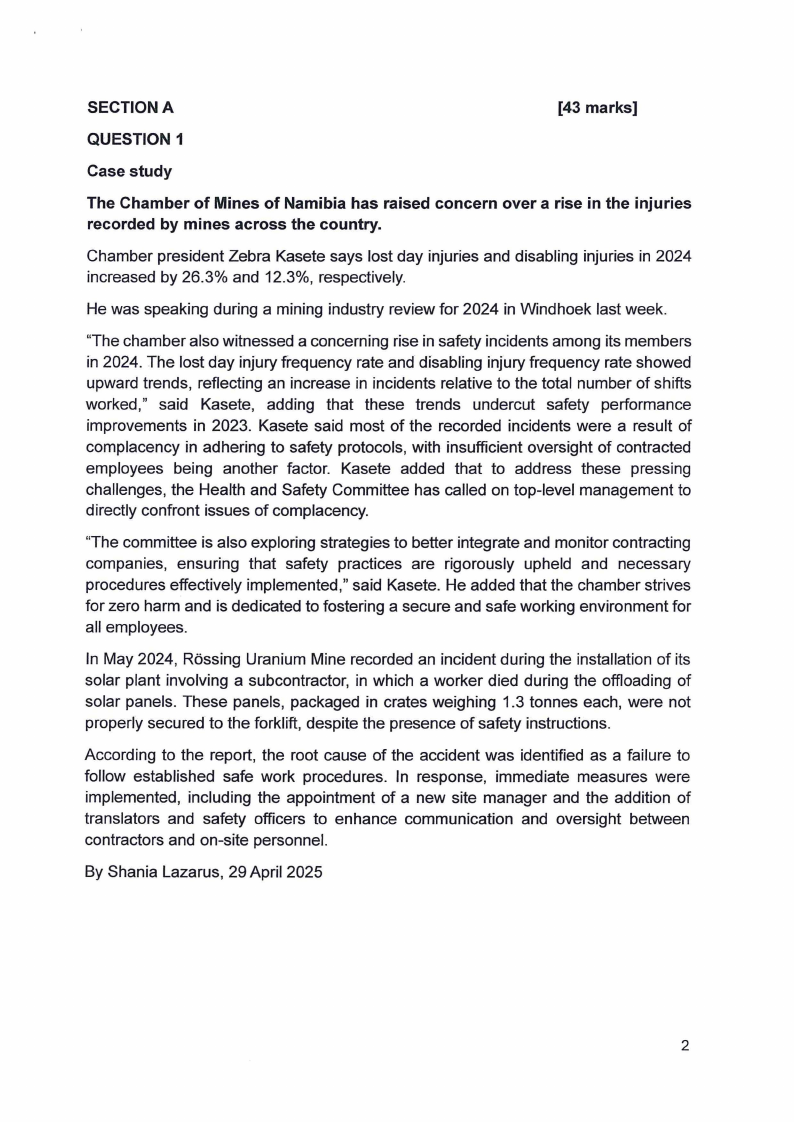
SECTION A
[43 marks]
QUESTION 1
Case study
The Chamber of Mines of Namibia has raised concern over a rise in the injuries
recorded by mines across the country.
Chamber president Zebra Kasete says lost day injuries and disabling injuries in 2024
increased by 26.3% and 12.3%, respectively.
He was speaking during a mining industry review for 2024 in Windhoek last week.
"The chamber also witnessed a concerning rise in safety incidents among its members
in 2024. The lost day injury frequency rate and disabling injury frequency rate showed
upward trends, reflecting an increase in incidents relative to the total number of shifts
worked," said Kasete, adding that these trends undercut safety performance
improvements in 2023. Kasete said most of the recorded incidents were a result of
complacency in adhering to safety protocols, with insufficient oversight of contracted
employees being another factor. Kasete added that to address these pressing
challenges, the Health and Safety Committee has called on top-level management to
directly confront issues of complacency.
"The committee is also exploring strategies to better integrate and monitor contracting
companies, ensuring that safety practices are rigorously upheld and necessary
procedures effectively implemented," said Kasete. He added that the chamber strives
for zero harm and is dedicated to fostering a secure and safe working environment for
all employees.
In May 2024, Rossing Uranium Mine recorded an incident during the installation of its
solar plant involving a subcontractor, in which a worker died during the offloading of
solar panels. These panels, packaged in crates weighing 1.3 tonnes each, were not
properly secured to the forklift, despite the presence of safety instructions.
According to the report, the root cause of the accident was identified as a failure to
follow established safe work procedures. In response, immediate measures were
implemented, including the appointment of a new site manager and the addition of
translators and safety officers to enhance communication and oversight between
contractors and on-site personnel.
By Shania Lazarus, 29 April 2025
2
|
|
3 Page 3 |
▲back to top |
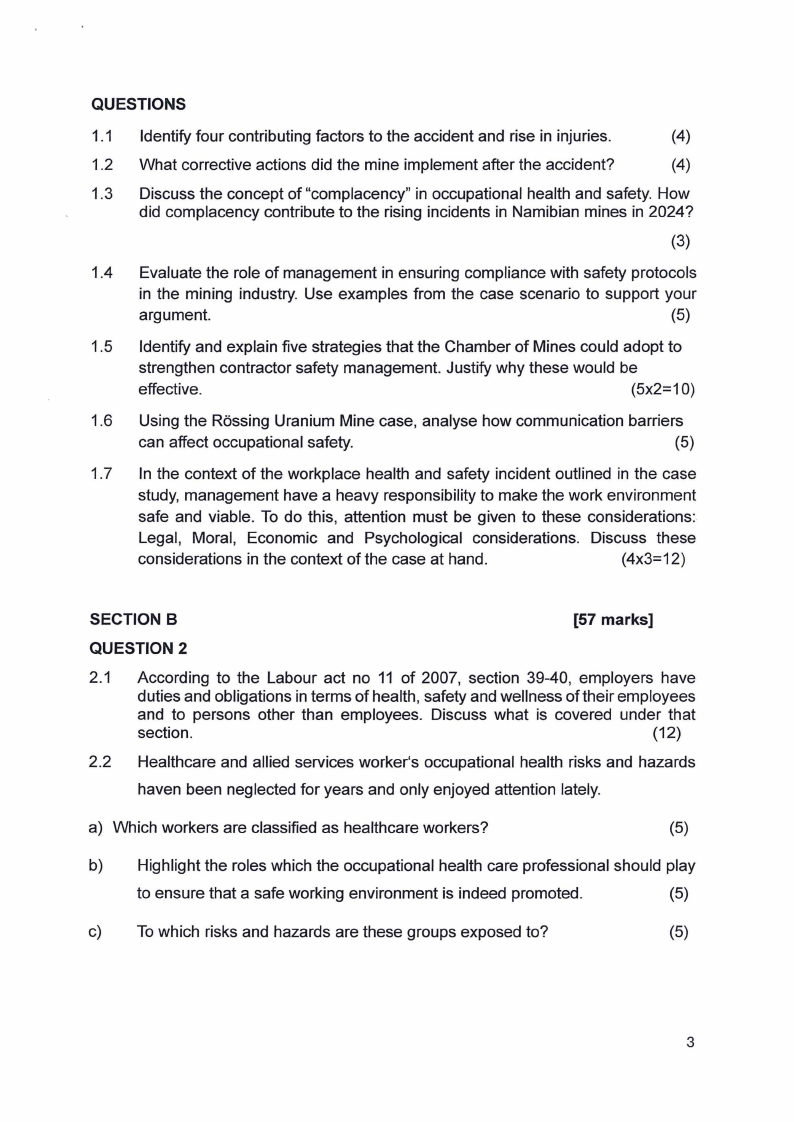
QUESTIONS
1.1 Identify four contributing factors to the accident and rise in injuries.
(4)
1.2 What corrective actions did the mine implement after the accident?
(4)
1.3 Discuss the concept of "complacency" in occupational health and safety. How
did complacency contribute to the rising incidents in Namibian mines in 2024?
(3)
1.4 Evaluate the role of management in ensuring compliance with safety protocols
in the mining industry. Use examples from the case scenario to support your
argument.
(5)
1.5 Identify and explain five strategies that the Chamber of Mines could adopt to
strengthen contractor safety management. Justify why these would be
effective.
(5x2=10)
1.6 Using the Rossing Uranium Mine case, analyse how communication barriers
can affect occupational safety.
(5)
1.7 In the context of the workplace health and safety incident outlined in the case
study, management have a heavy responsibility to make the work environment
safe and viable. To do this, attention must be given to these considerations:
Legal, Moral, Economic and Psychological considerations. Discuss these
considerations in the context of the case at hand.
(4x3=12)
SECTION B
[57 marks]
QUESTION 2
2.1 According to the Labour act no 11 of 2007, section 39-40, employers have
duties and obligations in terms of health, safety and wellness of their employees
and to persons other than employees. Discuss what is covered under that
section.
(12)
2.2 Healthcare and allied services worker's occupational health risks and hazards
haven been neglected for years and only enjoyed attention lately.
a) Which workers are classified as healthcare workers?
(5)
b) Highlight the roles which the occupational health care professional should play
to ensure that a safe working environment is indeed promoted.
(5)
c) To which risks and hazards are these groups exposed to?
(5)
3
|
|
4 Page 4 |
▲back to top |
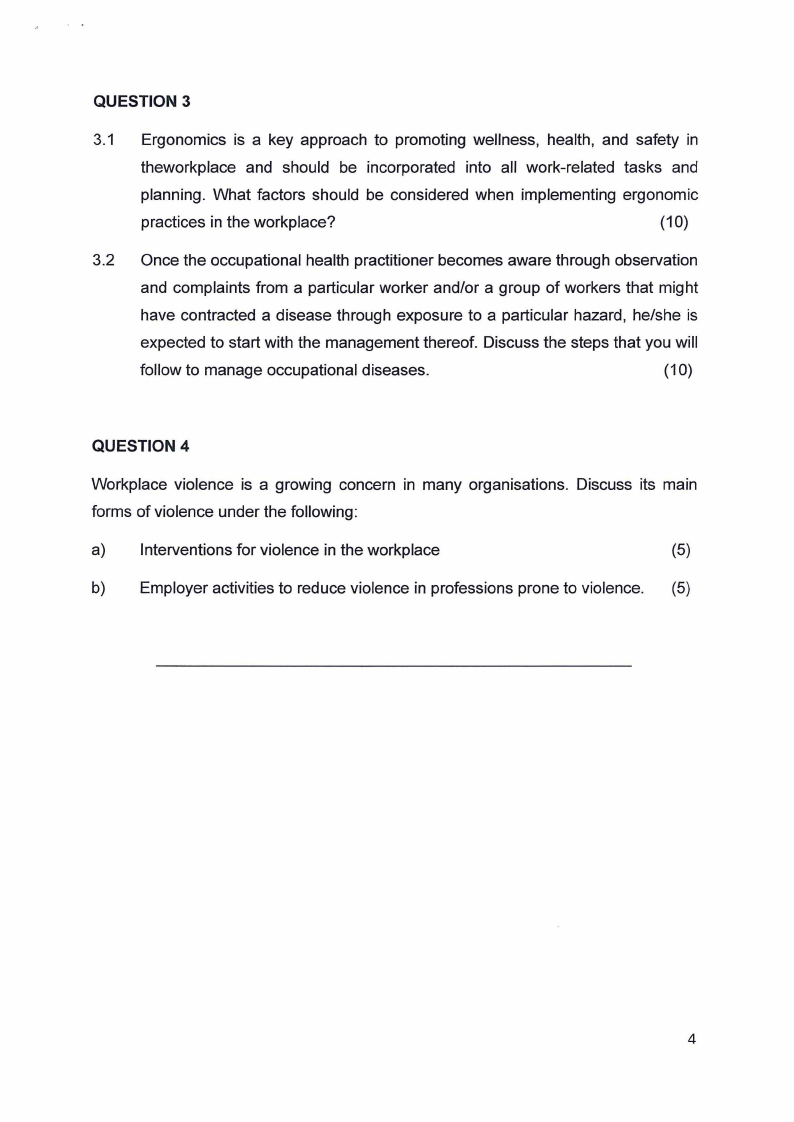
QUESTION 3
3.1 Ergonomics is a key approach to promoting wellness, health, and safety in
theworkplace and should be incorporated into all work-related tasks and
planning. What factors should be considered when implementing ergonomic
practices in the workplace?
(10)
3.2 Once the occupational health practitioner becomes aware through observation
and complaints from a particular worker and/or a group of workers that might
have contracted a disease through exposure to a particular hazard, he/she is
expected to start with the management thereof. Discuss the steps that you will
follow to manage occupational diseases.
(10)
QUESTION 4
Workplace violence is a growing concern in many organisations. Discuss its main
forms of violence under the following:
a) Interventions for violence in the workplace
(5)
b) Employer activities to reduce violence in professions prone to violence. (5)
4