


 |
PDP610S - PROFESSIONAL DEVELOPMENT AND PRACTICE - 1ST OPP - JUNE 2025 |
|
|
1 Page 1 |
▲back to top |

nAm I BIA un IVERSITY
OF SCIEn CE Ano TECHn OLOGY
FACULTY OF COMMERCE, HUMAN SCIENCE AND EDUCATION
DEPARTMENT OF TECHNICAL AND VOCATIONAL EDUCATION AND TRAINING
QUALIFICATION: DIPLOMA IN TECHNICAL AND VOCATIONAL EDUCATION AND TRAINING:
TRAINER
QUALIFICATION CODE: 0GDTVT
COURSE CODE: PDP610S
SESSION: JUNE 2025
LEVEL: 6
COURSE NAME: PROFESSIONAL DEVELOPMENT
AND PRACTICE
PAPER: 1
DURATION: 3 HOURS
MARKS: 100
FIRST OPPORTUNITY EXAMINATION QUESTION PAPER
EXAMINER(S) DR OKSANA KACHEPA
MODERATOR: DR MICHAEL TJIVIKUA
INSTRUCTIONS
1. Answer ALL the questions.
2. Read all the questions carefully before answering.
3. Number the answers clearly
THIS QUESTION PAPER CONSISTS OF _6_ PAGES (Including this front page)
|
|
2 Page 2 |
▲back to top |
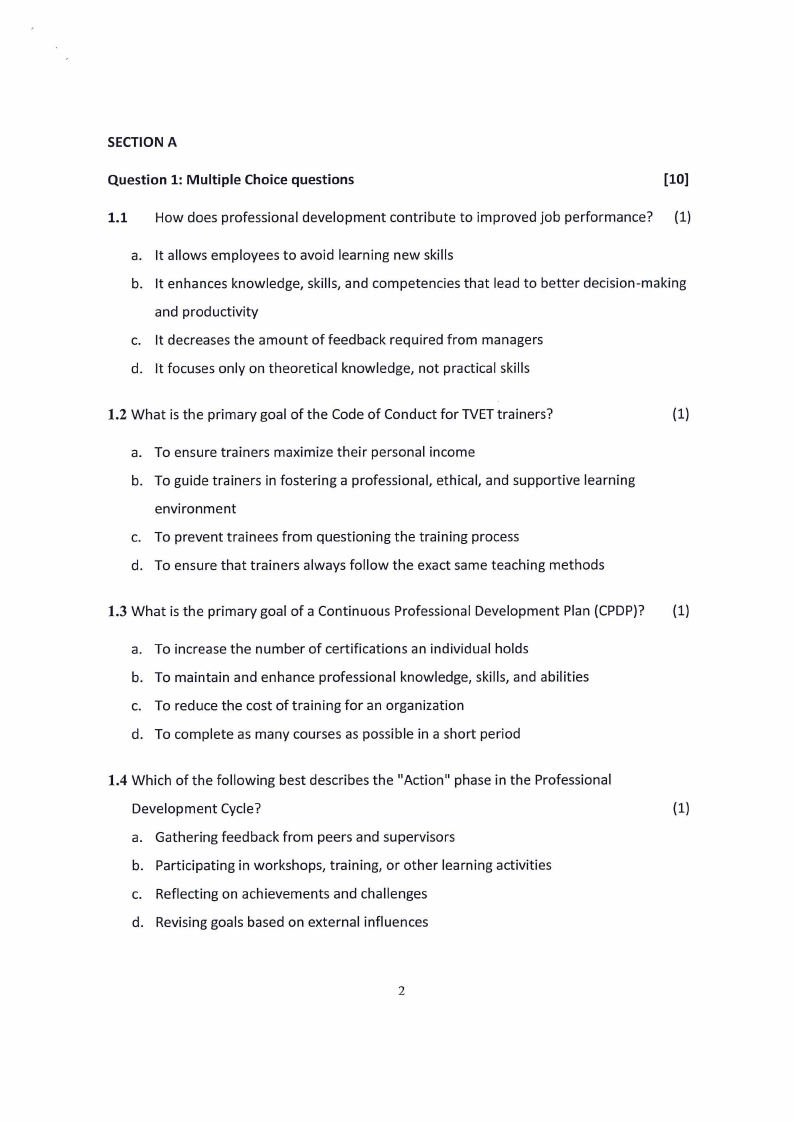
SECTION A
Question 1: Multiple Choice questions
[10)
1.1 How does professional development contribute to improved job performance? {1}
a. It allows employees to avoid learning new skills
b. It enhances knowledge, skills, and competencies that lead to better decision-making
and productivity
c. It decreases the amount of feedback required from managers
d. It focuses only on theoretical knowledge, not practical skills
1.2 What is the primary goal of the Code of Conduct for TVETtrainers?
{1}
a. To ensure trainers maximize their personal income
b. To guide trainers in fostering a professional, ethical, and supportive learning
environment
c. To prevent trainees from questioning the training process
d. To ensure that trainers always follow the exact same teaching methods
1.3 What is the primary goal of a Continuous Professional Development Plan {CPDP}? {1}
a. To increase the number of certifications an individual holds
b. To maintain and enhance professional knowledge, skills, and abilities
c. To reduce the cost of training for an organization
d. To complete as many courses as possible in a short period
1.4 Which of the following best describes the "Action" phase in the Professional
Development Cycle?
{1}
a. Gathering feedback from peers and supervisors
b. Participating in workshops, training, or other learning activities
c. Reflecting on achievements and challenges
d. Revising goals based on external influences
2
|
|
3 Page 3 |
▲back to top |
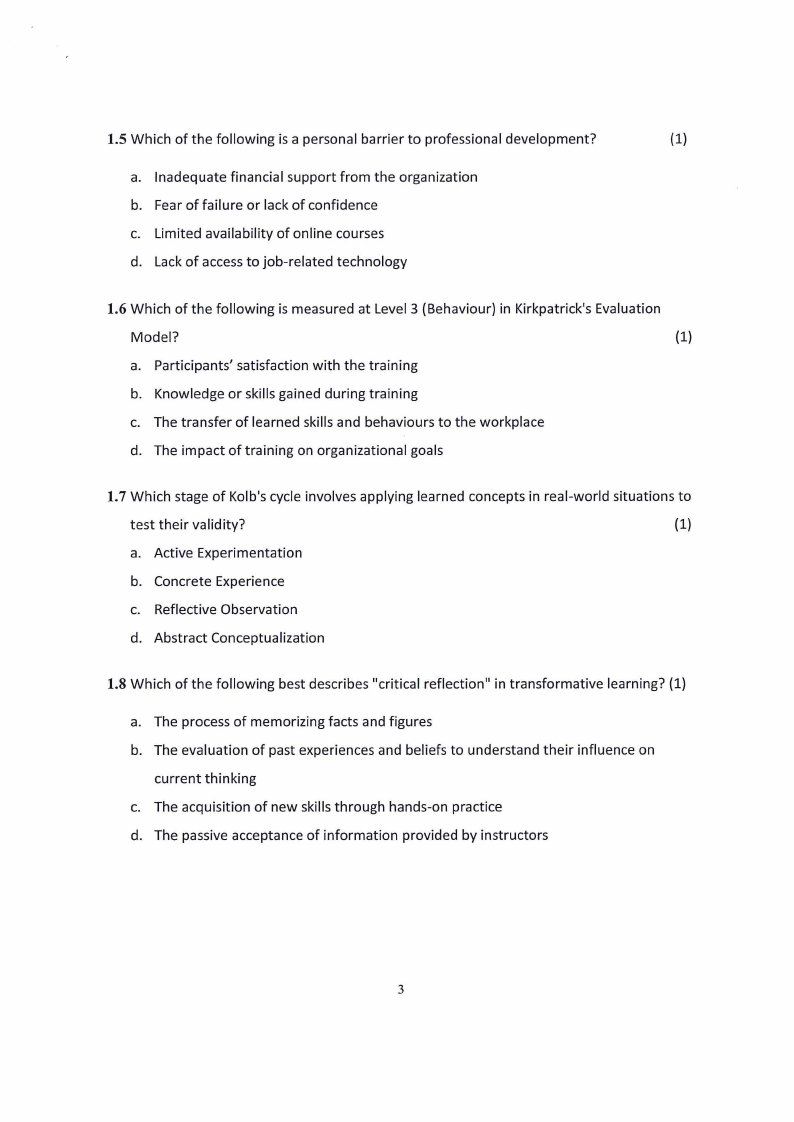
1.5 Which of the following is a personal barrier to professional development?
(1)
a. Inadequate financial support from the organization
b. Fear of failure or lack of confidence
c. Limited availability of online courses
d. Lack of access to job-related technology
1.6 Which of the following is measured at Level 3 (Behaviour) in Kirkpatrick's Evaluation
Model?
(1)
a. Participants' satisfaction with the training
b. Knowledge or skills gained during training
c. The transfer of learned skills and behaviours to the workplace
d. The impact of training on organizational goals
1.7 Which stage of Kolb's cycle involves applying learned concepts in real-world situations to
test their validity?
(1)
a. Active Experimentation
b. Concrete Experience
c. Reflective Observation
d. Abstract Conceptualization
1.8 Which of the following best describes "critical reflection" in transformative learning? (1)
a. The process of memorizing facts and figures
b. The evaluation of past experiences and beliefs to understand their influence on
current thinking
c. The acquisition of new skills through hands-on practice
d. The passive acceptance of information provided by instructors
3
|
|
4 Page 4 |
▲back to top |
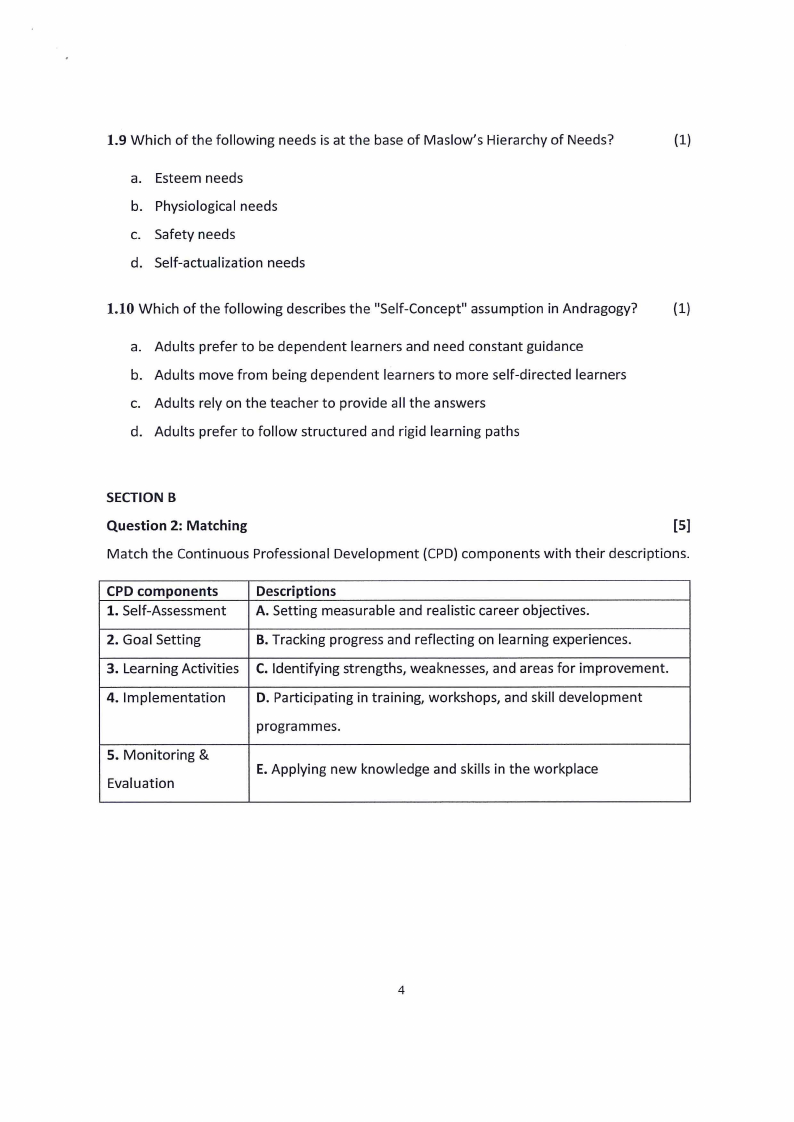
1.9 Which of the following needs is at the base of Maslow's Hierarchy of Needs?
(1)
a. Esteem needs
b. Physiological needs
c. Safety needs
d. Self-actualization needs
1.10 Which of the following describes the "Self-Concept" assumption in Andragogy?
{1}
a. Adults prefer to be dependent learners and need constant guidance
b. Adults move from being dependent learners to more self-directed learners
c. Adults rely on the teacher to provide all the answers
d. Adults prefer to follow structured and rigid learning paths
SECTION B
Question 2: Matching
[5]
Match the Continuous Professional Development {CPD)components with their descriptions.
CPD components
1. Self-Assessment
Descriptions
A. Setting measurable and realistic career objectives.
2. Goal Setting
B. Tracking progress and reflecting on learning experiences.
3. Learning Activities C. Identifying strengths, weaknesses, and areas for improvement.
4. Implementation
D. Participating in training, workshops, and skill development
programmes.
5. Monitoring &
Evaluation
E. Applying new knowledge and skills in the workplace
4
|
|
5 Page 5 |
▲back to top |
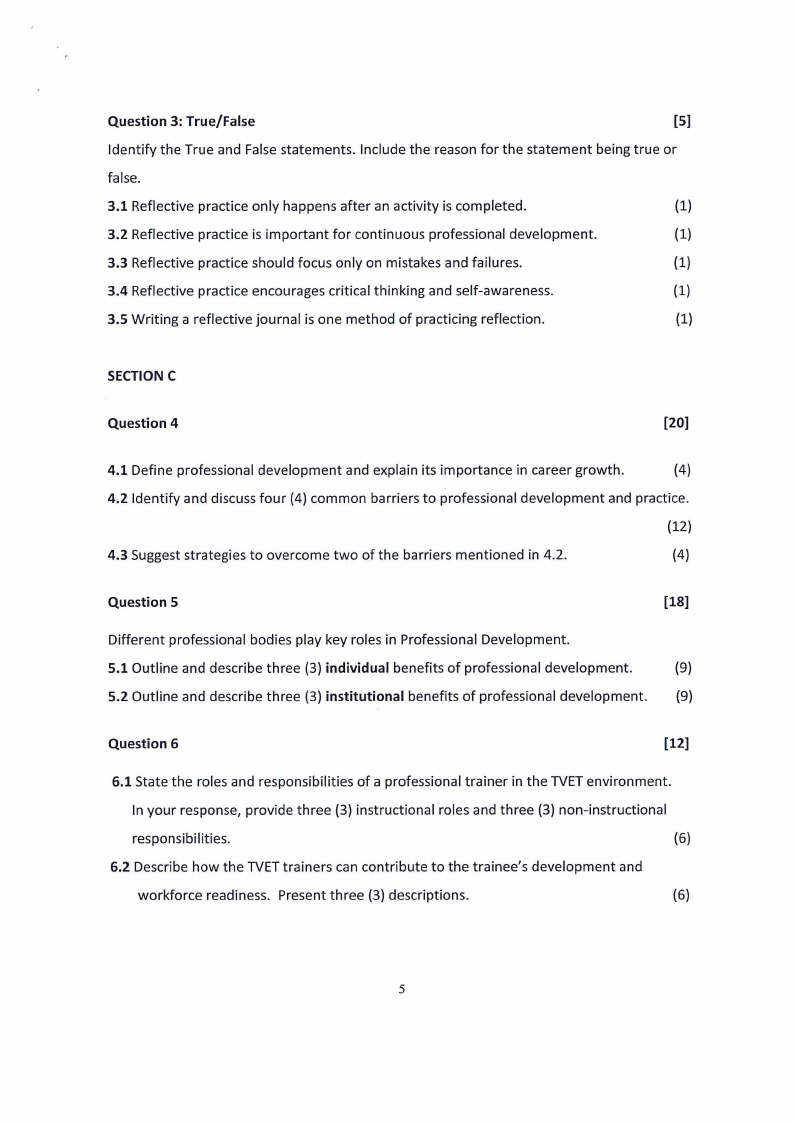
Question 3: True/False
[SJ
Identify the True and False statements. Include the reason for the statement being true or
false.
3.1 Reflective practice only happens after an activity is completed.
(1)
3.2 Reflective practice is important for continuous professional development.
(1)
3.3 Reflective practice should focus only on mistakes and failures.
{1)
3.4 Reflective practice encourages critical thinking and self-awareness.
(1)
3.5 Writing a reflective journal is one method of practicing reflection.
(1)
SECTION C
Question 4
[20)
4.1 Define professional development and explain its importance in career growth.
(4)
4.2 Identify and discuss four (4) common barriers to professional development and practice.
{12)
4.3 Suggest strategies to overcome two of the barriers mentioned in 4.2.
(4)
Question 5
[18)
Different professional bodies play key roles in Professional Development.
5.1 Outline and describe three (3) individual benefits of professional development.
(9)
5.2 Outline and describe three (3) institutional benefits of professional development.
{9)
Question 6
[12)
6.1 State the roles and responsibilities of a professional trainer in the TVET environment.
In your response, provide three (3) instructional roles and three (3) non-instructional
responsibilities.
{6)
6.2 Describe how the TVETtrainers can contribute to the trainee's development and
workforce readiness. Present three (3) descriptions.
(6)
5
|
|
6 Page 6 |
▲back to top |
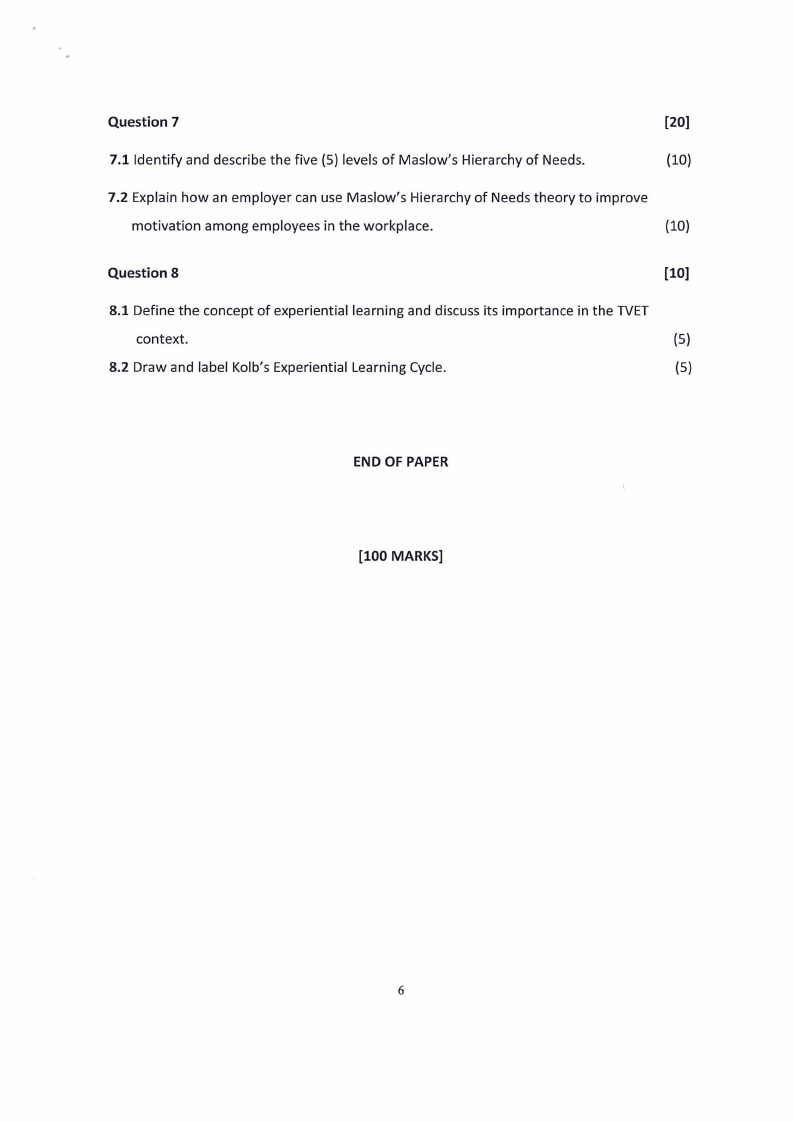
Question 7
[20]
7.1 Identify and describe the five (5) levels of Maslow's Hierarchy of Needs.
(10)
7.2 Explain how an employer can use Maslow's Hierarchy of Needs theory to improve
motivation among employees in the workplace.
(10)
Question 8
[10]
8.1 Define the concept of experiential learning and discuss its importance in the TVET
context.
(5)
8.2 Draw and label Kalb's Experiential Learning Cycle.
(5)
END OF PAPER
[100 MARKS]
6