


 |
PDP610S - PROFESSIONAL DEVELOPMENT AND PRACTICE - 2ND OPP - JULY 2025 |
|
|
1 Page 1 |
▲back to top |

nAmlBIA UnlVERSITY
OF SCIEnCE Ano TECHn OLOGY
FACULTYOF COMMERCE, HUMAN SCIENCEAND EDUCATION
DEPARTMENT OF TECHNICAL AND VOCATIONAL EDUCATION AND TRAINING
QUALIFICATION: DIPLOMA IN TECHNICAL AND VOCATIONAL EDUCATION AND TRAINING:
TRAINER
QUALIFICATION CODE: 0GDTVT
COURSE CODE: PDP610S
SESSION: JULY 2025
LEVEL: 6
COURSE NAME: PROFESSIONAL DEVELOPMENT
AND PRACTICE
PAPER: 2
DURATION: 3 HOURS
MARKS: 100
SECOND OPPORTUNITY EXAMINATION QUESTION PAPER
EXAMINER{S) DR OKSANA KACHEPA
MODERATOR: DR MICHAEL TJIVIKUA
INSTRUCTIONS
1. Answer ALLthe questions.
2. Read all the questions carefully before answering.
3. Number the answers clearly
THIS QUESTION PAPER CONSISTS OF _5_ PAGES (Including this front page}
|
|
2 Page 2 |
▲back to top |

SECTION A
Question 1: Multiple Choice questions
[10]
1.1 How does professional development benefit organizations?
(1)
a. By ensuring employees have limited skills that can be easily replaced
b. By increasing employee morale, motivation, and retention
c. By reducing the cost of training programmes
d. By limiting the exposure to new technologies and industry trends
1.2 Which of the following is the primary responsibility of TVETtrainers according to the
Code of Conduct?
(1)
a. To ensure that training programmes are only for individuals with prior work
experience
b. To maintain high standards of teaching and ethical behaviour
c. To prioritize personal opinions over professional ethics
d. To limit the number of trainees in each class to improve performance
1.3 Which of the following is NOT typically included in a Continuous Professional
Development Plan (CPDP)?
(1)
a. Identifying professional goals
b. Setting specific timelines for learning activities
c. Developing a strategy to update technical skills
d. Ignoring feedback from mentors or supervisors
1.4 Which of the following activities is most likely to take place during the "Review" phase of
the Professional Development Cycle?
(1)
a. Engaging in networking activities
b. Evaluating the effectiveness of the development activities and progress toward goals
c. Conducting performance reviews with a supervisor
d. Creating a new set of learning objectives for the next cycle
2
|
|
3 Page 3 |
▲back to top |
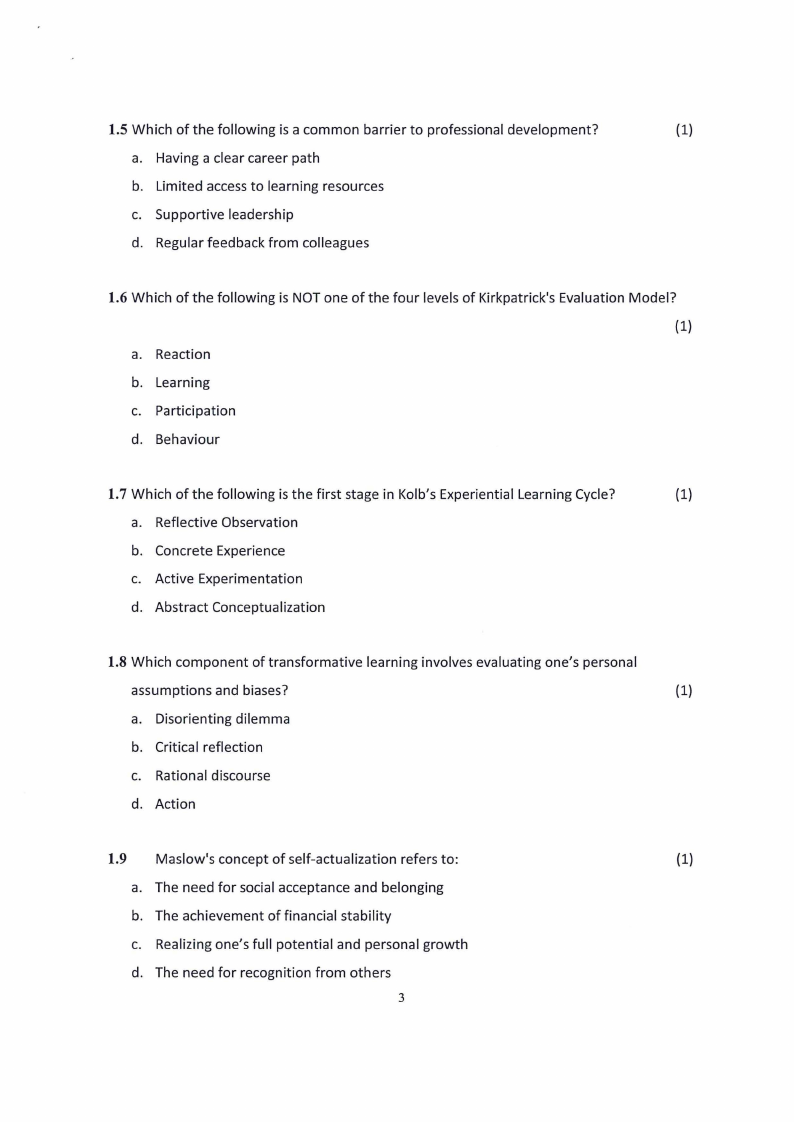
1.5 Which of the following is a common barrier to professional development?
(1)
a. Having a clear career path
b. Limited access to learning resources
c. Supportive leadership
d. Regular feedback from colleagues
1.6 Which of the following is NOT one of the four levels of Kirkpatrick's Evaluation Model?
(1)
a. Reaction
b. Learning
C. Participation
d. Behaviour
1.7 Which of the following is the first stage in Kolb's Experiential Learning Cycle?
(1)
a. Reflective Observation
b. Concrete Experience
c. Active Experimentation
d. Abstract Conceptualization
1.8 Which component of transformative learning involves evaluating one's personal
assumptions and biases?
(1)
a. Disorienting dilemma
b. Critical reflection
C. Rational discourse
d. Action
1.9 Maslow's concept of self-actualization refers to:
(1)
a. The need for social acceptance and belonging
b. The achievement of financial stability
c. Realizing one's full potential and personal growth
d. The need for recognition from others
3
|
|
4 Page 4 |
▲back to top |
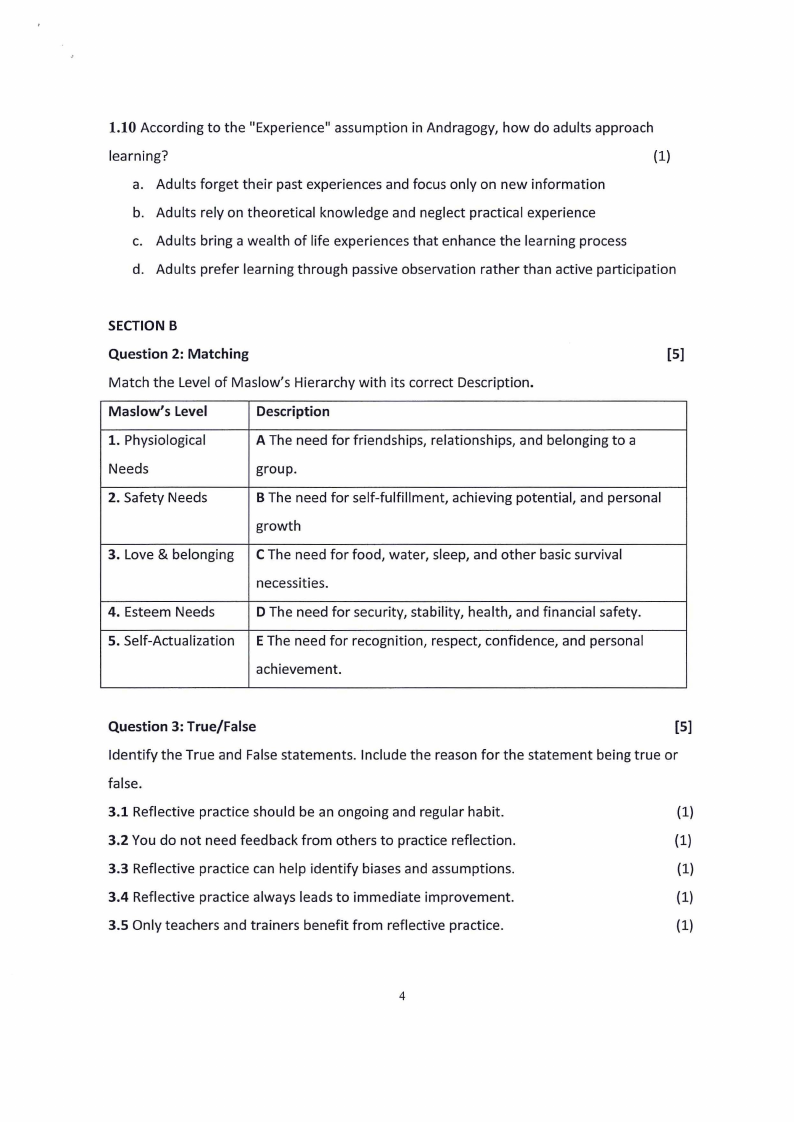
1.10 According to the "Experience" assumption in Andragogy, how do adults approach
learning?
(1)
a. Adults forget their past experiences and focus only on new information
b. Adults rely on theoretical knowledge and neglect practical experience
c. Adults bring a wealth of life experiences that enhance the learning process
d. Adults prefer learning through passive observation rather than active participation
SECTION B
Question 2: Matching
[5]
Match the Level of Maslow's Hierarchy with its correct Description.
Maslow's Level
Description
1. Physiological
A The need for friendships, relationships, and belonging to a
Needs
group.
2. Safety Needs
B The need for self-fulfillment, achieving potential, and personal
growth
3. Love & belonging C The need for food, water, sleep, and other basic survival
necessities.
4. Esteem Needs
D The need for security, stability, health, and financial safety.
5. Self-Actualization E The need for recognition, respect, confidence, and personal
achievement.
Question 3: True/False
[5]
Identify the True and False statements. Include the reason for the statement being true or
false.
3.1 Reflective practice should be an ongoing and regular habit.
(1)
3.2 You do not need feedback from others to practice reflection.
(1)
3.3 Reflective practice can help identify biases and assumptions.
(1)
3.4 Reflective practice always leads to immediate improvement.
(1)
3.5 Only teachers and trainers benefit from reflective practice.
(1)
4
|
|
5 Page 5 |
▲back to top |

SECTION C
Question 4
[15]
Outline and describe five (5) TVETTrainer professional development benefits.
Question 5
[15]
Outline and discuss the key characteristics of a professional TVETtrainer. Your answer
should include at least five (5) essential characteristics. Discuss how each characteristic
contributes to effective vocational education and training.
Question 6
[15]
State five (5) strategies used for the professional development of TVETtrainers and explain
how each contributes to improving trainer effectiveness.
Question 7
[20]
Explain how Kirkpatrick's Four-Level Evaluation Model can be applied to evaluate a TVET
Trainer Programme. For each level, describe the key focus and provide relevant examples of
how data can be collected and used for improving the programme.
Question 8
[15]
8.1 Define andragogy and explain how it differs from pedagogy.
(4)
8.2 Outline and discuss four (4) key principles of adult learning according to Malcolm
Knowles' theory of andragogy.
(8)
8.3 Explain how an understanding of andragogy can improve the effectiveness of a TVET
trainer when working with adult learners.
(3)
END OF PAPER
[100 MARKS]
5