


 |
SLA721S - SECOND LANGUAGE ACQUISITION - 2ND OPP - DECEMBER 2025 |
|
|
1 Page 1 |
▲back to top |
nAm l BI A UnlVERSITY
OF SC IEnCE Ano TECHnOLOGY
FACULTY NAME: COMMERCE, HUMAN SCIENCES AND LANGUAGES
DEPARTMENT NAME: COMMUNICATION AND LANGUAGES
QUALIFICATION: BACHELOR OF ENGLISH AND LINGUISTICS
QUALIFICATION CODE: 07BENL
LEVEL: 7
COURSE: SECOND LANGUAGE ACQUISITION COURSE CODE: SLA721S
SESSION: DECEMBER 2025
PAPER: THEORY
DURATION: 3 HOURS
MARKS: 100
SECOND OPPORTUNITY/SUPPLEMENTARY EXAMINATION QUESTION PAPER
EXAMINER
Dr. A. Nghikembua
MODERATOR
Dr. L. Namaseb
INSTRUCTIONS
1. Answer ALL the questions.
2. Write clearly and neatly.
3. Number the answers clearly.
THIS EXAMINATION PAPER CONSISTS OF 4 PAGES
(Including this front page)
1
|
|
2 Page 2 |
▲back to top |
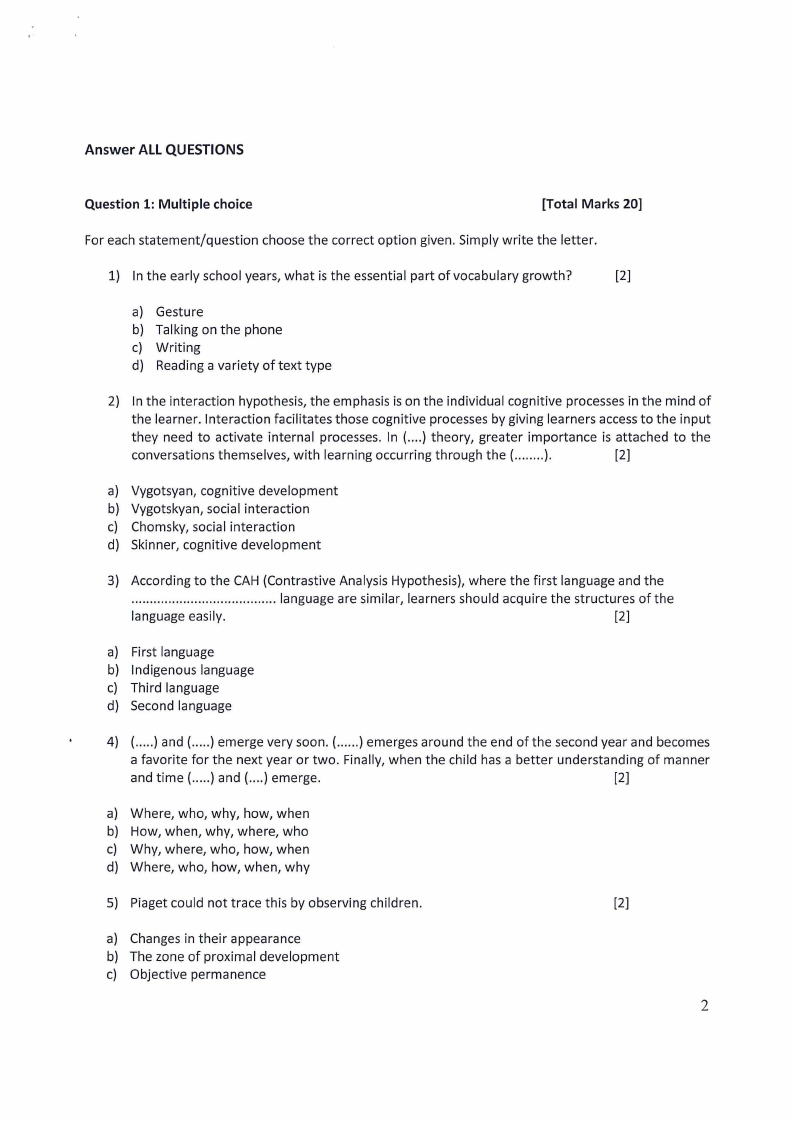
Answer ALL QUESTIONS
Question 1: Multiple choice
[Total Marks 20]
For each statement/question choose the correct option given. Simply write the letter.
1) In the early school years, what is the essential part of vocabulary growth?
[2]
a) Gesture
b) Talking on the phone
c) Writing
d) Reading a variety of text type
2) In the interaction hypothesis, the emphasis is on the individual cognitive processes in the mind of
the learner. Interaction facilitates those cognitive processes by giving learners access to the input
they need to activate internal processes. In (....) theory, greater importance is attached to the
conversations themselves, with learning occurring through the (........).
[2]
a) Vygotsyan, cognitive development
b) Vygotskyan, social interaction
c) Chomsky, social interaction
d) Skinner, cognitive development
3) According to the CAH (Contrastive Analysis Hypothesis), where the first language and the
.......................... ............. language are similar, learners should acquire the structures of the
language easily.
[2]
a) First language
b) Indigenous language
c) Third language
d) Secondlanguage
4) (.....) and (.....) emerge very soon. (......) emerges around the end of the second year and becomes
a favorite for the next year or two. Finally, when the child has a better understanding of manner
and time( .. ...) and (.... ) emerge .
[2]
a) Where, who, why, how, when
b) How, when, why, where, who
c) Why, where, who, how, when
d) Where, who, how, when, why
5) Piaget could not trace this by observing children.
[2]
a) Changes in their appearance
b) The zone of proximal development
c) Objective permanence
2
|
|
3 Page 3 |
▲back to top |
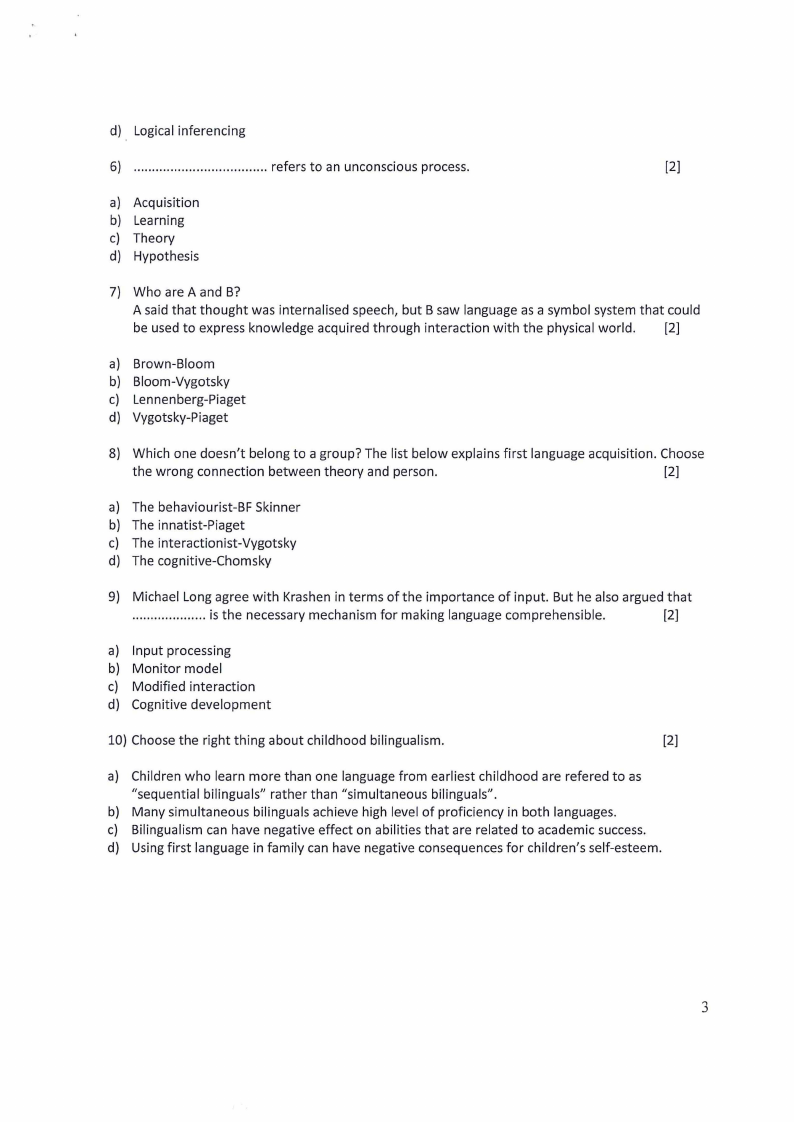
d) Logical inferencing
6) ....... ...... .......... ...... ....... refers to an unconscious process.
[2]
a) Acquisition
b) Learning
c) Theory
d) Hypothesis
7) Who are A and B?
A said that thought was internalised speech, but B saw language as a symbol system that could
be used to express knowledge acquired through interaction with the physical world . [2]
a) Brown-Bloom
b) Bloom-Vygotsky
c) Lennenberg-Piaget
d) Vygotsky-Piaget
8) Which one doesn' t belong to a group? The list below explains first language acquisition . Choose
the wrong connection between theory and person.
[2]
a) The behaviourist-BF Skinner
b) The innatist-Piaget
c) The interactionist-Vygotsky
d) The cognitive-Chomsky
9) Michael Long agree with Kras hen in terms of the importance of input. But he also argued that
.......... .......... is the necessary mechanism for making language comprehensible.
[2]
a) Input processing
b) Monitor model
c) Modified interaction
d) Cognitive development
10) Choose the right thing about childhood bilingualism.
[2]
a) Children who learn more than one language from earliest childhood are refered to as
"sequential bilinguals" rather than "simultaneous bilinguals" .
b) Many simultaneous bilinguals achieve high level of proficiency in both languages.
c) Bilingualism can have negative effect on abilities that are related to academic success.
d) Using first language in family can have negative consequences for children's self-esteem .
3
|
|
4 Page 4 |
▲back to top |
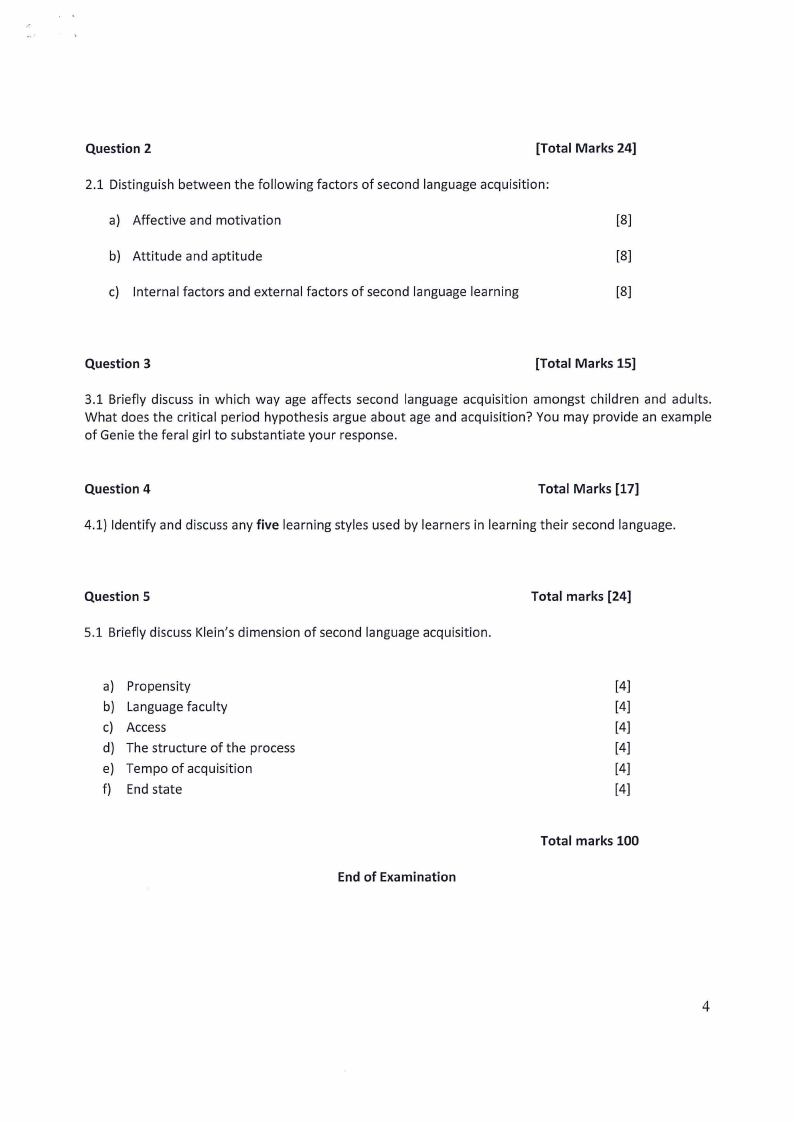
Question 2
[Total Marks 24]
2.1 Distinguish between the following factors of second language acquisition :
a) Affective and motivation
[8]
b) Attitude and aptitude
[8]
c) Internal factors and external factors of second language learning
[8]
Question 3
[Total Marks 15]
3.1 Briefly discuss in which way age affects second language acquisition amongst children and adults.
What does the critical period hypothesis argue about age and acquisition? You may provide an example
of Genie the feral girl to substantiate your response.
Question 4
Total Marks [17]
4.1) Identify and discuss any five learning styles used by learners in learning their second language.
Question 5
5.1 Briefly discuss Klein's dimension of second language acquisition.
Total marks [24]
a) Propensity
[4]
b) Language faculty
[4]
c) Access
[4]
d) The structure of the process
[4]
e) Tempo of acquisition
[4]
f) End state
[4]
End of Examination
Total marks 100
4