


 |
SLA721S - SECOND LANGUAGE ACQUISITION - 1ST OPP - NOVEMBER 2025 |
|
|
1 Page 1 |
▲back to top |

n Am I BI A u n IVE RS ITY
OF SCIEnCE Ano TECHnOLOGY
FACULTY NAME: COMMERCE, HUMAN SCIENCES AND EDUCATION
DEPARTMENT NAME: COMMUNICATION AND LANGUAGES
QUALIFICATION: BACHELOR OF ENGLISH AND LINGUISTICS
QUALIFICATION CODE: 07BENL
LEVEL: 7
COURSE: SECOND LANGUAGE ACQUISITION COURSE CODE: SLA721S
SESSION: NOVEMBER 2025
PAPER: THEORY
DURATION: 3 HOURS
MARKS: 100
EXAMINER
MODERATOR
FIRST OPPORTUNITY EXAMINATION QUESTION PAPER
Dr. A. Nghikembua
Dr. L. Namaseb
INSTRUCTIONS
1. Answer ALL the questions.
2. Write clearly and neatly.
3. Number the answers clearly.
THIS TEST PAPER CONSISTS OF 4 PAGES
(Including this front page)
1
|
|
2 Page 2 |
▲back to top |
r-
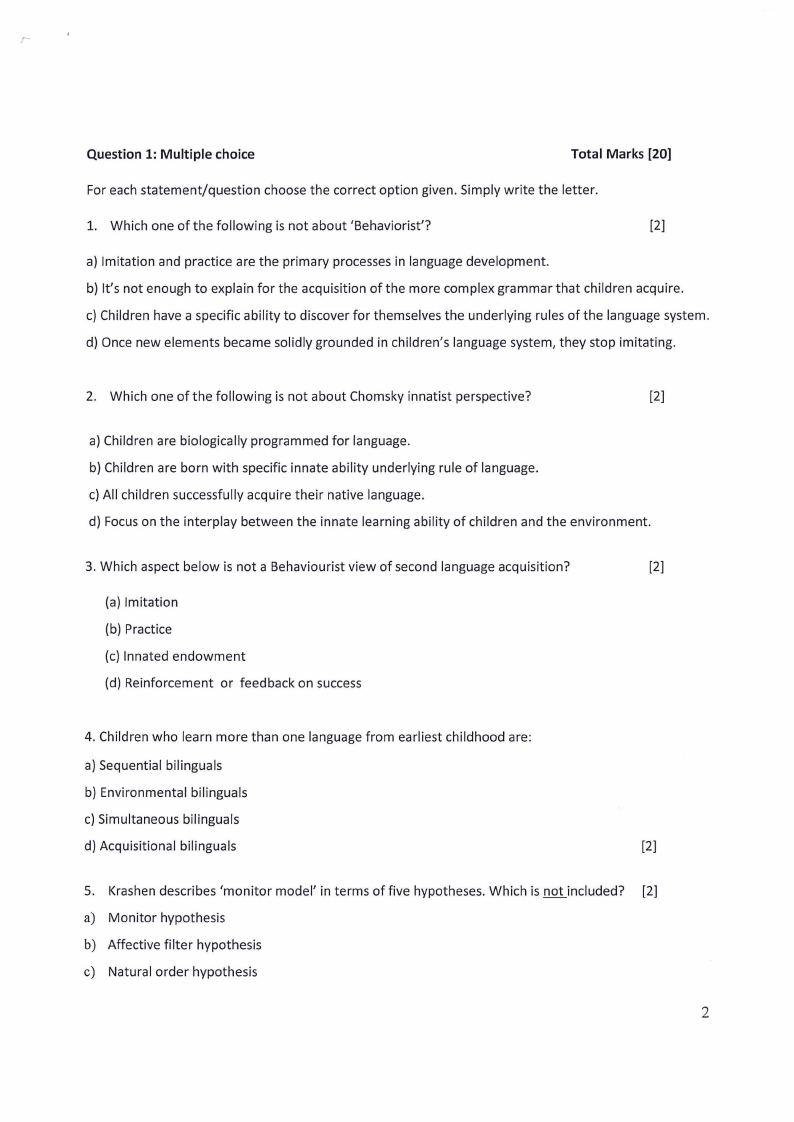
Question 1: Multiple choice
Total Marks [20)
For each statement/question choose the correct option given. Simply write the letter.
1. Which one of the following is not about 'Behaviorist'?
[2]
a) Imitation and practice are the primary processes in language development.
b) It's not enough to explain for the acquisition of the more complex grammar that children acquire.
c) Children have a specific ability to discover for themselves the underlying rules of the language system.
d) Once new elements became solidly grounded in children's language system, they stop imitating.
2. Which one of the following is not about Chomsky innatist perspective?
[2]
a) Children are biologically programmed for language.
b) Children are born with specific innate ability underlying rule of language.
c) All children successfully acquire their native language.
d) Focus on the interplay between the innate learning ability of children and the environment.
3. Which aspect below is not a Behaviourist view of second language acquisition?
[2]
(a) Imitation
(b) Practice
(c) lnnated endowment
(d) Reinforcement or feedback on success
4. Children who learn more than one language from earliest childhood are:
a) Sequential bilinguals
b) Environmental bilinguals
c) Simultaneous bilinguals
d) Acquisitional bilinguals
[2]
5. Krashen describes 'monitor model' in terms of five hypotheses. Which is not included? [2]
a) Monitor hypothesis
b) Affective filter hypothesis
c) Natural order hypothesis
2
|
|
3 Page 3 |
▲back to top |
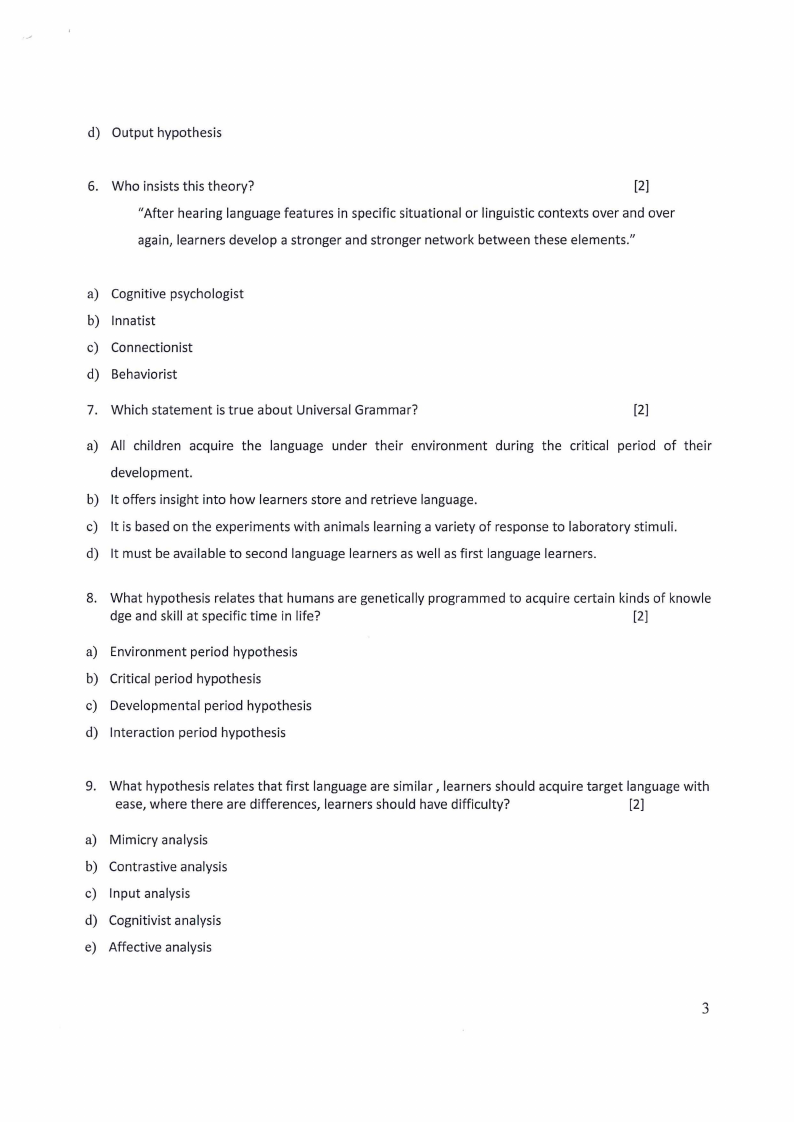
d) Output hypothesis
6. Who insists this theory?
[2]
"After hearing language features in specific situational or linguistic contexts over and over
again, learners develop a stronger and stronger network between these elements."
a) Cognitive psychologist
b) lnnatist
c) Connectionist
d) Behaviorist
7. Which statement is true about Universal Grammar?
[2]
a) All children acquire the language under their environment during the critical period of their
development.
b) It offers insight into how learners store and retrieve language.
c) It is based on the experiments with animals learning a variety of response to laboratory stimuli.
d) It must be available to second language learners as well as first language learners.
8. What hypothesis relates that humans are genetically programmed to acquire certain kinds of knowle
dge and skill at specific time in life?
[2]
a) Environment period hypothesis
b) Critical period hypothesis
c) Developmental period hypothesis
d) Interaction period hypothesis
9. What hypothesis relates that first language are similar, learners should acquire target language with
ease, where there are differences, learners should have difficulty?
[2]
a) Mimicry analysis
b) Contrastive analysis
c) Input analysis
d) Cognitivist analysis
e) Affective analysis
3
|
|
4 Page 4 |
▲back to top |
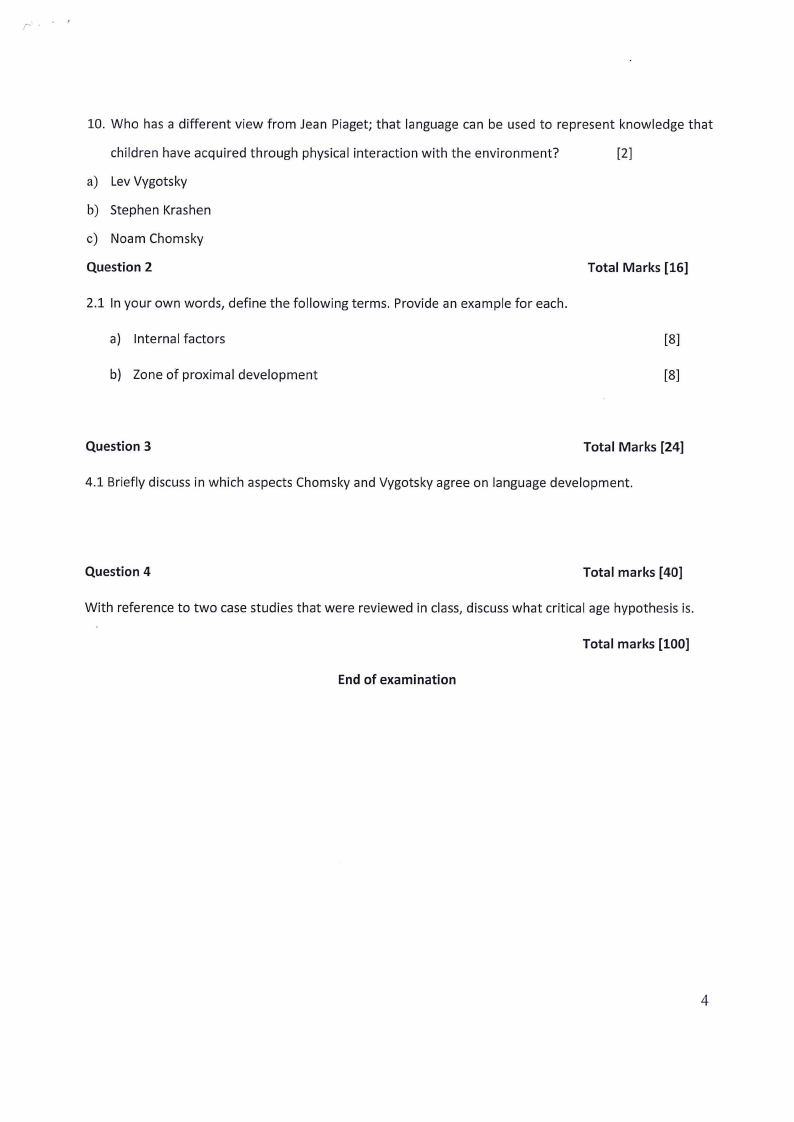
10. Who has a different view from Jean Piaget; that language can be used to represent knowledge that
children have acquired through physical interaction with the environment?
[2]
a) Lev Vygotsky
b) Stephen Krashen
c) Noam Chomsky
Question 2
Total Marks [16]
2.1 In your own words, define the following terms. Provide an example for each.
a) Internal factors
[8]
b) Zone of proximal development
[8]
Question 3
Total Marks [24)
4.1 Briefly discuss in which aspects Chomsky and Vygotsky agree on language development.
Question 4
Total marks [40)
With reference to two case studies that were reviewed in class, discuss what critical age hypothesis is.
Total marks [100]
End of examination
4