


 |
LIT811S - LITERARY THEORY - 2ND OPP - JULY 2025 |
|
|
1 Page 1 |
▲back to top |
nAmlBIA unlVERSITY
OF SCIEnCE Ano TECHnOLOGY
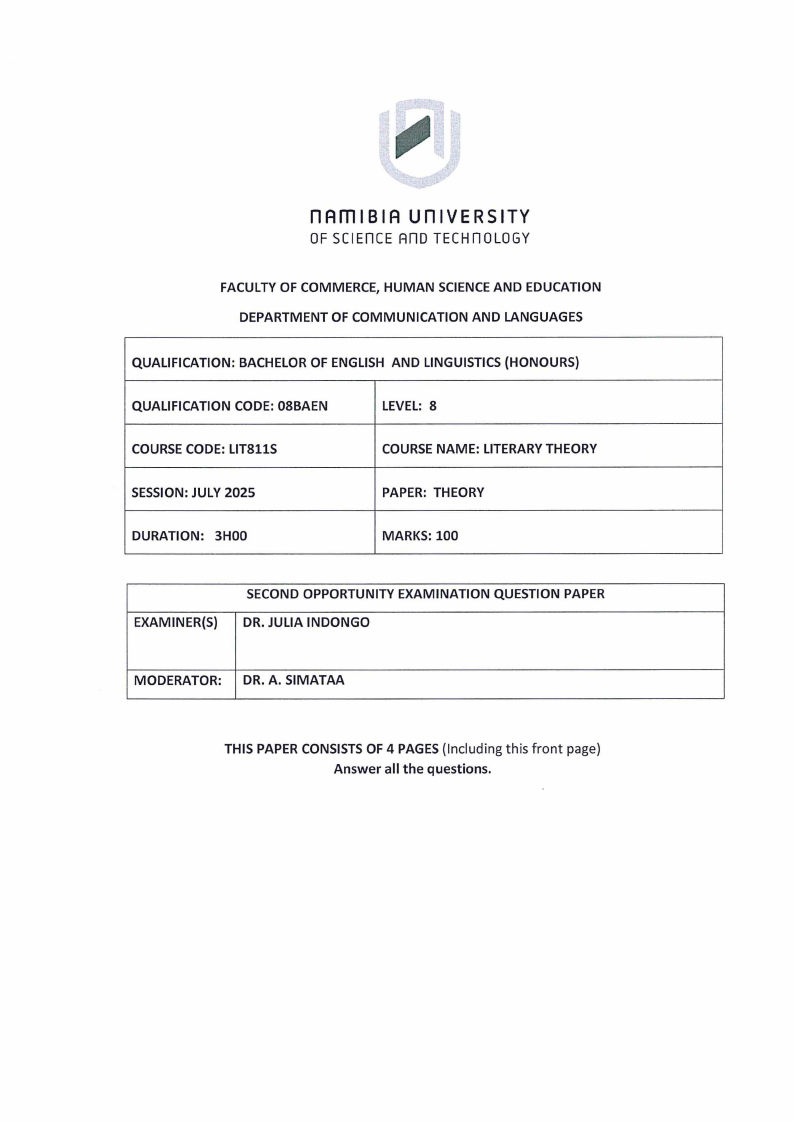
FACULTY OF COMMERCE, HUMAN SCIENCEAND EDUCATION
DEPARTMENT OF COMMUNICATION AND LANGUAGES
QUALIFICATION: BACHELOR OF ENGLISH AND LINGUISTICS (HONOURS)
QUALIFICATION CODE: 08BAEN
LEVEL: 8
COURSE CODE: LIT811S
COURSE NAME: LITERARYTHEORY
SESSION: JULY 2025
PAPER: THEORY
DURATION: 3H00
MARKS: 100
EXAMINER(S)
SECOND OPPORTUNITY EXAMINATION QUESTION PAPER
DR. JULIA INDONGO
MODERATOR: DR. A. SIMATAA
THIS PAPER CONSISTS OF 4 PAGES (Including this front page)
Answer all the questions.
|
|
2 Page 2 |
▲back to top |
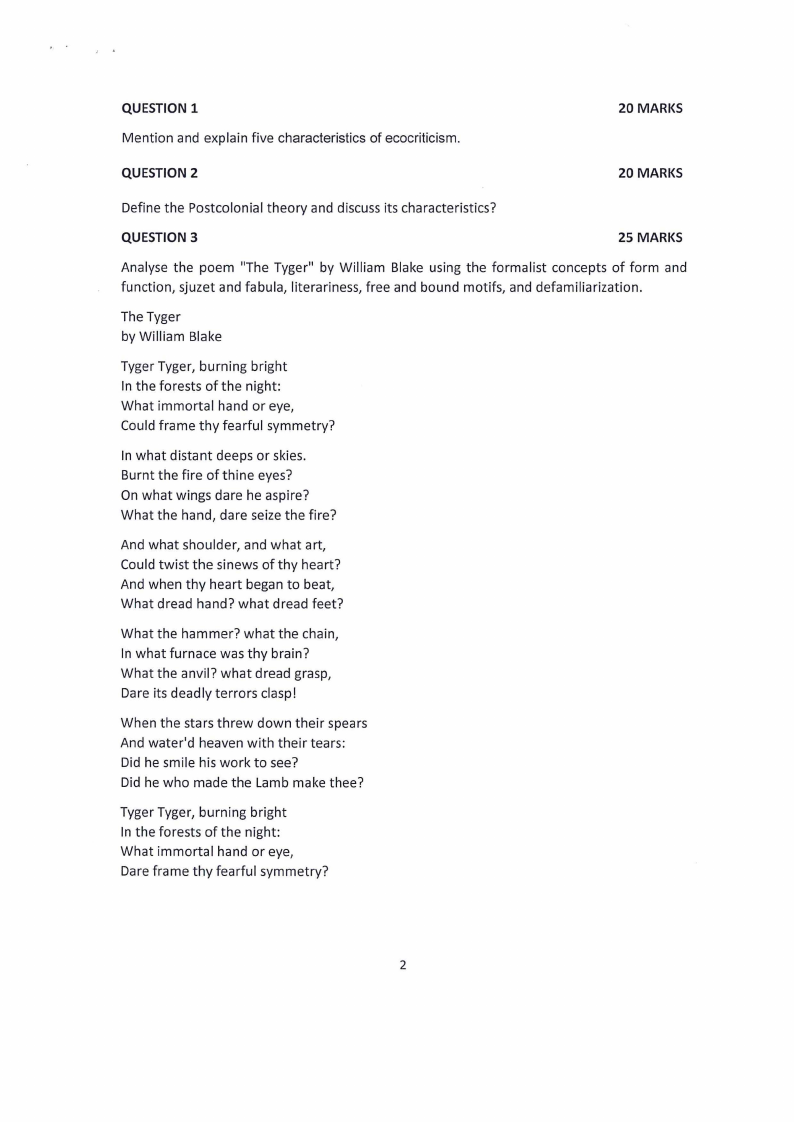
QUESTION 1
Mention and explain five characteristics of ecocriticism.
20 MARKS
QUESTION 2
20 MARKS
Define the Postcolonial theory and discuss its characteristics?
QUESTION 3
25 MARKS
Analyse the poem "The Tyger" by William Blake using the formalist concepts of form and
function, sjuzet and tabula, literariness, free and bound motifs, and defamiliarization.
The Tyger
by William Blake
Tyger Tyger, burning bright
In the forests of the night:
What immortal hand or eye,
Could frame thy fearful symmetry?
In what distant deeps or skies.
Burnt the fire of thine eyes?
On what wings dare he aspire?
What the hand, dare seize the fire?
And what shoulder, and what art,
Could twist the sinews of thy heart?
And when thy heart began to beat,
What dread hand? what dread feet?
What the hammer? what the chain,
In what furnace was thy brain?
What the anvil? what dread grasp,
Dare its deadly terrors clasp!
When the stars threw down their spears
And water'd heaven with their tears:
Did he smile his work to see?
Did he who made the Lamb make thee?
Tyger Tyger, burning bright
In the forests of the night:
What immortal hand or eye,
Dare frame thy fearful symmetry?
2
|
|
3 Page 3 |
▲back to top |
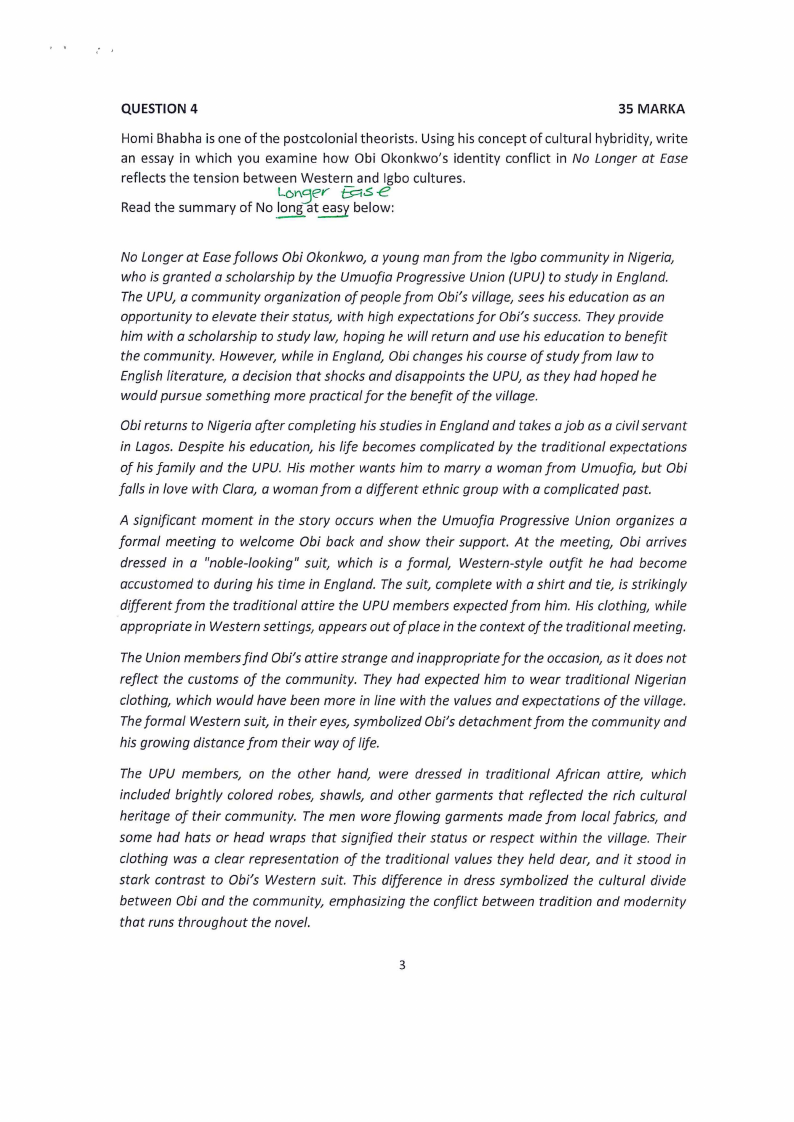
QUESTION 4
35 MARKA
Homi Bhabha is one of the postcolonial theorists. Using his concept of cultural hybridity, write
an essay in which you examine how Obi Okonkwo's identity conflict in No Longer at Ease
reflects the tension between Western and lgbo cultures.
5Lon.3er- t::s==i-.Se
Read the summary of No
at easy below:
No Longer at Ease follows Obi Okonkwo, a young man from the lgbo community in Nigeria,
who is granted a scholarship by the Umuofia Progressive Union {UPU}to study in England.
The UPU,a community organization of people from Obi's village, sees his education as an
opportunity to elevate their status, with high expectations for Obi's success. They provide
him with a scholarship to study law, hoping he will return and use his education to benefit
the community. However, while in England, Obi changes his course of study from law to
English literature, a decision that shocks and disappoints the UPU,as they had hoped he
would pursue something more practical for the benefit of the village.
Obi returns to Nigeria after completing his studies in England and takes a job as a civil servant
in Lagos. Despite his education, his life becomes complicated by the traditional expectations
of his family and the UPU. His mother wants him to marry a woman from Umuofia, but Obi
falls in love with Clara, a woman from a different ethnic group with a complicated past.
A significant moment in the story occurs when the Umuofia Progressive Union organizes a
formal meeting to welcome Obi back and show their support. At the meeting, Obi arrives
dressed in a "noble-looking" suit, which is a formal, Western-style outfit he had become
accustomed to during his time in England. The suit, complete with a shirt and tie, is strikingly
different from the traditional attire the UPUmembers expected from him. His clothing, while
appropriate in Western settings, appears out of place in the context of the traditional meeting.
The Union members find Obi's attire strange and inappropriate for the occasion, as it does not
reflect the customs of the community. They had expected him to wear traditional Nigerian
clothing, which would have been more in line with the values and expectations of the village.
The formal Western suit, in their eyes, symbolized Obi's detachment from the community and
his growing distance from their way of life.
The UPU members, on the other hand, were dressed in traditional African attire, which
included brightly colored robes, shawls, and other garments that reflected the rich cultural
heritage of their community. The men wore flowing garments made from local fabrics, and
some had hats or head wraps that signified their status or respect within the village. Their
clothing was a clear representation of the traditional values they held dear, and it stood in
stark contrast to Obi's Western suit. This difference in dress symbolized the cultural divide
between Obi and the community, emphasizing the conflict between tradition and modernity
that runs throughout the novel.
3
|
|
4 Page 4 |
▲back to top |
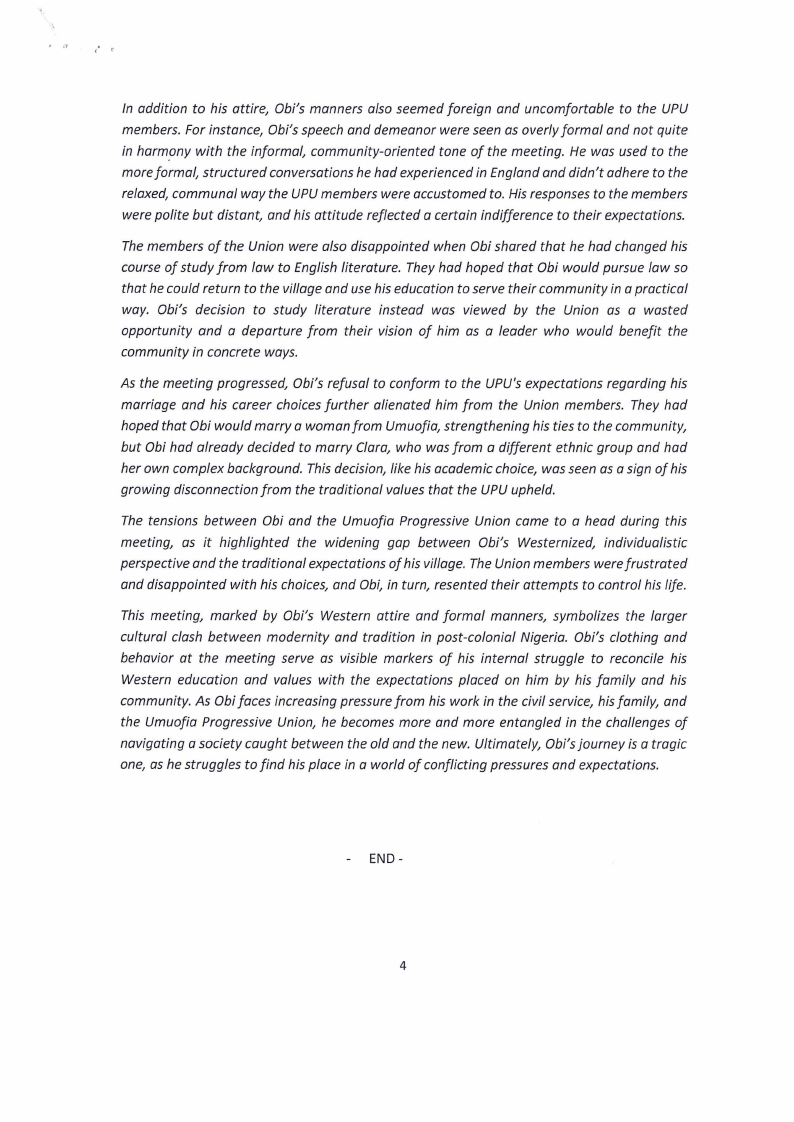
In addition to his attire, Obi's manners also seemed foreign and uncomfortable to the UPU
members. For instance, Obi's speech and demeanor were seen as overly formal and not quite
in harm_onywith the informal, community-oriented tone of the meeting. He was used to the
more formal, structured conversations he had experienced in England and didn't adhere to the
relaxed, communal way the UPUmembers were accustomed to. Hisresponses to the members
were polite but distant, and his attitude reflected a certain indifference to their expectations.
The members of the Union were also disappointed when Obi shared that he had changed his
course of study from law to English literature. They had hoped that Obi would pursue law so
that he could return to the village and use his education to serve their community in a practical
way. Obi's decision to study literature instead was viewed by the Union as a wasted
opportunity and a departure from their vision of him as a leader who would benefit the
community in concrete ways.
As the meeting progressed, Obi's refusal to conform to the UPU's expectations regarding his
marriage and his career choices further alienated him from the Union members. They had
hoped that Obi would marry a woman from Umuofia, strengthening his ties to the community,
but Obi had already decided to marry Clara, who was from a different ethnic group and had
her own complex background. This decision, like his academic choice, was seen as a sign of his
growing disconnection from the traditional values that the UPU upheld.
The tensions between Obi and the Umuofia Progressive Union came to a head during this
meeting, as it highlighted the widening gap between Obi's Westernized, individualistic
perspective and the traditional expectations of his village. The Union members were frustrated
and disappointed with his choices, and Obi, in turn, resented their attempts to control his life.
This meeting, marked by Obi's Western attire and formal manners, symbolizes the larger
cultural clash between modernity and tradition in post-colonial Nigeria. Obi's clothing and
behavior at the meeting serve as visible markers of his internal struggle to reconcile his
Western education and values with the expectations placed on him by his family and his
community. As Obi faces increasing pressure from his work in the civil service, his family, and
the Umuofia Progressive Union, he becomes more and more entangled in the challenges of
navigating a society caught between the old and the new. Ultimately, Obi's journey is a tragic
one, as he struggles to find his place in a world of conflicting pressures and expectations.
END-
4