


 |
GSC711S - GLOBAL SUPPLY CHAIN MANAGEMENT - 2ND OPP - JULYpdf |
|
|
1 Page 1 |
▲back to top |
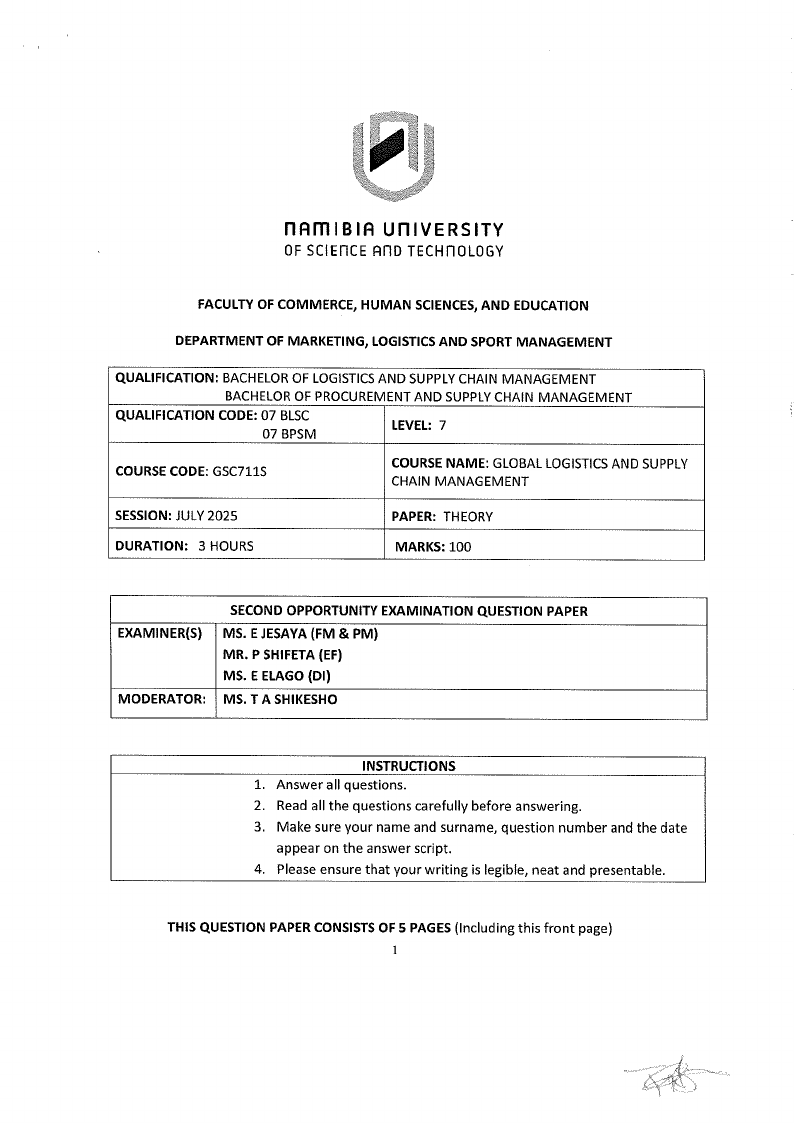
nAmlBIA UnlVERSITY
OF SCIEnCE Ano TECHnOLOGY
FACULTY OF COMMERCE, HUMAN SCIENCES,AND EDUCATION
DEPARTMENT OF MARKETING, LOGISTICSAND SPORT MANAGEMENT
QUALIFICATION: BACHELOROF LOGISTICSAND SUPPLYCHAIN MANAGEMENT
BACHELOROF PROCUREMENTAND SUPPLYCHAIN MANAGEMENT
QUALIFICATION CODE: 07 BLSC
07 BPSM
LEVEL: 7
COURSE CODE: GSC711S
COURSE NAME: GLOBALLOGISTICSAND SUPPLY
CHAIN MANAGEMENT
SESSION: JULY2025
DURATION: 3 HOURS
PAPER: THEORY
MARKS: 100
EXAMINER{S)
MODERATOR:
SECOND OPPORTUNITY EXAMINATION QUESTION PAPER
MS. E JESAYA (FM & PM)
MR. P SHIFETA (EF)
MS. E ELAGO {DI)
MS.TA SHIKESHO
INSTRUCTIONS
1. Answer all questions.
2. Read all the questions carefully before answering.
3. Make sure your name and surname, question number and the date
appear on the answer script.
4. Please ensure that your writing is legible, neat and presentable.
THIS QUESTION PAPER CONSISTS OF 5 PAGES (Including this front page)
1
|
|
2 Page 2 |
▲back to top |
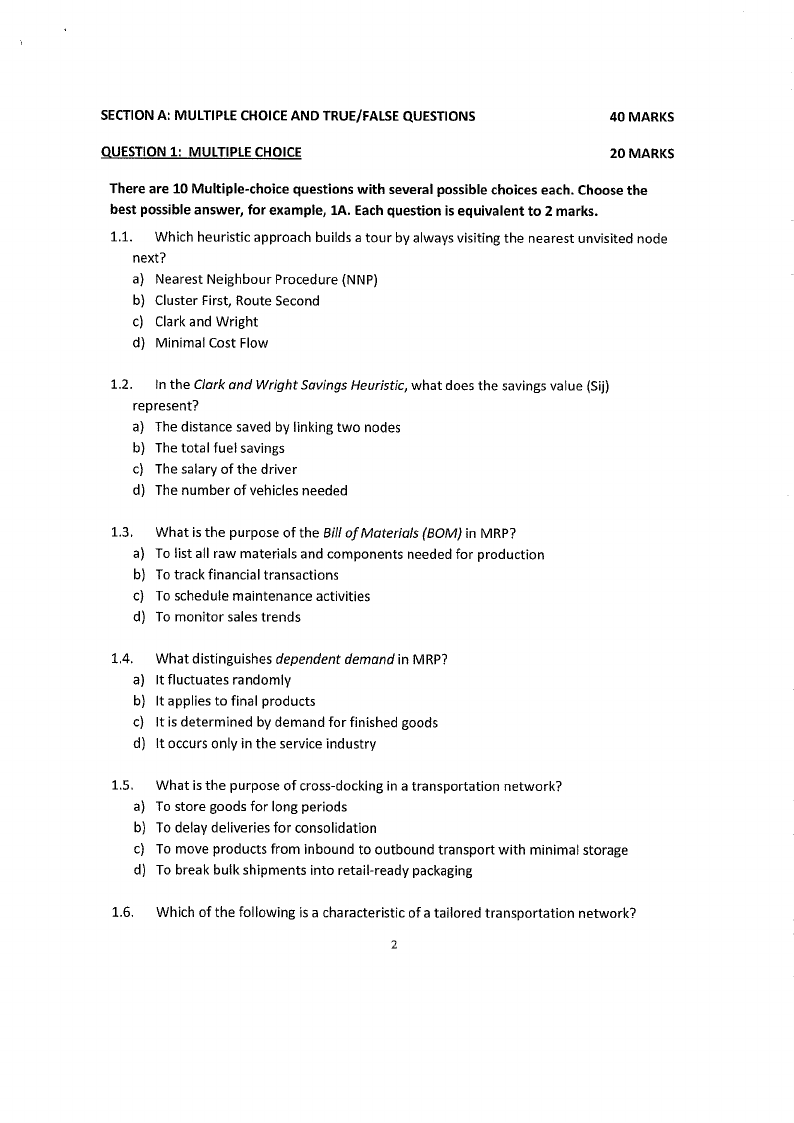
SECTION A: MULTIPLE CHOICE AND TRUE/FALSE QUESTIONS
40 MARKS
QUESTION 1: MULTIPLE CHOICE
20MARKS
There are 10 Multiple-choice questions with several possible choices each. Choose the
best possible answer, for example, lA. Each question is equivalent to 2 marks.
1.1. Which heuristic approach builds a tour by always visiting the nearest unvisited node
next?
a) Nearest Neighbour Procedure (NNP)
b) Cluster First, Route Second
c) Clark and Wright
d) Minimal Cost Flow
1.2. In the Clark and Wright Savings Heuristic, what does the savings value (Sij)
represent?
a) The distance saved by linking two nodes
b) The total fuel savings
c) The salary of the driver
d) The number of vehicles needed
1.3. What is the purpose of the Bill of Materials (BOM) in MRP?
a) To list all raw materials and components needed for production
b) To track financial transactions
c) To schedule maintenance activities
d) To monitor sales trends
1.4. What distinguishes dependent demand in MRP?
a) It fluctuates randomly
b) It applies to final products
c) It is determined by demand for finished goods
d) It occurs only in the service industry
1.5. What is the purpose of cross-docking in a transportation network?
a) To store goods for long periods
b) To delay deliveries for consolidation
c) To move products from inbound to outbound transport with minimal storage
d) To break bulk shipments into retail-ready packaging
1.6. Which of the following is a characteristic of a tailored transportation network?
2
|
|
3 Page 3 |
▲back to top |

a) One transportation method for all customers
b) The use of only cross-docking centers
c) A mix of multiple transportation and distribution methods
d) Elimination of intermediaries
1.7.
a)
b)
c)
d)
What does postponement
Number of workers
Raw material costs
Finished goods inventory
Factory size
in production primarily aim to reduce?
1.8. Which of the following best describes the Order Penetration Point (OPP}?
a) The first customer touch point on the website
b) The point where customer order triggers production or customisation
c) The last stage of inventory restocking
d) The end of the product life cycle
1.9. Which of the following best describes sourcing in supply chain operations?
a) A method for tracking inventory
b) A set of business processes required to purchase goods and services
c) The process of selling finished goods
d) The transportation of products to retailers
1.10. What is the main goal of supplier development?
a) Increase the number of suppliers
b) Monitor supplier emails
c) Improve a supplier's cost, quality, and delivery performance
d) Reduce supplier collaboration
QUESTION 2: TRUE/FALSE
20 MARKS
Please state whether the following statements are true or false.
2x10= 20 MARKS
a) In routing and scheduling problems, arcs can represent time, cost, or distance.
b) Vehicle routing and scheduling systems do not account for driver schedules or
vehicle capacities.
c) In a process-oriented layout, products move through a set of specialised, fixed
workstations.
d) MRP is a manual planning system for managing independent demand.
e) RELcharts are used to show the proximity relationships between different activities
in a facility.
3
|
|
4 Page 4 |
▲back to top |
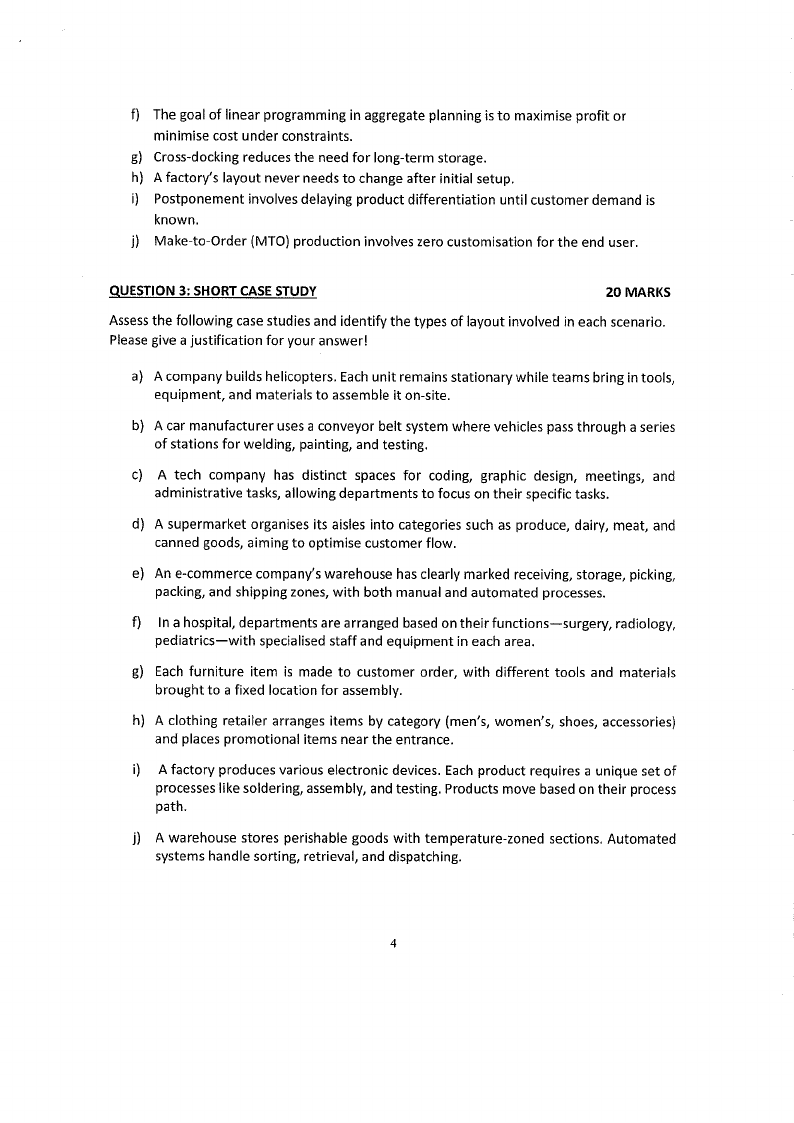
f) The goal of linear programming in aggregate planning is to maximise profit or
minimise cost under constraints.
g) Cross-docking reduces the need for long-term storage.
h) A factory's layout never needs to change after initial setup.
i) Postponement involves delaying product differentiation until customer demand is
known.
j) Make-to-Order (MTO) production involves zero customisation for the end user.
QUESTION3: SHORTCASESTUDY
20 MARKS
Assessthe following case studies and identify the types of layout involved in each scenario.
Pleasegive a justification for your answer!
a) A company builds helicopters. Eachunit remains stationary while teams bring in tools,
equipment, and materials to assemble it on-site.
b) A car manufacturer uses a conveyor belt system where vehicles pass through a series
of stations for welding, painting, and testing.
c) A tech company has distinct spaces for coding, graphic design, meetings, and
administrative tasks, allowing departments to focus on their specific tasks.
d) A supermarket organises its aisles into categories such as produce, dairy, meat, and
canned goods, aiming to optimise customer flow.
e) An e-commerce company's warehouse has clearly marked receiving, storage, picking,
packing, and shipping zones, with both manual and automated processes.
f) In a hospital, departments are arranged based on their functions-surgery, radiology,
pediatrics-with specialised staff and equipment in each area.
g) Each furniture item is made to customer order, with different tools and materials
brought to a fixed location for assembly.
h) A clothing retailer arranges items by category (men's, women's, shoes, accessories)
and places promotional items near the entrance.
i) A factory produces various electronic devices. Each product requires a unique set of
processes like soldering, assembly, and testing. Products move based on their process
path.
j) A warehouse stores perishable goods with temperature-zoned sections. Automated
systems handle sorting, retrieval, and dispatching.
4
|
|
5 Page 5 |
▲back to top |
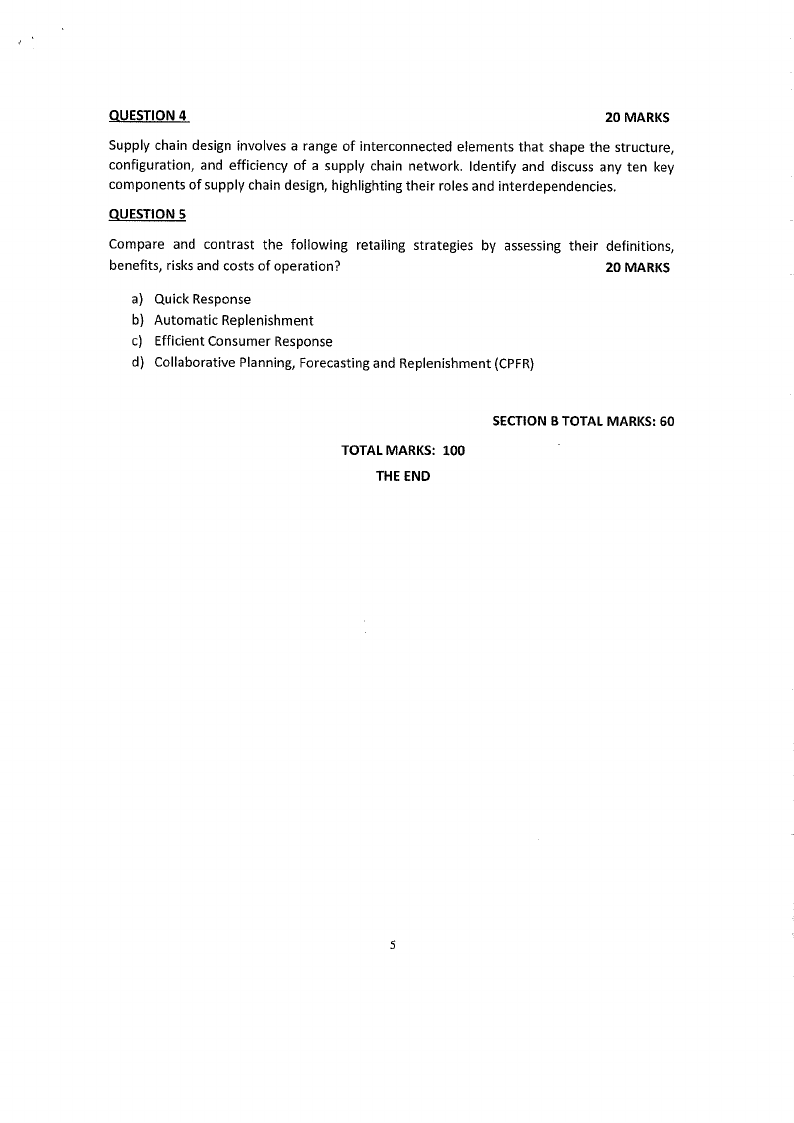
QUESTION4
20 MARKS
Supply chain design involves a range of interconnected elements that shape the structure,
configuration, and efficiency of a supply chain network. Identify and discuss any ten key
components of supply chain design, highlighting their roles and interdependencies.
QUESTION 5
Compare and contrast the following retailing strategies by assessing their definitions,
benefits, risks and costs of operation?
20 MARKS
a) Quick Response
b) Automatic Replenishment
c) Efficient Consumer Response
d) Collaborative Planning, Forecasting and Replenishment (CPFR)
TOTAL MARKS: 100
THEEND
SECTION B TOTAL MARKS: 60
5