


 |
MTS621S - Martime And Air Safety And Infrastructure Considerations- 2nd Opp - Nov 2025 |
|
|
1 Page 1 |
▲back to top |
nAmlBIA unlVERSITY
OF SCIEnCE Ano TECHnOLOGY
FACULTY OF COMMERCE, HUMAN SCIENCES AND EDUCATION
DEPARTMENT OF MARKETING, LOGISTICS AND SPORTS MANAGEMENT
QUALIFICATIONS: BACHELOR OF TRANSPORT MANAGEMENT
QUALIFICATION CODE: 07BTRA
COURSE CODE: MTS621S
LEVEL: 6
COURSE NAME: MARITIME AND AIR SAFETY
AND INFRASTRUCTURE CONSIDERATIONS
SESSION: JANUARY 2026
PAPER: THEORY
DURATION: 3 HOURS
MARKS: 100
SECOND OPPORTUNITY EXAMINATION PAPER
EXAMINER{S):
MODERATOR:
MR OSCAR KAVERU (FM & PM STUDENTS}
MR RODNEY APRIL (DI STUDENTS}
MR. AUGUSTUS STEPHANUS (FM EENHANA STUDENTS}
MR VETIRAIJE TJIPOMBO
INSTRUCTIONS
ANSWER ALL FOUR (4) QUESTIONS!!!
THIS MEMORANDUM PAPER CONSISTS OF 7 PAGES (Including this front Page}
|
|
2 Page 2 |
▲back to top |
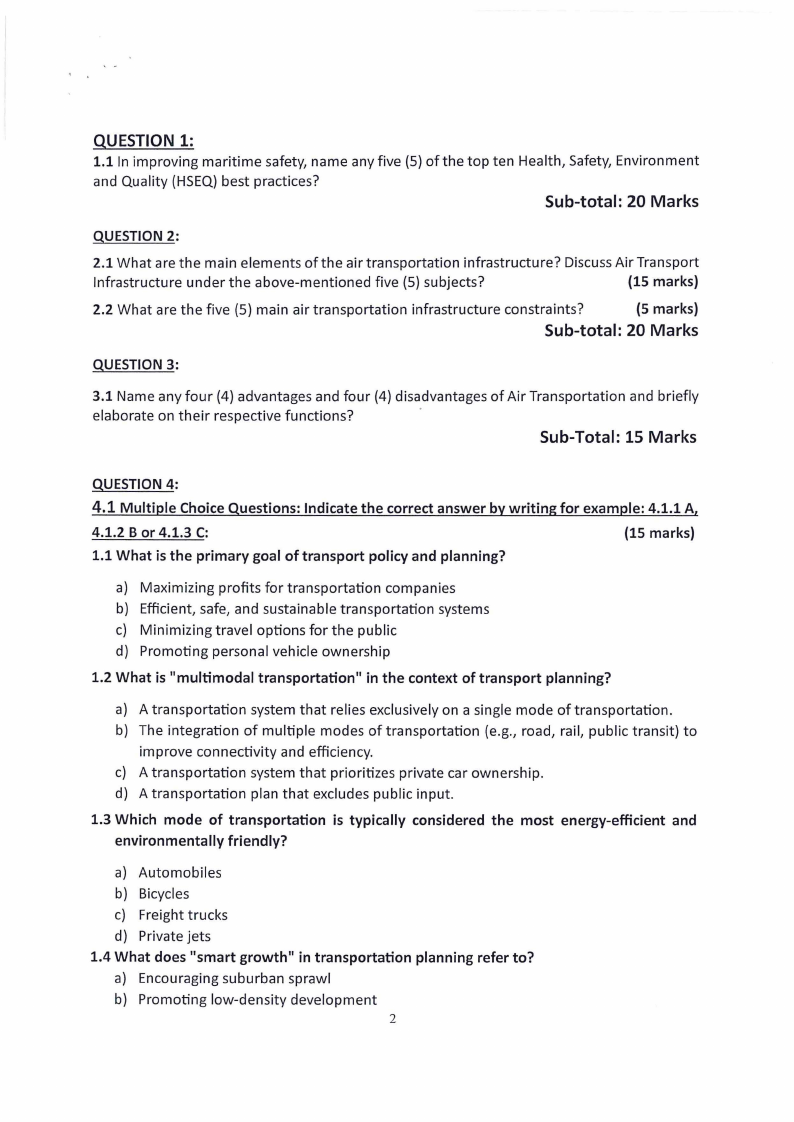
QUESTION 1:
1.1 In improving maritime safety, name any five (5) of the top ten Health, Safety, Environment
and Quality (HSEQ) best practices?
Sub-total: 20 Marks
QUESTION 2:
2.1 What are the main elements of the air transportation infrastructure? Discuss Air Transport
Infrastructure under the above-mentioned five (5) subjects?
(15 marks)
2.2 What are the five (5) main air transportation infrastructure constraints?
(5 marks)
Sub-total: 20 Marks
QUESTION 3:
3.1 Name any four (4) advantages and four (4) disadvantages of Air Transportation and briefly
elaborate on their respective functions?
Sub-Total: 15 Marks
QUESTION 4:
4.1 Multiple Choice Questions: Indicate the correct answer by writing for example: 4.1.1 A,
4.1.2 B or 4.1.3 C:
(15 marks)
1.1 What is the primary goal of transport policy and planning?
a) Maximizing profits for transportation companies
b) Efficient, safe, and sustainable transportation systems
c) Minimizing travel options for the public
d) Promoting personal vehicle ownership
1.2 What is "multimodal transportation" in the context of transport planning?
a) A transportation system that relies exclusively on a single mode of transportation.
b) The integration of multiple modes of transportation (e.g., road, rail, public transit) to
improve connectivity and efficiency.
c) A transportation system that prioritizes private car ownership.
d) A transportation plan that excludes public input.
1.3 Which mode of transportation is typically considered the most energy-efficient and
environmentally friendly?
a) Automobiles
b) Bicycles
c) Freight trucks
d) Private jets
1.4 What does "smart growth" in transportation planning refer to?
a) Encouraging suburban sprawl
b) Promoting low-density development
2
|
|
3 Page 3 |
▲back to top |
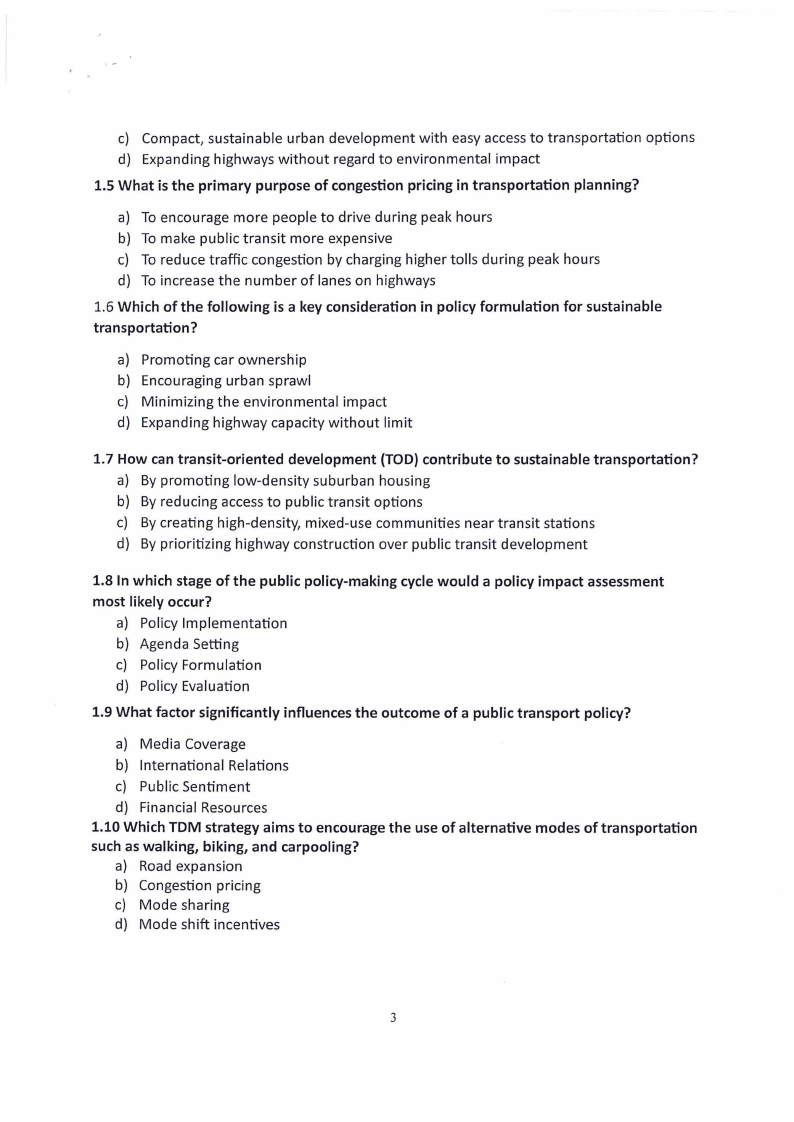
c) Compact, sustainable urban development with easy access to transportation options
d) Expanding highways without regard to environmental impact
1.5 What is the primary purpose of congestion pricing in transportation planning?
a) To encourage more people to drive during peak hours
b) To make public transit more expensive
c) To reduce traffic congestion by charging higher tolls during peak hours
d) To increase the number of lanes on highways
1.6 Which of the following is a key consideration in policy formulation for sustainable
transportation?
a) Promoting car ownership
b) Encouraging urban sprawl
c) Minimizing the environmental impact
d) Expanding highway capacity without limit
1.7 How can transit-oriented development (TOD) contribute to sustainable transportation?
a) By promoting low-density suburban housing
b) By reducing access to public transit options
c) By creating high-density, mixed-use communities near transit stations
d) By prioritizing highway construction over public transit development
1.8 In which stage of the public policy-making cycle would a policy impact assessment
most likely occur?
a) Policy Implementation
b) Agenda Setting
c) Policy Formulation
d) Policy Evaluation
1.9 What factor significantly influences the outcome of a public transport policy?
a) Media Coverage
b) International Relations
c) Public Sentiment
d) Financial Resources
1.10 Which TDM strategy aims to encourage the use of alternative modes of transportation
such as walking, biking, and carpooling?
a) Road expansion
b) Congestion pricing
c) Mode sharing
d) Mode shift incentives
3
|
|
4 Page 4 |
▲back to top |
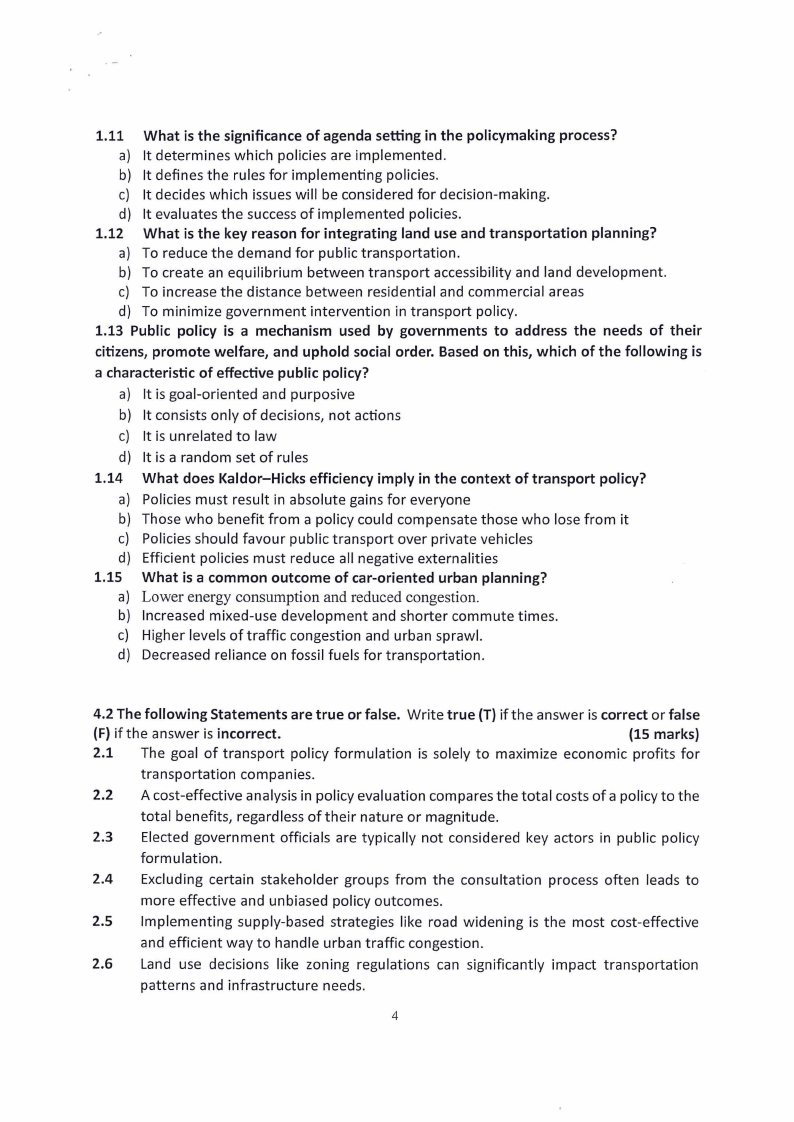
1.11 What is the significance of agenda setting in the policymaking process?
a) It determines which policies are implemented.
b) It defines the rules for implementing policies.
c) It decides which issues will be considered for decision-making.
d) It evaluates the success of implemented policies.
1.12 What is the key reason for integrating land use and transportation planning?
a) To reduce the demand for public transportation.
b) To create an equilibrium between transport accessibility and land development.
c) To increase the distance between residential and commercial areas
d) To minimize government intervention in transport policy.
1.13 Public policy is a mechanism used by governments to address the needs of their
citizens, promote welfare, and uphold social order. Based on this, which of the following is
a characteristic of effective public policy?
a) It is goal-oriented and purposive
b) It consists only of decisions, not actions
c) It is unrelated to law
d) It is a random set of rules
1.14 What does Kaldor-Hicks efficiency imply in the context of transport policy?
a) Policies must result in absolute gains for everyone
b) Those who benefit from a policy could compensate those who lose from it
c) Policies should favour public transport over private vehicles
d) Efficient policies must reduce all negative externalities
1.15 What is a common outcome of car-oriented urban planning?
a) Lower energy consumption and reduced congestion.
b) Increased mixed-use development and shorter commute times.
c) Higher levels of traffic congestion and urban sprawl.
d) Decreased reliance on fossil fuels for transportation.
4.2 The following Statements are true or false. Write true (T) if the answer is correct or false
(F) if the answer is incorrect.
(15 marks)
2.1 The goal of transport policy formulation is solely to maximize economic profits for
transportation companies.
2.2 A cost-effective analysis in policy evaluation compares the total costs of a policy to the
total benefits, regardless of their nature or magnitude.
2.3 Elected government officials are typically not considered key actors in public policy
formulation.
2.4 Excluding certain stakeholder groups from the consultation process often leads to
more effective and unbiased policy outcomes.
2.5 Implementing supply-based strategies like road widening is the most cost-effective
and efficient way to handle urban traffic congestion.
2.6 Land use decisions like zoning regulations can significantly impact transportation
patterns and infrastructure needs.
4
|
|
5 Page 5 |
▲back to top |
2.7 The "destination choice" step in the four-step transport modelling process involves
allocating trips to specific destinations based on their attractiveness.
2.8 Land Use Management (LUM) policies aim to reduce the need for travel by improving
access to services and managing zoning regulations.
2.9 Citizen participation in public policy making is essential for building a sense of
ownership and ensuring successful policy implementation.
2.10 Congestion is a result of an imbalance of the travel demand and the transport system
supply.
2.11 Businesses are not impacted by public policies and should not be concerned with the
policy-making process.
2.12 Non-decision making is a tactic used to prevent certain conditions from becoming
public policy issues.
2.13 Public policy making is solely the responsibility of the executive branch of government.
2.14 Sustainable urban mobility, as outlined in SDG 11, aims solely to improve the
affordability of transportation systems, without focusing on inclusivity, safety, or
environmental sustainability.
2.15 An informal policy is a documented and officially approved course of action, whereas
a formal policy is an unwritten but widely recognized practice within an organization.
4.3 Fill-in the missing word: Indicate the correct answer by writing for example: 4.3. 1 A,
4.3.2 B or 4.3.3 C:
(15 marks)
3.1 Maritime security largely focuses on the protection of vessels and their cargo from ............ .
threats such as smuggling, piracy, and:
(a) External th reats
(b) Governments officers'
(c) Intruders'
3.2 International Civil Aviation Organization (ICAO) does not have the power to enforce
penalties on non-complying accident investigation bodies, it is focusing on industry
coordination and highl ighting the importance of ......... ........................ :
(a) Responsible flying
(b) Aviation industry in general
(c) A ccident reporting
3.3 Safety monitoring could be an important source of information for measuring the effective
functioning of other Safety Management Systems (SMS) ... ..................................:
(a) Infrastructures
(b) Components
(c) Issues
3.4 The initial phases of the investigation of accidents consists of the following phases which
is the collection_of data, analysis of data, and ................................. :
(a) Perusals of data
(b) Interrogation of witnesses
(c) Presentation of findings
5
|
|
6 Page 6 |
▲back to top |
3.5 Much of any private investigation into Maritime and Air Transport must be conducted
within that forum's ...... .................................. and legal framework:
(a) Accepted practice
(b) Standard practice
(c) Accepted norms
3.6 The Health Safety and Environment (HSE) primary objectives is to identify hazards
originating outside the workplace capable of ......... ................... affecting the health and safety
of our employees and reducing their risks.
(a) Wrongly
(b) Adversely
(c) Negatively
3.7 According to Ruben Morales, General Manager of Safety and Risk Management at Hong
Kong Express Airways, a ........................ .................. ........_by airlines and pilots can also hinder the
investigation process, discouraging those closest to an accident from divulging information
freely.
(a) Fear losing job
(b) Fear of incompetence
(c) Fear of criminalization
3.8 International Maritime Organization (IMO) was founded in .................. ...... . and
headquarters in London, the IMO serves as a vital forum for member states to develop and
implement international maritime regulations and standards.
(a) 1957
(b) 1945
(c) 1948
3.10 Flying is immensely more dangerous in .............................. weather. A study by
the National Transportation Safety Board shows that more than two-thirds of all weather-
related airplane crashes have been fatal.
(a) Inclement weather
(b) Foggy weather
(c) Rainy weather
3.11 The bill of lading is a legally binding document providing the shipper and the carrier all
the details needed to process the freight shipment and ..................... it correctly:
(a) Discharge
(b) Invoice
(c) Receipt
3.12 Before arrival of a ship, the required ......... ........................... space must be allocated taking
the prospective time the ship spends in the terminal into account:
(a) Capacity
(b) Layout
(c) Berthing
6
|
|
7 Page 7 |
▲back to top |
3.13 Based on the stowage plan, planners in container terminals determine the sequence of
unloading ........................... and of loading outbound containers:
(a) Inbound containers
(b) Terminal Yard
(c) Transit containers
3.14 Sustainable development is development that meets the needs of the present without
................................. the ability of future generations to meet their own needs:
(a) Wasting
(b) Compromising
(c) Disposing
3.15 For maritime transport systems to be seamless, fluid and operational there is need for
reliable information flows between stakeholders enabled by manual documentation and
increasingly the information flows are being done ........................... ........................ :
(a) Smartly
(b) Smoothly
(c) Electronically
Sub-Total: 45 Marks
Grand Total: 100 Marks
7