ANP621S - ANATOMICAL PATHOLOGY 2B - 2ND OPP - DEC 2025


ANP621S - ANATOMICAL PATHOLOGY 2B - 2ND OPP - DEC 2025


1 Pages 1-10

▲back to top


1.1 Page 1

▲back to top


ANATOMICAL PATHOLOGY 2B {ANP621S) 2nd OPPORTUNITY EXAMINATION PAPER- 2025
nAm I BIA un IVE RS ITV
OF SCIEnCE Ano TECHnOLOGY
FACULTY OF HEALTH, NATURAL RESOURCES AND APPLIED SCIENCES
DEPARTMENT OF CLINICAL HEALTH SCIENCES
QUALIFICATION: BACHELOR OF MEDICAL LABORATORY SCIENCES
QUALIFICATION CODE: 08BMLS
LEVEL: 6
COURSE CODE: ANP621S
COURSE NAME: ANATOM ICAL PATHOLOGY 2B
SESSION: DECEMBER 2025
DURATION: 3 HOURS
PAPER: THEORY
MARKS: 100
SECOND OPPORTUNITY/SUPPLEMENTARY EXAMINATION PAPER
EXAMINER(S)
MS BELINDA ROSELIN TSAUSES
MODERATOR:
MS NDESHIPEWA HAMATWI-VALOMBOLA
INSTRUCTIONS TO CANDIDATES
1. Answer All questions in your answer booklet.
2. This exa min ation paper consists of THREE sections:
o Section A: 40 marks (Multiple Choice an d True/Fa lse questions}
o Section B: 25 marks (Short answer qu estions)
o Section C: 35 marks (Case studies w ith im age interpretation}
3. Write legibly and use black or blue ink only. Pencil may on ly be used for diagrams.
4. No ref erence materials, textbooks, or notes are permitted.
THIS QUESTION PAPER CONSISTS OF 12 PAGES (incl uding this front page}.
Page 1 of 12

1.2 Page 2

▲back to top


ANATOMICAL PATHOLOGY 2B (ANP621S) 2nd OPPORTUNITY EXAMINATION PAPER- 2025
Section A (40 marks)
Question 1
[30]
Evaluate the statements in each numbered section and select the most appropriate
answer. Write correct letter next to the corresponding number.
1.1 The transformation zone of the cervix is:
(1)
A. Only found in nulliparous women.
B. The site where reserve cells undergo metaplasia.
C. Located entirely within the endocervical canal.
D. Not important for cervical screening.
1.2 Which hormone is primarily responsible for proliferation and maturation of
vaginal epithelium?
(1)
A. Progesterone
B. Estrogen
C. FSH
D. LH
1.3 Navicular cells are characteristically seen in :
(1)
A. Atrophic smears.
B. Mid-cycle proliferative phase.
C. HPV infection.
D. Pregnancy/progesterone-dominant states.
1.4 The ideal time to take a cervical sample during the menstrual cycle is:
(1)
A. During menstruation
B. Days 1-5
C. Mid-cycle (days 10-18)
D. Day 28
Page 2 of 12

1.3 Page 3

▲back to top


ANATOMICAL PATHOLOGY 28 (ANP621S) 2nd OPPORTUNITY EXAMINATION PAPER- 2025
1.5 Which cell type predominates in postmenopausa l atrophic smears?
(1)
A. Superficial cells
B. Parabasal cells
C. Intermediate cells
D. Metaplastic cells
1.6 The Maturation Index is expressed as :
(1)
A. Superficial: Intermediate : Parabasal
B. Parabasal : Intermediate : Superficial
C. Intermediate : Superficial : Parabasal
D. Parabasal: Superficial: Intermediate
1.7 Cytolysis is caused by:
(1)
A. Lactobacilli fermenting glycogen
B. HPV infection
C. Radiation therapy
D. Bacterial vaginosis
1.8 Blue blobs in atrophic smears represent:
(1)
A. Bacterial colonies
B. HPV-infected cells
C. Degenerative parabasal cells
D. Fungal elements
1.9 The secretory phase of the menstrual cycle is dominated by:
(1)
A. Estrogen only
B. Progesterone
C. FSH
D. LH
Page 3 of 12

1.4 Page 4

▲back to top


ANATOMICAL PATHOLOGY 2B (ANP621S) 2nd OPPORTUNITY EXAMINATION PAPER- 2025
1.10 Numerous anucleate squames and orangeophilic keratinized squamous cells
with smal l pyknotic nuclei are present; no dysplasia. The finding is best called: (1)
A. HSIL, keratinizing type.
B. Parakeratosis/hyperkeratosis (benign reactive change}.
C. ASC-H.
D. Unsatisfactory due to keratin.
1.11 A maturation index compatible with estrogenic peak (mid-cycle) is most likely: (1)
A. 80:20:0
B. 0:80:20
C. 20:60:20
D. 0:20:80
1.12 Endocervical cells in a cervical smear indicate:
(1)
A. Transformation zone sampling.
B. Endometrial pathology.
C. HPV infection.
D. Invasive cancer.
1.13 Endocervical cells classically show:
(1)
A. Top-hat clusters.
B. Honeycomb sheets/pa lisades.
C. Single dispersed cells.
D. Nuclear grooves.
1.14 Blue blobs are most associated w ith:
(1)
A. Severe atrophy.
B. Candida infection.
C. Trichomonas.
D. Normal mid-cycle smears.
Page 4 of 12

1.5 Page 5

▲back to top


ANATOMICAL PATHOLOGY 2B (ANP621S) 2nd OPPORTUNITY EXAMINATION PAPER- 2025
1.15 The hallmark nuclear feature of superficial squamous cells is:
(1)
A. Large vesicular nucleus.
B. Small pyknotic nucleus (~5 µm).
C. Hyperchromatic nucleus.
D. Multiple nucleoli.
1.16 Reserve cell hyperplasia is the precursor for:
(1)
A. Glandular lesions only.
B. Squamous lesions only.
C. Both squamous and adenocarcinoma.
D. Normal metaplasia only.
1.17 The secretory phase is characterized by:
(1)
A. Superficial cell predominance
B. Intermediate cell predominance
C. Parabasal cell predominance
D. Anucleate squames
1.18 HPV vaccination targets which high-risk types primarily?
(1)
A. HPV 6 and 11
B. HPV 31 and 33
C. HPV 16 and 18
D. HPV 45 and 52
1.19 Liquid-based cyto logy (LBC) compared to conventiona l smears:
(1)
A. Has more air-drying artifacts.
B. Produces cleaner backgrounds.
C. Cannot be used for HPV testing.
D. Requires immediate staining.
Page 5 of 12

1.6 Page 6

▲back to top


ANATOMICAL PATHOLOGY 28 (ANP621S) 2nd OPPORTUNITY EXAMINATION PAPER- 2025
1.20 Transformation Zone adequate sampling requires at least:
(1)
A. 5 superficial cells.
B. ;?:10 endocervica l or metaplastic cells.
C. 50 parabasal cells.
D. Navicular cel ls present.
1.21 On a conventional Pap smear, several squamous cells show irregular, refractile,
"cornflake-like" cytopla smic edges with overall pale, washed-out cytoplasm. The
background also appears slightly granular, and fixation was reported to be
delayed. What is the best interpretation?
(1)
A. l<oilocytosis due to HPV effect.
B. Glycogenated intermediate cells.
C. Air-drying artifact ("cornflake" artifact) from delayed fixation.
D. Degenerative changes in atrophic vagin itis.
1.22 Which finding most strongly supports an "adequate" Pap test under the
Bethesda System?
(1)
A. ;?:5,000 squamous cells on a conventiona l smear.
B. Presence of endocervical/transformation zone component.
C. Completely blood-stained background.
D. Predominance of parabasal cells only.
1.23 The correct fixation procedure for conventional cervical smears is:
(1)
A. Air-dry for 10 minutes first.
B. Fix immediately in 95% ethanol while wet.
C. Allow partial drying.
D. Fix after staining.
Page 6 of 12

1.7 Page 7

▲back to top


ANATOMICAL PATHOLOGY 2B (ANP621S) 2nd OPPORTUNITY EXAMINATION PAPER- 2025
1.24 A Pap test shows cells with markedly increased N:C ratio, coarse/clumped
chromatin, irregular nuclear contours, and scant cyanophi li c cytoplasm.
Which diagnosis is most consistent?
(1)
A. Reactive/reparative changes.
B. LSIL (CIN 1).
C. HSIL (CIN 2-3).
D. Atrophy w ith inflammation.
1.25 NILM smear with many navicular cells is most consistent with:
(1)
A. Atrophy
B. HSIL
C. Early pregnancy/luteal phase
D. Menstruation
1.26 Actinomyces-like organisms are classically associated with:
(1)
A. IUCD {IUD) use
B. Menopause
C. HSV infection
D. Diabetes
1.27 Why is the menstrual cycle phase important in cytology interpretation?
(1)
A. It determines malignancy likelihood.
B. Hormones influence cell maturation types.
C. It only affects staining.
D. Cytology requires menstruation.
1.28 Degenerative changes in cyto logy include:
(1)
A. l<oilocytosis
B. Karyorrhexis, karyolysis, cytop lasmic changes
C. Active hormonal stimulation
D. Viral proliferation
Page 7 of 12

1.8 Page 8

▲back to top


ANATOMICAL PATHOLOGY 28 (ANP621S} 2nd OPPORTUNITY EXAMINATION PAPER- 2025
1.29 An asymptomatic 48-year-old has exfoliated endometrial cells reported on
Pap test. What is the best next step?
(1)
A. No action; always a benign finding
B. Treat empirically for endometritis
C. Clinical evaluation for possible endometrial pathology
D. Repeat Pap in 3 years.
1.30 Filamentous, radiating bacterial colonies ("cotton-ball" or sunburst) are seen
on a Pap smear from a patient with an intrauterine device (IUD). The most
likely organism is:
(1)
A. Trichomonas vaginalis
B. Actinomyces-like organisms
C. Candida species
D. Chlamydia trachomatis
Question 2
[10]
Indicate whether each statement is TRUE or FALSE. Write only "True" or "False" next to
the question number.
2.1 Superficia l cel ls have large pyknotic nuclei approximately 5 µmin size.
(1)
2.2 Progesterone promotes complete maturation to superficial cells.
(1)
2.3 Metastasis is the spread of cancer cel ls from the primary tumor site to distant
organs or tissues through the bloodstream or lymphatic system.
(1)
2.4 Invasion refers to the penetration of malignant cel ls through the
basement membrane into underlying stroma l tissue.
(1)
2.5 Endocervical cel ls indicate sampling of the transformation zone.
(1)
2.6 Menstruation is the ideal time for cervical screening.
(1)
2.7 Navicular cells are boat-shaped glycogenated intermediate cells.
(1)
2.8 Atrophic smears show predominantly superficia l cells.
(1)
2.9 The lactating pattern shows parabasal cell predominance.
(1)
2.10 HPV vaccination eliminates the need for cervical screen ing.
(1)
Page 8 of 12

1.9 Page 9

▲back to top


ANATOMICAL PATHOLOGY 2B (ANP621S) 2nd OPPORTUNITY EXAMINATION PAPER- 2025
Section B (25 marks)
Question 3
[12]
3.1 Identify the FOUR normal squamous epithelial cell types in the correct order of
progression from the least mature to the most mature.
(4)
3.2 Explain how the identified squamous epithelial cells in question 3.1 proliferate and
differentiate to form each subsequent cell layer, describing ONE key nuclear and
cytoplasmic changes that occur during these maturation processes at cellular
level. Present all your answers in a table.
(8)
Question 4
[13]
4.1 State which cells lactobacilli act upon during cytolysis and explain how.
(5)
4.2 Briefly explain FOUR key quality control steps for conventional smears and fixation
to minimize artefacts.
(4)
4.3 Differentiate between cytology and histology as diagnostic methods, and explain
when cytology is the preferred choice.
(4)
Section C (35 marks)
Question 5
[15]
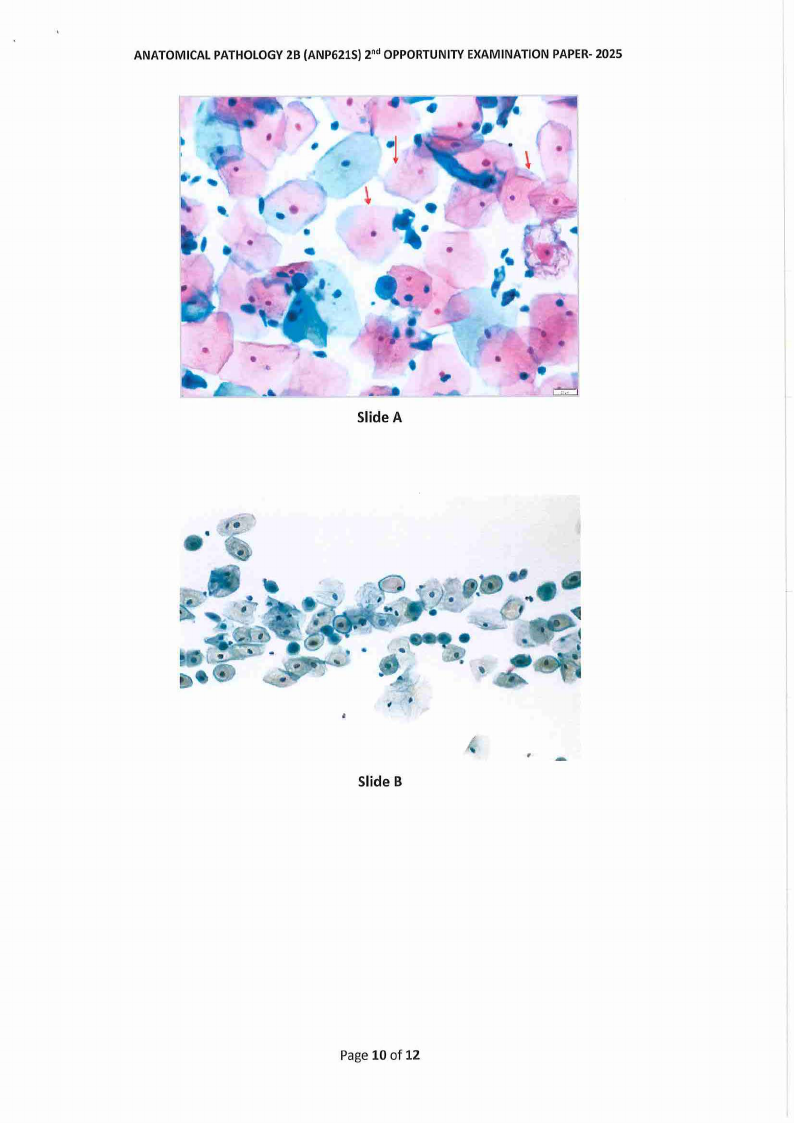
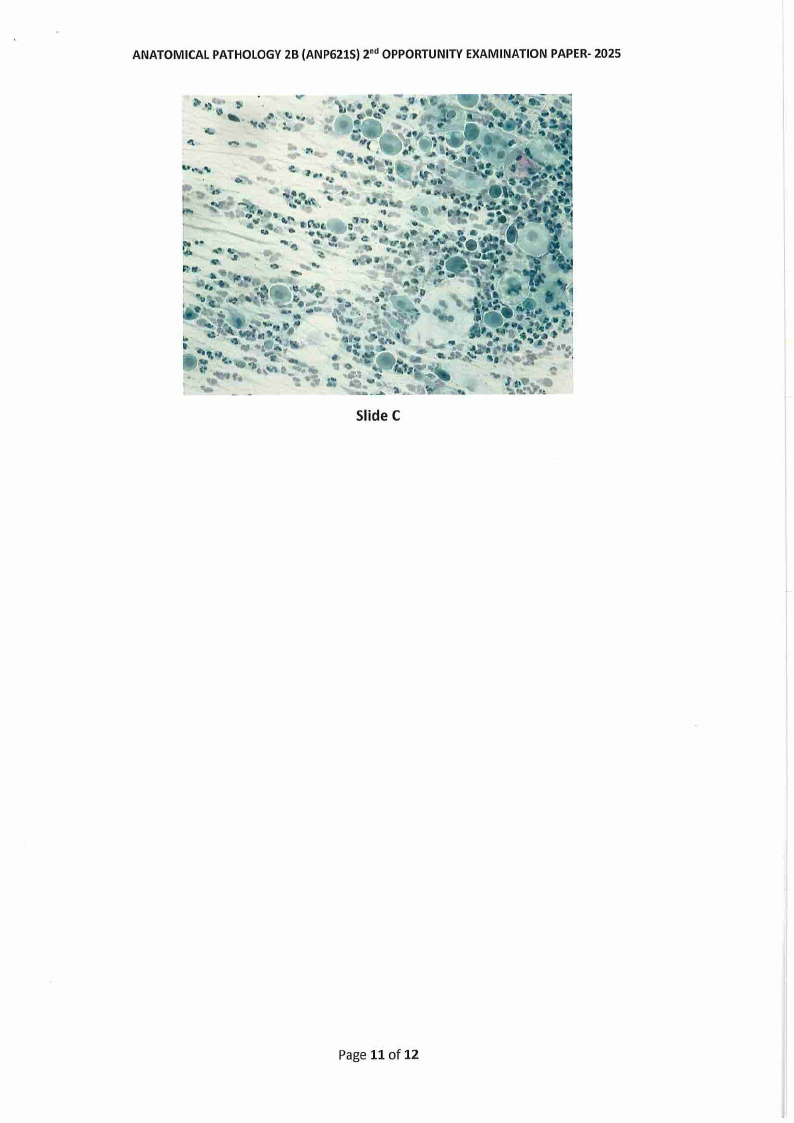
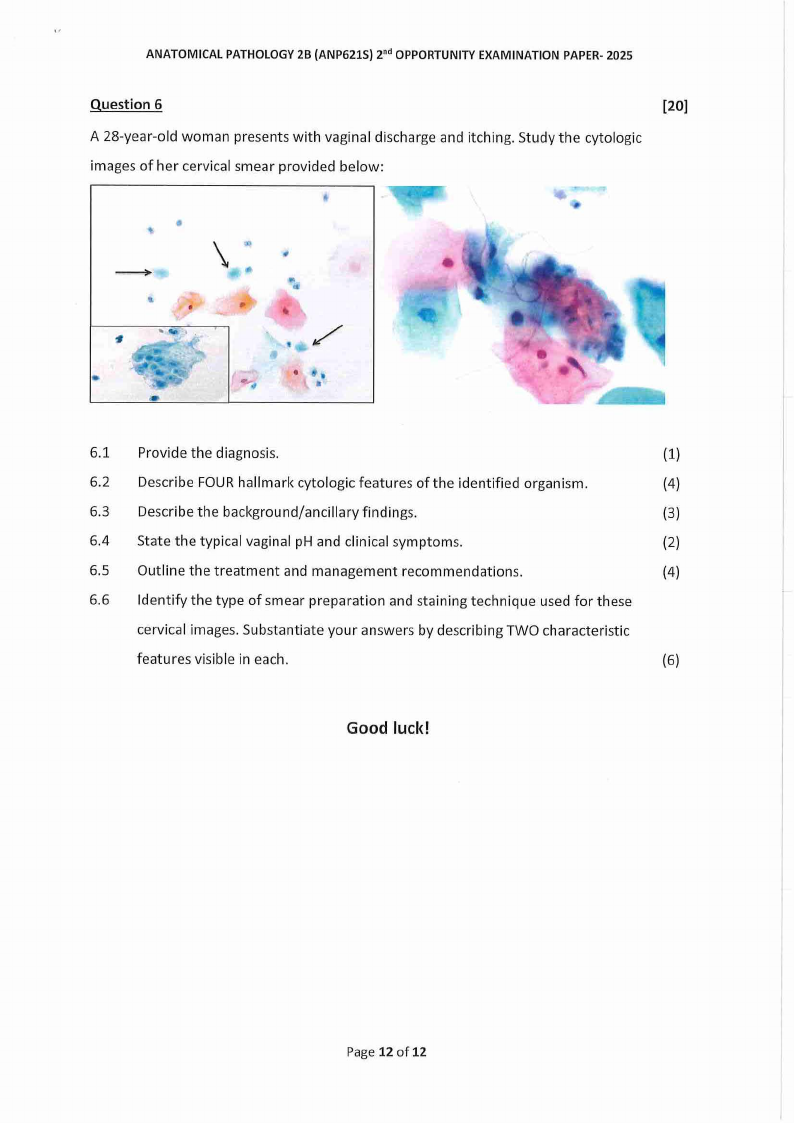
Study the three cytologic images provided below representing different menopausal
phases. For EACH slide (labelled A-C), provide the following information in one table:
5.1 Phase identification
(3)
5.2 Two cytologic features
(6)
5.3 Maturation Index (Ml)
(3)
5.4 Clinical significance
(3)
Page 9 of 12

1.10 Page 10

▲back to top


ANATOMICAL PATHOLOGY 2B (ANP621S) 2nd OPPORTUNITY EXAMINATION PAPER- 2025
Slide A
Slide B
-,,
Page 10 of12

2 Pages 11-20

▲back to top


2.1 Page 11

▲back to top


ANATOMICAL PATHOLOGY 2B (ANP621S) 2nd OPPORTUNITY EXAMINATION PAPER- 2025
Slide C
Page 11 of 12

2.2 Page 12

▲back to top


ANATOMICAL PATHOLOGY 2B (ANP621S) 2nd OPPORTUNITY EXAMINATION PAPER- 2025
Question 6
[20]
A 28-year-old woman presents with vaginal discharge and itching. Study the cytologic
images of her cervical smear provided below:
.
\\-
~
'/
••
6.1 Provide the diagnosis.
(1)
6.2 Describe FOUR hallmark cytologic features of the identified organ ism.
(4)
6.3 Describe the background/ancillary findings.
(3)
6.4 State the typical vaginal pH and clinical symptoms.
(2)
6.5 Outline the treatment and management recommendations.
(4)
6.6 Identify the type of smear preparation and staining technique used for these
cervical images. Substantiate your answers by describing TWO characteristic
features visib le in each.
(6)
Good luck!
Page 12 of 12