|
CWM510S - CLASSROOM AND WORKSHOP MANAGEMENT - 1ST OPP - JUNE 2025 |
|
|
1 Page 1 |
▲back to top |

nAmlBIA UnlVERSITY
OF SCIEnCE Ano TECHnOLOGY
FACULTY OF COMMERCE, HUMAN SCIENCE AND EDUCATION
DEPARTMENT OF TECHNICAL, VOCATIONAL EDUCATION AND TRAINING
QUALIFICATION: DIPLOMA IN TECHNICAL AND VOCATIONAL EDUCATION AND TRAINING:
TRAINER
QUALIFICATION CODE: 06DTVT
COURSE CODE: CWMSl0S
SESSION: JUNE 2025
LEVEL: 5
COURSE NAME: CLASSROOM AND WORKSHOP
MANAGEMENT
PAPER: 1
DURATION: 3 HOURS
MARKS: 100
EXAMINER{S)
FIRST OPPORTUNITY EXAMINATION QUESTION PAPER
DR K. JUNIAS
MODERATOR: MS. CLAUDIA MARITSHANE
INSTRUCTIONS
1. Answer ALL the questions.
2. Read all the questions carefully before answering.
3. Number the answers clearly
THIS QUESTION PAPER CONSISTS OF _6_ PAGES (Including this front page)
|
|
2 Page 2 |
▲back to top |

Question 1 True or False questions
[7]
State whether the following statements about classroom/workshop management are true or
false by writing the word True or False on the sheet provided.
(a) Classroom management only involves dealing with misbehaviour when it occurs.
(b) Effective classroom management helps to maximise instructional time and student learning.
(c) Arranging the physical environment has little to no effect on student behaviour.
(d) Classroom management is the sole responsibility ofthe teacher, and students play no role it.
(e) Consistency in applying rules and consequences is essential to effective classroom
management.
(f) Classroom management strategies should consider the developmental level and needs of
learners.
(g) A quiet classroom always means effective classroom management is taking place.
Question 2
[4]
Match each student behaviour in Column A with the most appropriate action plan or strategy in
Column B. Write the correct letter of the action plan from Column B next to the corresponding
number in Column A.
::olumn A
::olumn B
~- Defiance
a) Offer structured choices
D. Lack of motivation
b) Assign roles or engage with questions
B.Need for control
c ) Acknowledge the student's feelings, then
restate expectations
ij, Off-task behaviour
d) Dismiss Behaviour
e) Connect lessons to real-life applications
Question 3
[25]
(a)
Study the two pictures (X) and (Y) provided below about the physical layout of a
learning environment, and answer the following questions:
(Picture X)
(Picture Y)
2
|
|
3 Page 3 |
▲back to top |
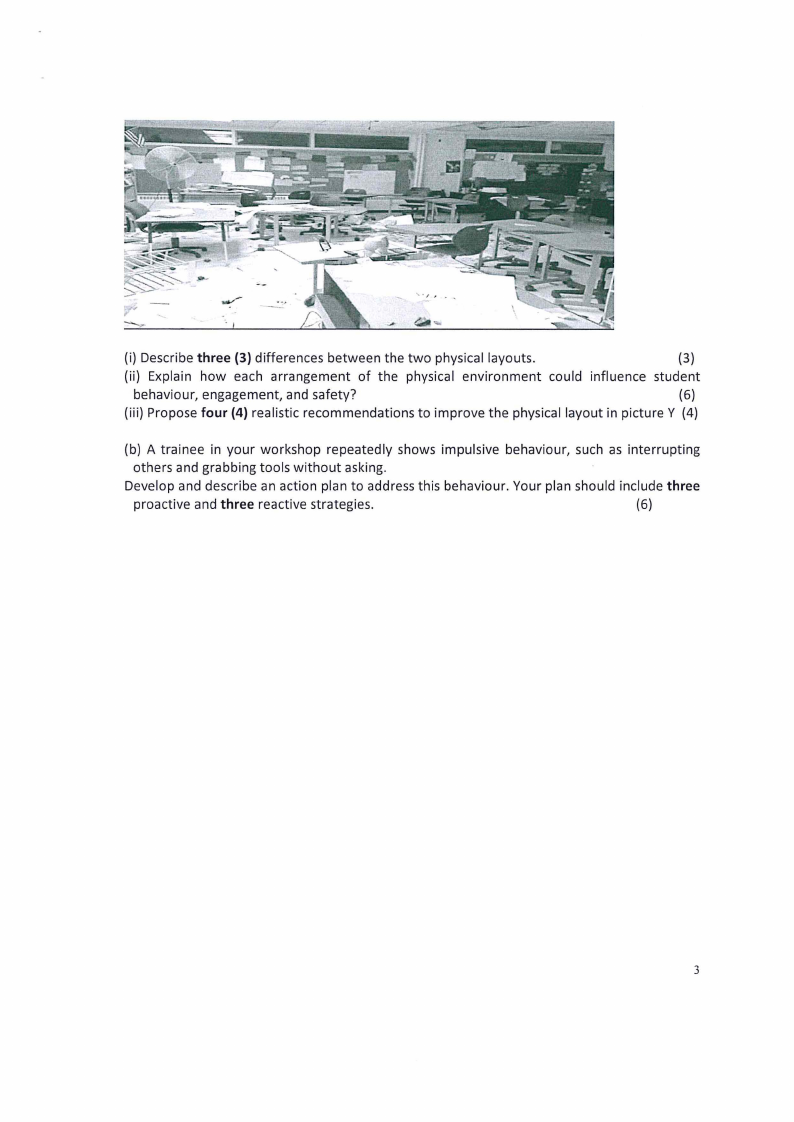
(i) Describe three (3) differences between the two physical layouts.
(3)
(ii) Explain how each arrangement of the physical environment could influence student
behaviour, engagement, and safety?
(6)
(iii) Propose four (4) realistic recommendations to improve the physical layout in picture Y (4)
(b) A trainee in your workshop repeatedly shows impulsive behaviour, such as interrupting
others and grabbing tools without asking.
Develop and describe an action plan to address this behaviour. Your plan should include three
proactive and three reactive strategies.
(6)
3
|
|
4 Page 4 |
▲back to top |
(c) You are placed at a Vocational Training Centre where classrooms are overcrowded, and
trainees often arrive late, and move around frequently. The Head ofTrainee asksfor your input
to improve classroom management without changing staff or class size.
Using your understanding of physical environment arrangement, propose and justify three
practical changes you will make to the classroom layout to improve learner behaviour,
participation, and flow of instruction.
(6)
Question 4
[39]
Readthe four classroom scenarios provided below. Eachscenario represents a different trainer's
belief system about teaching, learning, and student motivation. These belief systems
significantly influence how these trainers manage their classroom or workshop environment.
Scenario A: Mr. Gabriel-The Enforcer
Mr. Gabriel believes that students learn best when rules are strictly followed and consequences
are consistently applied. He uses a structured system of rewards for good behaviour and
punishments for misbehaviour. His lessons are highly organised and teacher-directed.
Scenario B: Ms. Lien -The Nurturer
Ms. Lien believes that every learner has an inner drive to learn and succeed. She prioritises
students' emotional well-being, builds strong teacher-student relationships, and avoids
punitive measures. She gives learners time to reflect and connect personally with their work.
Scenario C: Mr. Moses -The Collaborator
Mr. Moses believes that students learn through interaction and social engagement. He often
organises group work, encourages dialogue, and involves learners in co-creating class rules and
goals. He sees misbehavior as an opportunity to teach social skills.
Scenario D: Ms. Anna - The Coach
Ms. Anna believes that learners should take responsibility for their own learning and behaviours.
She gives students choices, promotes self-assessment, and holds learners accountable through
logical consequences. She sees motivation as a product of autonomy and ownership.
Using the scenarios above:
(a) Outline three strengths and three limitations of each educator's belief system.
{Consider aspects such as discipline, learner engagement, autonomy, and classroom climate.)
(24)
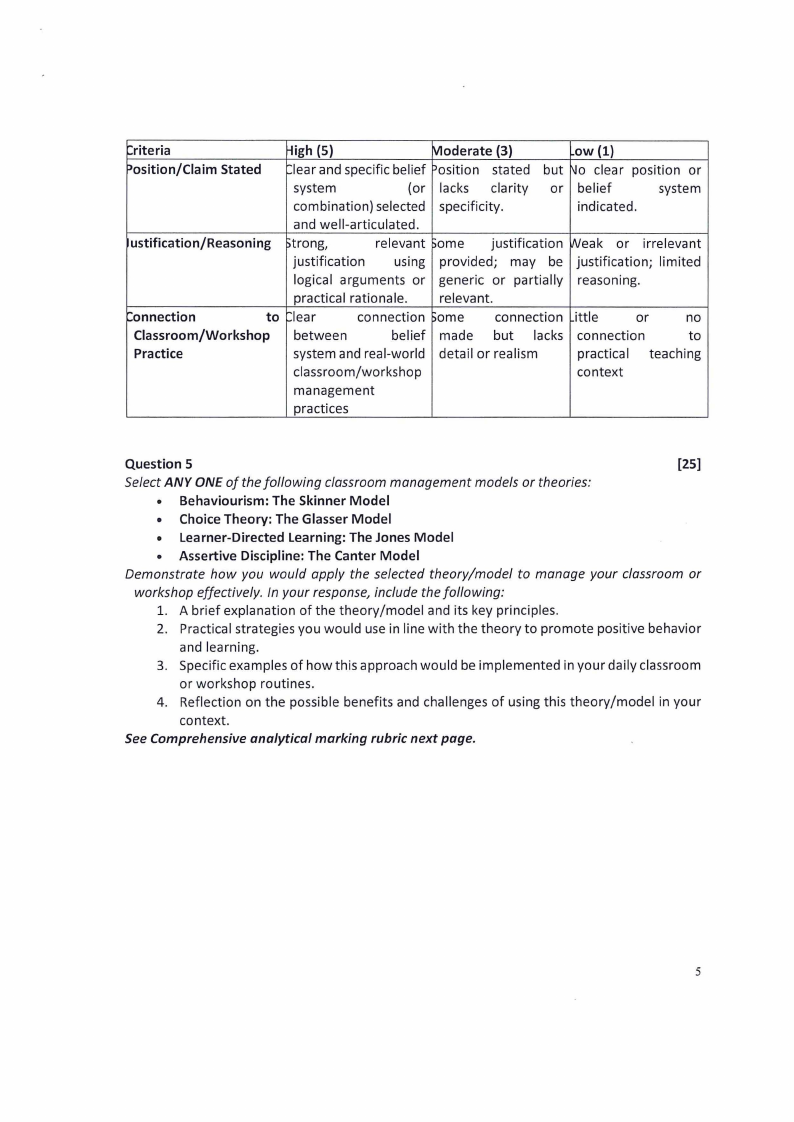
(b) Based on your answers in (a), argue which belief system (or combination) you consider most
appropriate and effective for managing a diverse classroom or workshop. Justify your position.
(15)
See Scoring Rubric (next page)
4
|
|
5 Page 5 |
▲back to top |
:riteria
riigh (5)
Moderate (3)
ow (1)
t>osition/Claim Stated :1ear and specific belief :>osition stated but \\Jo clear position or
system
(or lacks clarity or belief
system
combination) selected specificity.
indicated.
and well-articulated.
ustification/Reasoning )trong,
relevant )Orne justification Neak or irrelevant
justification
using provided; may be justification; limited
logical arguments or generic or partially reasoning.
practical rationale.
relevant.
:onnection
to :I ear
connection )Orne connection ittle
or
no
Classroom/Workshop between
belief made but lacks connection
to
Practice
system and real-world detail or realism
practical teaching
classroom/workshop
context
management
practices
Question 5
[25]
Select ANY ONE of the following classroom management models or theories:
• Behaviourism: The Skinner Model
• Choice Theory: The Glasser Model
• Learner-Directed Learning: The Jones Model
• Assertive Discipline: The Canter Model
Demonstrate how you would apply the selected theory/mode/ to manage your classroom or
workshop effectively. In your response, include the following:
1. A brief explanation of the theory/model and its key principles.
2. Practical strategies you would use in line with the theory to promote positive behavior
and learning.
3. Specific examples of how this approach would be implemented in your daily classroom
or workshop routines.
4. Reflection on the possible benefits and challenges of using this theory/model in your
context.
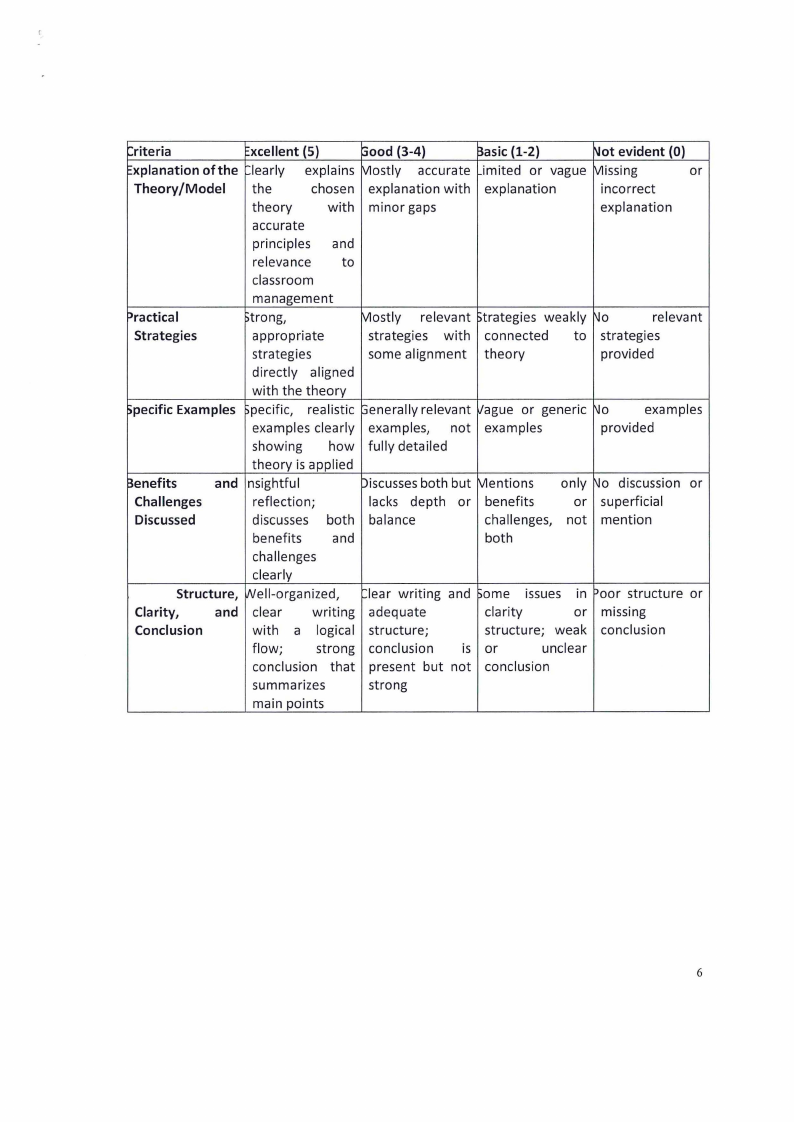
See Comprehensive analytical marking rubric next page.
5
|
|
6 Page 6 |
▲back to top |
:riteria
xcellent (5)
3ood (3-4)
Basic (1-2)
Not evident (0)
xplanation of the :I early explains V1ostly accurate imited or vague V1issing
or
Theory/Model
the
chosen explanation with explanation
incorrect
theory
with minor gaps
explanation
accurate
principles and
relevance to
classroom
management
:>ractical
)trong,
V1ostly relevant e>trategies weakly \\Jo
relevant
Strategies
appropriate
strategies with connected to strategies
strategies
some alignment theory
provided
directly aligned
with the theory
)pecific Examples )pecific, realistic :3enerally relevant Vague or generic \\Jo
examples
examples clearly examples, not examples
provided
showing how fully detailed
theory is applied
Benefits
and nsightful
)iscusses both but Mentions only \\Jo discussion or
Challenges
reflection;
lacks depth or benefits
or superficial
Discussed
discusses both balance
challenges, not mention
benefits and
both
challenges
clearly
Structure, Nell-organized, :lear writing and )Orne issues in t>oor structure or
Clarity,
and clear writing adequate
clarity
or missing
Conclusion
with a logical structure;
structure; weak conclusion
flow;
strong conclusion is or
unclear
conclusion that present but not conclusion
summarizes
strong
main points
6
|
|
7 Page 7 |
▲back to top |