


 |
CWM510S - CLASSROOM AND WORKSHOP MANAGEMENT - 2ND OPP - JULY 2025 |
|
|
1 Page 1 |
▲back to top |

nAmlBIA UnlVERSITY
OF SCIEnCE Ano TECHnOLOGY
FACULTY OF COMMERCE, HUMAN SCIENCE AND EDUCATION
DEPARTMENT OF TECHNICAL, VOCATIONAL EDUCATION AND TRAINING
QUALIFICATION: DIPLOMA IN TECHNICAL AND VOCATIONAL EDUCATION AND TRAINING:
TRAINER
QUALIFICATION CODE: 0GDTVT
COURSE CODE: CWMSl0S
SESSION: JULY 2025
DURATION: 3 HOURS
LEVEL: 5
COURSE NAME: CLASSROOM AND WORKSHOP
MANAGEMENT
PAPER: 2
MARKS: 100
SECOND OPPORTUNITY EXAMINATION QUESTION PAPER
EXAMINER(S) DR K. JUNIAS
MODERATOR: MS. CLAUDIA MARITSHANE
INSTRUCTIONS
1. Answer ALL the questions.
2. Read all the questions carefully before answering.
3. Number the answers clearly
THIS QUESTION PAPER CONSISTS OF _6_ PAGES {Including this front page)
|
|
2 Page 2 |
▲back to top |
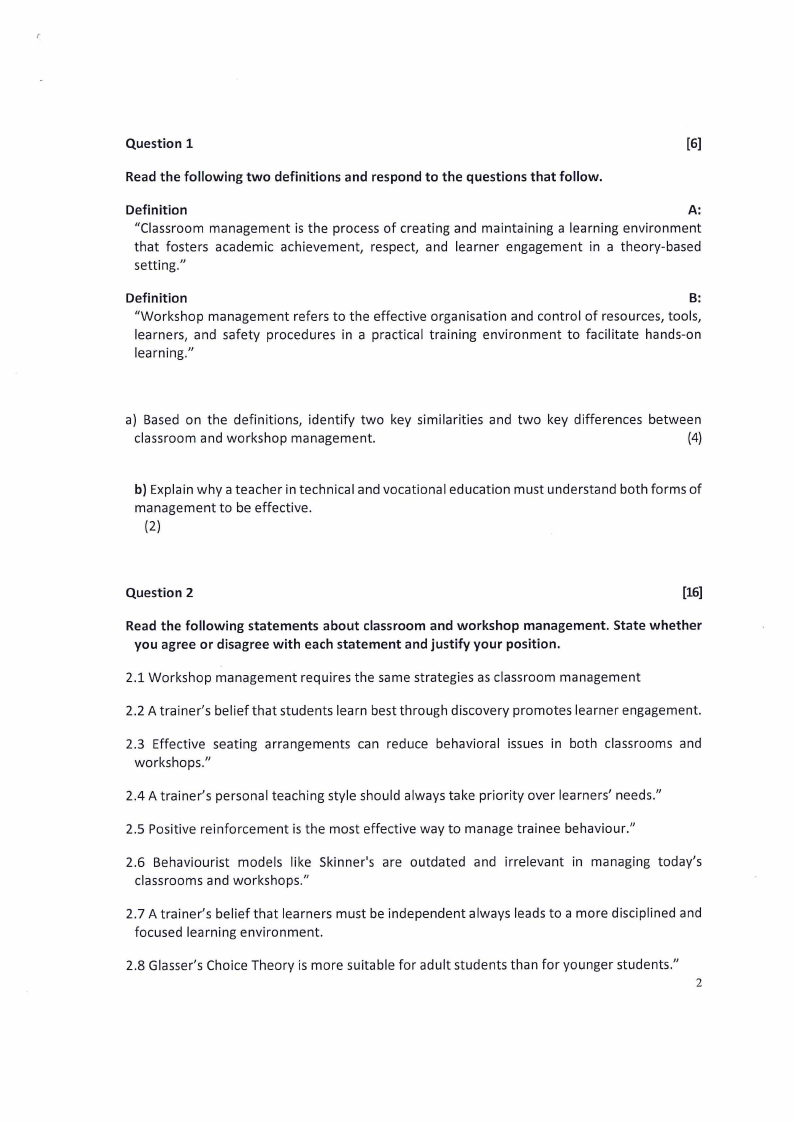
Question 1
[6]
Read the following two definitions and respond to the questions that follow.
Definition
A:
"Classroom management is the process of creating and maintaining a learning environment
that fosters academic achievement, respect, and learner engagement in a theory-based
setting."
Definition
B:
"Workshop management refers to the effective organisation and control of resources, tools,
learners, and safety procedures in a practical training environment to facilitate hands-on
learning."
a) Based on the definitions, identify two key similarities and two key differences between
classroom and workshop management.
(4)
b) Explain why a teacher in technical and vocational education must understand both forms of
management to be effective.
(2)
Question 2
[16]
Read the following statements about classroom and workshop management. State whether
you agree or disagree with each statement and justify your position.
2.1 Workshop management requires the same strategies as classroom management
2.2 A trainer's belief that students learn best through discovery promotes learner engagement.
2.3 Effective seating arrangements can reduce behavioral issues in both classrooms and
workshops."
2.4 A trainer's personal teaching style should always take priority over learners' needs."
2.5 Positive reinforcement is the most effective way to manage trainee behaviour."
2.6 Behaviourist models like Skinner's are outdated and irrelevant in managing today's
classrooms and workshops."
2.7 A trainer's belief that learners must be independent always leads to a more disciplined and
focused learning environment.
2.8 Glasser's Choice Theory is more suitable for adult students than for younger students."
2
|
|
3 Page 3 |
▲back to top |
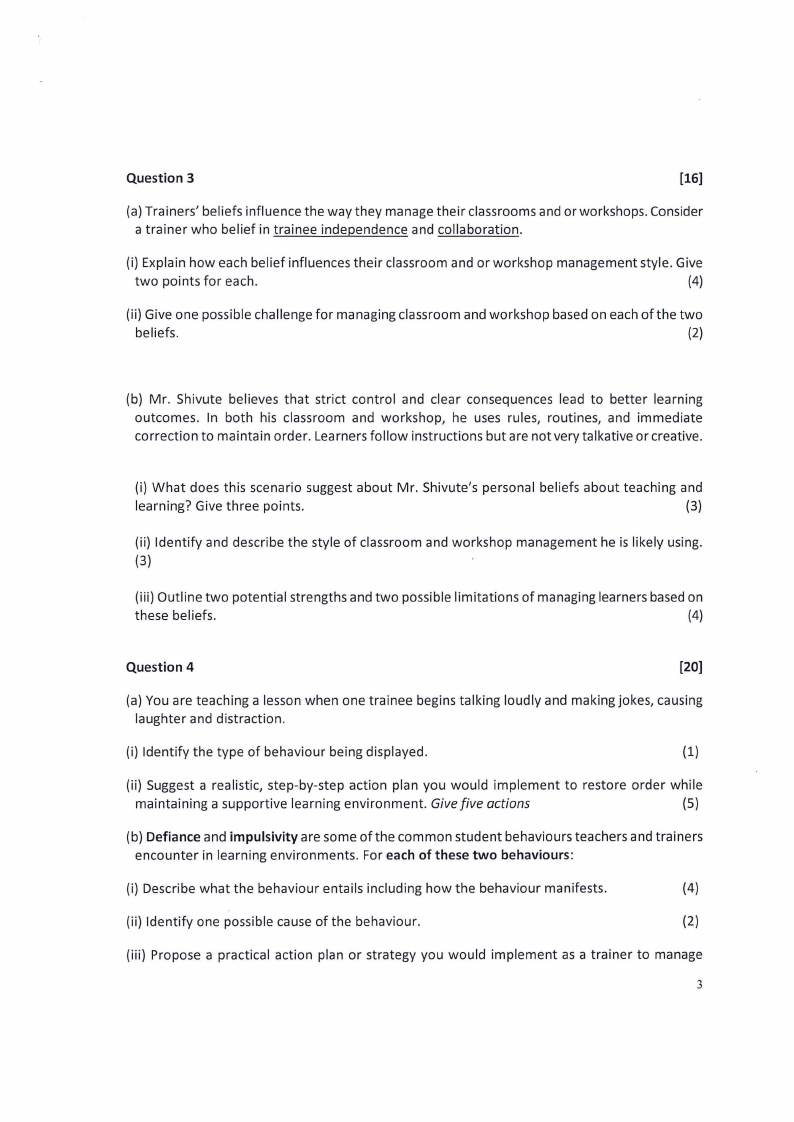
Question 3
[16]
(a) Trainers' beliefs influence the way they manage their classrooms and or workshops. Consider
a trainer who belief in trainee independence and collaboration.
(i) Explain how each belief influences their classroom and or workshop management style. Give
two points for each.
(4)
(ii) Give one possible challenge for managing classroom and workshop based on each of the two
beliefs.
(2)
(b) Mr. Shivute believes that strict control and clear consequences lead to better learning
outcomes. In both his classroom and workshop, he uses rules, routines, and immediate
correction to maintain order. Learners follow instructions but are not very talkative or creative.
(i) What does this scenario suggest about Mr. Shivute's personal beliefs about teaching and
learning? Give three points.
(3)
(ii) Identify and describe the style of classroom and workshop management he is likely using.
(3)
(iii) Outline two potential strengths and two possible limitations of managing learners based on
these beliefs.
(4)
Question 4
[20]
(a) You are teaching a lesson when one trainee begins talking loudly and making jokes, causing
laughter and distraction.
(i) Identify the type of behaviour being displayed.
(1)
(ii) Suggest a realistic, step-by-step action plan you would implement to restore order while
maintaining a supportive learning environment. Give five actions
(5)
(b) Defiance and impulsivity are some of the common student behaviours teachers and trainers
encounter in learning environments. For each of these two behaviours:
(i) Describe what the behaviour entails including how the behaviour manifests.
(4)
(ii) Identify one possible cause of the behaviour.
(2)
(iii) Propose a practical action plan or strategy you would implement as a trainer to manage
3
|
|
4 Page 4 |
▲back to top |
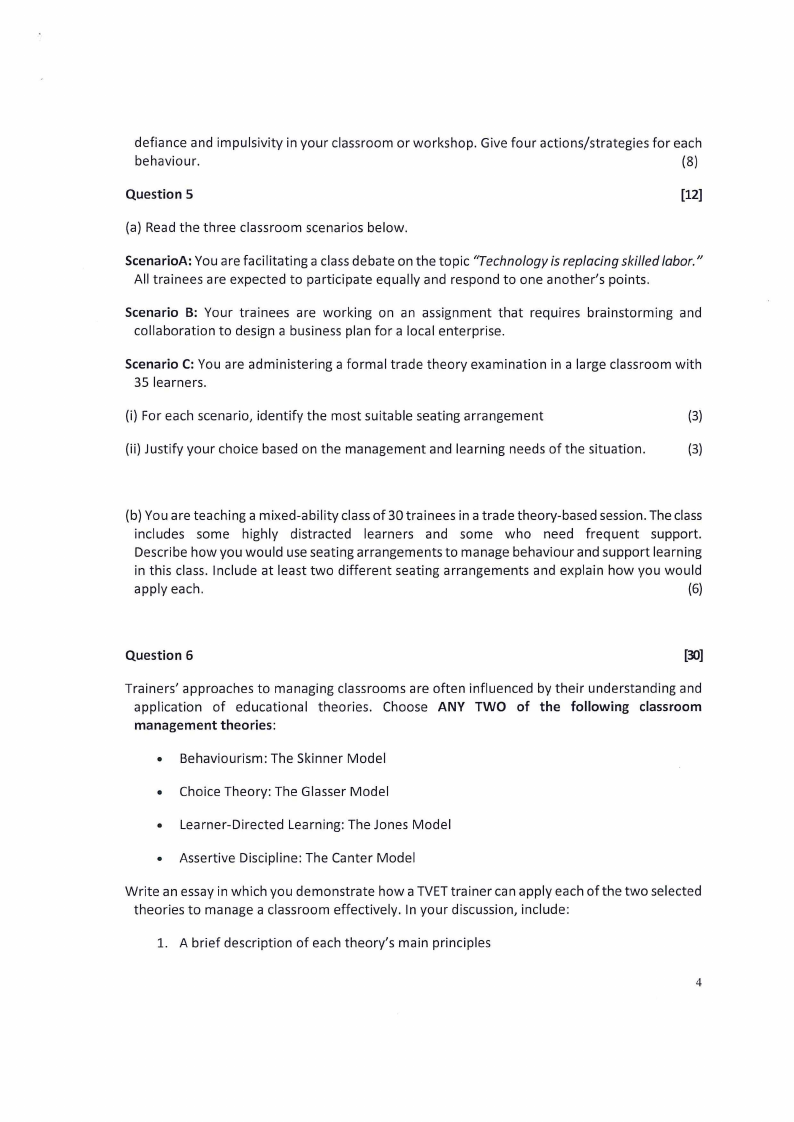
defiance and impulsivity in your classroom or workshop. Give four actions/strategies for each
behaviour.
(8)
Question 5
[12]
(a) Read the three classroom scenarios below.
ScenarioA: You are facilitating a class debate on the topic "Technology is replacing skilled labor. 11
All trainees are expected to participate equally and respond to one another's points.
Scenario B: Your trainees are working on an assignment that requires brainstorming and
collaboration to design a business plan for a local enterprise.
Scenario C: You are administering a formal trade theory examination in a large classroom with
35 learners.
(i) For each scenario, identify the most suitable seating arrangement
(3)
(ii) Justify your choice based on the management and learning needs of the situation.
(3)
(b) You are teaching a mixed-ability class of 30 trainees in a trade theory-based session. The class
includes some highly distracted learners and some who need frequent support.
Describe how you would use seating arrangements to manage behaviour and support learning
in this class. Include at least two different seating arrangements and explain how you would
apply each.
(6)
Question 6
[30]
Trainers' approaches to managing classrooms are often influenced by their understanding and
application of educational theories. Choose ANY TWO of the following classroom
management theories:
• Behaviourism: The Skinner Model
• Choice Theory: The Glasser Model
• Learner-Directed Learning: The Jones Model
• Assertive Discipline: The Canter Model
Write an essay in which you demonstrate how a TVETtrainer can apply each of the two selected
theories to manage a classroom effectively. In your discussion, include:
1. A brief description of each theory's main principles
4
|
|
5 Page 5 |
▲back to top |

2. Specific strategies and examples of how the theory can be used in managing trainee
behaviour, motivation, and engagement
3. A reflection on the strengths and possible limitations of using each theory in a real-
world classroom setting.
Scoring Rubric (next page)
5
|
|
6 Page 6 |
▲back to top |
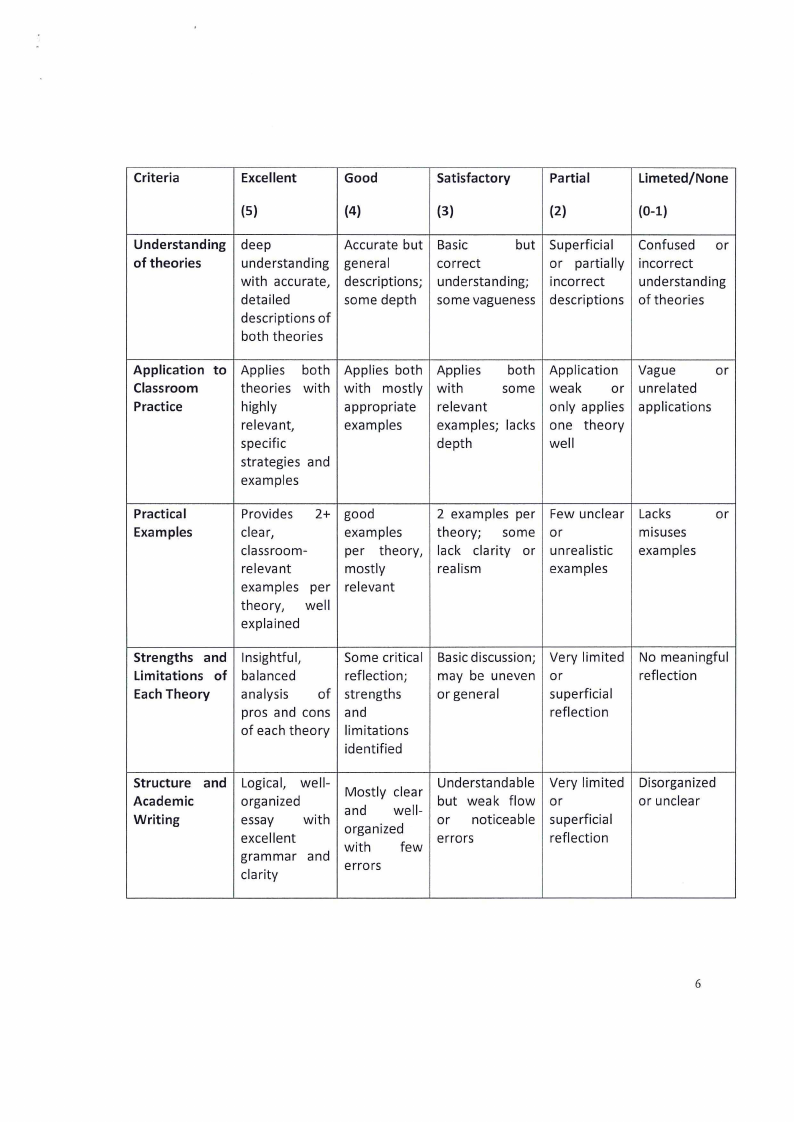
Criteria
Excellent
Good
Satisfactory
Partial
Limeted/None
(S)
(4)
(3)
(2)
(0-1)
Understanding
of theories
deep
understanding
with accurate,
detailed
descriptions of
both theories
Accurate but
general
descriptions;
some depth
Basic
but
correct
understanding;
some vagueness
Superficial
or partially
incorrect
descriptions
Confused or
incorrect
understanding
of theories
Application to
Classroom
Practice
Applies both
theories with
highly
relevant,
specific
strategies and
examples
Applies both
with mostly
appropriate
examples
Applies both
with
some
relevant
examples; lacks
depth
Application
weak or
only applies
one theory
well
Vague
or
unrelated
applications
Practical
Examples
Provides 2+ good
2 examples per Few unclear Lacks
or
clear,
examples
theory; some or
misuses
classroom-
per theory, lack clarity or unrealistic examples
relevant
mostly
realism
examples
examples per relevant
theory, well
explained
Strengths and
Limitations of
Each Theory
Insightf uI,
balanced
analysis of
pros and cons
of each theory
Some critical
reflection;
strengths
and
limitations
identified
Basic discussion;
may be uneven
or general
Very limited
or
superficial
reflection
No meaningful
reflection
Structure and
Academic
Writing
Logical, well-
organized
essay with
excellent
grammar and
clarity
Mostly clear
and well-
organized
with few
errors
Understandable
but weak flow
or noticeable
errors
Very limited
or
superficial
reflection
Disorganized
or unclear
6