


 |
WLT620S - WIRELESS TECHNOLOGIES - 2ND OPP - DEC 2025 |
|
|
1 Page 1 |
▲back to top |
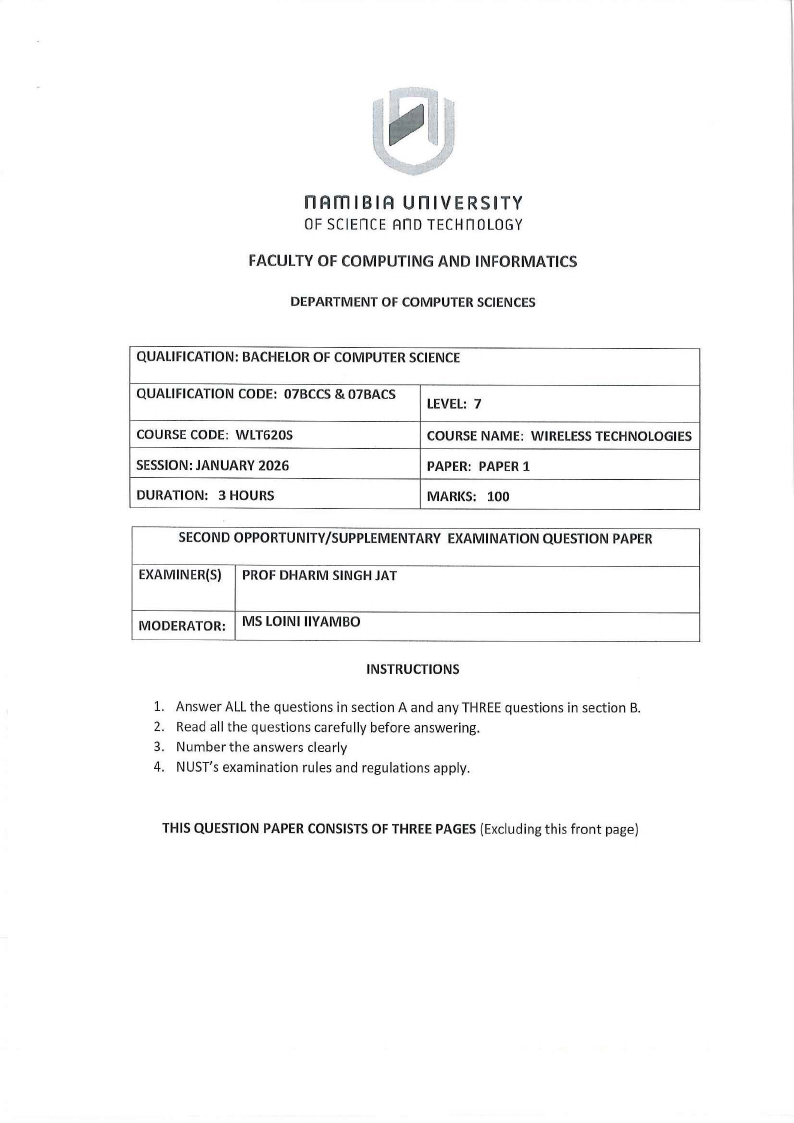
nAmlBIA unlVERSITY
OF SCIEnCE Ano TECHnOLOGY
FACULTY OF COMPUTING AND INFORMATICS
DEPARTMENT OF COMPUTER SCIENCES
QUALIFICATION: BACHELOR OF COMPUTER SCIENCE
QUALIFICATION CODE: 07BCCS & 07BACS
COURSE CODE: WLT620S
SESSION: JANUARY 2026
DURATION : 3 HOURS
LEVEL: 7
COURSE NAME: WIRELESS TECHNOLOGIES
PAPER: PAPER 1
MARKS: 100
SECOND OPPORTUNITY/SUPPLEMENTARY EXAMINATION QUESTION PAPER
EXAMINER($) PROF DHARM SINGH JAT
MODERATOR: MS LOINI IIYAMBO
INSTRUCTIONS
1. Answer ALL the questions in section A and any THREE questions in section B.
2. Read all the questions carefully before answering.
3. Number the answers clearly
4. NUST's examination rules and regulations apply.
THIS QUESTION PAPER CONSISTS OF THREE PAGES (Excluding this front page)
|
|
2 Page 2 |
▲back to top |
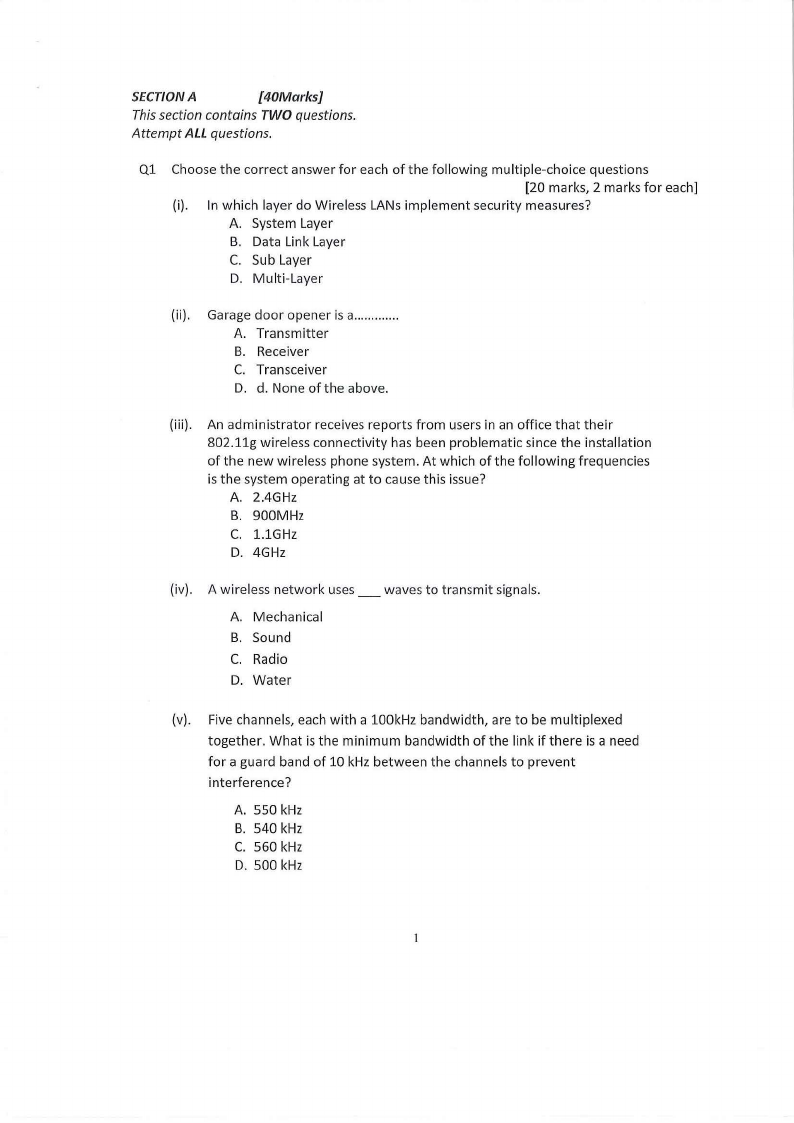
SECT/ONA
{40Marks]
This section contains TWO questions.
Attempt All questions.
Ql Choose the correct answer for each of the following multiple-choice questions
[20 marks, 2 marks for each]
(i). In which layer do Wireless LANs implement security measures?
A. System Layer
B. Data Link Layer
C. Sub Layer
D. Multi-Layer
(ii). Garage door opener is a.............
A. Transmitter
B. Receiver
C. Transceiver
D. d. None of the above.
(iii). An administrator receives reports from users in an office that their
802.llg wireless connectivity has been problematic since the installation
of the new wireless phone system. At which of the following frequencies
is the system operating at to cause this issue?
A. 2.4GHz
B. 900MHz
C. 1.1GHz
D. 4GHz
(iv). A wireless network uses_ waves to transmit signals.
A. Mechanical
B. Sound
C. Radio
D. Water
(v). Five channels, each with a lO0kHz bandwidth, are to be multiplexed
together. What is the minimum bandwidth of the link if there is a need
for a guard band of 10 kHz between the channels to prevent
interference?
A. 550 kHz
B. 540 kHz
C. 560 kHz
D. 500 kHz
|
|
3 Page 3 |
▲back to top |
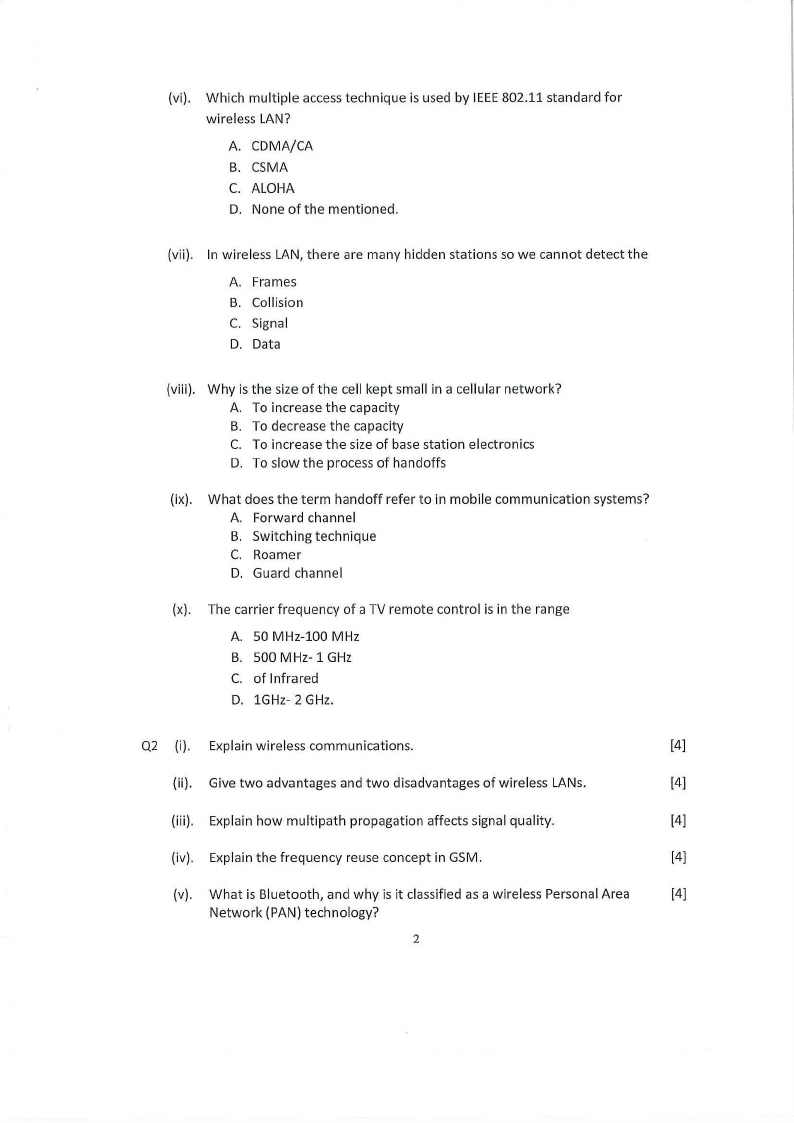
(vi). Which mu lt iple access technique is used by IEEE 802.11 standard for
wireless LAN?
A. CDMA/CA
B. CSMA
C. ALOHA
D. None of the mentioned.
(vii). In wire less LAN, there are many hidden stations so we cannot detect the
A. Frames
B. Collision
C. Signal
D. Data
(viii).
Why is the size of the cell kept sma ll in a cellular network?
A. To increase the capacity
B. To decrease the capacity
C. To increase the size of base station electronics
D. To slow the process of handoffs
(ix). What does the term handoff refer to in mobile communication systems?
A. Forward channel
B. Switching technique
C. Roamer
D. Guard channel
(x). The carrier frequency of a TV remote control is in the range
A. 50 MHz-100 MHz
B. 500 MHz-1 GHz
C. of Infrared
D. 1GHz- 2 GHz.
Q2 (i). Explain wireless communications.
[4]
(ii). Give two advantages and two disadvantages of wireless LANs.
[4]
(iii). Explain how multipath propagation affects signal quality.
[4]
(iv). Explain t he frequency reuse concept in GSM.
[4]
(v). What is Bluetooth, and why is it classified as a wireless Personal Area
[4]
Network (PAN) technology?
2
|
|
4 Page 4 |
▲back to top |
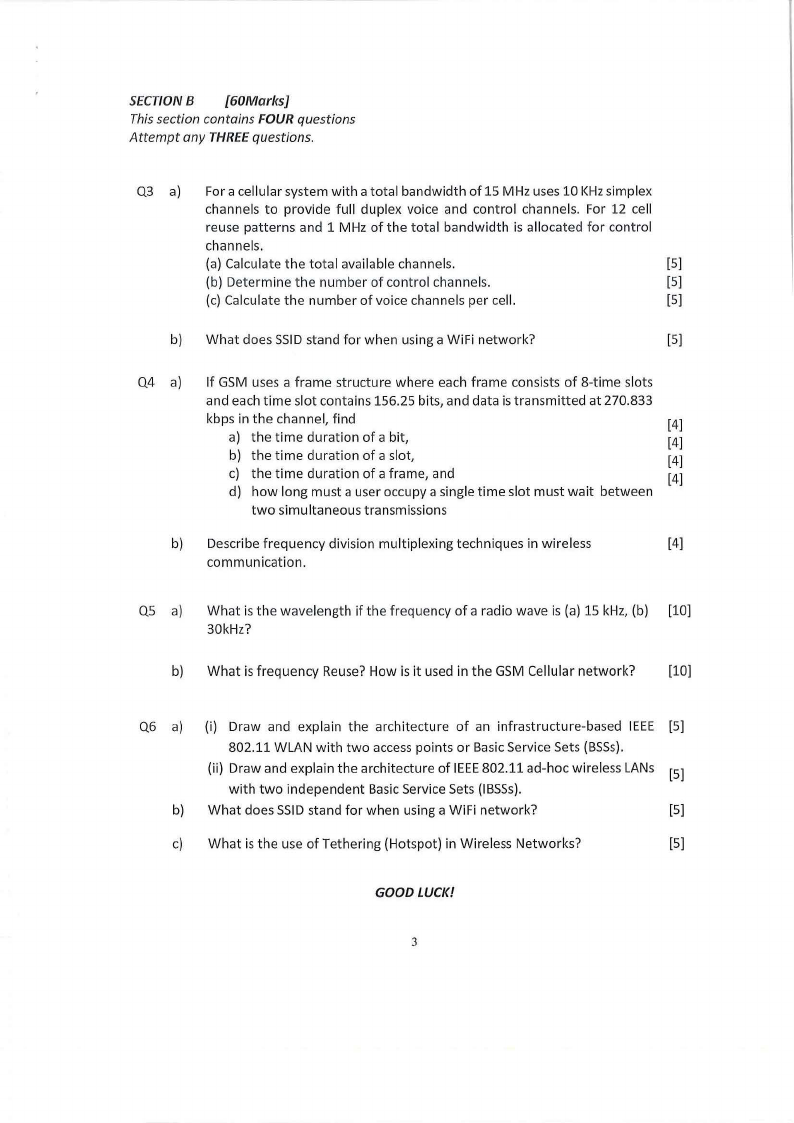
SECTION B {60Marks]
This section contains FOUR questions
Attempt any THREE questions.
Q3 a)
For a cellular system with a total bandwidth of 15 M Hz uses 10 l<Hz simplex
channels to provide full duplex voice and control channels. For 12 cell
reuse patterns and 1 M Hz of the total bandwidth is allocated for control
channels.
(a) Calculate the total available channels.
[SJ
(b) Determine the number of control channels.
[S]
(c) Ca lculate the number of voice channels per cell.
[S]
b) What does SSID stand for when using a WiFi network?
[SJ
Q4 a)
If GSM uses a frame structure where each frame consists of 8-time slots
and each time slot contains 156.25 bits, and data is transm itted at 270.833
kbps in the channel, find
[4]
a) the time duration of a bit,
[4]
b) the time duration of a slot,
[4]
c) the time duration of a frame, and
[4)
d) how long must a user occupy a single time slot must wait between
two simu ltaneous transm issions
b) Describe frequency division mu ltiplexing techniques in wireless
[4)
communication.
QS a)
What is the wavelength if the frequency of a radio wave is (a) 15 kHz, {b) [10)
30kHz?
b) What is frequency Reuse? How is it used in the GSM Cellular network? [10]
Q6 a)
b)
(i) Draw and explain t he architectu re of an infrastructure-based IEEE [S]
802.11 WLAN with two access points or Basic Service Sets (BSSs).
(i i) Draw and explain the architecture of IEEE 802.11 ad-hoc wireless LANs [SJ
with two independent Basic Service Sets {IBSSs).
What does SSID stand for when using a WiFi network?
[SJ
c) What is the use of Tethering {Hotspot) in Wireless Networks?
[S]
GOOD LUCI<!
3
|
|
5 Page 5 |
▲back to top |
NAMIBIA UNIVERSITY OF SCIENCE
AND TECHNOLOGY
FACULTY OF COMPUTING AND INFORMATICS
DEPARTMENT OF COMPUTER SCIENCE
Private Bag 13388, 13 Jackson Kaujeua Street, Windhoek, Namibia
Tel: +264-(0)61-207-2052 Fax: +264-(0)61- 207-2051
Curriculum:
Subject Code:
Subject:
Date:
Duration:
Paper:
Total Marks:
Bachelor of Computer Science
SAD622S
Systems Administration
December 2025
120 minutes
Theory
80
2nd Opportunity Examination Paper
Lecturer/ First Examiner: Peter Gallert
Moderator
Isaac Nhamu
This examination paper consists of 4 pages (including the front page).
Student Name: _ __ _ _ _ _ _ __ __ _ _ _ _ _ _ _ _ _ _ _ __
Student Number: _ _ _ __ __ _ _ __ _ _ __ _ __ _ __ _ __
Instructions
1. Answer all questions.
2. When answering questions you should be led by the allocation of marks.
3. Do not use or bring into the examination venue books, mobile devices and other
material that may provide you with unfair advantage. Should you be in possession
of one right now, draw the attention of the examination officer or invigilator.
4. NUST's examination rule s and regulations apply.