


 |
TEC711S-TRANSPORT ECONOMICS-2ND OPP DEC 2025 |
|
|
1 Page 1 |
▲back to top |
nAmlBIA UnlVERSITY
OF SCIEnCE Ano TECHnOLOGY
FACULTY OF COMMERCE, HUMAN SCIENCES AND EDUCATION
DEPARTMENT OF ECONOMICS, ACCOUNTING AND FINANCE
QUALIFICATION : BACHELOR OF ECONONOMICS
QUALIFICATION CODE: 07BECO
LEVEL: 7
COURSE CODE: TEC711S
COURSE NAME: TRANSPORT ECONOMICS
SESSION: DECEMBER 2025
DURATION: 3 HOURS
PAPER: THEORY (PAPER 1)
MARKS: 100
SECOND OPPORTUNITY EXAMINATION QUESTION PAPER
EXAMINER(S) Mr. Eslon Ngeendepi
MODERATOR: Dr. Anthony Adeyanju
INSTRUCTIONS
1. Answer ALL the questions.
2. Read all the questions carefully before answering.
3. Number the answers clearly
THIS QUESTION PAPER CONSISTS OF _5_ PAGES (Including this front page)
|
|
2 Page 2 |
▲back to top |

QUESTION 1
[35 Marks]
i. Transport is often described as a key driver of economic growth. Although
transport alone may not guarantee development, the lack of transport
infrastructure can severely constrain it. List and briefly explain five (5) key ways
in which transport contributes to economic development.
(15)
ii. At the level of the local economy, an efficient transport system brings several
benefits that support growth and development. List and briefly explain four (4)
advantages of having an efficient local transport system.
(8)
iii. Figure 1: Multiplier effect: The case of Airport investment
/
Perpetuity effect
~ Tertiary effect
/ / Secondary effect
/ / / Primary effect
Multiplicand
0
Geographical range
Using the case of an airport investment, explain the operation of the multiplier effect
in the local economy. The stages from planning the investment to the airport's
operationalization provide insights into how one investment can generate multiple
effects across different phases of the economy. With reference to Figure 1, discuss the
impact of the investment at each of the following levels:
• Primary effects:
(3)
• Secondary effects:
(3)
• Tertiary effects:
(3)
• Perpetuity effects:
(3)
2
|
|
3 Page 3 |
▲back to top |
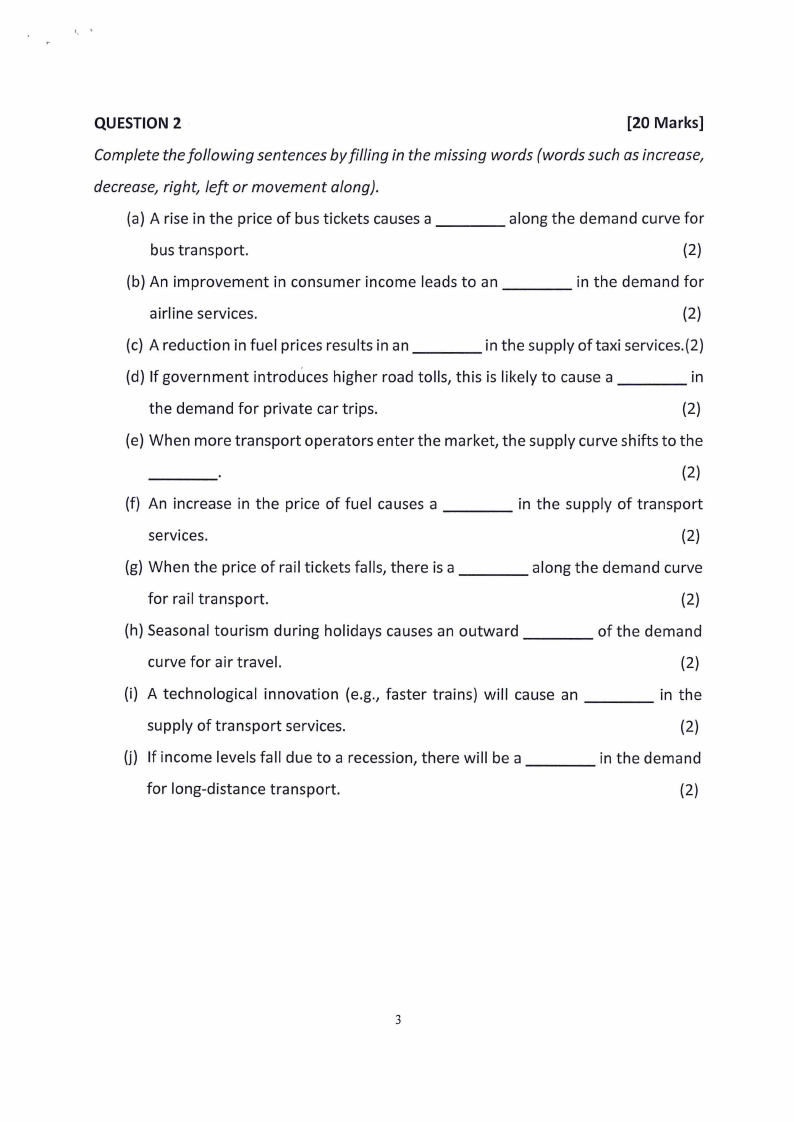
QUESTION 2
[20 Marks]
Complete the following sentences byfilling in the missing words (words such as increase,
decrease, right, left or movement along).
(a) A rise in the price of bus tickets causes a _ _ _ _ along the demand curve for
bus transport.
(2)
(b) An improvement in consumer income leads to an ____ in the demand for
airline services.
(2)
(c) A reduction in fuel prices results in an ____ in the supply of taxi services.(2)
(d) If government introduces higher road tolls, this is likely to cause a ____ in
the demand for private car trips.
(2)
(e) When more transport operators enter the market, the supply curve shifts to the
(2)
(f) An increase in the price of fuel causes a ____ in the supply of transport
services.
(2)
(g) When the price of rail tickets falls, there is a ____ along the demand curve
for rail transport.
(2)
(h) Seasonal tourism during holidays causes an outward ____ of the demand
curve for air travel.
(2)
(i) A technological innovation (e.g., faster trains) will cause an ____ in the
supply of transport services.
(2)
(j) If income levels fall due to a recession, there will be a ____ in the demand
for long-distance transport.
(2)
3
|
|
4 Page 4 |
▲back to top |
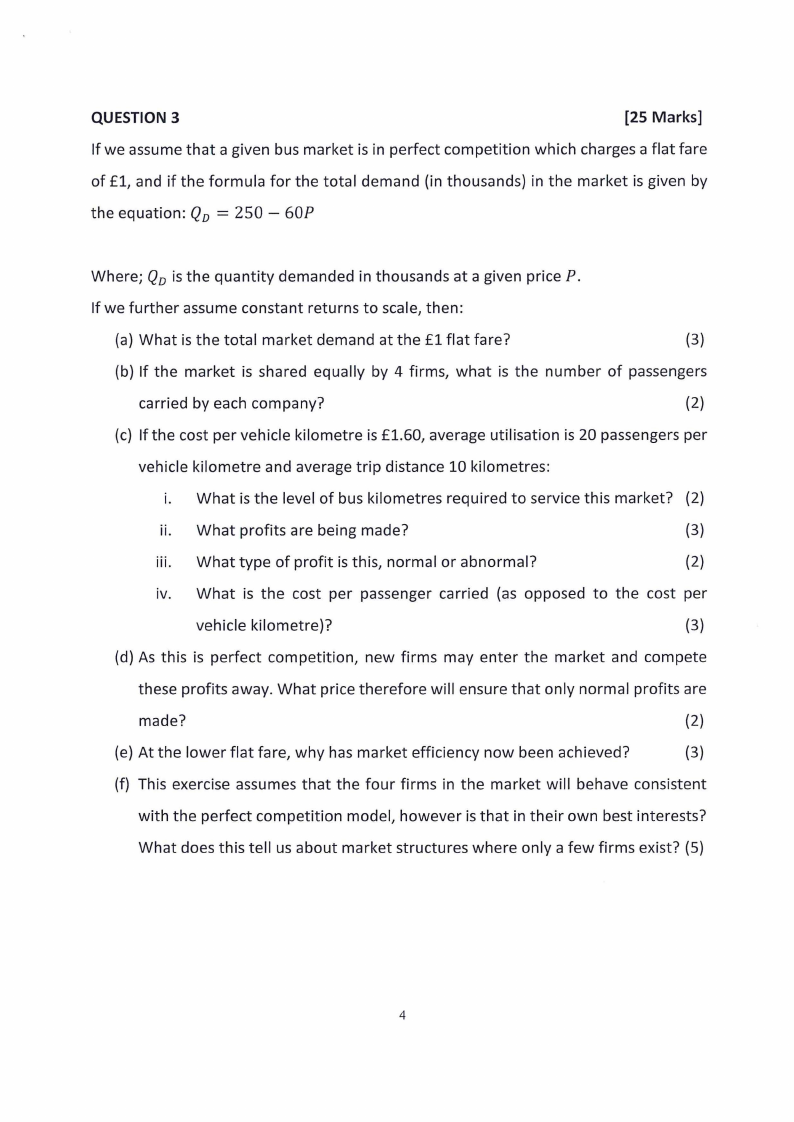
QUESTION 3
[25 Marks]
If we assume that a given bus market is in perfect competition which charges a flat fare
of £1, and if the formula for the total demand (in thousands) in the market is given by
= the equation: QD 250 - 60P
Where; QD is the quantity demanded in thousands at a given price P.
If we further assume constant returns to scale, then:
(a) What is the total market demand at the fl flat fare?
(3)
(b) If the market is shared equally by 4 firms, what is the number of passengers
carried by each company?
(2)
(c) If the cost per vehicle kilometre is £1.60, average utilisation is 20 passengers per
vehicle kilometre and average trip distance 10 kilometres:
i. What is the level of bus kilometres required to service this market? (2)
ii. What profits are being made?
(3)
iii. What type of profit is this, normal or abnormal?
(2)
iv. What is the cost per passenger carried (as opposed to the cost per
vehicle kilometre)?
(3)
(d) As this is perfect competition, new firms may enter the market and compete
these profits away. What price therefore will ensure that only normal profits are
made?
(2)
(e) At the lower flat fare, why has market efficiency now been achieved?
(3)
(f) This exercise assumes that the four firms in the market will behave consistent
with the perfect competition model, however is that in their own best interests?
What does this tell us about market structures where only a few firms exist? (5)
4
|
|
5 Page 5 |
▲back to top |
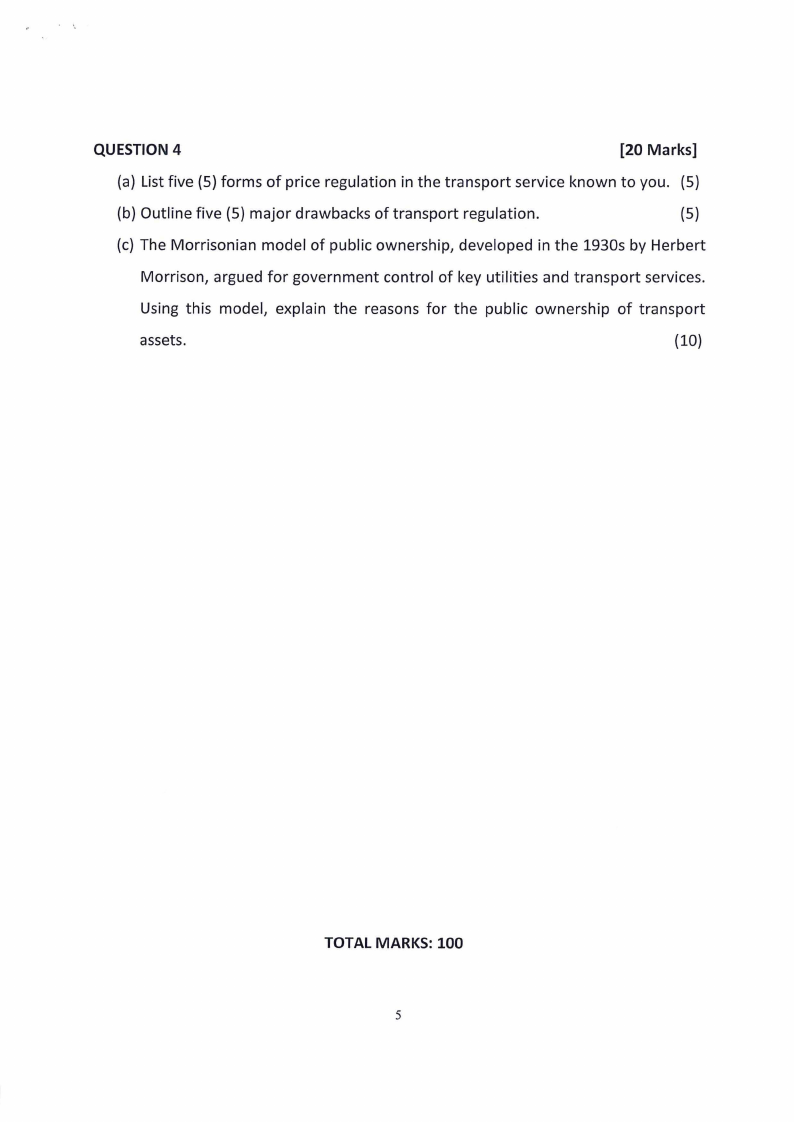
QUESTION 4
[20 Marks]
(a) List five (5) forms of price regulation in the transport service known to you . (5)
(b) Outline five (5) major drawbacks of transport regulation.
(5)
(c) The Morrisonian model of public ownership, developed in the 1930s by Herbert
Morrison, argued for government control of key utilities and transport services.
Using this model, explain the reasons for the public ownership of transport
assets.
(10)
TOTAL MARKS: 100
5