


 |
OSM612S - ORGANISATIONAL MANAGEMENT - 1ST OPP - NOV 2025 |
|
|
1 Page 1 |
▲back to top |
n Am I BI A u n I VE RS ITY
OF SCIEnCE Ano TECHnOLOGY
FACULTY OF COMMERCE, HUMAN SCIENCE AND EDUCATION
DEPARTMENT OF GOVERNANCE & MANAGEMENT SCIENCES
QUALIFICATION: BACHELOR OF HUMAN RESOURCES MANAGEMENT
QUALIFICATION CODE: 07BHRM
LEVEL: 6
COURSE CODE: OSM612S
COURSE NAME: ORGANISATIONAL MANAGEMENT
SESSION: NOVEMBER 2025
DURATION: 3 HOURS
PAPER: THEORY
MARKS: 100
EXAMINER(S)
OSM FIRST OPPORTUNITY EXAMINATION QUESTION PAPER
Mr. Ehrenfried Tjivii Ndjoonduezu
MODERATOR:
Ms. M Sezuni
INSTRUCTIONS
1. The paper consists of Sections A, B, and C. Answer ALL the questions.
2. Write clearly and neatly.
3. Number the answers clearly.
PERMISSIBLE MATERIALS
1. Examination paper.
2. Examination sc ript.
THIS QUESTION PAPER CONSISTS OF 8 PAGES (Including this front page)
|
|
2 Page 2 |
▲back to top |
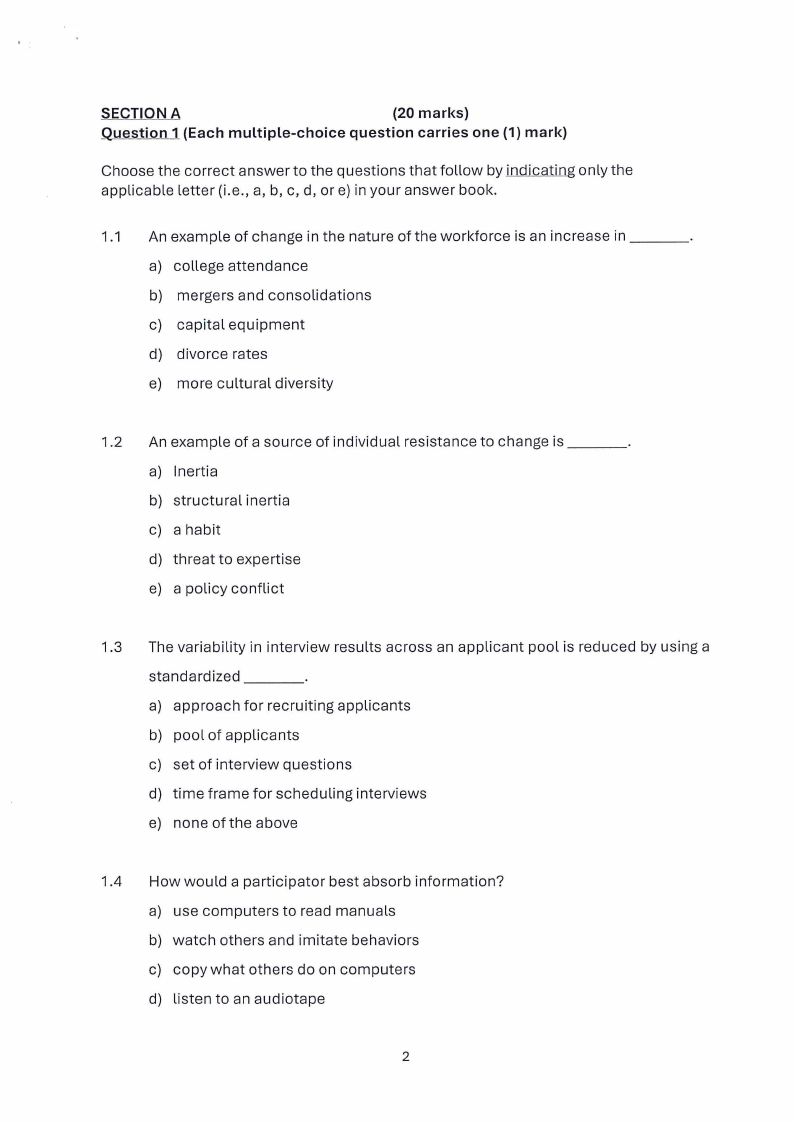
SECTION A
{20 marks)
Question 1 {Each multiple-choice question carries one {1) mark)
Choose the correct answer to the questions that follow by indicating only the
applicable letter (i.e., a, b, c, d, ore) in your answer book.
1.1 An example of change in the nature of the workforce is an increase in _ __
a) college attendance
b) mergers and consolidations
c) capital equipment
d) divorce rates
e) more cultural diversity
1.2 An example of a source of individual resistance to change is _ __
a) Inertia
b) structural inertia
c) a habit
d) threat to expertise
e) a policy conflict
1.3 The variability in interview results across an applicant pool is reduced by using a
standardized _ __
a) approach for recruiting applicants
b) pool of applicants
c) set of interview questions
d) time frame for scheduling interviews
e) none of the above
1.4 How would a participator best absorb information?
a) use computers to read manuals
b) watch others and imitate behaviors
c) copy what others do on computers
d) listen to an audiotape
2
|
|
3 Page 3 |
▲back to top |

e) gain hands-on experience
1.5 Notemba works for HJC publishing which is a publisher of scientific journals. The
company is dominated by low risk taking and high attention to detail. Jean's
department is also committed to high team orientation and provides many team-
building activities in which Jean and other department members work together
and socialize. Which of the following statements best describes Jean's
department?
a) It represents the dominant culture.
b) It does not include core values.
c) The organizational culture is undefined.
d) It is a subculture sharing core values.
e) It has low stability.
1.6 The more that lower-level personnel provide input or are actually given the
discretion to make decisions, the more _ _ _ there is within an organization.
a) disempowerment
b) centralization
c) work specialization
d) departmentalization
e) decentralization
1.7 Which of the following is not an advantage that virtual organizations have over the
common organization structures?
a) uses the best talent for each project
b) decreases flexibility of the project
c) minimizes bureaucratic overhead
d) lessens long-term risks associated with investment
e) decreases costs
3
|
|
4 Page 4 |
▲back to top |
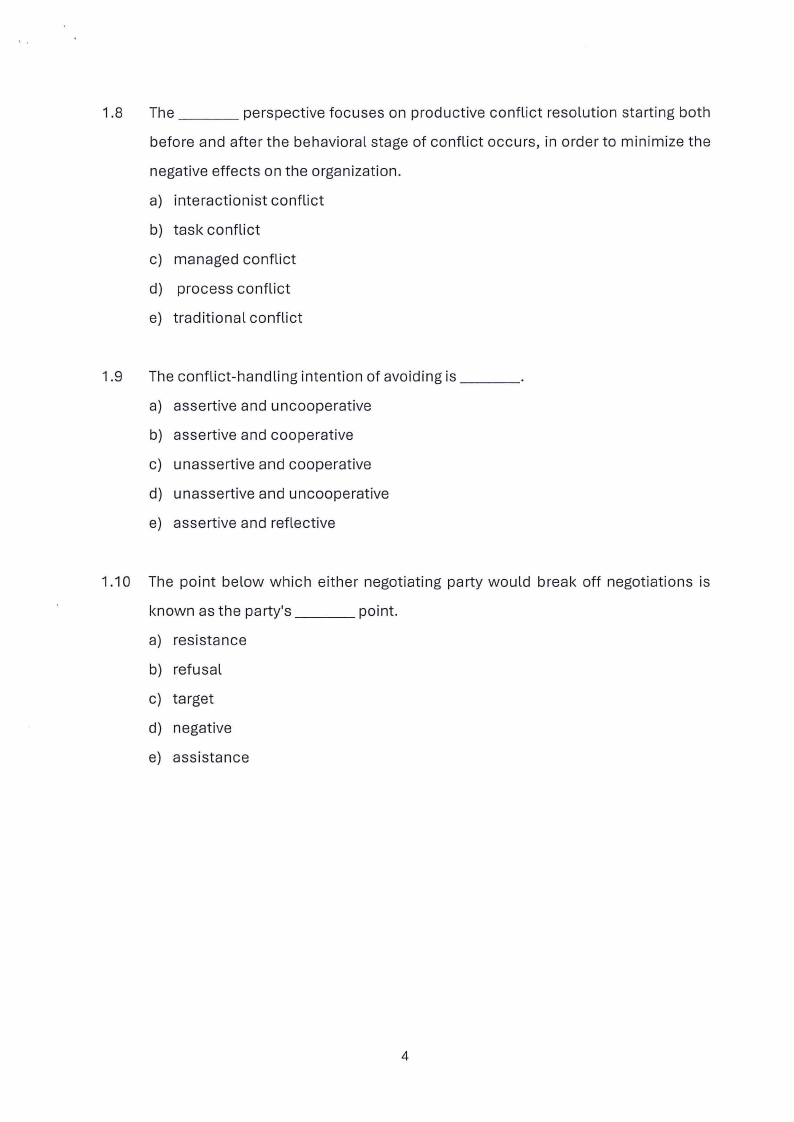
1.8 The ____ perspective focuses on productive conflict resolution starting both
before and after the behavioral stage of conflict occurs, in order to minimize the
negative effects on the organization.
a) interactionist conflict
b) task conflict
c) managed conflict
d) process conflict
e) traditional conflict
1.9 The conflict-handling intention of avoiding is _ __
a) assertive and uncooperative
b) assertive and cooperative
c) unassertive and cooperative
d) unassertive and uncooperative
e) assertive and reflective
1.10 The point below which either negotiating party would break off negotiations is
known as the party's
point.
a) resistance
b) refusal
c) target
d) negative
e) assistance
4
|
|
5 Page 5 |
▲back to top |
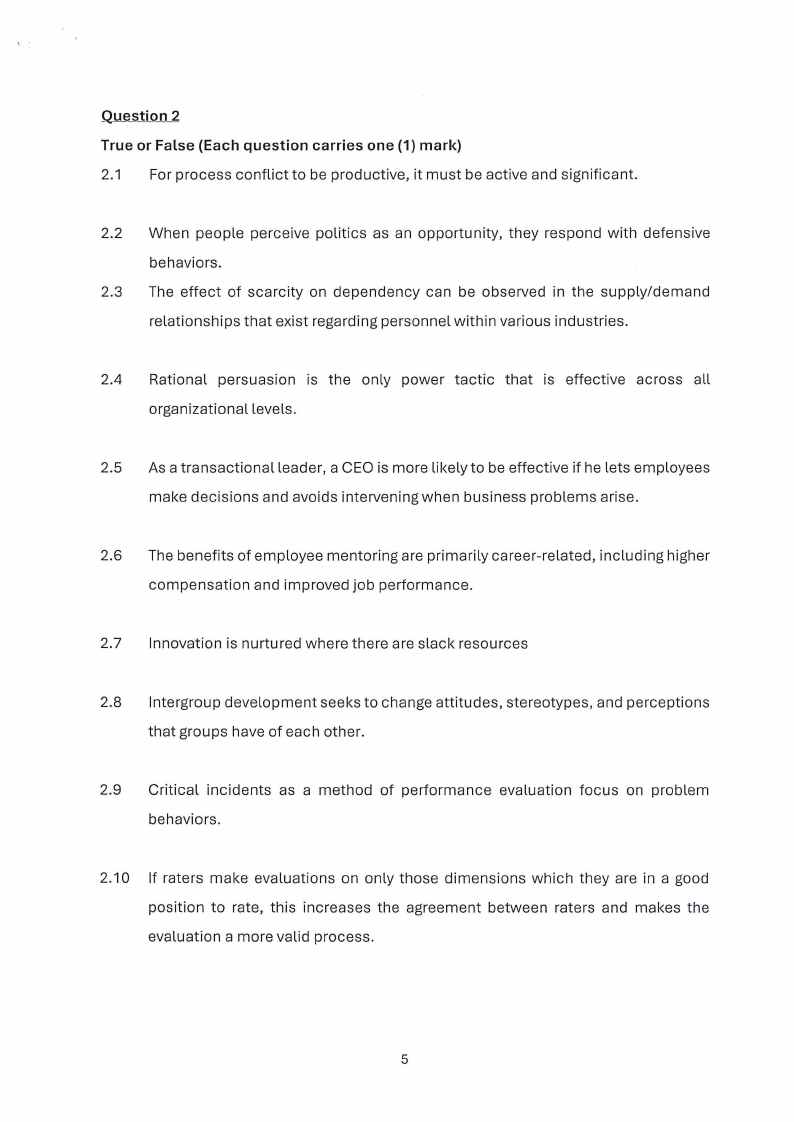
Question 2
True or False (Each question carries one (1) mark)
2.1 For process conflict to be productive, it must be active and significant.
2.2 When people perceive politics as an opportunity, they respond with defensive
behaviors.
2.3 The effect of scarcity on dependency can be observed in the supply/demand
relationships that exist regarding personnel within various industries.
2.4 Rational persuasion is the only power tactic that is effective across all
organizational levels.
2.5 As a transactional leader, a CEO is more likely to be effective if he lets employees
make decisions and avoids intervening when business problems arise.
2.6 The benefits of employee mentoring are primarily career-related, including higher
compensation and improved job performance.
2.7 Innovation is nurtured where there are slack resources
2.8 Intergroup development seeks to change attitudes, stereotypes, and perceptions
that groups have of each other.
2.9 Critical incidents as a method of performance evaluation focus on problem
behaviors.
2.1 O If raters make evaluations on only those dimensions which they are in a good
position to rate, this increases the agreement between raters and makes the
evaluation a more valid process.
5
|
|
6 Page 6 |
▲back to top |
Section B
[15]
Question 3
From a Lebanese family-owned small business to a leading multi-line conglomerate in
the Middle East and North Africa (MENA) region, l<halil Fattal & Fils (l<FF) Holding
(www.kff.com.lb) is the exclusive agent and distributor of many multinational brands
within the following categories: food and beverages, home and personal care, beauty
and accessories, household and office equipment, consumer electronics, and
pharmaceuticals. The corporation now employs more than 2,100 individuals with a
turnover of approximately US$650 million.
Over the course of 112 years (1897-2009), the corporation has gone through many
successful structural changes that have shaped the business and contributed to its
success. At the base of this success is the owners' philosophy, which drove the
corporation toward its vision and instilled solid corporate values that have increased
performance and created a spirit of unity among its members.
At the beginning of the year 2002, the owners gathered 30 of their top managers in a
retreat to define the corporate culture in the coming years. The team succeeded in
drafting a mission that enlarged the scope of the corporation's activities to "reach out to
millions of consumers in the Levant and North African countries." (The Levant is
comprised of Lebanon, Syria, Jordan, and Iraq.) The team also adopted a set of corporate
values that were disseminated to all other employees through workshops and group
discussions.
The corporation's core values revolve around trust, respect, sharing, and courage, with
a specific set of expected behaviors for each value. Under the value of courage,
embracing change was selected as the main behavior for individuals who aspire to
6
|
|
7 Page 7 |
▲back to top |
succeed in their careers with the group. This is now stated in the corporate manual as
" embrace change as an opportunity to grow," and employees are invited to accept
rotation in their assignments every four to five years, or whenever needed, not only in
Lebanon but also throughout the region where the corporation operates.
To conduct business in the MENA region, it is a legal requirement that local partners and
employees be engaged. Hence, to ensure the operation's success, the corporation
decided to relocate part of the management team to its subsidiaries in Syria, Jordan, Iraq ,
Sudan, Algeria, and Egypt. Although these countries share a common language (Arabic)
with Lebanon, their social, economic, and political systems differ. As a result, some
managers were reluctant to relocate outside their home country. This became a major
obstacle that needed to be resolved .
To overcome this impediment, the KFF's CEO took the initiative and moved ahead of
everyone else to ensure a satisfactory setup and even asked some members of his family
to accept these new foreign assignments, thereby setting the example for others to
follow suit, and many managers did. To further motivate these managers , an attractive
financial package was offered, including fringe benefits such as housing, schooling for
children, expatriate allowances, and longer vacations. This rotational path has since
become part of KFF management's recognized fast track for career progression within
the group.
KFF's expans ion throughout the region exposed the corporation to new kinds of
customers, such as hypermarket chains. This necessitated a change in the business
model, which required new knowledge and techniques and raised awareness of the need
to enhance employee skills. Accordingly, the corporation took the initiative and provided
employees with intens ive training and workshops aimed at improving the competencies
and skills of its workforce. As a result, it was better able to meet the expectations of its
customers and suppliers alike.
Sources: KFF Holding Manual. Special thanks to Samir Messarra for his valuable
suggestions.
7
|
|
8 Page 8 |
▲back to top |

•r
Questions
3.1 What were the forces that necessitated a change in the organisation?
(5)
3.2 Why is it so difficult for individuals to accept change?
(4)
3.3 What were the forces that helped make the change process smoother?
(6)
Section C
(65)
Question 4
4.1 Explain what purposes performance evaluations serve in organizations? (10)
4.2 Discuss the characteristics of a spiritual organization.
(12)
4.3 Explain the difference between centralization and decentralization? Would a
simple structure be centralized or decentralized? Explain your answer. (10)
4.4 Define and describe the traditional view of conflict.
(8)
4.5 Explain the principles of Hersey and Blanchard's situational leadership theory.
(12)
4.6 Discuss what the benefits and drawbacks are of e-mails.
(13)
8