


 |
OSM612S - ORGANISATIONAL MANAGEMENT - 2ND OPP - NOV 2025 |
|
|
1 Page 1 |
▲back to top |
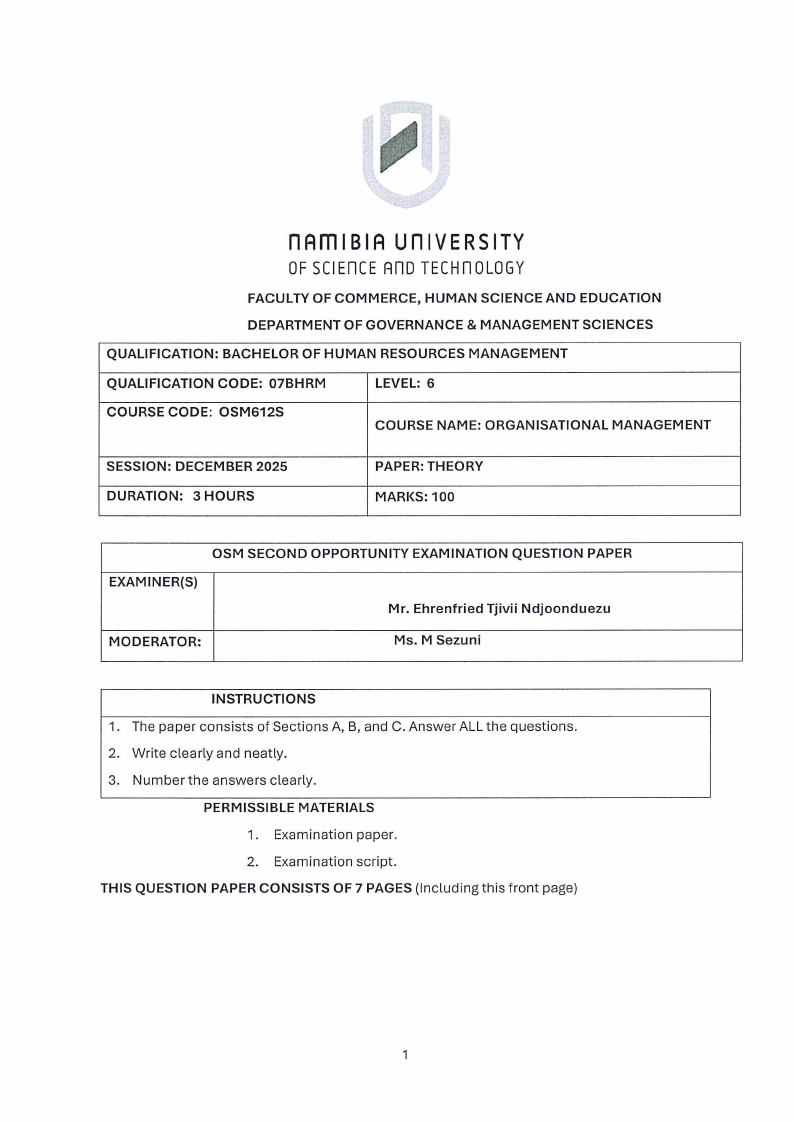
n Am I BI A u n IVER sITY
OF SCIEnCE Ano TECHnOLOGY
FACULTY OF COMMERCE, HUMAN SCIENCE AND EDUCATION
DEPARTMENT OF GOVERNANCE & MANAGEMENT SCIENCES
QUALIFICATION : BACHELOR OF HUMAN RESOURCES MANAGEMENT
QUALIFICATION CODE: 07BHRM
LEVEL: 6
COURSE CODE: OSM612S
COURSE NAME: ORGANISATIONAL MANAGEMENT
SESSION: DECEMBER 2025
DURATION: 3 HOURS
PAPER: THEORY
MARKS: 100
OSM SECOND OPPORTUNITY EXAMINATION QUESTION PAPER
EXAMINER(S)
Mr. Ehrenfried Tjivii Ndjoonduezu
MODERATOR:
Ms. M Sezuni
INSTRUCTIONS
1. The paper consists of Sections A, B, and C. Answer ALL the questions.
2. Write clearly and neatly.
3. Number the answers clearly.
PERMISSIBLE MATERIALS
1. Examination paper.
2. Examination script.
THIS QUESTION PAPER CONSISTS OF 7 PAGES (Including this front page)
1
|
|
2 Page 2 |
▲back to top |
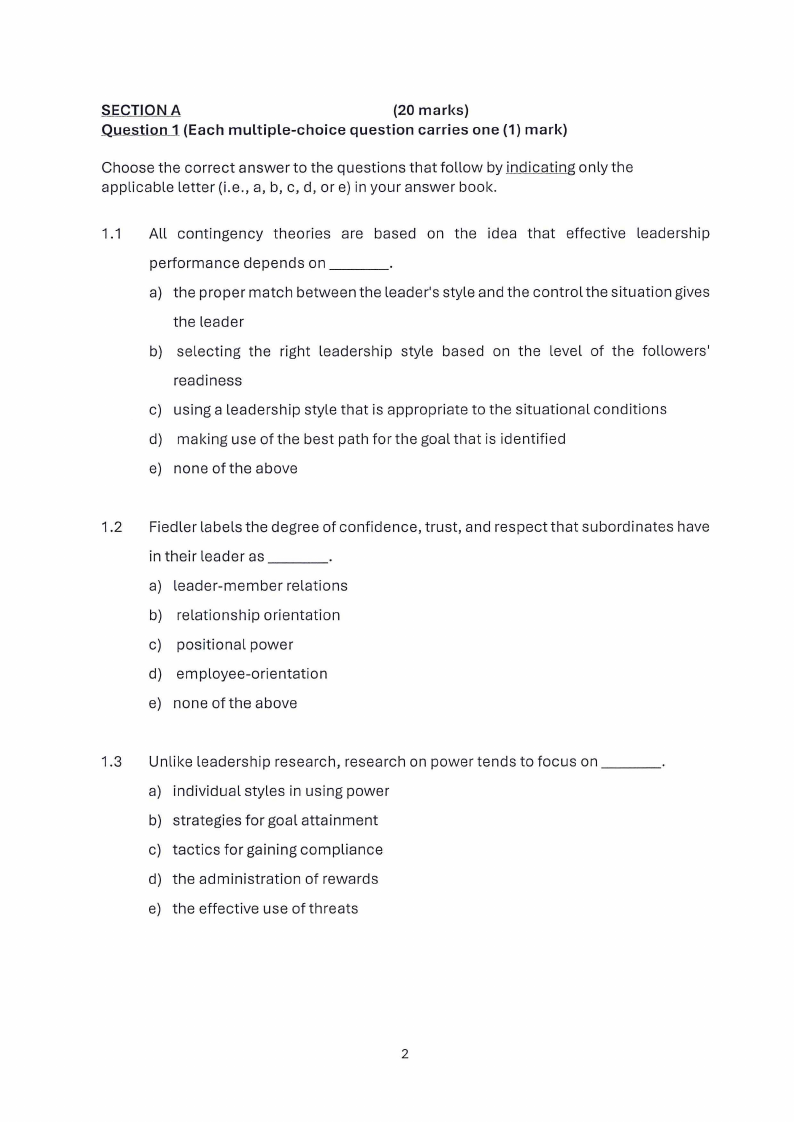
SECTION A
(20 marks)
Question 1 (Each multiple-choice question carries one (1) mark)
Choose the correct answer to the questions that follow by indicating only the
applicable letter (i.e., a, b, c, d, ore) in your answer book.
1.1 All contingency theories are based on the idea that effective leadership
performance depends on _ __
a) the proper match between the leader's style and the control the situation gives
the leader
b) selecting the right leadership style based on the level of the followers'
readiness
c) using a leadership style that is appropriate to the situational conditions
d) making use of the best path for the goal that is identified
e) none of the above
1.2 Fiedler labels the degree of confidence, trust, and respect that subordinates have
in their leader as _ __
a) leader-member relations
b) relationship orientation
c) positional power
d) employee-orientation
e) none of the above
1.3 Unlike leadership research, research on power tends to focus on _ __
a) individual styles in using power
b) strategies for goal attainment
c) tactics for gaining compliance
d) the administration of rewards
e) the effective use of threats
2
|
|
3 Page 3 |
▲back to top |
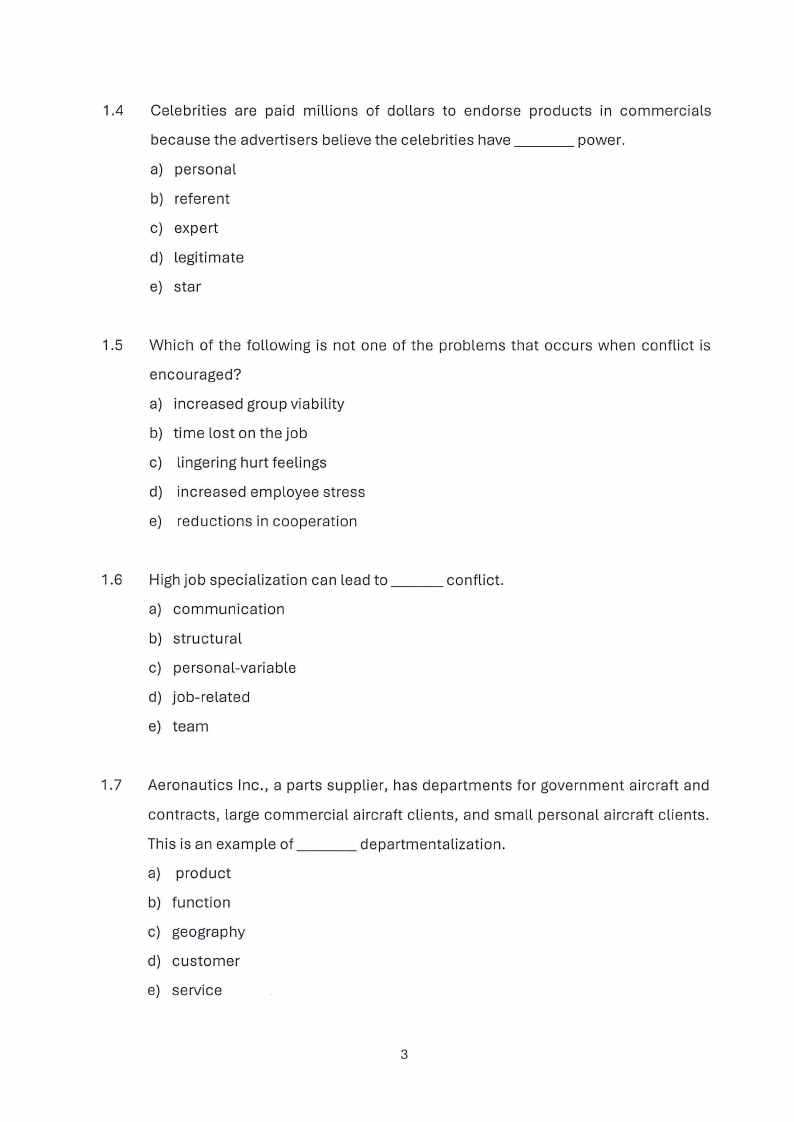
1.4 Celebrities are paid millions of dollars to endorse products in commercials
because the advertisers believe the celebrities have _ _ _ power.
a) personal
b) referent
c) expert
d) legitimate
e) star
1.5 Which of the following is not one of the problems that occurs when conflict is
encouraged?
a) increased group viability
b) time lost on the job
c) lingering hurt feelings
d) increased employee stress
e) reductions in cooperation
1.6 High job specialization can lead to
a) communication
b) structural
c) personal-variable
d) job-related
e) team
conflict.
1. 7 Aeronautics Inc., a parts supplier, has departments for government aircraft and
contracts, large commercial aircraft clients, and small personal aircraft clients.
This is an example of _ _ _ departmentalization.
a) product
b) function
c) geography
d) customer
e) service
3
|
|
4 Page 4 |
▲back to top |
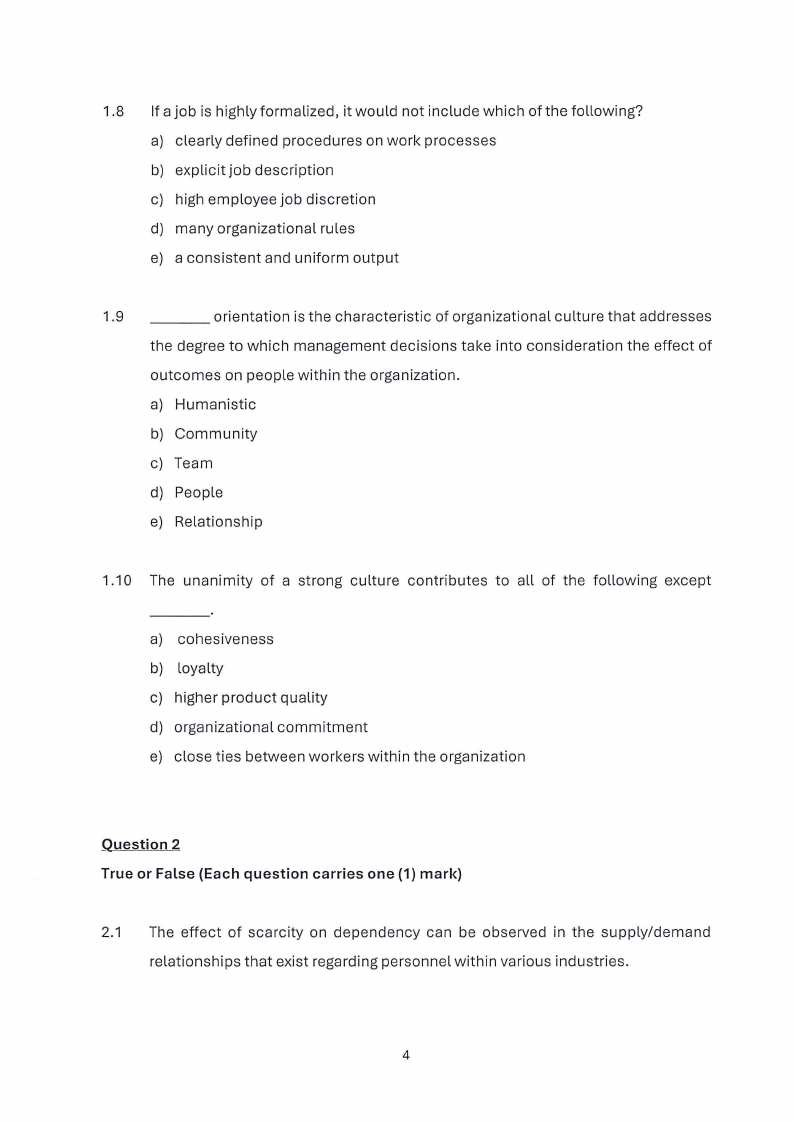
1.8 If a job is highly formalized, it would not include which of the following?
a) clearly defined procedures on work processes
b) explicit job description
c) high employee job discretion
d) many organizational rules
e) a consistent and uniform output
1.9 _ _ _ orientation is the characteristic of organizational culture that addresses
the degree to which management decisions take into consideration the effect of
outcomes on people within the organization.
a) Humanistic
b) Community
c) Team
d) People
e) Relationship
1.1 O The unanimity of a strong culture contributes to all of the following except
a) cohesiveness
b) loyalty
c) higher product quality
d) organizational commitment
e) close ties between workers within the organization
Question 2
True or False (Each question carries one (1) mark)
2.1 The effect of scarcity on dependency can be observed in the supply/demand
relationships that exist regarding personnel within various industries.
4
|
|
5 Page 5 |
▲back to top |
2.2 Because of the coalition factor, the expert power of an individual within an
organization is strengthened when another individual with the same job-related
knowledge and skills is hired by the organization.
2,3 One assumption of the trait view of leadership is that leaders cannot be trained.
2.4 Studies regarding the Fiedler model have shown that respondents' questionnaire
scores tend to be relatively stable.
2.5 If the aspiration ranges of two parties overlap, then a settlement range for the
conflict exists.
2.6 Autonomy and formalization are positively related.
2.7 Organizations operating in highly scarce, dynamic, and complex environments
fare best if under organic structures.
2.8 An organization pursues a price-minimization strategy by controlling costs,
avoiding unnecessary innovation or marketing expenses, and cutting prices in
selling basic products.
2.9 Intergroup development seeks to change attitudes, stereotypes, and perceptions
that groups have of each other.
2, 1O Experience on the job tends to be positively related to work stress.
5
|
|
6 Page 6 |
▲back to top |
Section B
[13]
Question 3
The financial sector is the third largest sector in the Australian economy, and the banking
industry accounts for more than half of the financial sector. Financial services
organizations depend on their employees to deliver superior customer service and to
maintain successful customer relationships. Treating employees fairly may lead to the
operational success of financial services organizations. Fair treatment also
communicates that organizations are committed to their employees. Employees assess
their work experiences in terms of whether organizations show concern for them as
individuals and provide fair treatment. When employees perceive that human resources
management (HRM) decisions and procedures are fair and satisfactory, they can be
expected to repay the organization by forming positive attitudes toward it.
Twenty-nine senior, middle, and lower-level managers from one Australian bank in South
Australia were interviewed. All interviewees had direct involvement with HRM practices
in the banking organization. Interviewees were asked to name those HRM practices in
which fairness would be most important. Options included HR planning, recruiting,
selection, compensation, promotion/career development, performance management,
and employee relations. The findings indicated that interviewees perceived fairness to
be most important in three main HRM areas: compensation (44.8 percent), performance
management (27.6 percent), and promotion/career development (27.6 percent).
Compensation and performance management are areas where fairness is most
important because these two are linked together. I suppose it is about what you do and
howyou get rewarded. I think that's where fairness becomes important-howyou reward
your people. Performance management goes hand in hand with compensation and
benefits.
Interviewees claimed that compensation needed to be fair and transparent because
employees perceived that if they were exerting as much effort as others but getting fewer
rewards, they became de-motivated, and their performance declined. Employees expect
fair remuneration. It helps them to work better if their organization compensates them
according to their contributions and acknowledges them. Moreover, employees with
different needs accordingly should be given different benefits.
Interviewees also considered fairness in performance management important as it
affected their opportunities for career development and for bonus payments.
Performance management, however, has the potential to be subjective because it deals
with judgments. For instance, when a superior who acts as an appraiser or reviewer does
not believe or does not get along with staff, it may somehow affect employees'
6
|
|
7 Page 7 |
▲back to top |
performance because their performance is based on relationships with their superior. If
employees do not get on well with the superior, they are unlikely to receive a good report.
Interviewees also perceived that fairness in promotion/ career development was
important so that employees have goals to work toward and equal chances for
promotion. For instance, job candidates must be treated with fairness relative to every
other candidate, so everyone goes through the same testing procedures, interview
procedures, and screening. Each employee expects equal opportunity to progress on his
or her career path and to be rewarded for what he or she does.
The interview illustrates how perception of fairness is important in the distribution of
HRM practices such as compensation, performance evaluations, and promotion/career
development. There is clear evidence that bank employees place emphasis on the issue
of fairness in these areas.
Questions
3.1 What is the link between fairness and HRM?
(7)
3.2 If you were the HR manager, could you explain why Australian bank employees
chose compensation and benefits, performance management, and career
development as their most important HRM practices?
(6)
Section C
(67)
Question 4
4.1 Explain how the grapevine functions and why it exists in organizational
communication.
(10)
4.2 Explain the leader-member exchange theory.
(14)
4.3 Discuss the behaviors to be expected from people who exhibit each of the five
primary conflict-handling intentions.
(12)
4,4 What is a virtual organization? What elements of organizational structure are
important to create and sustain a successful virtual organization? Explain your
answer.
(12)
4.5 Discuss the difference between strong and weak organizational cultures. (9)
4.6 Describe three of the seven tactics that change agents can use when dealing with
resistance to change. Mention the advantages and drawbacks of each one. (10)
7