


 |
BRM711C-RETAIL MANAGEMENT-2ND OPP-DEC 2025 |
|
|
1 Page 1 |
▲back to top |
nAm I BI A u nlVERS ITV
OF SCIEnCE Ano TECH no LOGY
FACULTY OF COMMERCE; HUMAN SCIENCES AND EDUCATION
CENTRE FOR ENTERPRISE DEVELOPMENT (CED)
QUALIFICATION: DIPLOMA IN BUSINESS PROCESS MANAGEMENT
QUALIFICATION CODE: 06DBPM LEVEL: 6
COURSE CODE: BRM 711 C
COURSE NAME: RETAIL MANAGEMENT
SESSION: NOVEMBER 2025
DURATION: 3 HOURS
PAPER: PAPER 1
MARKS: 100
SECOND OPPORTUNITY EXAMINATION - QUESTION PAPER
EXAMINER(S) MR. S. TJITAMUNISA
MODERATOR: MR. R. RITTER
I. Answer ALL the questions.
2. Write clearly and neatly.
INSTRUCTIONS
THIS QUESTION PAPER CONSISTS OF 06 PAGES (Including this front page)
llPa ge
|
|
2 Page 2 |
▲back to top |
SECTION A
ANALYTICAL QUESTIONS
60 marks
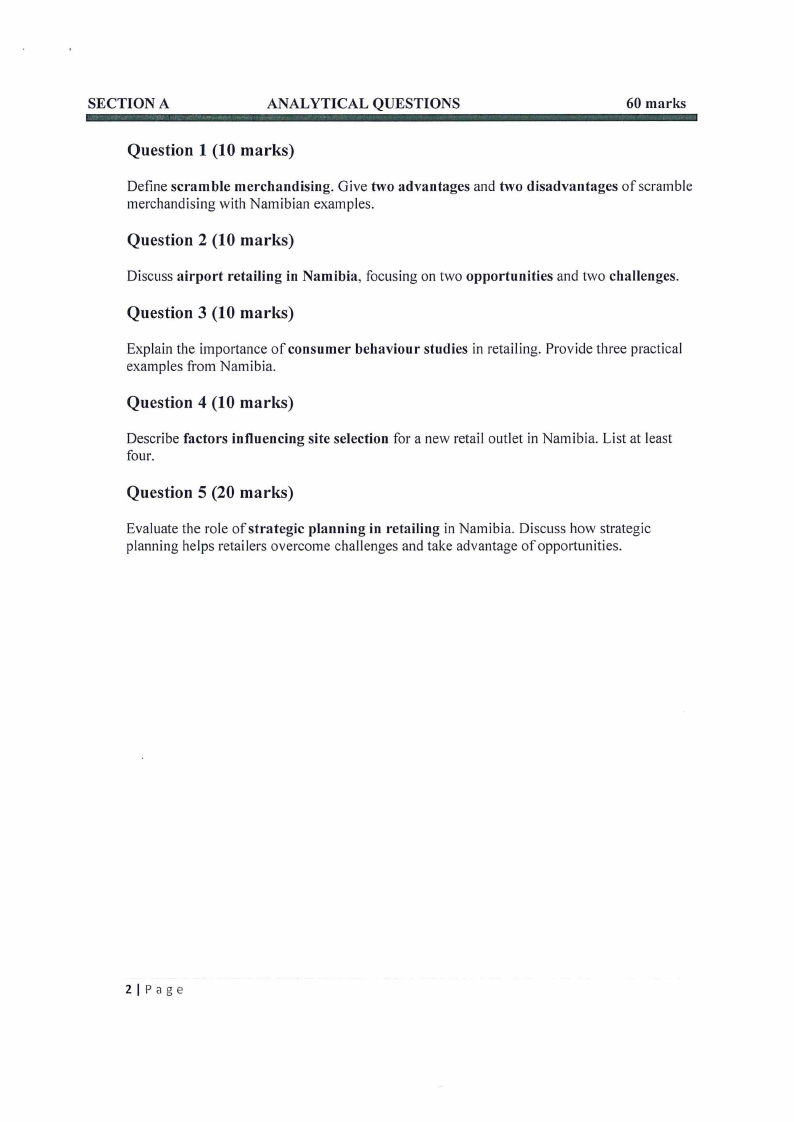
Question 1 (10 marks)
Define scramble merchandising. Give two advantages and two disadvantages of scramble
merchandising with Namibian examples.
Question 2 (10 marks)
Discuss airport retailing in Namibia, focusing on two opportunities and two challenges.
Question 3 (10 marks)
Explain the impo11ance of consumer behaviour studies in retailing. Provide three practical
examples from Namibia.
Question 4 (10 marks)
Describe factors influencing site selection for a new retail outlet in Namibia. List at least
four.
Question 5 (20 marks)
Evaluate the role of strategic planning in retailing in Namibia. Discuss how strategic
planning helps retailers overcome challenges and take advantage of opportunities.
21Pag e
|
|
3 Page 3 |
▲back to top |
SECTIONB
MULTIPLE CHOICE QUESTIONS
20 marks
Answer all questions by ticking, or inserting an X in the table provide (page 06) after
the set of questions below.
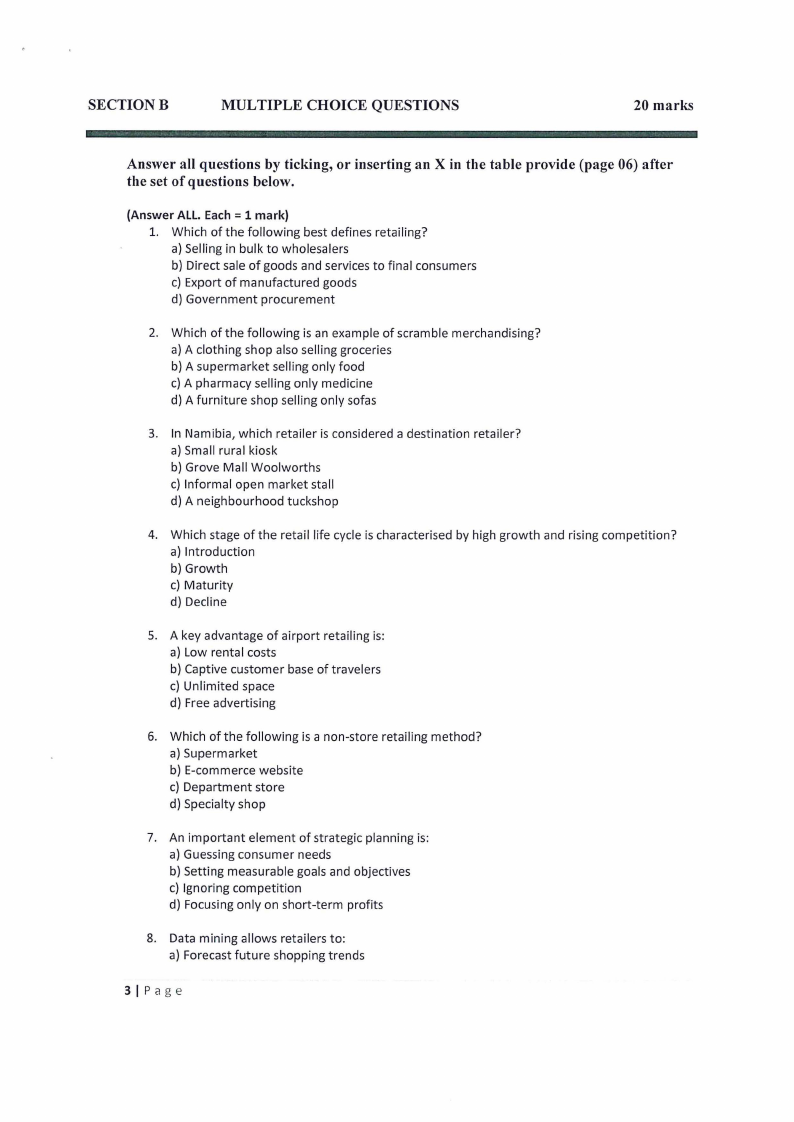
(Answer ALL. Each = 1 mark)
1. Which of the following best defines retailing?
a) Selling in bulk to wholesalers
b) Direct sale of goods and services to final consumers
c) Export of manufactured goods
d) Government procurement
2. Which of the following is an example of scramble merchandising?
a) A clothing shop also selling groceries
b) A supermarket selling only food
c) A pharmacy selling only medicine
d) A furniture shop selling only sofas
3. In Namibia, which retailer is considered a destination retailer?
a) Small rural kiosk
b) Grove Mall Woolworths
c) Informal open market stall
d) A neighbourhood tuckshop
4. Which stage of the retail life cycle is characterised by high growth and rising competition?
a) Introduction
b) Growth
c) Maturity
d) Decline
5. A key advantage of airport retailing is :
a) Low rental costs
b) Captive customer base of travelers
c) Unlimited space
d) Free advertising
6. Which of the following is a non-store retailing method?
a) Supermarket
b) E-commerce website
c) Department store
d) Specialty shop
7. An important element of strategic planning is:
a) Guessing consumer needs
b) Setting measurable goals and objectives
c) Ignoring competition
d) Focusing only on short-term profits
8. Data mining allows retailers to:
a) Forecast future shopping trends
3I Pa ge
|
|
4 Page 4 |
▲back to top |
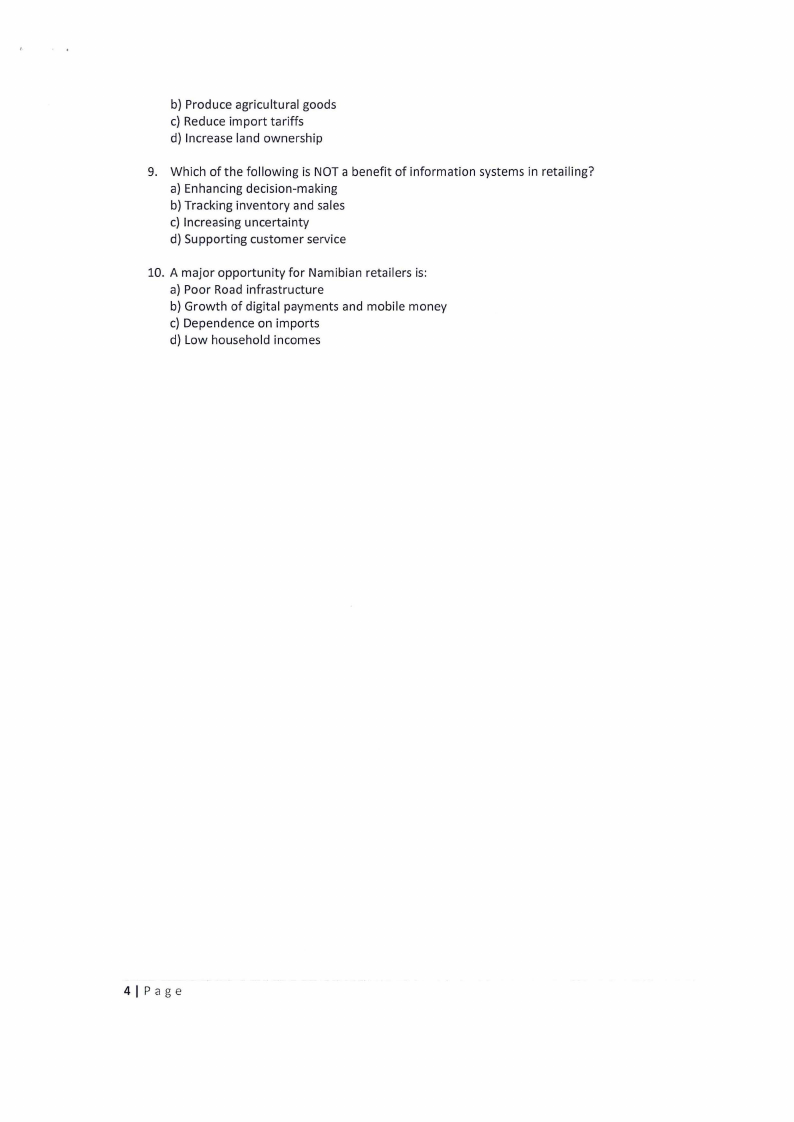
b) Produce agricultu ral goods
c) Reduce import tariffs
d) Increase land ownership
9. Which of the following is NOT a benefit of information systems in retailing?
a) Enhancing decision-making
b) Tracking inventory and sales
c) Increasing uncertainty
d) Supporting customer service
10. A major opportunity for Namibian retailers is :
a) Poor Road infrastructure
b) Growth of digital payments and mobile money
c) Dependence on imports
d) Low household incomes
41 Page
|
|
5 Page 5 |
▲back to top |
SECTIONC
TRUE OR FALSE
(20x1=20 Marks)
Use Table A on page 7 to answer and detach, hand in with your answer sheet.
No. Question
1
Retailing is the final step in the distribution channel.
2
Scramble merchandising improves product specialization.
3
Retailers in the growth stage of the life cycle face increasing competition .
4
Destination retailers are small outlets with limited reach.
5
Namibia's airport retailing benefits from tourism flows.
6
E-commerce is irrelevant for Namibian retailing.
7
Consumer behaviour analysis includes studying cultural, social, and personal factors.
8
Information gathering helps retailers make informed strategic decisions.
9
Trading area analysis is unnecessary in rural Namibia.
10
Location decisions can directly affect profitability.
11
Store-based retailing includes supermarkets and department stores.
12
Non-store retailing is decreasing globally.
13
Strategic planning in retail ensures adaptability to market changes.
14
Information systems are only useful for large retailers.
15
Data mining is a tool used in customer relationship management.
16
Airport retailers mostly rely on local repeat customers.
17
The decline stage of the retail life cycle shows falling sales.
18
Trading area analysis helps determine store catchment zones.
19
Poor site selection can lead to business failure.
20
Namibian retailers face high costs of imported goods.
THE END
SI Pa ge
|
|
6 Page 6 |
▲back to top |
MULTIPLE CHOICE QUESTIONS/TRUE AND FALSE
NB!!!! (DETACH AND INSERT IN YOUR ANSWER SHEET)
(20+20) =40 Marks
Section B (Multiple Questions) (2X10) =20marks
Section C (True and False) 20 marks
GI P age
THE END