


 |
CAH610S-COST AND MANAGEMENT ACCOUNTING FOR HOSPITALITY TOURISM-1ST OPP-NOV 2025 |
|
|
1 Page 1 |
▲back to top |
nAmlBIA UnlVERSITY
OF SCIEnCE Ano TECHnOLOGY
FACULTY OF COMMERCE, HUMAN SCIENCES AND EDUCATION
DEPARTMENT OF HOSPITALITY AND TOURISM
QUALIFICATION: BACHELOR OF CULINARY ARTS & BACHELOR OF TOURISM INNOVATION AND
DEVELOPMENT
QUALIFICATION CODE: 07BCNA & 07BTID LEVEL: 6
COURSE CODE: CAH610S
COURSE NAME: COST & MANAGEMENT
ACCOUNTING FOR HOSPITALITY &
TOURISM
SESSION: NOVEMBER 2025
PAPER: THEORY AND CALCULATIONS (PAPER 1)
DURATION: 3 HOURS
MARKS: 100
EXAMINER
FIRST OPPORTUNITY EXAMINATION QUESTION PAPER
Gerhardt Sheehama
MODERATOR Lamecl< Odada
INSTRUCTIONS
• Answer ALL five (5) questions in blue or black ink only. NO PENCIL.
• Start each question on a new page, number the answers correctly and clearly.
• Write clearly and neatly showing all your workings/assumptions.
• Round off only final answers to two (2) decimal places.
• Questions relating to this examination may be raised in the initial 30 minutes after the start
of the examination. Thereafter, candidates must use their initiative to deal with any
perceived errors or ambiguities and any assumptions made by the candidate should be
clearly stated.
PERMISSIBLE MATERIALS
• Silent, non-programmable calculators
THIS QUESTION PAPER CONSISTS OF _6_ PAGES (including this front page)
|
|
2 Page 2 |
▲back to top |
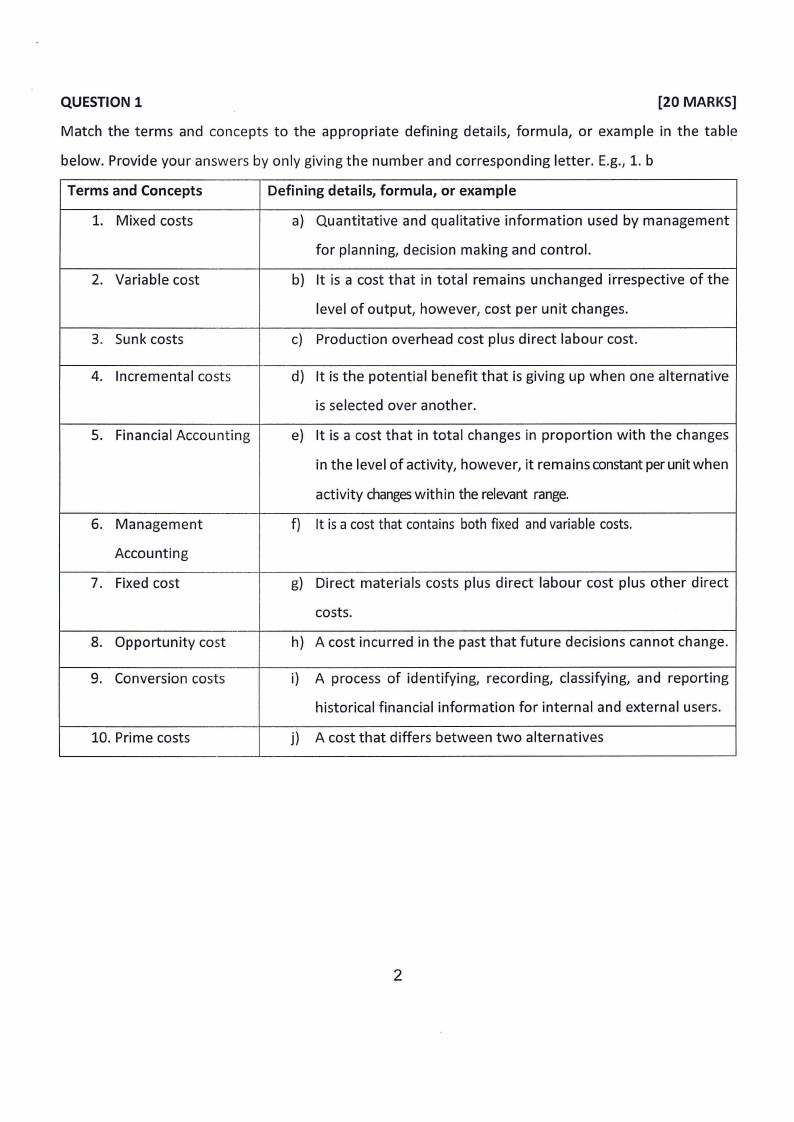
QUESTION 1
[20 MARKS]
Match the terms and concepts to the appropriate defining details, formula, or example in the table
below. Provide your answers by only giving the number and corresponding letter. E.g., 1. b
Terms and Concepts
Defining details, formula, or example
1. Mixed costs
a} Quantitative and qualitative information used by management
for planning, decision making and control.
2. Variable cost
b} It is a cost that in total remains unchanged irrespective of the
level of output, however, cost per unit changes.
3. Sunk costs
c} Production overhead cost plus direct labour cost.
4. Incremental costs
5. Financial Accounting
6. Management
Accounting
7. Fixed cost
8. Opportunity cost
d} It is the potential benefit that is giving up when one alternative
is selected over another.
e} It is a cost that in total changes in proportion with the changes
in the level of activity, however, it remains constant per unit when
activity changes within the relevant range.
f) It is a cost that contains both fixed and variable costs.
g) Direct materials costs plus direct labour cost plus other direct
costs.
h} A cost incurred in the past that future decisions cannot change.
9. Conversion costs
10. Prime costs
i) A process of identifying, recording, classifying, and reporting
historical financial information for internal and external users.
j) A cost that differs between two alternatives
2
|
|
3 Page 3 |
▲back to top |
QUESTION 2
[23 MARKS]
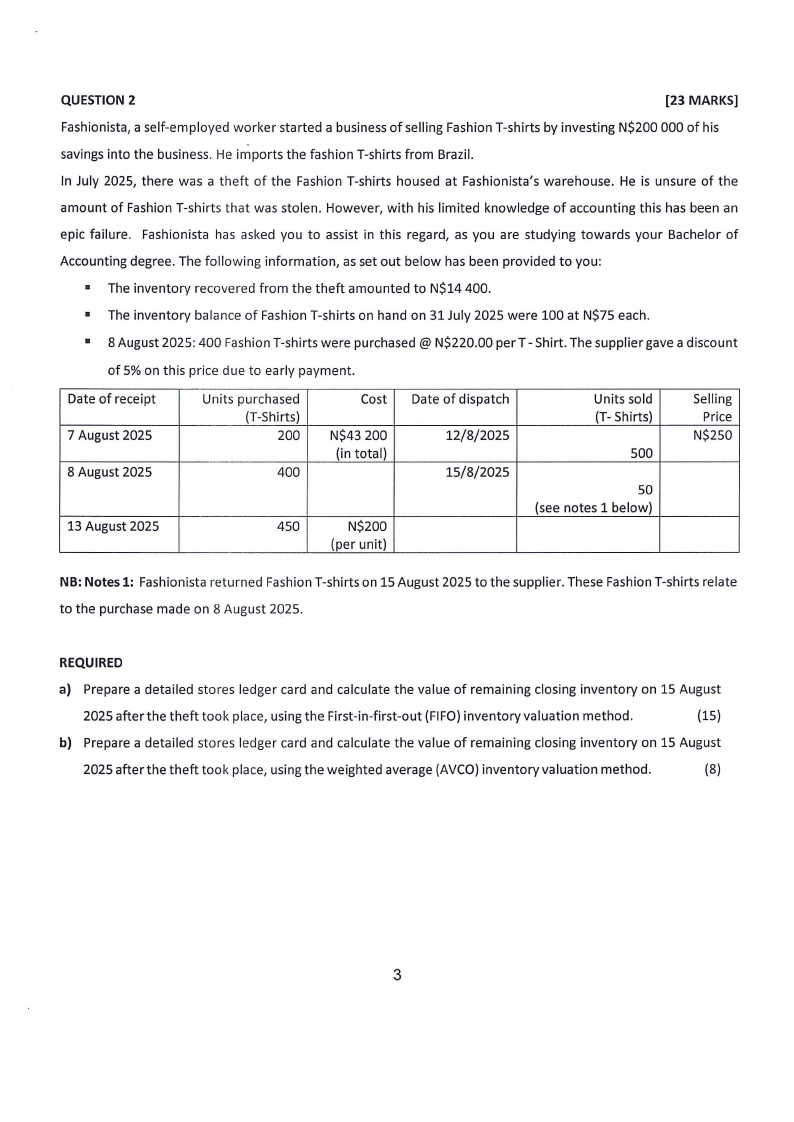
Fashionista, a self-employed worker started a business of selling Fashion T-shirts by investing N$200 000 of his
savings into the business . He imports the fashion T-shirts from Brazil.
In July 2025, there was a theft of the Fashion T-shirts housed at Fashionista's warehouse. He is unsure of the
amount of Fashion T-shirts that was stolen . However, with his limited knowledge of accounting this has been an
epic failure . Fashionista has asked you to assist in this regard, as you are studying towards your Bachelor of
Accounting degree. The following information, as set out below has been provided to you:
■ The inventory recovered from the theft amounted to N$14 400.
■ The inventory balance of Fashion T-shirts on hand on 31 July 2025 were 100 at N$75 each.
■ 8 August 2025: 400 Fashion T-shirts were purchased@ N$220.00 per T - Shirt. The supplier gave a discount
of 5% on this price due to early payment.
Date of receipt
7 August 2025
8 August 2025
13 August 2025
Units purchased
(T-Shirts)
200
400
450
Cost
N$43 200
(in total)
N$200
(per unit)
Date of dispatch
12/8/2025
15/8/2025
Units sold
(T- Shirts)
500
so
(see notes 1 below)
Selling
Price
N$250
NB: Notes 1: Fashionista returned Fashion T-shirts on 15 August 2025 to the supplier. These Fashion T-shirts relate
to the purchase made on 8 August 2025.
REQUIRED
a) Prepare a detailed stores ledger card and calculate the value of remaining closing inventory on 15 August
2025 after the theft took place, using the First-in-first-out (FIFO) inventory valuation method.
(15)
b) Prepare a detailed stores ledger card and calculate the value of remaining closing inventory on 15 August
2025 after the theft took place, using the weighted average (AVCO) inventory valuation method.
(8)
3
|
|
4 Page 4 |
▲back to top |
QUESTION 3
(22 MARKS]
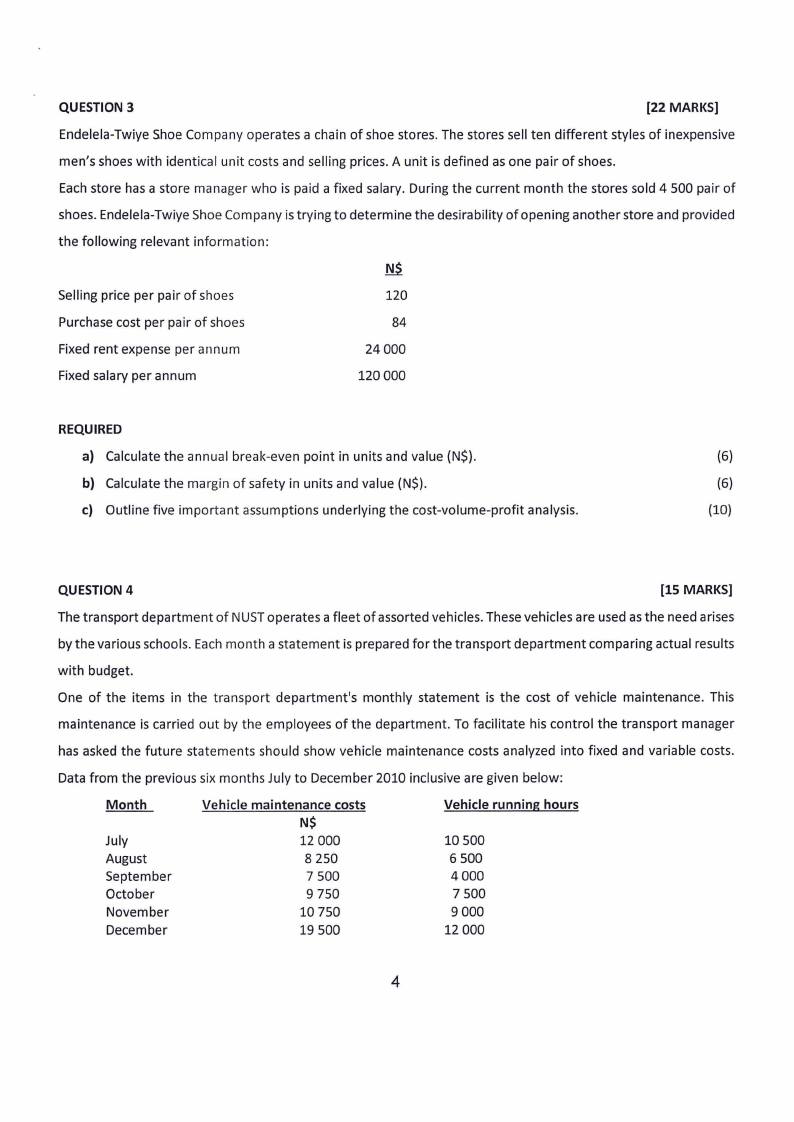
Endelela-Twiye Shoe Company operates a chain of shoe stores. The stores sell ten different styles of inexpensive
men's shoes with identical unit costs and selling prices. A unit is defined as one pair of shoes.
Each store has a store manager who is paid a fixed salary. During the current month the stores sold 4 500 pair of
shoes. Endelela-Twiye Shoe Company is trying to determine the desirability of opening another store and provided
the following relevant information:
~
Selling price per pair of shoes
120
Purchase cost per pair of shoes
84
Fixed rent expense per annum
24000
Fixed salary per annum
120 000
REQUIRED
a) Calculate the annual break-even point in units and value (N$).
(6)
b) Calculate the margin of safety in units and value (N$).
(6)
c) Outline five important assumptions underlying the cost-volume-profit analysis.
(10)
QUESTION 4
(15 MARKS]
The transport department of NUST operates a fleet of assorted vehicles. These vehicles are used as the need arises
by the various schools. Each month a statement is prepared for the transport department comparing actual results
with budget.
One of the items in the transport department's monthly statement is the cost of vehicle maintenance. This
maintenance is carried out by the employees of the department. To facilitate his control the transport manager
has asked the future statements should show vehicle maintenance costs analyzed into fixed and variable costs.
Data from the previous six months July to December 2010 inclusive are given below:
Month
July
August
September
October
November
December
Vehicle maintenance costs
N$
12 000
8 250
7 500
9 750
10750
19 500
Vehicle running hours
10500
6 500
4000
7 500
9 000
12 000
4
|
|
5 Page 5 |
▲back to top |
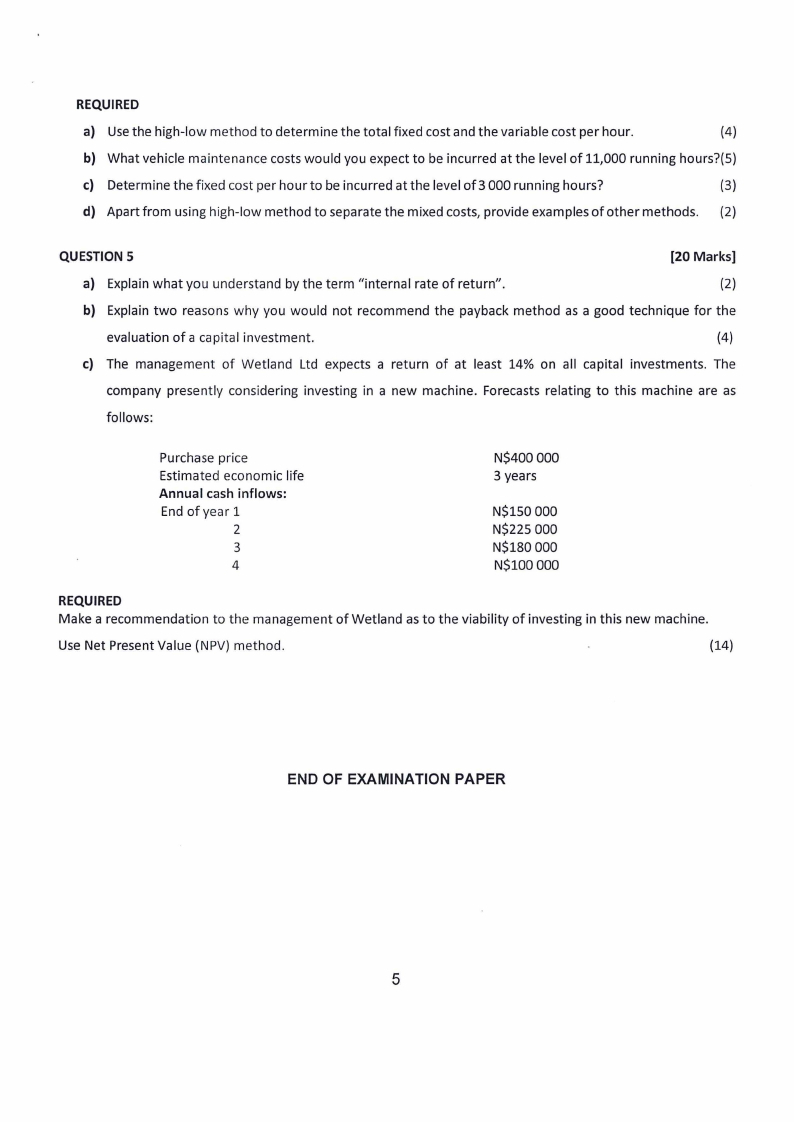
REQUIRED
a) Use the high-low method to determine the total fixed cost and the variable cost per hour.
(4)
b) What vehicle maintenance costs would you expect to be incurred at the level of 11,000 running hours?(S)
c) Determine the fixed cost per hour to be incurred at the level of 3 000 running hours?
(3)
d) Apart from using high-low method to separate the mixed costs, provide examples of other methods. (2)
QUESTION 5
[20 Marks]
a) Explain what you understand by the term "internal rate of return".
(2)
b) Explain two reasons why you would not recommend the payback method as a good technique for the
evaluation of a capital investment.
(4)
c) The management of Wetland Ltd expects a return of at least 14% on all capital investments. The
company presently considering investing in a new machine. Forecasts relating to this machine are as
follows :
Purchase price
Estimated economic life
Annual cash inflows:
End of year 1
2
3
4
N$400 000
3 years
N$150 000
N$225 000
N$180 000
N$100 000
REQUIRED
Make a recommendation to the management of Wetland as to the viability of investing in this new machine.
Use Net Present Value (NPV) method.
(14)
END OF EXAMINATION PAPER
5
|
|
6 Page 6 |
▲back to top |
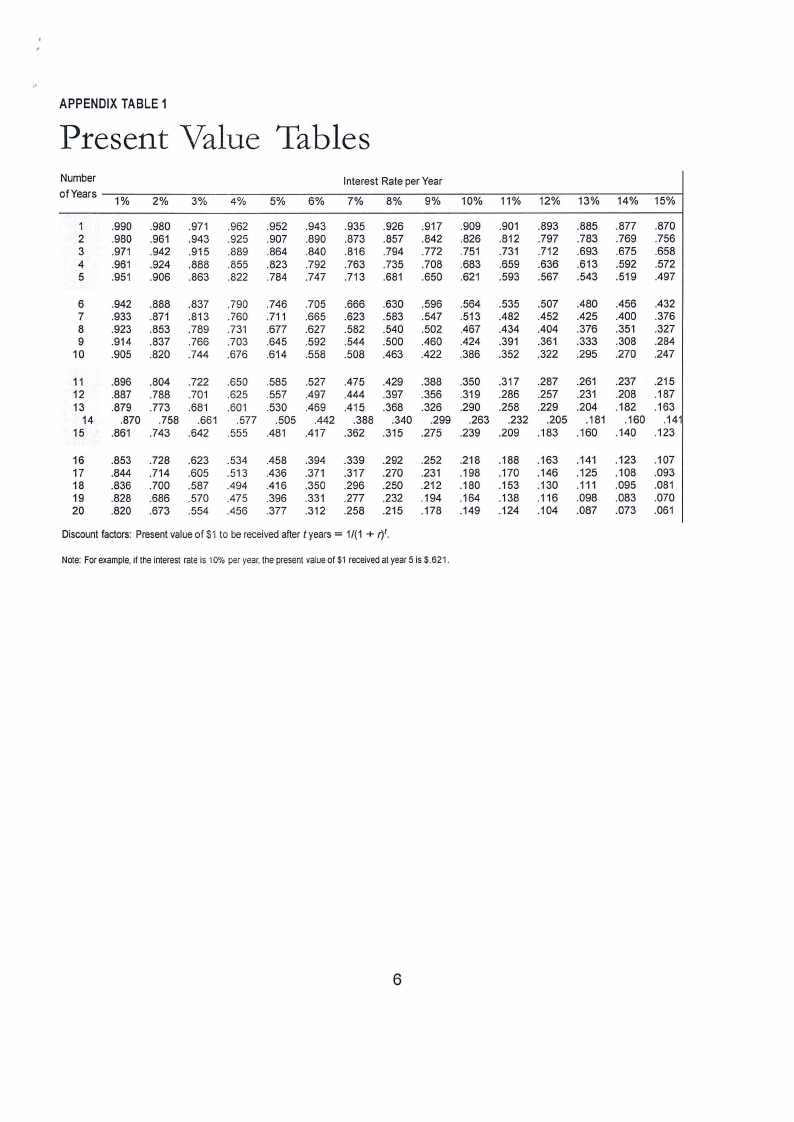
APPENDIX TABLE 1
Present Value Tables
Number
Interest Rate per Year
of Years 1%
2%
3%
4%
5%
6%
7%
8%
9% 10% 11% 12% 13% 14% 15%
1
.990 .980 .971 .962 .952 .943 .935 .926 .917 .909 .901 .893 .885 .877 .870
2
.980 .961 .943 .925 .907 .890 .873 .857 .842 .826 .812 .797 .783 .769 .756
3
.971 .942 .915 .889 .864 .840 .816 .794 .772 .751 .731 .712 .693 .675 .658
4
.961 .924 .888 .855 .823 .792 .763 .735 .708 .683 .659 .636 .613 .592 .572
5
.951 .906 .863 .822 .784 .747 .713 .681 .650 .621 .593 .567 .543 .519 .497
6
.942 .888 .837 .790 .746 .705 .666 .630 .596 .564 .535 .507 .480 .456 .432
7
.933 .871 .813 .760 .711 .665 .623 .583 .547 .513 .482 .452 .425 .400 .376
8
.923 .853 .789 .731 .677 .627 .582 .540 .502 .467 .434 .404 .376 .351 .327
9
.914 .837 .766 .703 .645 .592 .544 .500 .460 .424 .391 .361 .333 .308 .284
10 .905 .820 .744 .676 .614 .558 .508 .463 .422 .386 .352 .322 .295 .270 .247
11
.896 .804 .722 .650 .585 .527 .475 .429 .388 .350 .317 .287 .261 .237 .215
12
.887 .788 .701 .625 .557 .497 .444 .397 .356 .319 .286 .257 .231 .208 .187
13
.879 .773 .681 .601 .530 .469 .415 .368 .326 .290 .258 .229 .204 .182 .163
14
.870 .758 .661 .577 .505 .442 .388 .340 .299 .263 .232 .205 .181 .160 .141
15 .861 .743 .642 .555 .481 .417 .362 .315 .275 .239 .209 .183 .160 .140 .123
16 .853 .728 .623 .534 .458 .394 .339 .292 .252 .218 .188 .163 .141 .123 .107
17 .844 .714 .605 .51 3 .436 .371 .317 .270 .231 .198 .170 .146 .125 .108 .093
18
.836 .700 .587 .494 .416 .350 .296 .250 .212 .180 .153 .130 .111 .095 .081
19
.828 .686 .570 .475 .396 .331 .277 .232 .194 .164 .138 .116 .098 .083 .070
20 .820 .673 .554 .456 .377 .312 .258 .215 .178 .149 .124 .104 .087 .073 .061
Discount factors: Present value of $1 to be received after t years= 1/(1 + r)1.
Note: For example, if the interest rate is 10% per year, the present value of $1 received at year 5 is $. 621 .
6