LET621S - LAND ECONOMICS AND TAXATION - 2ND OPP - DEC 2025


LET621S - LAND ECONOMICS AND TAXATION - 2ND OPP - DEC 2025


1 Page 1

▲back to top


nAmlBIA unlV ERSITY
OF SCI En CE Ano TECH n OLOGY
FACULTY OF ENGINEERING AND THE BUILT ENVIRONMENT
DEPARTMENT OF LAND AND SPATIAL SCIENCES
QUALIFICATION(S): BACHELOR OF PROPERTY STUDIES
BACHELOR OF LAND ADMINISTRATION
DIPLOMA IN PROPERTY STUDIES
QUALIFICATION(S) CODE: 08BOPS
07BLAM
NQF LEVEL: 6
06DIPS
COURSE CODE: LET621S
COURSE NAME: LAND ECONOMICS AND TAXATION
EXAMS SESSION: DECEMBER 2025
PAPER:
THEORY
DURATION: 3 HOURS
MARKS:
100
SECOND OPPORTUNITY/SUPPLEMENTARY EXAMINATION QUESTION PAPER
EXAMINER(S) MR SAMUEL ATO K. HAYFORD
MODERATOR: MR VERINJAERAKO KANGOTUE
INSTRUCTIONS
1. Read the entire question paper before answering the Questions.
2. Please write clearly and legibly!
3. Please START EACH QUESTION ON A FRESH PAGE.
4. The question paper conta ins a total of 5 questions.
5. You must answer ALL QUESTIONS.
6. Make sure your Student Number is on the EXAMINATION BOOK(S) .
PERMISSIBLE MATERIALS
1. Non-programmable Scientific Calculator
THIS QUESTION PAPER CONSISTS OF 9 PAGES (Including this front page)

2 Page 2

▲back to top


Land Economics and Taxation
LET621S
Question 1
For each of the following statements indicate whether it is 'TRUE' or 'FALSE'. Each correct answer carries 1
mark.
1.1 Land by itself has little economic value until it is used in conjunction w ith inputs of capital, labour and
managem ent.
1.2 The threefold framework affecting land use includes economic, social, and environmental factors.
1.3 Economic factors in the threefold land use framework primarily involve considerations such as land
value and market demand.
1.4 Social factors in land use decisions typically ignore cultural and community needs.
1.5 Environmental factors in the framework include the sustainability of natural resources and
ecosystem protection.
1.6 The threefold framework suggests that land use decisions are solely based on economic gain.
1.7 Urbanisation and population growth are social factors that can influence land use patterns.
1.8 Land use planning under the threefold framework does not consider the impact of environmental
degradation.
1.9 Land use planning under the threefold framework of land use does not consider the impact of
environmental degradation.
1.10 Evaluating land use capacity is essential for identifying areas that are suitable for different
development purposes.
1.11 The threefold framework encourages balancing development needs with environmental
conservation.
Second Opportunity/Supplementary Question Paper Page 2 of 9
December 2025

3 Page 3

▲back to top


Land Econom ics and Taxation
LET621S
1.12 Increasing discretionary grants or unrestricted indirect taxes to local governments encourages more
efforts to improve property tax mobilization.
1.13 Political support for property tax reform tends to increase when alternative funding sources are
reduced.
1.14 Central government control over property tax rate setting has no effect on local governments'
incentives to improve tax collection.
1.15 Reforming property tax administration requires addressing both technical and political cha llenges to
be effective.
1.16 Property tax buoyancy increases automatically with economic growth without the need for
revaluation or policy changes.
1.17 Environmental factors play a critical role in determining the land's capacity for specific uses.
1.18 Land with harsh physical conditions is always unsuitable for any productive use.
1.19 For any two parcels of different locations, the magnitude of rent advantage associated with the use
of land closer to the market corresponds with the differences in transportation cost between the two
areas to the market.
1.20 Beyond the no-rent point any production carried out will call for reduction of payment that normally
goes to labour and management (cost of production).
1.21 By Von Thunens theory of land rent, farm product prices are determined by the production cost at
the extensive margins of production.
1.22 Ricardo believed that the use of less productive lands (extensive margin of land use) leads to
increasing cost of production and rising price per unit to command the additional production. This
arises as a result of corresponding higher output associated w ith the use of such lands.
Second Opportunity/Supplementary Question Paper Page 3 of 9
December 2025

4 Page 4

▲back to top


Land Economics and Taxation
LET621S
1.23 Von Thunen concept of emergence of land rent is based on the simple re ason when crops are
produced for central city market; lands which are located near the city and thus of higher quality in
terms of productivity enjoys rent advantage over those located at greater distance.
1.24 To determine the highest and best use, market demand and legal constraints must be analyzed.
1.25 Land capability classifications are commonly used in agricultural planning to guide land use decisions.
1.26 Social and cultural factors are irrelevant when assessing land use capacity.
(26]
Question 2
2.1 Distinguish between the concepts of 'Land use capacity' and 'Highest and best Use'.
(3)
2.2 State the significance of the concept of 'Land use capacity' with regards to rent-paying ability. (2)
2.3 List the two (2) main factors responsible for ability of land to pay rent.
(2)
2.4 Briefly account for any the factors that may cause changes in Use-Capacity of land.
(7)
2.5 Profile of urban land Uses on the basis of Returns earned is such that the highest value lands at the
centre of cities are used for commercial purposes, while areas with successively lower values are
used for residential, cropland etc.
Mention the four (4) areas where variations in this general profile usually take place.
(6)
(20]
Question 3
3.1 The volume of revenue from property tax depends partly on the rateable value and tax rates, and
partly on collection efficiency. To what extent is this statement true regarding property tax
administration?
(15}
Second Opportunity/Supplementary Question Paper Page 4 of 9
December 2025

5 Page 5

▲back to top


Land Economics and Taxation
LET621S
3.2 The process of property ident ification is often more difficult in developing countries. Enumerate any
five (5) factors responsible for t his sit uation.
(5)
[20)
Question 4
Read each question carefully. Among the alternative answers, choose the letter that correspond to the
best/correct answer. Each correct answer carries 1 mark.
4.1 What is t he prima ry purpose of assessing land use capacity?
A) To determ ine ownership rights
B) To identify suitable uses balancing economic and environmenta l factors
C) To increase taxation rates
D) To map polit ical bou ndaries
4.2 Decentralization in property tax administration can improve mobilization by:
A) Reducing local government responsibility for valuation
B) Increasing local government control and accountability
C) Centralizing t ax collection t o nat ional authorit ies
D) Eliminating tax rates to encourage development
4.3 What is a key policy issue limiting property t ax buoyancy in many African countries?
A) High tax ra tes im posed by central governm ents
B) Central government restrictions limiting loca l government rate-setting
C) Excessive loca l government politica l cont rol
D) Frequent reva luations increasing t axpayer resistance
4.4 Why do local governments sometimes resist property tax reforms?
A) Beca use t hey benefit from ind irect taxes and government transfers
B) Because t hey want to increase property tax revenue
C) Because they lack any political opposition
D) Beca use property owners support reforms strongly
Second Opportunity/Supplementary Question Paper Page 5 of 9
December 2025

6 Page 6

▲back to top


Land Economics and Taxation
LET621S
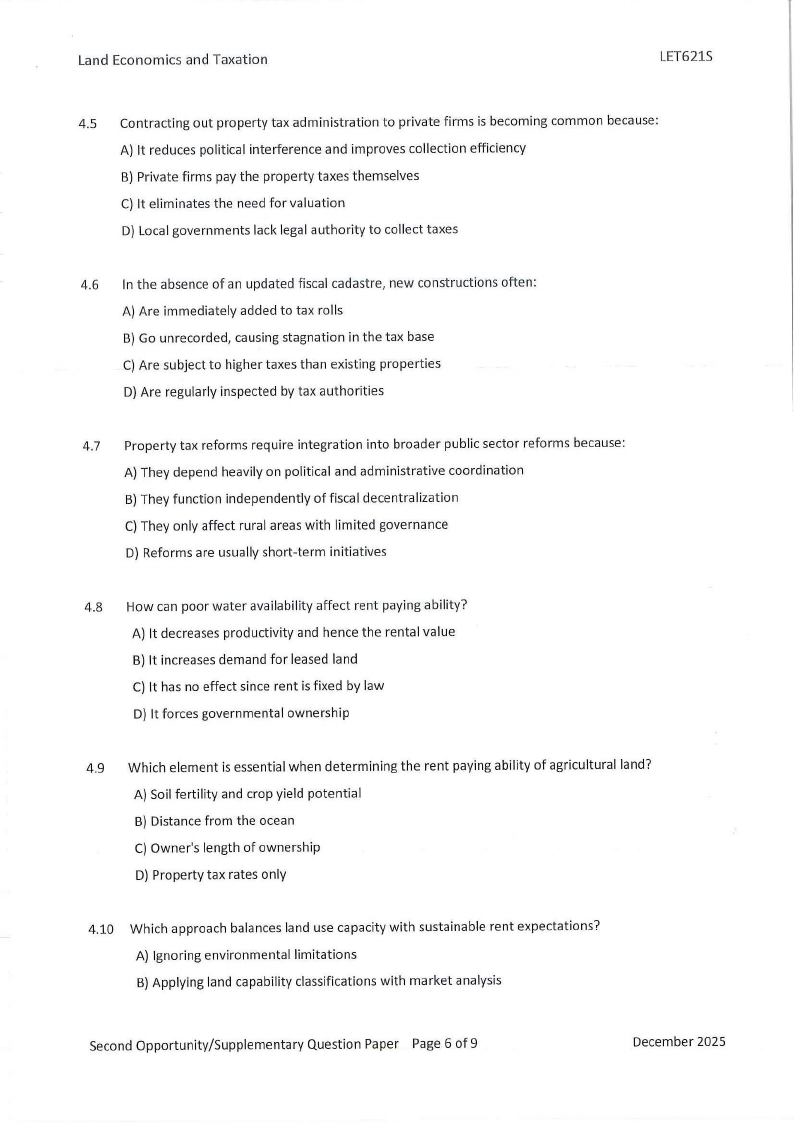
4.5 Contracting out property tax administration to private firms is becoming common because:
A) It reduces political interference and improves collection efficiency
B) Private firms pay the property taxes themselves
C) It eliminates the need for valuation
D) Local governments lack legal authority to collect taxes
4.6 In the absence of an updated fiscal cadastre, new constructions often:
A) Are immediately added to tax rolls
B) Go unrecorded, causing stagnation in the tax base
C) Are subject to higher taxes than existing properties
D) Are regularly inspected by tax authorities
4.7 Property tax reforms require integration into broader public sector reforms because :
A) They depend heavily on political and administrative coordination
B) They function independently of fiscal decentralization
C) They only affect rural areas with limited governance
D) Reforms are usually short-term initiatives
4.8 How can poor water availability affect rent paying ability?
A) It decreases productivity and hence the rental value
B) It increases demand for leased land
C) It has no effect since rent is fixed by law
D) It forces governmental ownership
4.9 Which element is essential when determining the rent paying ability of agricultural land?
A) Soil fertility and crop yield potential
B) Distance from the ocean
C) Owner's length of ownership
D) Property tax rates only
4.10 Which approach balances land use capacity with sustainable rent expectations?
A) Ignoring environmental limitations
B) Applying land capability classifications with market analysis
Second Opportunity/Supplementary Question Paper Page 6 of 9
December 2025

7 Page 7

▲back to top


Land Economics and Taxation
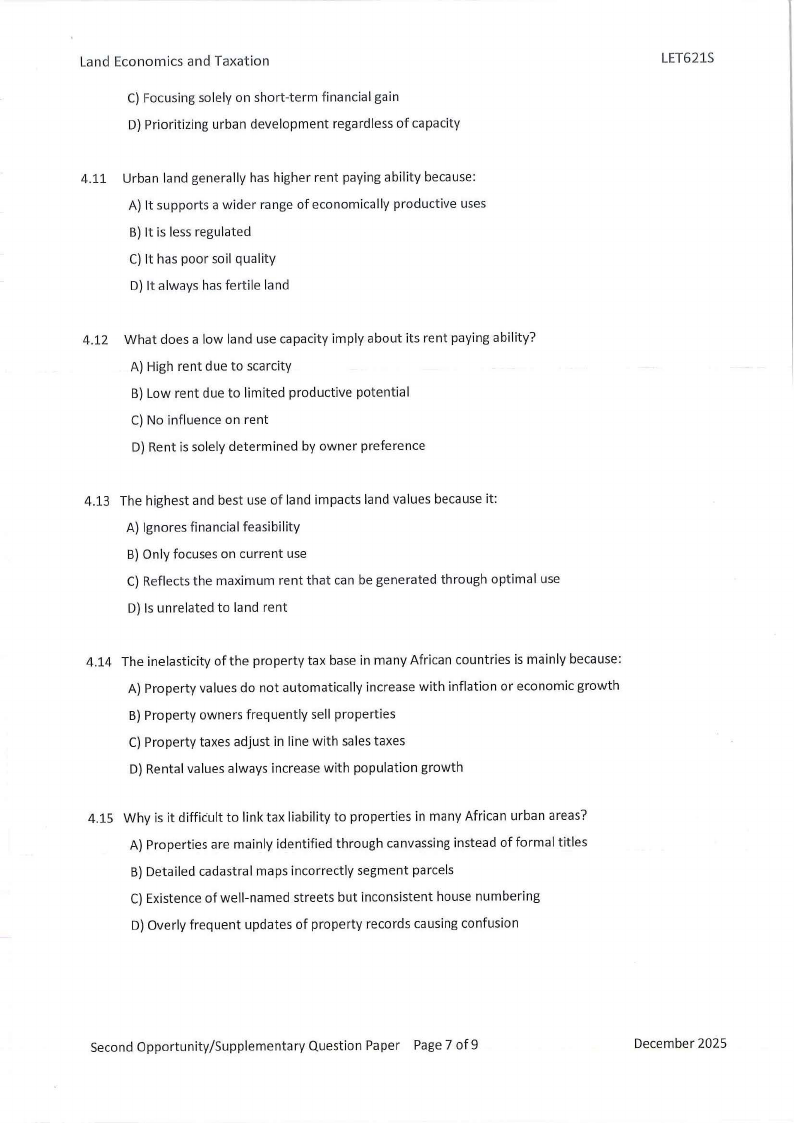
C) Focusing solely on short-term financial gain
D) Prioritizing urban development regardless of capacity
LET621S
4.11 Urban land generally has higher rent paying ability because:
A) It supports a wider range of economically productive uses
B) It is less regulated
C) It has poor soil quality
D) It always has fertile land
4.12 What does a low land use capacity imply about its rent paying ability?
A) High rent due to scarcity
B) Low rent due to limited productive potential
C) No influence on rent
D) Rent is solely determined by owner preference
4.13 The highest and best use of land impacts land values because it:
A) Ignores financial feasibility
B) Only focuses on current use
C) Reflects the maximum rent that ca n be generated through optimal use
D) Is unrelated to land rent
4.14 The inelasticity of the property tax base in many African countries is mainly because:
A) Property values do not automatically increase with inflation or economic growth
B) Property owners frequently sell properties
C) Property taxes adjust in line with sales taxes
D) Rental values always increase with population growth
4.15 Why is it difficult to link tax liability to properties in many African urban areas?
A) Properties are mainly identified through canvassing instead of formal titles
B) Detailed cadastral maps incorrectly segment parcels
C) Existence of well-named streets but inconsistent house numbering
D) Overly frequent updates of property records causing confusion
Second Opportunity/Supplementary Question Paper Page 7 of 9
December 2025

8 Page 8

▲back to top


Land Economics and Taxation
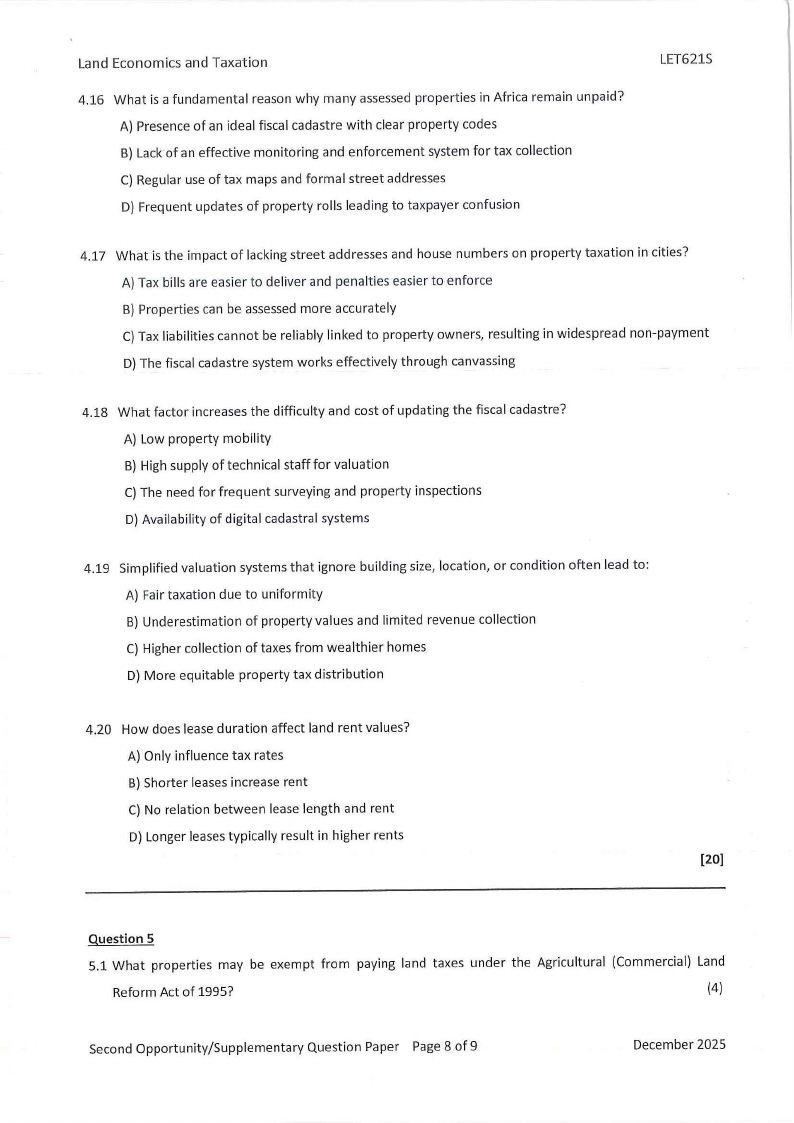
4.16 What is a fundamental reason why many assessed properties in Africa remain unpaid?
A) Presence of an ideal fiscal cadastre with clear property codes
B) Lack of an effective monitoring and enforcement system for tax collection
C) Regular use of tax maps and formal street addresses
D) Frequent updates of property rolls leading to taxpayer confusion
LET621S
4.17 What is the impact of lacking street addresses and house numbers on property taxation in cities?
A) Tax bills are easi er to deliver and penaltie s easier to enforce
B) Properties can be assessed more accurately
C) Tax liabilities cannot be reliably linked to property owners, resulting in widespread non-payment
D) The fiscal cadastre system works effectively through canvassing
4.18 What factor increases the difficulty and cost of updating the fiscal cadastre?
A) Low property mobility
B) High supply of technical staff for valuation
C) The need for frequent surveying and property inspections
D) Availability of digital cadastral systems
4.19 Simplified valuation systems that ignore building size, location, or condition often lead to:
A) Fair taxation due to uniformity
B) Underestimation of property values and limited revenue collection
C) Higher collection of taxes from wealthier homes
D) More equitable property tax distribution
4.20 How does lease duration affect land rent values?
A) Only influence tax rates
B) Shorter leases increase rent
C) No relation between lease length and rent
D) Longer leases typically result in higher rents
[20]
Question 5
5.1 What properties may be exempt from paying land taxes under the Agricultural (Commercial) Land
Reform Act of 1995?
(4)
Second Opportunity/Supplementary Question Paper Page 8 of 9
December 2025

9 Page 9

▲back to top


Land Economics and Taxation
LET621S
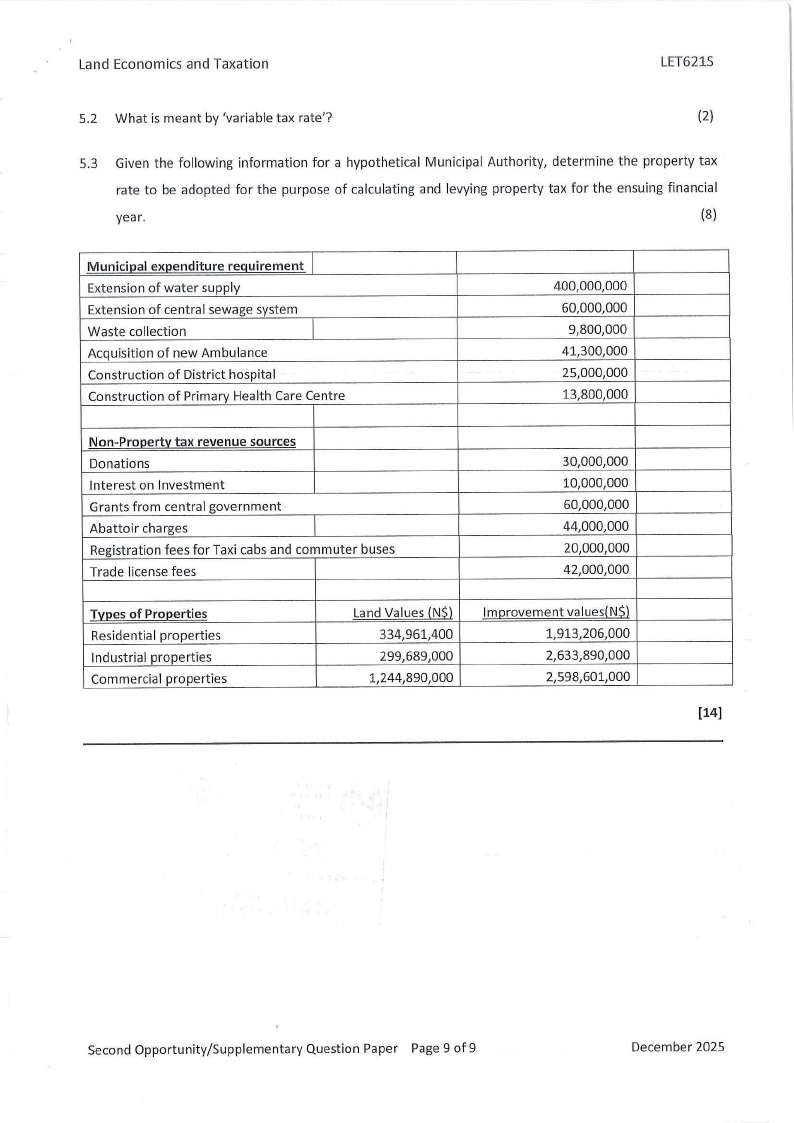
5.2 What is meant by 'variable tax rate'?
(2)
5.3 Given the following information for a hypothetical Municipa l Authority, determine the property tax
rate to be adopted for the purpose of calculating and levying property tax for the ensuing financia l
year.
(8)
MuniciQal exQenditure reguirement
Extension of water supply
Extension of centra l sewage system
Waste collection
Acquisit ion of new Ambulance
Construction of District hospital
Construction of Primary Health Care Centre
400,000,000
60,000,000
9,800,000
41,300,000
25,000,000
13,800,000
Non-ProQert~ tax revenue sources
Donations
Interest on Investment
Grants from centra l government
Abattoir charges
Registration fees for Taxi cabs and commuter buses
Trade license fees
30,000,000
10,000,000
60,000,000
44,000,000
20,000,000
42,000,000
T~Qes of ProQerties
Residential properties
Industria l properties
Commercial properties
Land Values (NS)
334,961,400
299,689,000
1,244,890,000
lm~rovement values(NSl
1,913,206,000
2,633,890,000
2,598,601,000
[14]
Second Opportunity/Supplementary Question Paper Page 9 of 9
December 2025