ISM520S - INTRODUCTION TO MAPPING - 2ND OPP - DEC 2025


ISM520S - INTRODUCTION TO MAPPING - 2ND OPP - DEC 2025


1 Page 1

▲back to top


n Am I BI A u n IVER s ITY
OF SC IEn CE Ano TECH n OLOGY
FACULTY OF ENGINEERING AND THE BU ILT ENVIRONMENT
DEPARTMENT OF LAND AND SPATIAL SCIENCES
QUALIFICATION: BACHELOR OF QUANTITY SURVEYING, BACHELOR OF GEOINFORMATION TECHNOLOGY,
BACHELOR OF LAND ADMINISTRATION, BACHELOR OF ARCHITECTURE, BACHELOR OF REGIONAL AND
URBAN PLANNING, BACHELOR OF REGIONAL AND RURAL DEVELOPMENT
QUALIFICATION CODE: 07BQOS, 07BGEI, LEVEL: 5
07BLAM, 07BARC, 07BURP, 07BROR
COURSE:
INTRODUCTION TO
SURVEY AND MAPPING
COURSE CODE: ISM520S
SESSION: DECEMBER 2025
PAPER:
THEORY
DURATION: 3 HOURS
MARl<S:
100
SECOND OPPORTUNITY/ SUPPLEMENTARY EXAMINATION QUESTION PAPER
EXAMINERS: Ms D. Husselmann and Mr D. Varges
MODERATOR: Mr F. Louw
THIS QUESTION PAPER CONSISTS OF 9 PAGES (Including this front page)
INSTRUCTIONS
1. Answer ALL the questions.
2. Write clearly and neatly.
3. Number the answers clearly.
4. Answers to calculations must be rounded off to three decimal places, excluding
answers to co-ordinate conversions
PERMISSIBLE MATERIALS
1. Calculators and other drawing equipment

2 Page 2

▲back to top


Introduction to Survey and Mapping
Question 1
State whether the following are True or False.
ISM520S
(10)
1.1. Office work is the part of su rveying when calculations and drawings are done in order
to prepare for observations to be done.
1.2. A theodolite and total station can both measure angles.
1.3. A digital level only needs to be levelled approximately as it has a compensator inside
the level that makes it exactly levelled.
1.4. On the Namibian LO co-ordinate system the fal se origin for Y is formed by the odd
Latitudes.
1.5. When doing a taped measurement, if your tape is sagging, the measured distance will
be longer.
1.6. Polars and joins can be considered the inverse of each other as with one co-ordinates
are determined using distance and direction, and with the other distance and
direction are determined using co-ordinates.
1.7. To check the accuracy of your traverse, one should start and end at a known point.
1.8. Horizontal setting out is the process whereby the Y, X and Z values are marked on the
ground using values determined with the help of surveying software .
1.9. The Differential GNSS positioning technique is less accurate than autonomous GNSS
positioning technique.
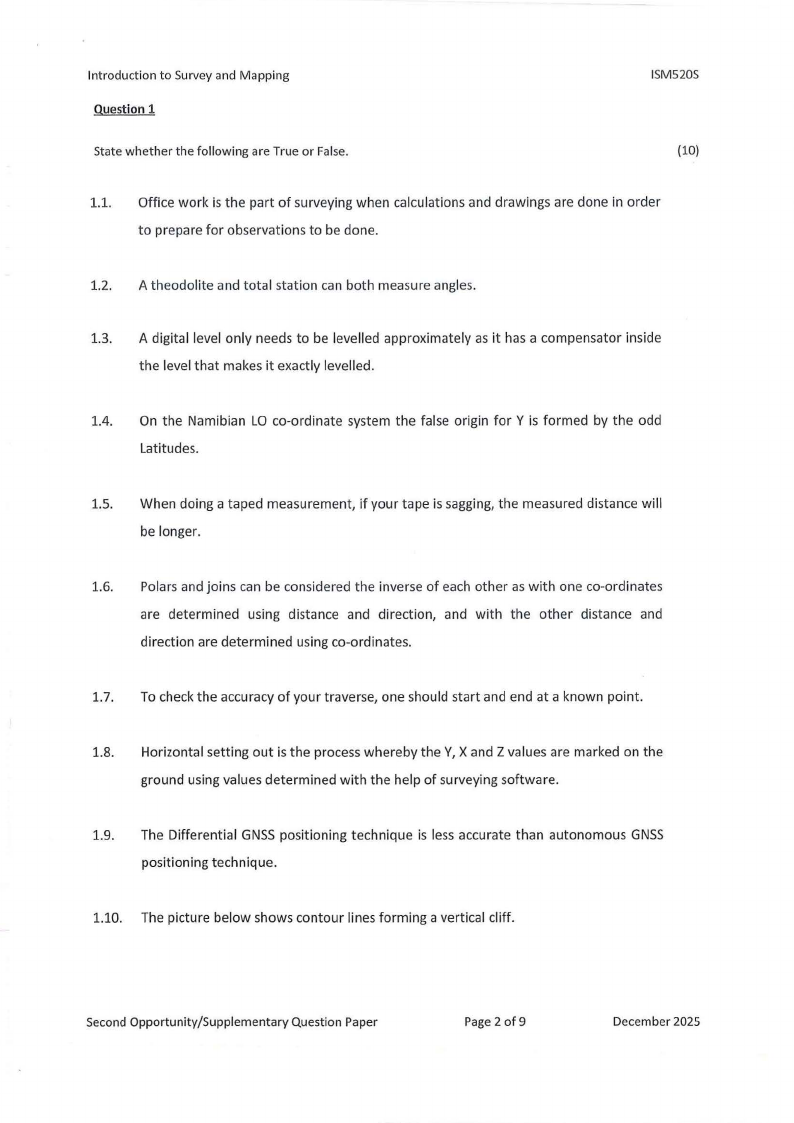
1.10. The picture below shows contour lines forming a vertical cliff.
Second Opportunity/Supplementary Question Paper
Page 2 of 9
December 2025

3 Page 3

▲back to top


Introduction to Survey and Mapping
ISMS20S
(10)
Question 2
2.1. What do the following acronyms stand for?
(3)
a. GNSS
b. DOP
c. Glm
2.2. Differentiate between a map and a plan.
(2)
2.3. Match the correct letters to the correct numbers, explaining what each mean.
(3)
Word
Definition
A. Correction
1. Small discrepancy that remains
after the correction has been
applied to a reading.
B. Residual
2. Difference between a measured
value and the true value of a
reading or observation.
C. Error
3. Quantity that must be applied to
the measured value to get the true
value.
Second Opportunity/Supplementary Question Paper
Page 3 of 9
December 2025

4 Page 4

▲back to top


Introduction to Survey and Mapping
2.4. Name 2 different methods used to determine the position of a point.
ISM520S
(2)
2.5. State the three basic principles that must always be applied during a levelling procedure.
(3)
2.6. Draw and label the axes (orientation) of the Namibian LO coordinate system. Indicate the (4)
signs for both Y and X in each quadrant.
2.7. What are the purposes of a Reference Object (R/O)?
(3)
2.8. Explain why slope corrections must be applied to EDM measurements.
(3)
2.9 . List three of the corrections applied to electronic-measured distances.
(3)
[26]
Question 3
3.1. What type of traverse needs to be performend in order to be able to check the accuracy of
(1)
the traverse?
3.2. Draw a table comparing an open traverse and a closed traverse.
(2)
3.3. Describe the procedure for horizontal setting out of a feature such as a road or a pipeline or a (3)
building or an erf, etc.
3.4. What is the difference between the Post-processing surveying and the Real Time Kinematic
(4)
surveying styles.
3.5. Contour Interval is the vertical distance between any two consecutive contours. The contour (4)
interval is kept the same on a map to depict correct topography of the terrain. The contour
intervals on a map depend on certain factors; name ANY THREE of these factors.
(14]
Second Opportunity/Supplementary Question Paper
Page 4 of 9
December 2025

5 Page 5

▲back to top


Introduction to Survey and Mapping
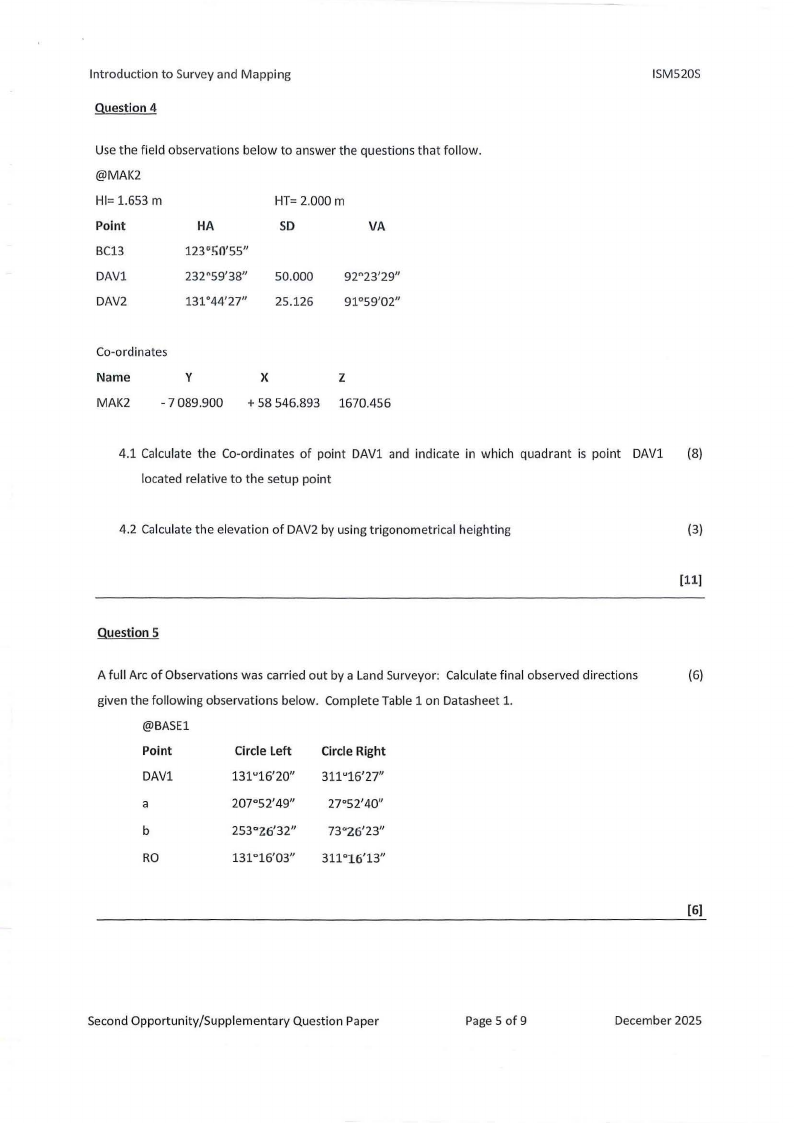
Question 4
Use the field observations below t o answer t he questions that follow.
@MAK2
HI= 1.653 m
HT= 2.000 m
Point
HA
SD
VA
BC13
123°~0'55"
DAVl
232"59'38" 50.000 92n23'29"
DAV2
131°44'27" 25.126 91°59'02"
ISM520S
Co-ordinates
Name
V
MAK2 - 7 089.900
X
Z
+ 58 546.893 1670.456
4.1 Calculate the Co-ordinat es of point DAVl and indicate in which quadrant is point DAVl (8)
locat ed relative t o the setup point
4.2 Calculate t he elevation of DAV2 by using trigonometrical heighting
(3)
[11]
Question 5
A full Arc of Observations was carried out by a Land Surveyor: Calculate final observed directions
(6)
given th e following observations below. Complete Table 1 on Datasheet 1.
@BASEl
Point
DAVl
Circle Left
131u16'20"
Circle Right
311u16'27"
a
207°52'49"
27°52'40"
b
253°26'32" 73°26'23"
RO
131°16'03" 311°16'13"
[6]
Second Opportunity/Supplementary Question Paper
Page 5 of 9
December 2025

6 Page 6

▲back to top


Introduction to Survey and Mappi ng
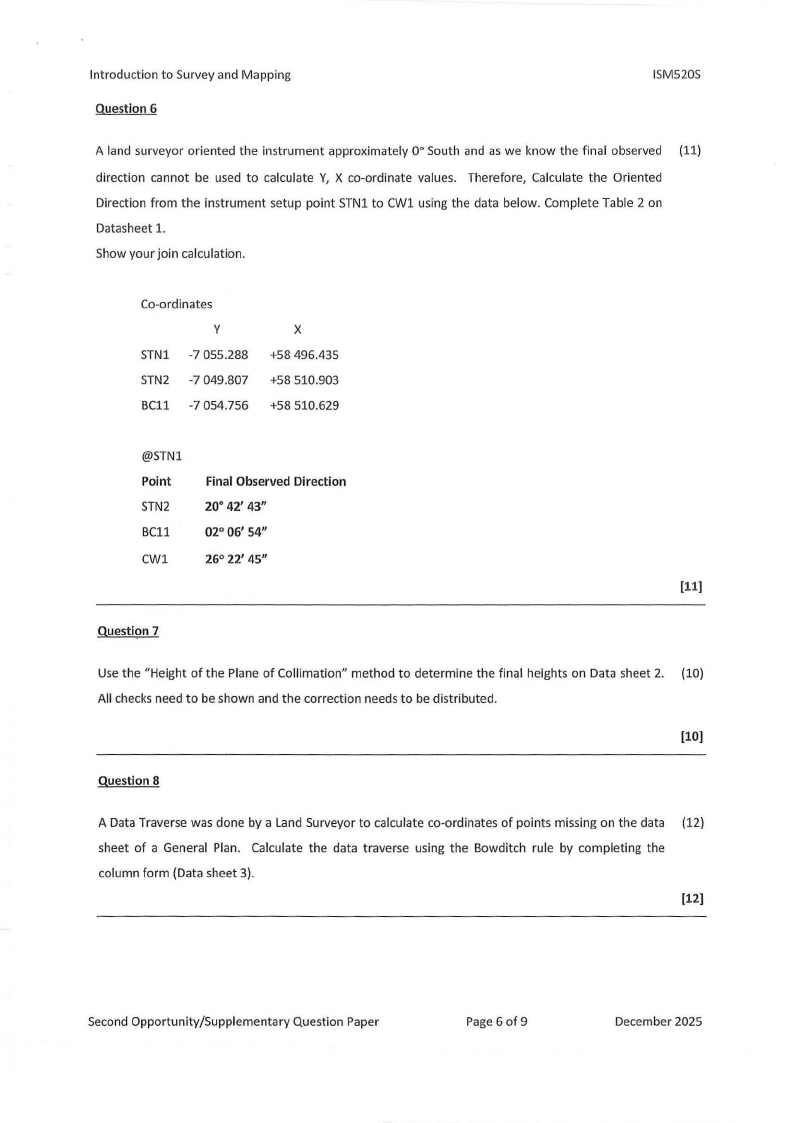
Question 6
ISM520S
A land surveyor oriented the instrument approximately 0° South and as we know the final observed (11)
direction cannot be used to calculate Y, X co-ordinate values. Therefore, Calculate t he Oriented
Direction from the instrument setup point STN1 to CW1 using the data below. Complete Table 2 on
Datasheet 1.
Show your join calculation.
Co-ordinates
y
STN1 -7 055.288
STN2 -7 049.807
BC11 -7 054.756
X
+58 496.435
+58 510.903
+58 510.629
@STN1
Point
Final Observed Direction
STN2
20° 42' 43"
BC11
02° 06' 54"
CW1
26° 22' 45"
[11)
Question 7
Use t he "Height of the Plane of Collimation" method to determine the final heights on Data sheet 2. (10)
All checks need to be shown and the correction needs to be distributed.
[10)
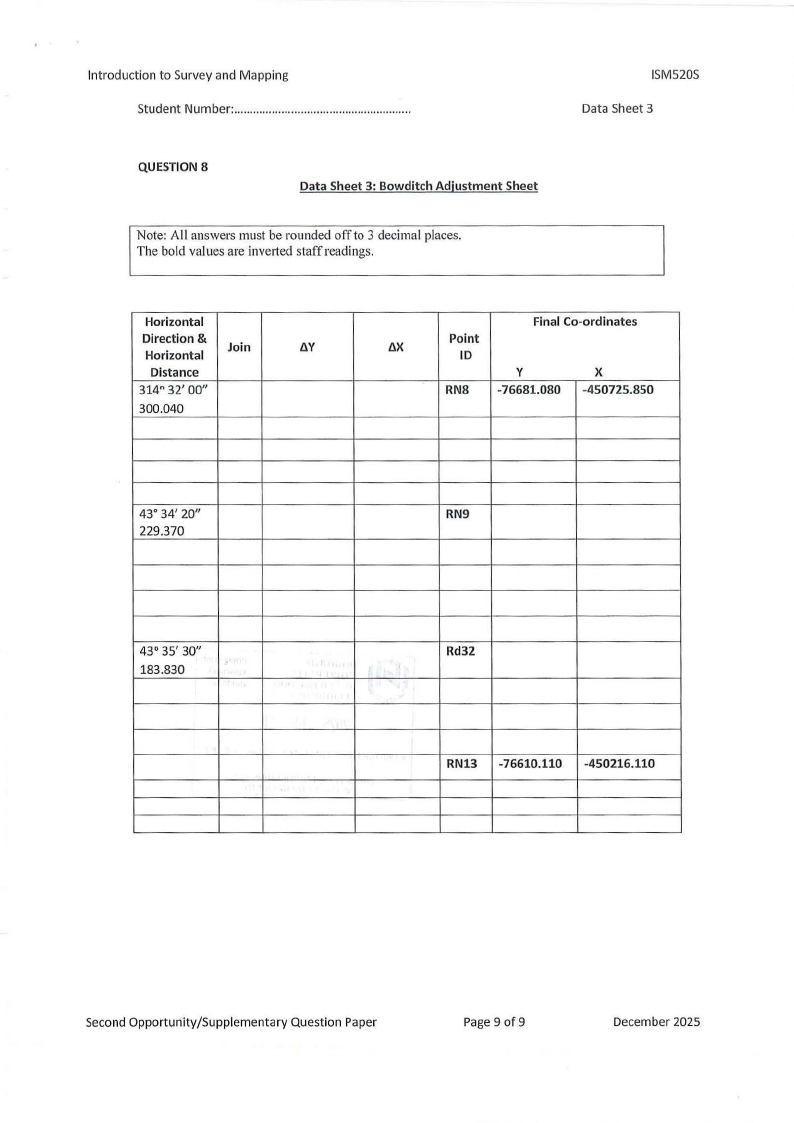
Question 8
A Data Traverse was done by a Land Surveyor to calculate co-ordinates of points missing on the data (12)
sheet of a General Plan. Calculate the data traverse using t he Bowditch rule by completing the
column form (Data sheet 3).
[12)
Second Opportunity/ Supplementary Question Paper
Page 6 of 9
December 2025

7 Page 7

▲back to top


Introduct io n to Survey and Mapping
Student Number:... ............................................ ........ .
Dat asheet 1
ISM520S
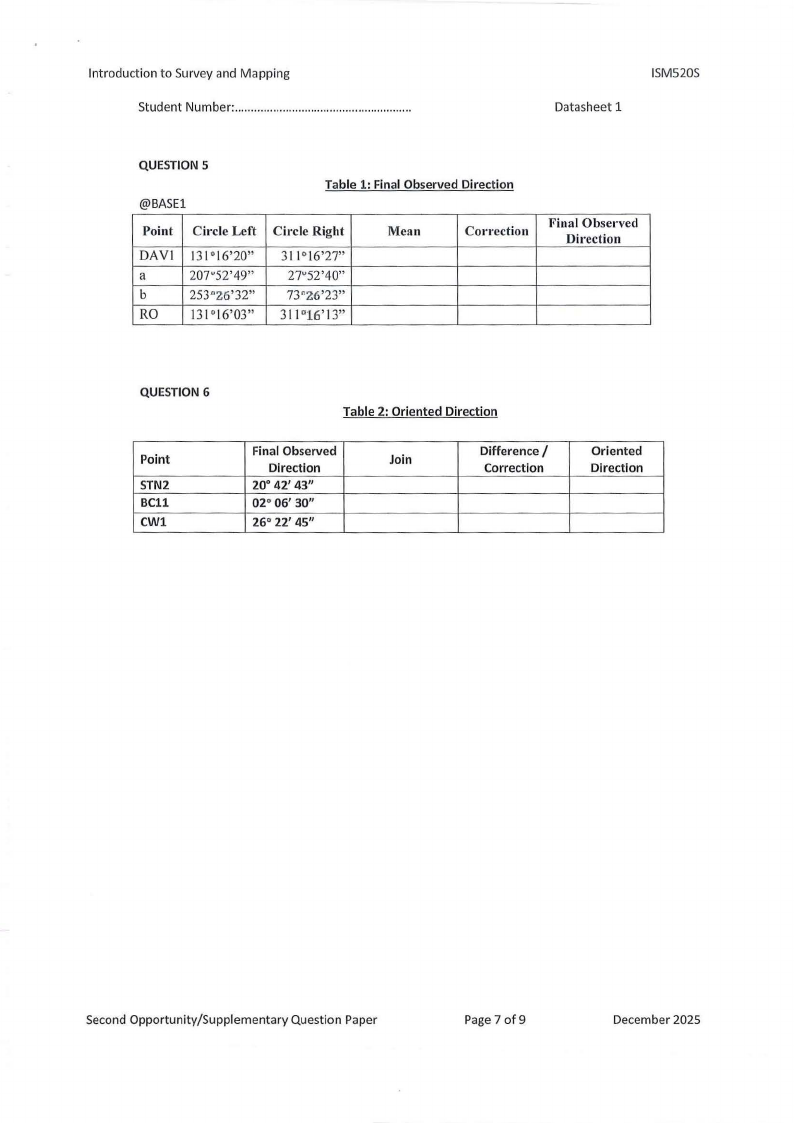
QUESTION 5
@BASEl
Table 1: Final Observed Direction
Point Circle Left Circle Right
DAVI
a
b
RO
13 1°16'20"
207"52 '49"
253 "26'32"
131°16' 03"
31 I0 16'27"
27v52'40"
73 "26'23"
31 1°16' 13"
Mean
Correction
Final Observed
D i rect io n
QUESTION 6
Point
STN2
BCll
CWl
Table 2: Oriented Direction
Final Observed
Join
Direction
20· 42' 43"
02° 06' 30"
2 22' 45"
Difference /
Correction
Oriented
Direction
Second Opportunity/Supplementary Question Paper
Page 7 of9
December 2025

8 Page 8

▲back to top


Introduction to Survey and M apping
Student Number:........................................................
ISM520S
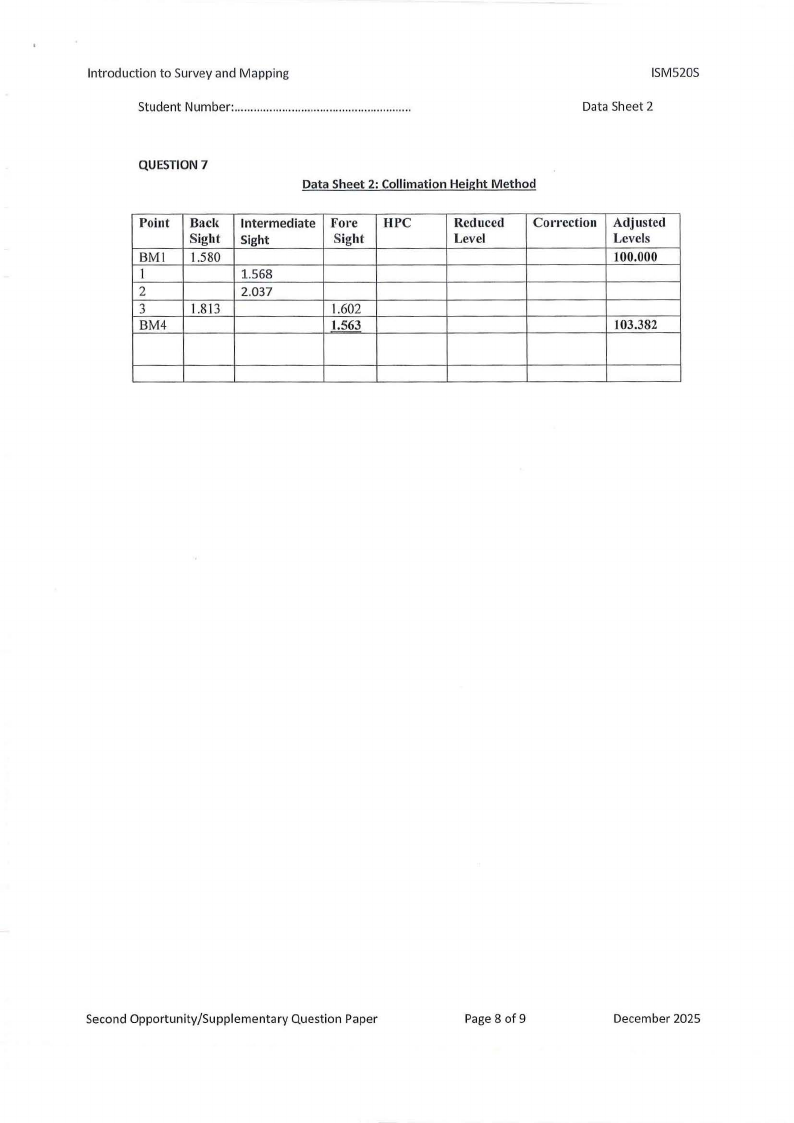
Data Sheet 2
QUESTION 7
Data Sheet 2: Collimation Height Method
Point
BMI
1
2
3
BM4
Back
S ig ht
1.580
1.81 3
Intermediate Fore
Sight
Sight
1.568
2.037
1.602
1.563
HPC
Reduced
Level
Correction Adjusted
Levels
100.000
103 .382
Second Opportunity/Supplementary Question Paper
Page 8 of 9
December 2025

9 Page 9

▲back to top


Introduction to Survey and M apping
Student Number:........................................................
ISM520S
Dat a Sheet 3
QUESTION 8
Data Sheet 3: Bowditch Adjustment Sheet
Note: All answers must be rou nded off to 3 decimal places.
The bold values are inve1t ed staff readings.
Horizontal
Direction &
Horizontal Join
/lY
Distance
314n 32' 00"
300.040
Final Co-ordinates
Point
/lX
ID
y
X
RNS -76681.080 -450725.850
43• 34' 20"
RN9
229.370
43° 35' 30"
183.830
Rd3 2
RN13 -76610.110 -450216.110
Second Opportunity/Supplementary Question Paper
Page 9 of 9
December 2025