


 |
BST61S - SYSTEM THINKING - 1ST OPP - JUNE 2025 |
|
|
1 Page 1 |
▲back to top |

nAmlBIA UnlVERSITY
OF SCIEnCE TECHnOLOGY
FACULTY OF COMMERCE, HUMAN SCIENCES AND EDUCATION
DEPARTMENT OF GOVERNANCE AND SCIENCES, HOSPITALITY, TECHNICAL AND
VOCATIONAL EDUCATION AND TRAINING
QUALIFICATION : BACHELOR OF BUSINESS MANAGEMENT
QUALIFICATION CODE: 07BBMN
LEVEL: 7
COURSE CODE: BST611S
COURSE NAME: SYSTEMS THINKING
SESSION: JUNE/ JULY 2025
DURATION: 3 HOURS
PAPER: THEORY
MARKS: 100
EXAMINER(S)
FIRST OPPORTUNITY EXAMINATION
Mr MICHAEL NEEMA
MODERATOR: PROF. ASA ROMEO ASA
INSTRUCTIONS
1. There are FIVE questions, Answer any FOUR questions.
2. Read all the questions carefully before answering.
3. Number the answers clearly
THIS QUESTION PAPER CONSISTS OF _3_ PAGES (Including this front page)
Page 1 of 3
|
|
2 Page 2 |
▲back to top |
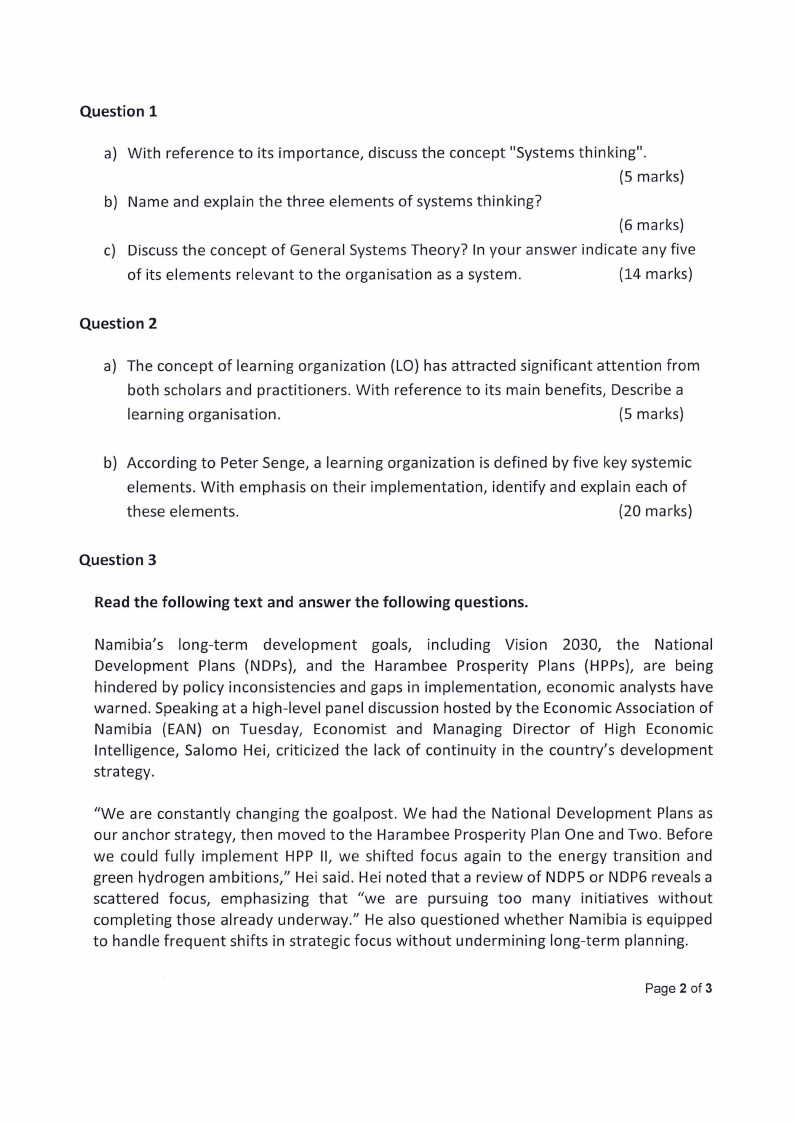
Question 1
a) With reference to its importance, discuss the concept "Systems thinking".
(5 marks)
b) Name and explain the three elements of systems thinking?
(6 marks)
c) Discuss the concept of General Systems Theory? In your answer indicate any five
of its elements relevant to the organisation as a system.
(14 marks}
Question 2
a) The concept of learning organization (LO} has attracted significant attention from
both scholars and practitioners. With reference to its main benefits, Describe a
learning organisation.
(5 marks)
b) According to Peter Senge, a learning organization is defined by five key systemic
elements. With emphasis on their implementation, identify and explain each of
these elements.
(20 marks}
Question 3
Read the following text and answer the following questions.
Namibia's long-term development goals, including Vision 2030, the National
Development Plans (NDPs}, and the Harambee Prosperity Plans (HPPs}, are being
hindered by policy inconsistencies and gaps in implementation, economic analysts have
warned. Speaking at a high-level panel discussion hosted by the Economic Association of
Namibia (EAN} on Tuesday, Economist and Managing Director of High Economic
Intelligence, Salomo Hei, criticized the lack of continuity in the country's development
strategy.
"We are constantly changing the goalpost. We had the National Development Plans as
our anchor strategy, then moved to the Harambee Prosperity Plan One and Two. Before
we could fully implement HPP 11,we shifted focus again to the energy transition and
green hydrogen ambitions," Hei said. Hei noted that a review of NDP5 or NDP6 reveals a
scattered focus, emphasizing that "we are pursuing too many initiatives without
completing those already underway." He also questioned whether Namibia is equipped
to handle frequent shifts in strategic focus without undermining long-term planning.
Page 2 of 3
|
|
3 Page 3 |
▲back to top |
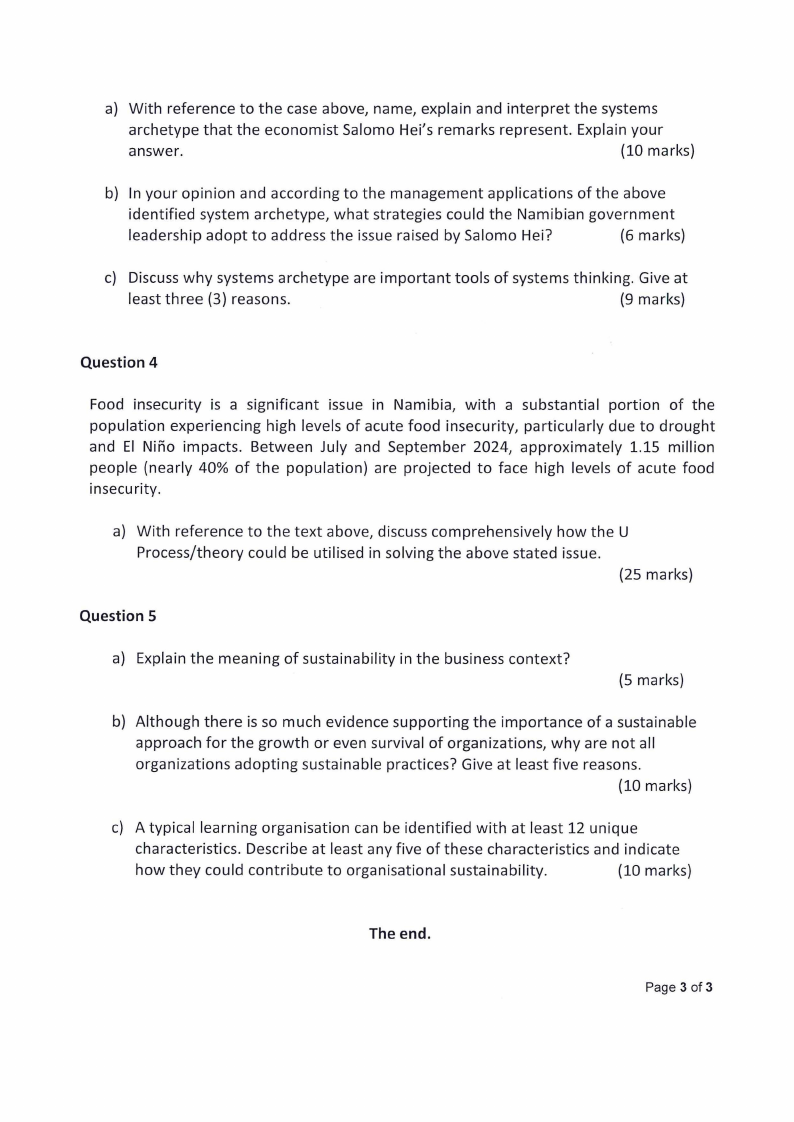
a) With reference to the case above, name, explain and interpret the systems
archetype that the economist Salomo Hei's remarks represent. Explain your
answer.
{10 marks)
b) In your opinion and according to the management applications of the above
identified system archetype, what strategies could the Namibian government
leadership adopt to address the issue raised by Salomo Hei?
{6 marks)
c) Discuss why systems archetype are important tools of systems thinking. Give at
least three {3} reasons.
{9 marks)
Question 4
Food insecurity is a significant issue in Namibia, with a substantial portion of the
population experiencing high levels of acute food insecurity, particularly due to drought
and El Nino impacts. Between July and September 2024, approximately 1.15 million
people (nearly 40% of the population) are projected to face high levels of acute food
insecurity.
a) With reference to the text above, discuss comprehensively how the U
Process/theory could be utilised in solving the above stated issue.
{25 marks)
Question 5
a) Explain the meaning of sustainability in the business context?
(5 marks)
b) Although there is so much evidence supporting the importance of a sustainable
approach for the growth or even survival of organizations, why are not all
organizations adopting sustainable practices? Give at least five reasons.
{10 marks)
c) A typical learning organisation can be identified with at least 12 unique
characteristics. Describe at least any five of these characteristics and indicate
how they could contribute to organisational sustainability.
{10 marks)
The end.
Page 3 of 3