GFA711S-FINANCIAL ACCOUNTING 310-2ND OPP-JULY 2025


GFA711S-FINANCIAL ACCOUNTING 310-2ND OPP-JULY 2025


1 Pages 1-10

▲back to top


1.1 Page 1

▲back to top


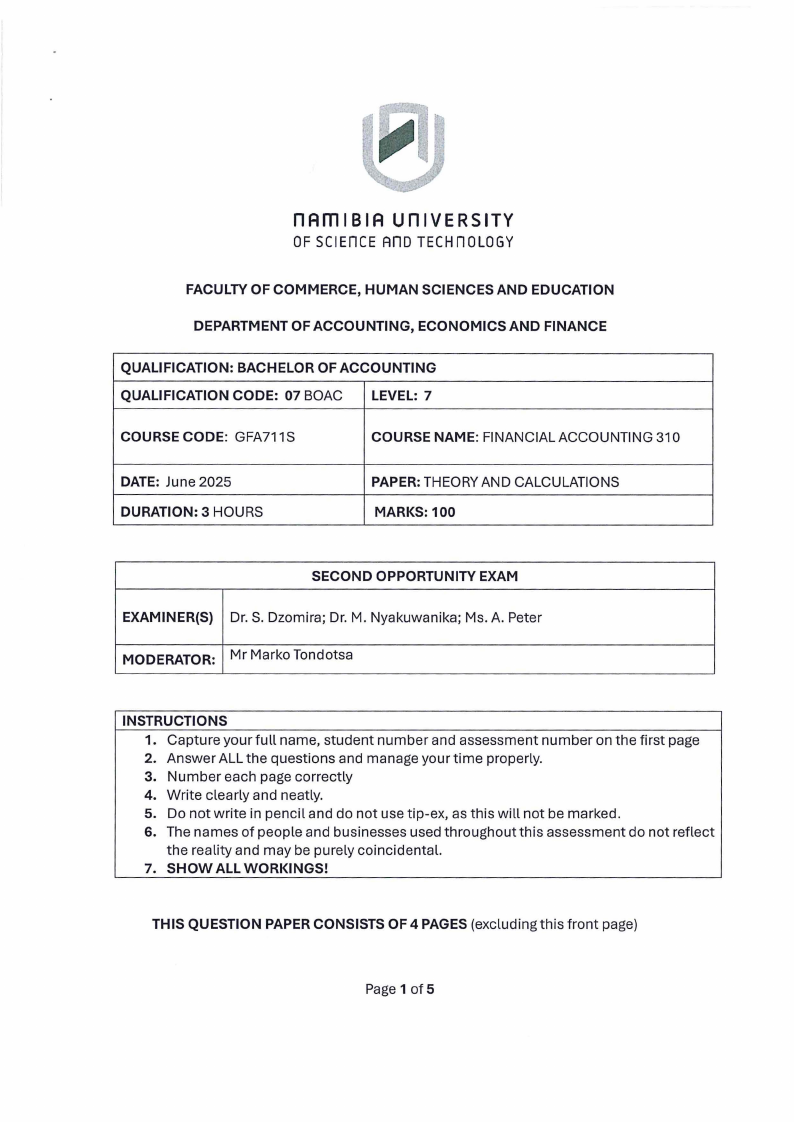
nAmlBIA UnlVERSITY
OF SCIEnCE TECHnOLOGY
FACULTY OF COMMERCE, HUMAN SCIENCES AND EDUCATION
DEPARTMENT OF ACCOUNTING, ECONOMICS AND FINANCE
QUALIFICATION: BACHELOR OF ACCOUNTING
QUALIFICATION CODE: 07 BOAC LEVEL: 7
COURSE CODE: GFA711S
COURSE NAME: FINANCIAL ACCOUNTING 310
DATE: June 2025
DURATION: 3 HOURS
PAPER:THEORYAND CALCULATIONS
MARKS: 100
SECOND OPPORTUNITY EXAM
EXAMINER(S) Dr. S. Dzomira; Dr. M. Nyakuwanika; Ms. A. Peter
MODERATOR: Mr Marko Tondotsa
INSTRUCTIONS
1. Capture your full name, student number and assessment number on the first page
2. Answer ALL the questions and manage your time properly.
3. Number each page correctly
4. Write clearly and neatly.
5. Do not write in pencil and do not use tip-ex, as this will not be marked.
6. The names of people and businesses used throughout this assessment do not reflect
the reality and may be purely coincidental.
7. SHOW ALL WORKINGS!
THIS QUESTION PAPER CONSISTS OF 4 PAGES (excluding this front page)
Page 1 of 5

1.2 Page 2

▲back to top


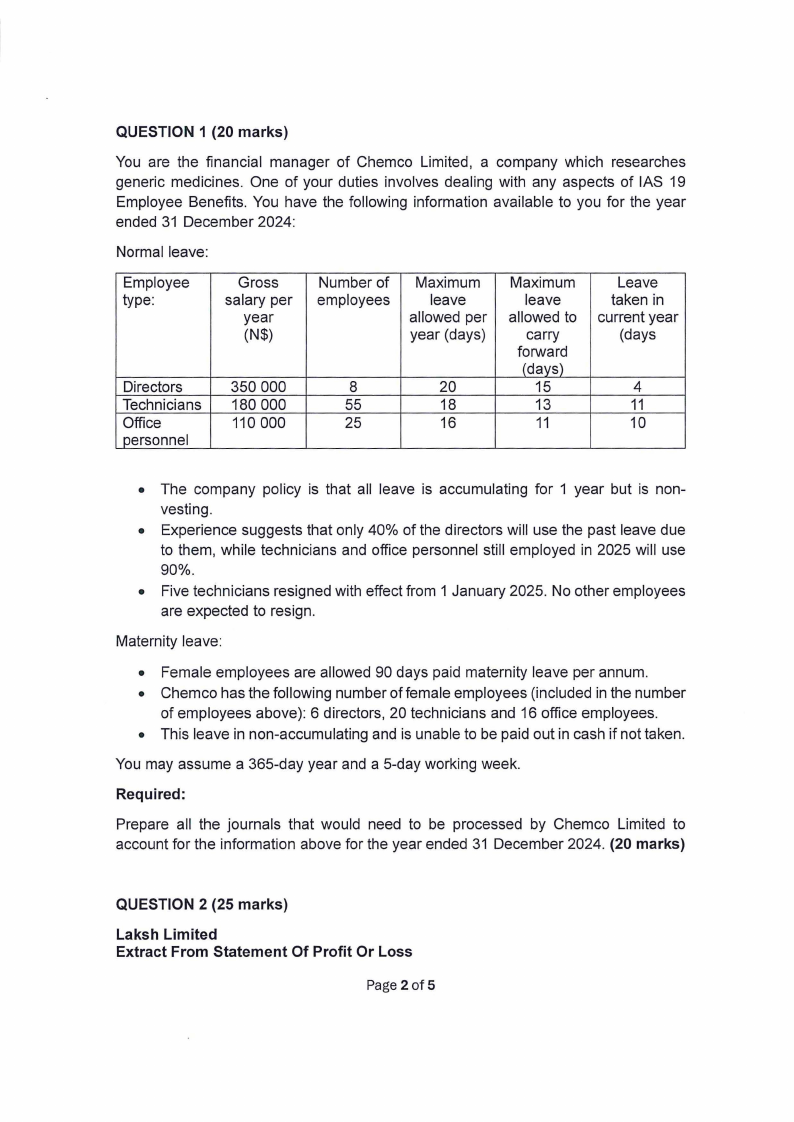
QUESTION 1 (20 marks)
You are the financial manager of Chemco Limited, a company which researches
generic medieines. One of your duties involves dealing with any aspects of IAS 19
Employee Benefits. You have the following information available to you for the year
ended 31 December 2024:
Normal leave:
Employee
type:
Directors
Technicians
Office
personnel
Gross
salary per
year
(N$)
350 000
180 000
110 000
Number of
employees
8
55
25
Maximum
leave
allowed per
year (days)
20
18
16
Maximum
leave
allowed to
carry
forward
(days)
15
13
11
Leave
taken in
current year
(days
4
11
10
• The company policy is that all leave is accumulating for 1 year but is non-
vesting.
• Experience suggests that only 40% of the directors will use the past leave due
to them, while technicians and office personnel still employed in 2025 will use
90%.
• Five technicians resigned with effect from 1 January 2025. No other employees
are expected to resign.
Maternity leave:
• Female employees are allowed 90 days paid maternity leave per annum.
• Chem co has the following number of female employees (included in the number
of employees above): 6 directors, 20 technicians and 16 office employees.
• This leave in non-accumulating and is unable to be paid out in cash if not taken.
You may assume a 365-day year and a 5-day working week.
Required:
Prepare all the journals that would need to be processed by Chemco Limited to
account for the information above for the year ended 31 December 2024. (20 marks)
QUESTION 2 (25 marks)
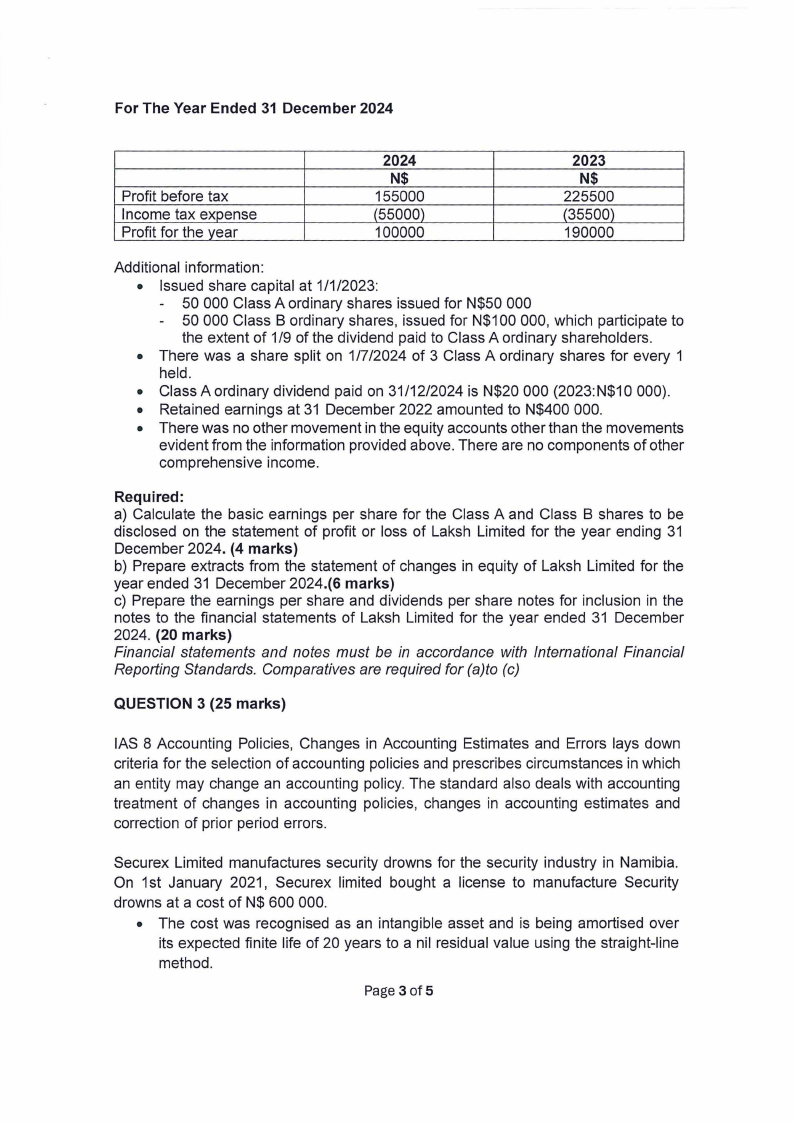
Laksh Limited
Extract From Statement Of Profit Or Loss
Page 2 of 5

1.3 Page 3

▲back to top


For The Year Ended 31 December 2024
Profit before tax
Income tax expense
Profit for the year
2024
N$
155000
(55000)
100000
2023
N$
225500
(35500)
190000
Additional information:
• Issued share capital at 1/1/2023:
- 50 000 Class A ordinary shares issued for N$50 000
- 50 000 Class B ordinary shares, issued for N$100 000, which participate to
the extent of 1/9 of the dividend paid to Class A ordinary shareholders.
• There was a share split on 1/7/2024 of 3 Class A ordinary shares for every 1
held.
• Class A ordinary dividend paid on 31/12/2024 is N$20 000 (2023:N$10 000).
• Retained earnings at 31 December 2022 amounted to N$400 000.
• There was no other movement in the equity accounts other than the movements
evident from the information provided above. There are no components of other
comprehensive income.
Required:
a) Calculate the basic earnings per share for the Class A and Class B shares to be
disclosed on the statement of profit or loss of Laksh Limited for the year ending 31
December 2024. (4 marks)
b) Prepare extracts from the statement of changes in equity of Laksh Limited for the
year ended 31 December 2024.(6 marks)
c) Prepare the earnings per share and dividends per share notes for inclusion in the
notes to the financial statements of Laksh Limited for the year ended 31 December
2024. (20 marks)
Financial statements and notes must be in accordance with International Financial
Reporting Standards. Comparatives are required for (a)to (c)
QUESTION 3 (25 marks)
IAS 8 Accounting Policies, Changes in Accounting Estimates and Errors lays down
criteria for the selection of accounting policies and prescribes circumstances in which
an entity may change an accounting policy. The standard also deals with accounting
treatment of changes in accounting policies, changes in accounting estimates and
correction of prior period errors.
Securex Limited manufactures security drowns for the security industry in Namibia.
On 1st January 2021, Securex limited bought a license to manufacture Security
drowns at a cost of N$ 600 000.
• The cost was recognised as an intangible asset and is being amortised over
its expected finite life of 20 years to a nil residual value using the straight-line
method.
Page 3 of 5

1.4 Page 4

▲back to top


• During February 2025 while finalising the financial statements for 31 December
2024, it was discovered that Securex limited had purchased the legal rights for
a period of only 15 years. The effect of this information is material. The journals
for 2024 had already been processed based on previous information.
• Namibia revenue authority (NAM RA) allows Securex Limited to deduct the cost
of the rights over a period of 1Oyears on straight line method.
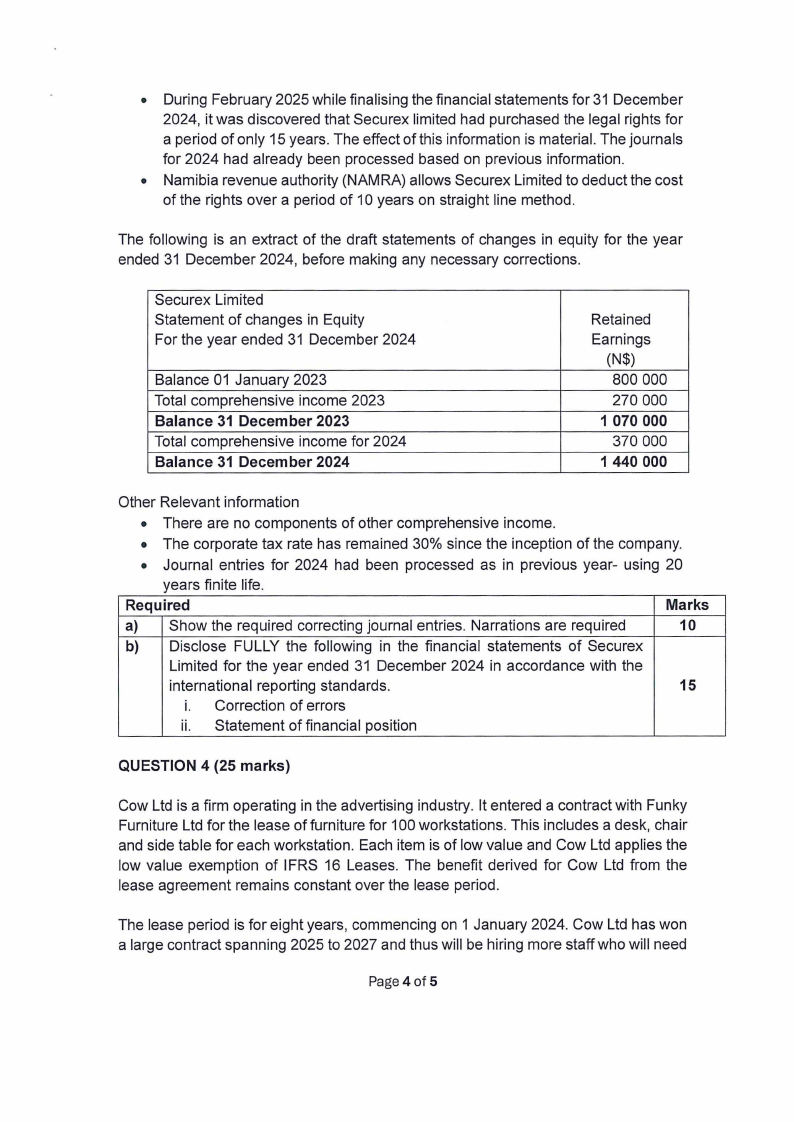
The following is an extract of the draft statements of changes in equity for the year
ended 31 December 2024, before making any necessary corrections.
Securex Limited
Statement of changes in Equity
For the year ended 31 December 2024
Balance 01 January 2023
Total comprehensive income 2023
Balance 31 December 2023
Total comprehensive income for 2024
Balance 31 December 2024
Retained
Earnings
(N$)
800 000
270 000
1070000
370 000
1 440 000
Other Relevant information
• There are no components of other comprehensive income.
• The corporate tax rate has remained 30% since the inception of the company.
• Journal entries for 2024 had been processed as in previous year- using 20
years finite life.
Required
Marks
a) Show the required correcting journal entries. Narrations are required
10
b) Disclose FULLY the following in the financial statements of Securex
Limited for the year ended 31 December 2024 in accordance with the
international reporting standards.
15
i. Correction of errors
ii. Statement of financial position
QUESTION 4 (25 marks)
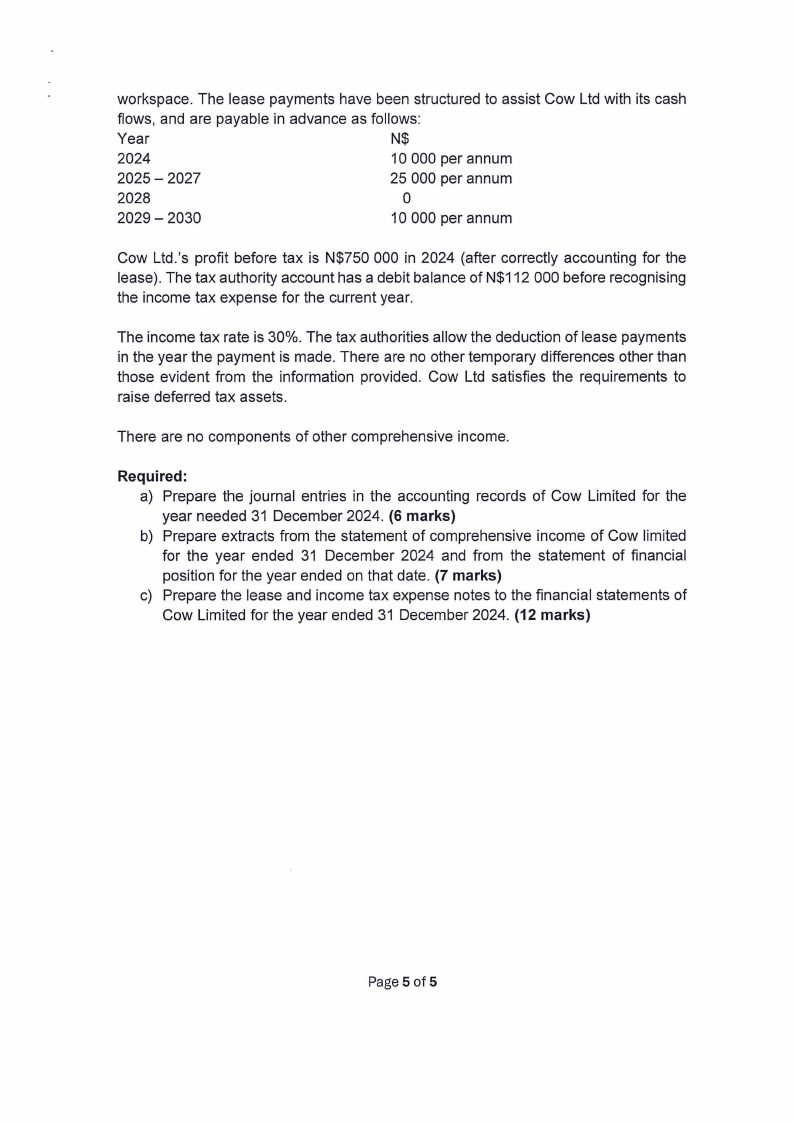
Cow Ltd is a firm operating in the advertising industry. It entered a contract with Funky
Furniture Ltd for the lease of furniture for 100 workstations. This includes a desk, chair
and side table for each workstation. Each item is of low value and Cow Ltd applies the
low value exemption of IFRS 16 Leases. The benefit derived for Cow Ltd from the
lease agreement remains constant over the lease period.
The lease period is for eight years, commencing on 1 January 2024. Cow Ltd has won
a large contract spanning 2025 to 2027 and thus will be hiring more staff who will need
Page 4 of 5

1.5 Page 5

▲back to top


workspace. The lease payments have been structured to assist Cow Ltd with its cash
flows, and are payable in advance as follows:
Year
N$
2024
10 000 per annum
2025 - 2027
25 000 per annum
2028
0
2029-2030
10 000 per annum
Cow Ltd.'s profit before tax is N$750 000 in 2024 (after correctly accounting for the
lease). The tax authority account has a debit balance of N$112 000 before recognising
the income tax expense for the current year.
The income tax rate is 30%. The tax authorities allow the deduction of lease payments
in the year the payment is made. There are no other temporary differences other than
those evident from the information provided. Cow Ltd satisfies the requirements to
raise deferred tax assets.
There are no components of other comprehensive income.
Required:
a) Prepare the journal entries in the accounting records of Cow Limited for the
year needed 31 December 2024. (6 marks)
b) Prepare extracts from the statement of comprehensive income of Cow limited
for the year ended 31 December 2024 and from the statement of financial
position for the year ended on that date. (7 marks)
c) Prepare the lease and income tax expense notes to the financial statements of
Cow Limited for the year ended 31 December 2024. (12 marks)
Page 5 of 5

1.6 Page 6

▲back to top


nAmlBl1A1unlVE
OFSCIEn(ERnDTECH
NAMIBIA UNIVERSITY OF SCIENCE AND TECHNOLOGY
COURSE OUTLINE 2025
FINANCIAL ACCOUNTING 310 (GFA 711S)
STATEMENT ABOUT ACADEMIC HONESTY AND INTEGRITY
All staff and students of the Namibia University of Science and Technology (NUST), upon signing their
employment contracts and registration forms, commit themselves to abide by the policies and rules of the
institution. The core activity of the NUST is learning and in this respect academic honesty and integrity is
very important to ensure that learning is valid, reliable and credible.
The NUST therefore does not condone any form of academic dishonesty, including plagiarism and cheating
on tests and assessments, amongst other such practices. The NUST requires students to always do their
own assignments and to produce their own academic work, unless given a group assignment.
Academic Dishonesty includes, but is not limited to:
• Using the ideas, words, works or inventions of someone else as if it is your own work.
• Using the direct words of someone else without quotation marks, even if it is referenced.
• Copying from writings (books, articles, webpages, other students' assignments, etc.), published or
unpublished, without referencing.
• Syndication of a piece of work, all or part of an assignment, by a group of students, unless the
assignment was a legitimate group assignment.
• The borrowing and use of another person's assignment, with or without their knowledge or
permission.
• Infringing copyright, including documents copied or cut and pasted from the internet.
• Asking someone else to prepare an assignment for you or to write or sit an assessment for you,
whether this is against payment or not.
• Re-submitting work done already for another course or programme as new work, so-called self-
plagiarism.
• Bringing notes into an examination or test venue, regardless of whether the notes were used to
copy or not.
• Receiving any outside assistance in any form or shape during an examination or test.
All forms of academic dishonesty are viewed as misconduct under the NUST Student Rules and
Regulations. Students who make themselves guilty of academic dishonesty will be brought before a
Disciplinary Committee and may be suspended from studying for a certain time or may be expelled. All
students who are found guilty of academic dishonesty shall have an appropriate endorsement on their
academic record, which will never be erased.

1.7 Page 7

▲back to top


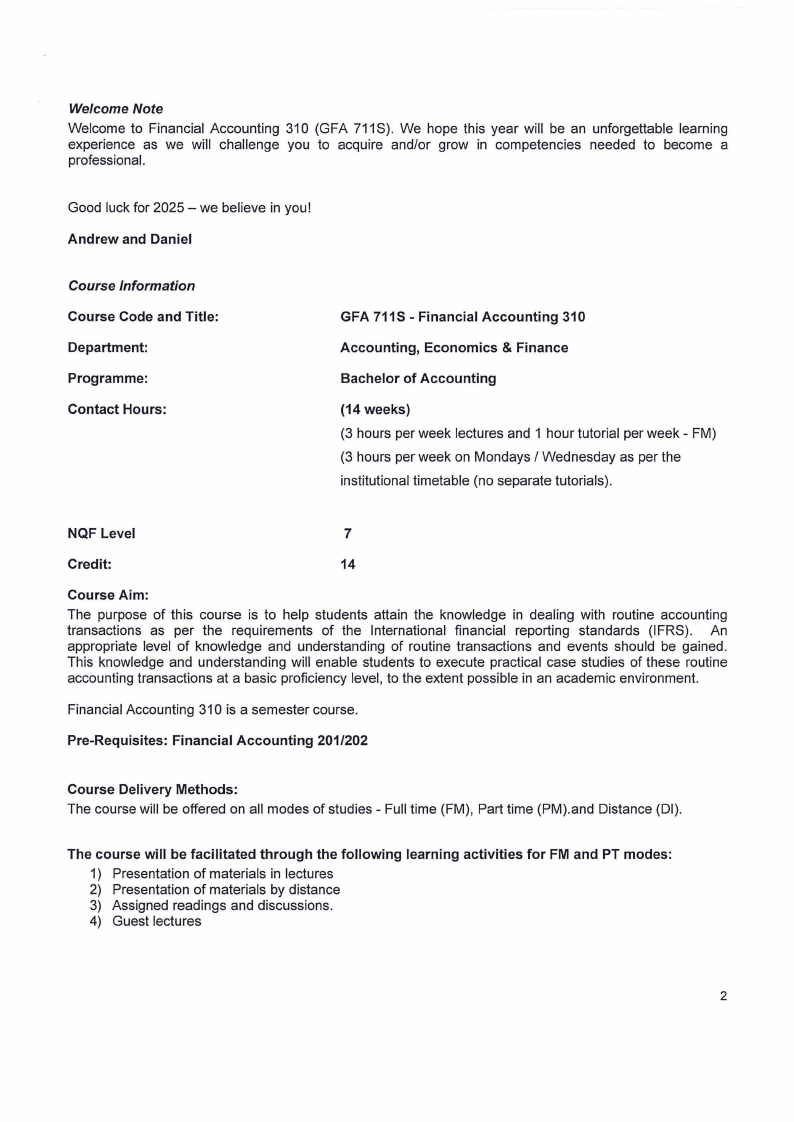
Welcome Note
Welcome to Financial Accounting 310 (GFA 711S). We hope this year will be an unforgettable learning
experience as we will challenge you to acquire and/or grow in competencies needed to become a
professional.
Good luck for 2025 - we believe in you!
Andrew and Daniel
Course Information
Course Code and Title:
Department:
Programme:
Contact Hours:
GFA 711S - Financial Accounting 310
Accounting, Economics & Finance
Bachelor of Accounting
(14 weeks)
(3 hours per week lectures and 1 hour tutorial per week - FM)
(3 hours per week on Mondays / Wednesday as per the
institutional timetable (no separate tutorials).
NQF Level
7
Credit:
14
Course Aim:
The purpose of this course is to help students attain the knowledge in dealing with routine accounting
transactions as per the requirements of the International financial reporting standards (IFRS). An
appropriate level of knowledge and understanding of routine transactions and events should be gained.
This knowledge and understanding will enable students to execute practical case studies of these routine
accounting transactions at a basic proficiency level, to the extent possible in an academic environment.
Financial Accounting 310 is a semester course.
Pre-Requisites: Financial Accounting 201/202
Course Delivery Methods:
The course will be offered on all modes of studies - Full time (FM), Part time (PM).and Distance (DI).
The course will be facilitated through the following learning activities for FM and PT modes:
1) Presentation of materials in lectures
2) Presentation of materials by distance
3) Assigned readings and discussions.
4) Guest lectures
2

1.8 Page 8

▲back to top


Study Material
Prescribed Textbooks
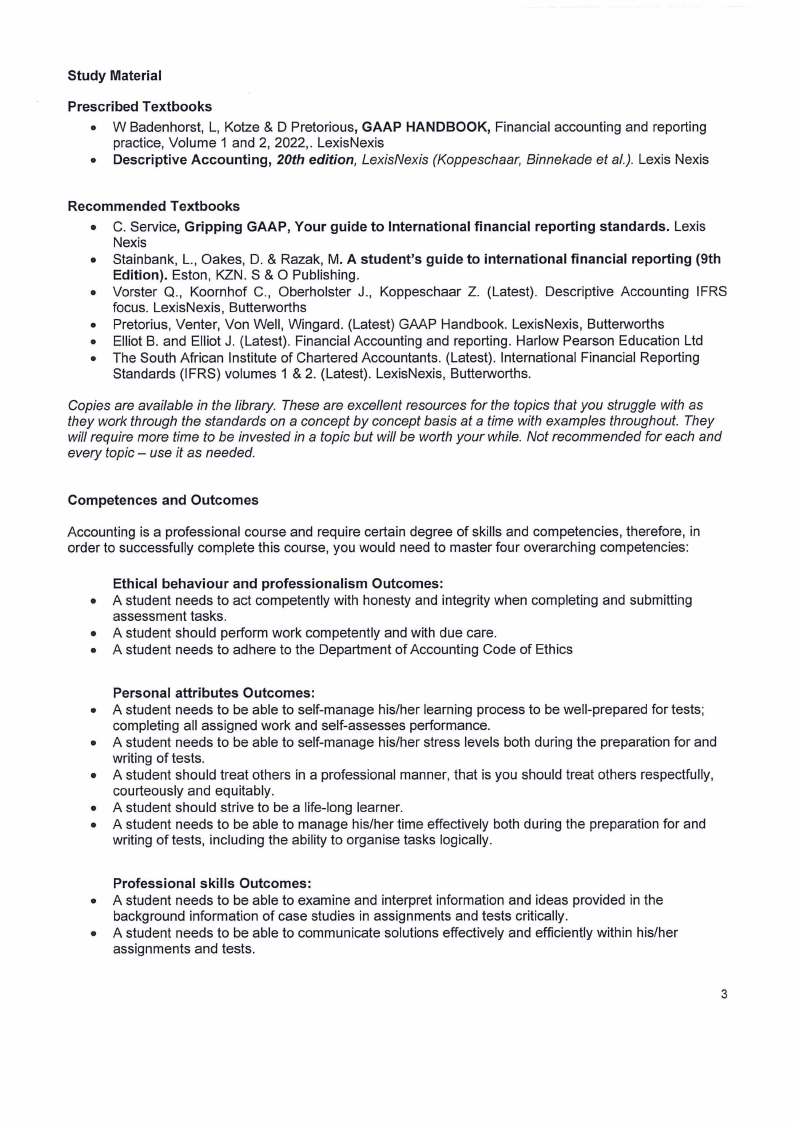
• W Badenhorst, L, Kotze & D Pretorious, GAAP HANDBOOK, Financial accounting and reporting
practice, Volume 1 and 2, 2022,. LexisNexis
Descriptive Accounting, 20th edition, LexisNexis (Koppeschaar, Binnekade et al.). Lexis Nexis
Recommended Textbooks
• C. Service, Gripping GAAP, Your guide to International financial reporting standards. Lexis
Nexis
• Stainbank, L., Oakes, D. & Razak, M. A student's guide to international financial reporting (9th
Edition). Eston, KZN. S & 0 Publishing.
• Vorster Q., Koornhof C., Oberholster J., Koppeschaar Z. (Latest). Descriptive Accounting IFRS
focus. LexisNexis, Butterworths
• Pretorius, Venter, Von Well, Wingard. (Latest) GAAP Handbook. LexisNexis, Butterworths
• Elliot B. and Elliot J. (Latest). Financial Accounting and reporting. Harlow Pearson Education Ltd
• The South African Institute of Chartered Accountants. (Latest). International Financial Reporting
Standards (IFRS) volumes 1 & 2. (Latest). LexisNexis, Butterworths.
Copies are available in the library. These are excellent resources for the topics that you struggle with as
they work through the standards on a concept by concept basis at a time with examples throughout. They
will require more time to be invested in a topic but will be worth your while. Not recommended for each and
every topic - use it as needed.
Competences and Outcomes
Accounting is a professional course and require certain degree of skills and competencies, therefore, in
order to successfully complete this course, you would need to master four overarching competencies:
Ethical behaviour and professionalism Outcomes:
• A student needs to act competently with honesty and integrity when completing and submitting
assessment tasks.
• A student should perform work competently and with due care.
• A student needs to adhere to the Department of Accounting Code of Ethics
Personal attributes Outcomes:
• A student needs to be able to self-manage his/her learning process to be well-prepared for tests;
completing all assigned work and self-assesses performance.
• A student needs to be able to self-manage his/her stress levels both during the preparation for and
writing of tests.
• A student should treat others in a professional manner, that is you should treat others respectfully,
courteously and equitably.
• A student should strive to be a life-long learner.
• A student needs to be able to manage his/her time effectively both during the preparation for and
writing of tests, including the ability to organise tasks logically.
Professional skills Outcomes:
• A student needs to be able to examine and interpret information and ideas provided in the
background information of case studies in assignments and tests critically.
• A student needs to be able to communicate solutions effectively and efficiently within his/her
assignments and tests.
3

1.9 Page 9

▲back to top


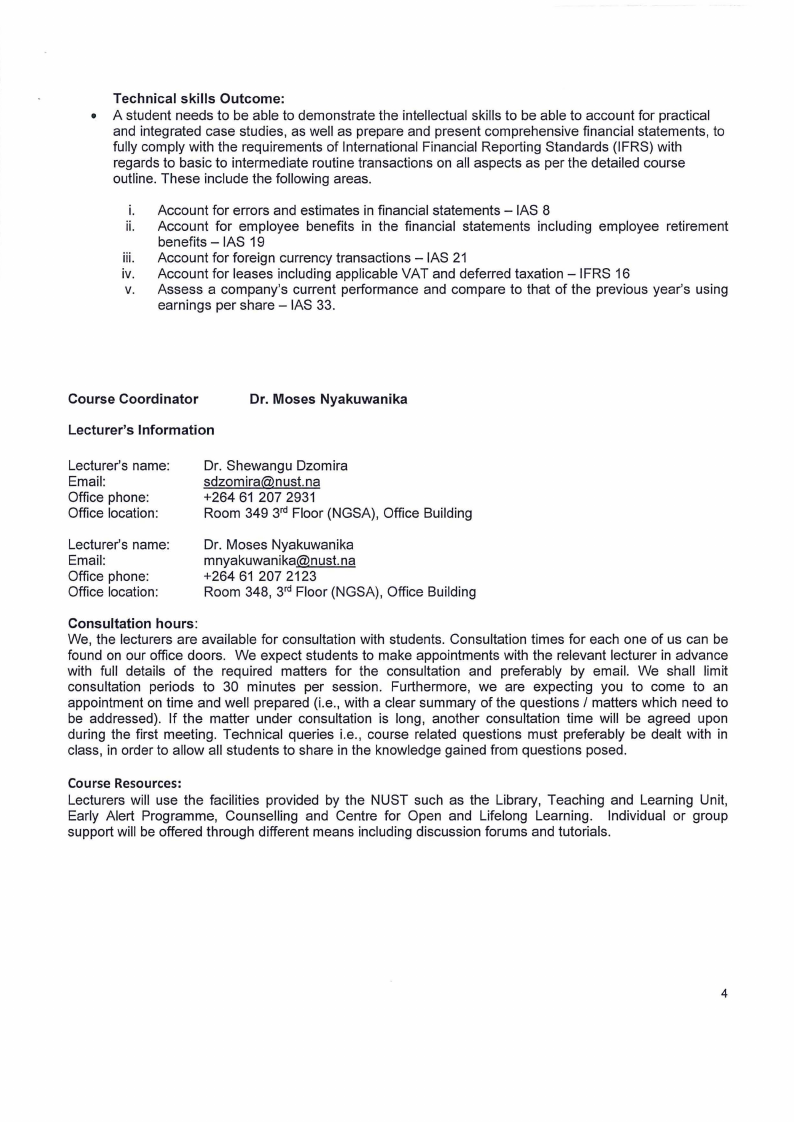
Technical skills Outcome:
• A student needs to be able to demonstrate the intellectual skills to be able to account for practical
and integrated case studies, as well as prepare and present comprehensive financial statements, to
fully comply with the requirements of International Financial Reporting Standards (IFRS) with
regards to basic to intermediate routine transactions on all aspects as per the detailed course
outline. These include the following areas.
i. Account for errors and estimates in financial statements - IAS 8
ii. Account for employee benefits in the financial statements including employee retirement
benefits - IAS 19
iii. Account for foreign currency transactions - IAS 21
iv. Account for leases including applicable VAT and deferred taxation - IFRS 16
v. Assess a company's current performance and compare to that of the previous year's using
earnings per share - IAS 33.
Course Coordinator
Lecturer's Information
Dr. Moses Nyakuwanika
Lecturer's name:
Email:
Office phone:
Office location:
Dr. Shewangu Dzomira
sdzomira@nust.na
+264 61 207 2931
Room 349 3rd Floor (NGSA), Office Building
Lecturer's name:
Email:
Office phone:
Office location:
Dr. Moses Nyakuwanika
mnyakuwanika@nust.na
+264 61 207 2123
Room 348, 3rd Floor (NGSA), Office Building
Consultation hours:
We, the lecturers are available for consultation with students. Consultation times for each one of us can be
found on our office doors. We expect students to make appointments with the relevant lecturer in advance
with full details of the required matters for the consultation and preferably by email. We shall limit
consultation periods to 30 minutes per session. Furthermore, we are expecting you to come to an
appointment on time and well prepared (i.e., with a clear summary of the questions/ matters which need to
be addressed). If the matter under consultation is long, another consultation time will be agreed upon
during the first meeting. Technical queries i.e., course related questions must preferably be dealt with in
class, in order to allow all students to share in the knowledge gained from questions posed.
Course Resources:
Lecturers will use the facilities provided by the NUST such as the Library, Teaching and Learning Unit,
Early Alert Programme, Counselling and Centre for Open and Lifelong Learning. Individual or group
support will be offered through different means including discussion forums and tutorials.
4

1.10 Page 10

▲back to top


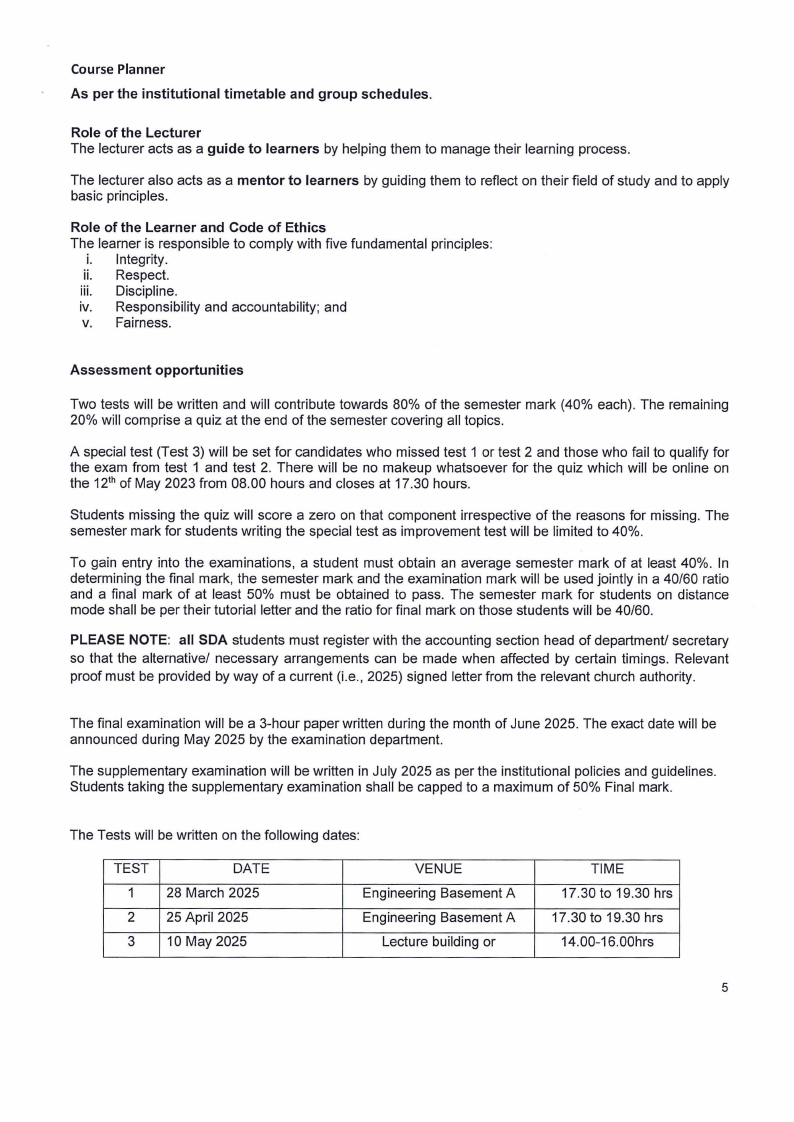
Course Planner
As per the institutional timetable and group schedules.
Role of the Lecturer
The lecturer acts as a guide to learners by helping them to manage their learning process.
The lecturer also acts as a mentor to learners by guiding them to reflect on their field of study and to apply
basic principles.
Role of the Learner and Code of Ethics
The learner is responsible to comply with five fundamental principles:
i. Integrity.
ii. Respect.
iii. Discipline.
iv. Responsibility and accountability; and
v. Fairness.
Assessment opportunities
Two tests will be written and will contribute towards 80% of the semester mark (40% each). The remaining
20% will comprise a quiz at the end of the semester covering all topics.
A special test (Test 3) will be set for candidates who missed test 1 or test 2 and those who fail to qualify for
the exam from test 1 and test 2. There will be no makeup whatsoever for the quiz which will be online on
the 12th of May 2023 from 08.00 hours and closes at 17.30 hours.
Students missing the quiz will score a zero on that component irrespective of the reasons for missing. The
semester mark for students writing the special test as improvement test will be limited to 40%.
To gain entry into the examinations, a student must obtain an average semester mark of at least 40%. In
determining the final mark, the semester mark and the examination mark will be used jointly in a 40/60 ratio
and a final mark of at least 50% must be obtained to pass. The semester mark for students on distance
mode shall be per their tutorial letter and the ratio for final mark on those students will be 40/60.
PLEASE NOTE: all SDA students must register with the accounting section head of department/ secretary
so that the alternative/ necessary arrangements can be made when affected by certain timings. Relevant
proof must be provided by way of a current (i.e., 2025) signed letter from the relevant church authority.
The final examination will be a 3-hour paper written during the month of June 2025. The exact date will be
announced during May 2025 by the examination department.
The supplementary examination will be written in July 2025 as per the institutional policies and guidelines.
Students taking the supplementary examination shall be capped to a maximum of 50% Final mark.
The Tests will be written on the following dates:
TEST
1
2
3
DATE
28 March 2025
25 April 2025
10 May 2025
VENUE
Engineering Basement A
Lecture building or
TIME
17.30 to 19.30 hrs
17.30 to 19.30 hrs
14.00-16.00hrs
5

2 Pages 11-20

▲back to top


2.1 Page 11

▲back to top


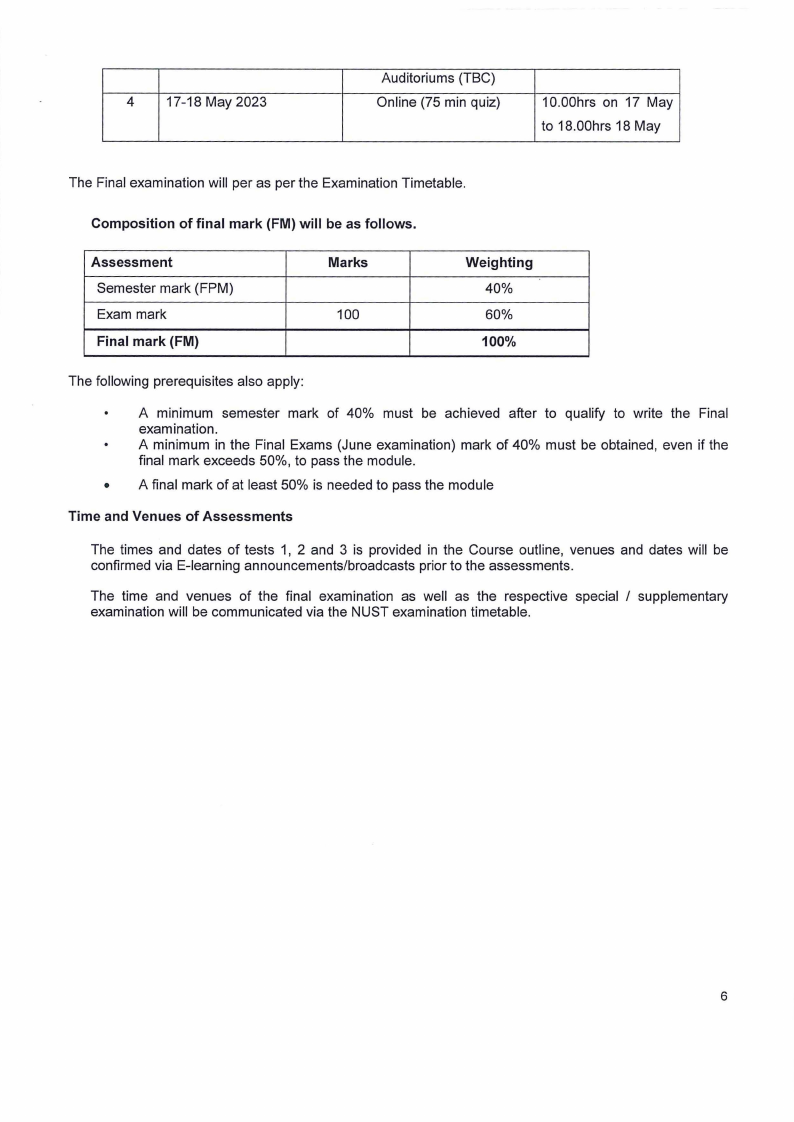
4 17-18 May 2023
Auditoriums (TBC)
Online (75 min quiz)
10.00hrs on 17 May
to 18.00hrs 18 May
The Final examination will per as per the Examination Timetable.
Composition of final mark (FM) will be as follows.
Assessment
Semester mark (FPM)
Exam mark
Final mark (FM)
Marks
100
Weighting
40%
60%
100%
The following prerequisites also apply:
A minimum semester mark of 40% must be achieved after to qualify to write the Final
examination.
• A minimum in the Final Exams (June examination) mark of 40% must be obtained, even if the
final mark exceeds 50%, to pass the module.
• A final mark of at least 50% is needed to pass the module
Time and Venues of Assessments
The times and dates of tests 1, 2 and 3 is provided in the Course outline, venues and dates will be
confirmed via E-learning announcements/broadcasts prior to the assessments.
The time and venues of the final examination as well as the respective special / supplementary
examination will be communicated via the NUST examination timetable.
6

2.2 Page 12

▲back to top


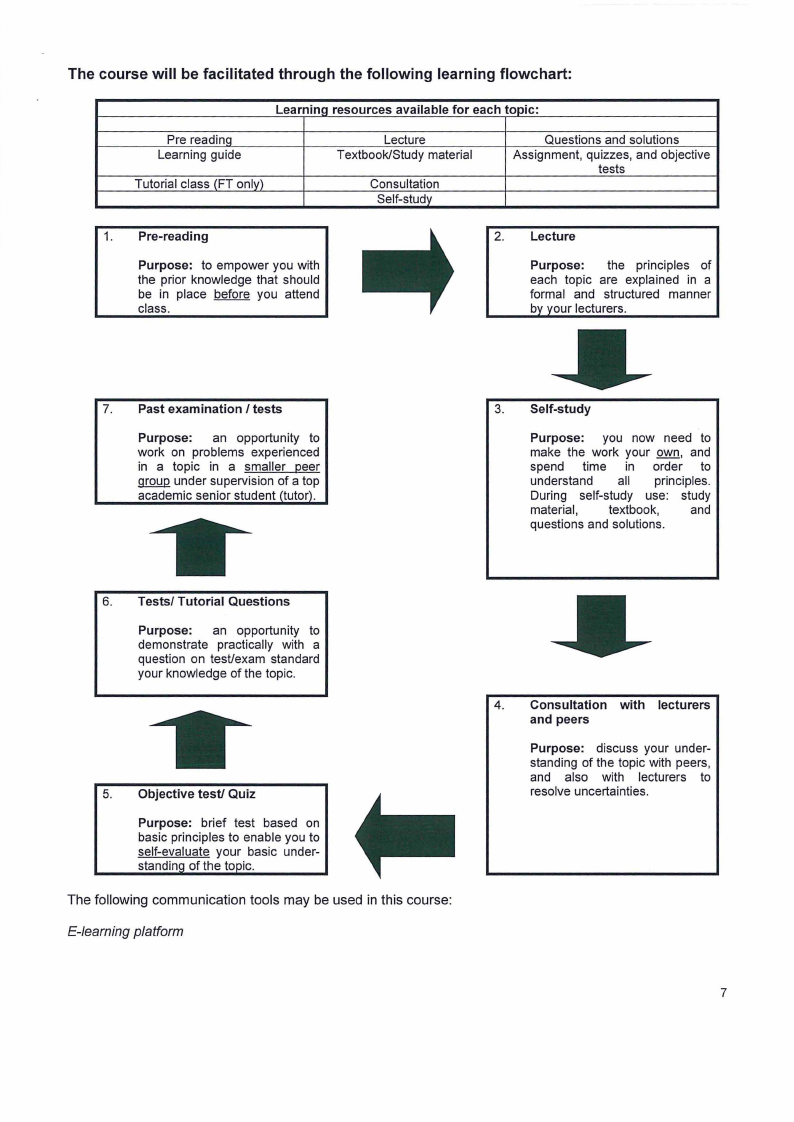
The course will be facilitated through the following learning flowchart:
Learnin~ resources available for each topic:
Pre readina
Learning guide
Tutorial class (FT only)
Lecture
Textbook/Study material
Consultation
Self-study
Questions and solutions
Assignment, quizzes, and objective
tests
1. Pre-reading
Purpose: to empower you with
the prior knowledge that should
be in place before you attend
class.
2. Lecture
Purpose: the principles of
each topic are explained in a
formal and structured manner
by your lecturers.
7. Past examination / tests
Purpose: an opportunity to
work on problems experienced
in a topic in a smaller peer
9I.QYQ.under supervision of a top
academic senior student tutor .
3. Self-study
Purpose: you now need to
make the work your own, and
spend time in order to
understand all principles.
During self-study use: study
material,
textbook,
and
questions and solutions.
6. Tests/ Tutorial Questions
Purpose: an opportunity to
demonstrate practically with a
question on test/exam standard
your knowledge of the topic.
5. Objective test/ Quiz
Purpose: brief test based on
basic principles to enable you to
self-evaluate your basic under-
standin of the to ic.
The following communication tools may be used in this course:
E-learning platform
4. Consultation with lecturers
and peers
Purpose: discuss your under-
standing of the topic with peers,
and also with lecturers to
resolve uncertainties.
7

2.3 Page 13

▲back to top


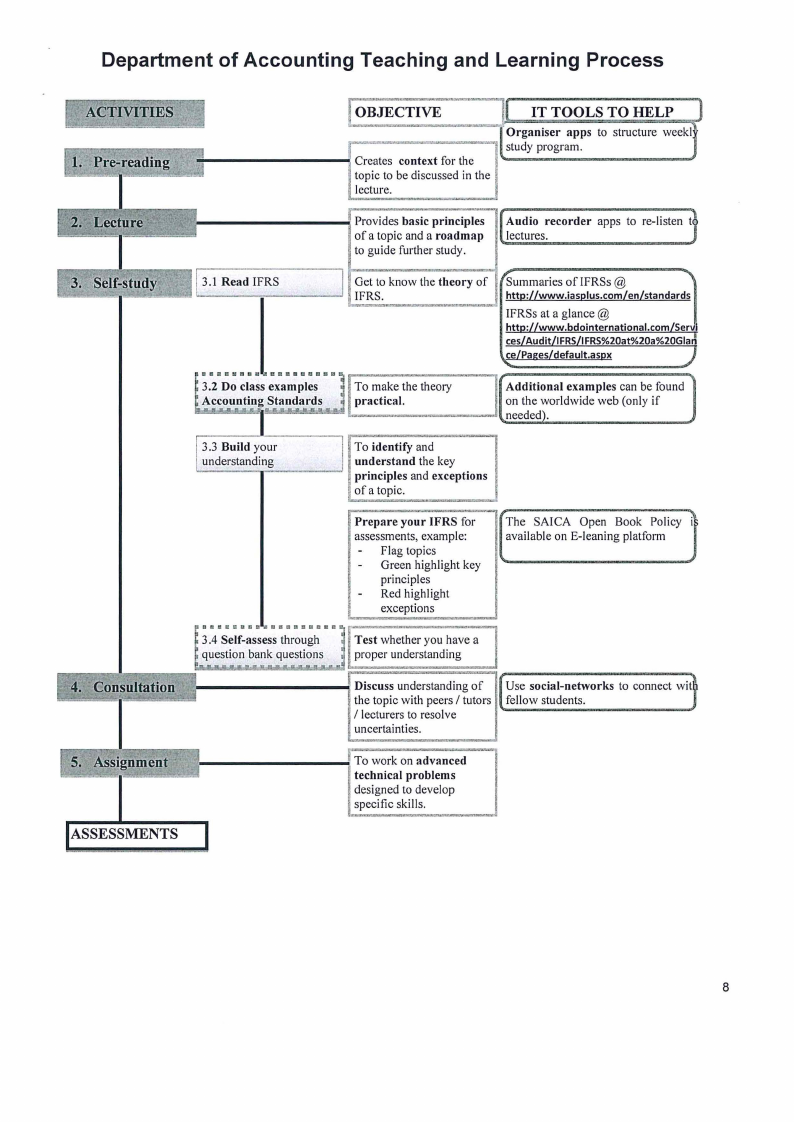
Department of Accounting Teaching and Learning Process
ACTIVITIES
1. Pre-reading -----------~~·;:es
I
.-2-.--··,-----;-:----------~rPr~vides
OBJECTIVE
context for the
topic to be discussed in the
lecture.
IT TOOLS TO HELP
Organiser apps to structure week!
study program.
basic principl:s
of a topic and a roadmap
to guide further study.
Audio recorder apps to re-listen t
lectures.
_..,3..,..,.,.,..,Ss.....t,_,eul,_.,df_- .Y,.~,,_. _I .R..e..a_d..IFRS
11
- ] Get to know the theory of
IFRS.
Summaries of IFRSs@
http://www.iasplus.com/en/standards
IFRSs at a glance @
http://www.bdointernational.com/Serv
ces Audit IFRS IFRS%20at%20a%20Gla~
ce/ Pages/default.aspx
3.2 Do class examples
Accounting Standards
----!::f'1!1<1Ul:Alll;!ld!AJ1:A:11
To make the theory
practical.
-~-~-----~-•,needed
3.3 Build your
understanding
.....
J To identify and
. understand the key
principles and exceptions
of a topic.
Additional examples can be found
on the worldwide web (only if
----. ---------
Prepare your IFRS for
assessments, example:
- Flag topics
- Green highlight key
principles
- Red highlight
exceptions
The SAICA Open Book Policy i
available on E-leaning platform
4. Consultation
Test whether you have a
proper understanding
:----------""!:!Discuss understanding of
the topic with peers/ tutors
/ lecturers to resolve
uncertainties.
Use social-networks to connect wit
fellow students.
5. Assignment · ·:-----------:
To work on advanced
technical problems
designed to develop
specifie skills.
ASSESSMENTS
8

2.4 Page 14

▲back to top


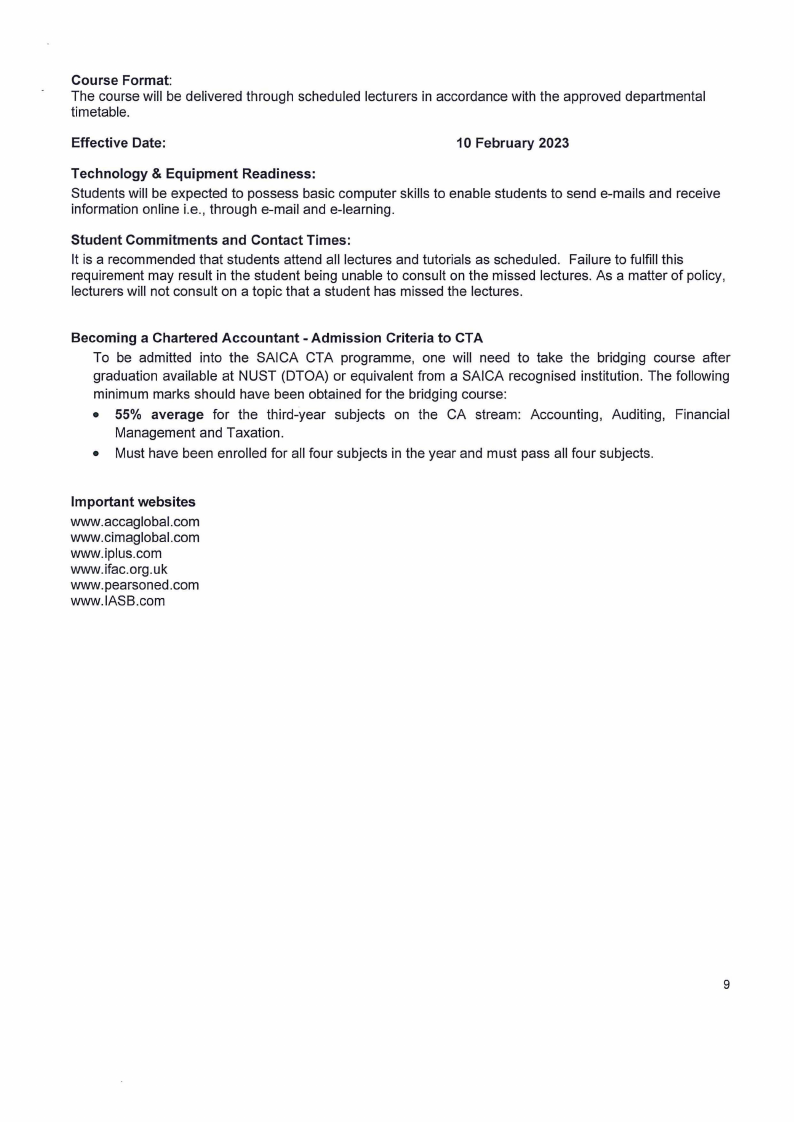
Course Format:
The course will be delivered through scheduled lecturers in accordance with the approved departmental
timetable.
Effective Date:
10 February 2023
Technology & Equipment Readiness:
Students will be expected to possess basic computer skills to enable students to send e-mails and receive
information online i.e., through e-mail and e-learning.
Student Commitments and Contact Times:
It is a recommended that students attend all lectures and tutorials as scheduled. Failure to fulfill this
requirement may result in the student being unable to consult on the missed lectures. As a matter of policy,
lecturers will not consult on a topic that a student has missed the lectures.
Becoming a Chartered Accountant - Admission Criteria to CTA
To be admitted into the SAICA CTA programme, one will need to take the bridging course after
graduation available at NUST (DTOA) or equivalent from a SAICA recognised institution. The following
minimum marks should have been obtained for the bridging course:
55% average for the third-year subjects on the CA stream: Accounting, Auditing, Financial
Management and Taxation.
• Must have been enrolled for all four subjects in the year and must pass all four subjects.
Important websites
www.accaglobal.com
www.cimaglobal.com
www.iplus.com
www.ifac.org.uk
www.pearsoned.com
www.lASB.com
9

2.5 Page 15

▲back to top


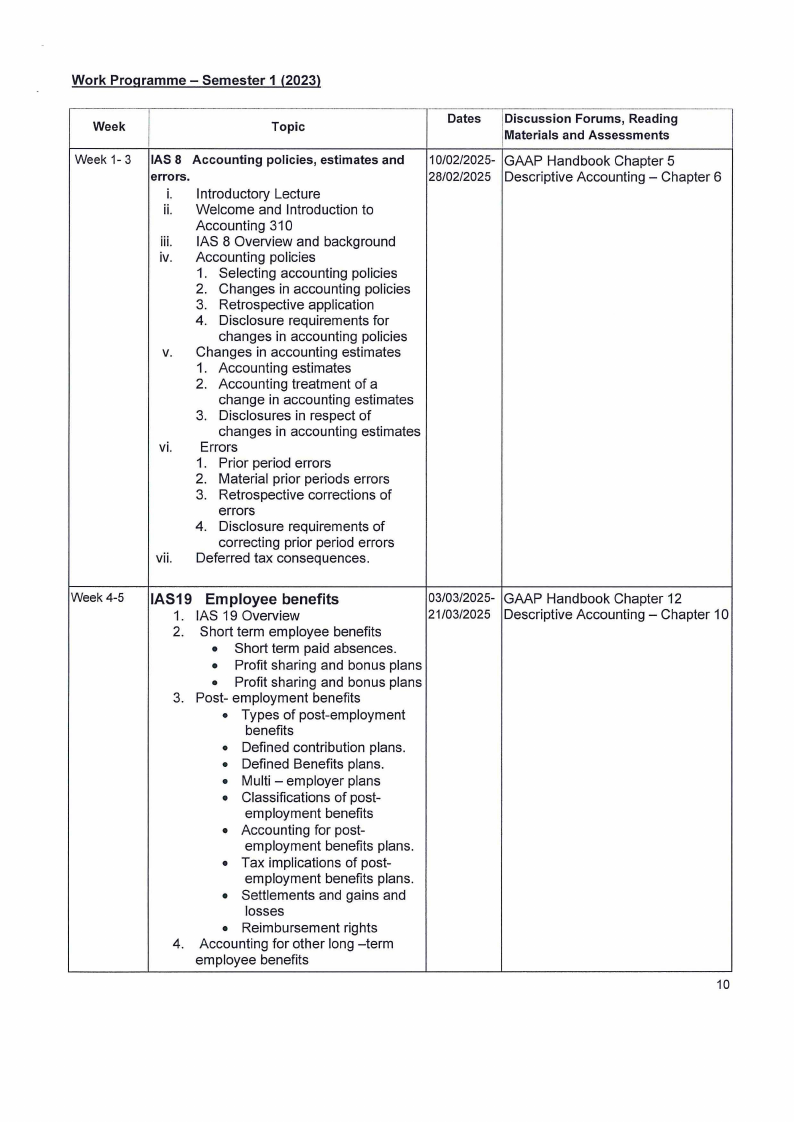
Work Programme - Semester 1 (2023)
Week
Week 1- 3
Topic
Dates
Discussion Forums, Reading
Materials and Assessments
IASB Accounting policies, estimates and 10/02/2025- GAAP Handbook Chapter 5
errors.
28/02/2025 Descriptive Accounting - Chapter 6
i. Introductory Lecture
ii. Welcome and Introduction to
Accounting 310
iii. IAS 8 Overview and background
iv. Accounting policies
1. Selecting accounting policies
2. Changes in accounting policies
3. Retrospective application
4. Disclosure requirements for
changes in accounting policies
V. Changes in accounting estimates
1. Accounting estimates
2. Accounting treatment of a
change in accounting estimates
3. Disclosures in respect of
changes in accounting estimates
vi. Errors
1. Prior period errors
2. Material prior periods errors
3. Retrospective corrections of
errors
4. Disclosure requirements of
correcting prior period errors
vii. Deferred tax consequences.
Week 4-5
IAS19 Employee benefits
03/03/2025- GAAP Handbook Chapter 12
1. IAS 19 Overview
21/03/2025 Descriptive Accounting - Chapter 10
2. Short term employee benefits
Short term paid absences .
Profit sharing and bonus plans
3. Post- employment benefits
Types of post-employment
benefits
Defined contribution plans .
Defined Benefits plans .
Multi - employer plans
Classifications of post-
employment benefits
Accounting for post-
employment benefits plans.
Tax implications of post-
employment benefits plans.
Settlements and gains and
losses
Reimbursement rights
4. Accounting for other long -term
employee benefits
10

2.6 Page 16

▲back to top


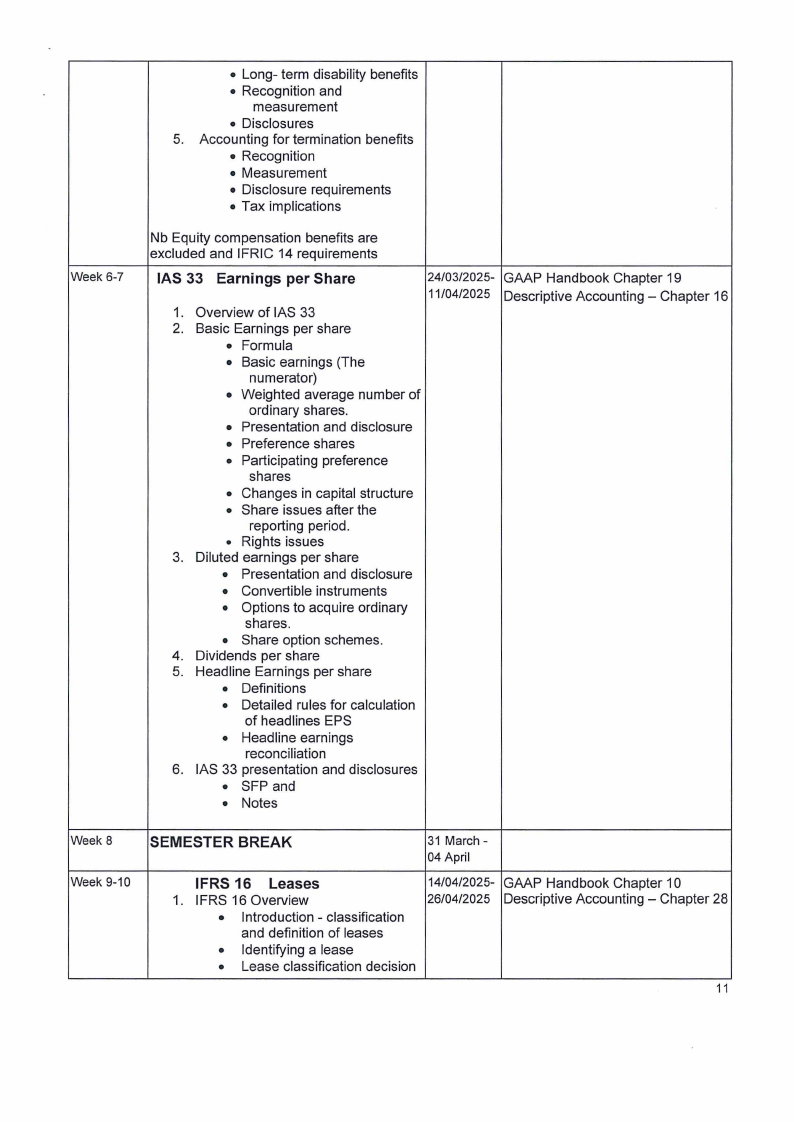
Week 6-7
• Long- term disability benefits
• Recognition and
measurement
• Disclosures
5. Accounting for termination benefits
• Recognition
• Measurement
• Disclosure requirements
• Tax implications
Nb Equity compensation benefits are
excluded and IFRIC 14 requirements
IAS 33 Earnings per Share
24/03/2025-
11/04/2025
1. Overview of IAS 33
2. Basic Earnings per share
• Formula
• Basic earnings (The
numerator)
• Weighted average number of
ordinary shares.
• Presentation and disclosure
• Preference shares
• Participating preference
shares
• Changes in capital structure
• Share issues after the
reporting period.
Rights issues
3. Diluted earnings per share
Presentation and disclosure
Convertible instruments
Options to acquire ordinary
shares.
Share option schemes .
4. Dividends per share
5. Headline Earnings per share
Definitions
Detailed rules for calculation
of headlines EPS
Headline earnings
reconciliation
6. IAS 33 presentation and disclosures
SFP and
Notes
GAAP Handbook Chapter 19
Descriptive Accounting - Chapter 16
Week8
Week 9-10
SEMESTER BREAK
31 March -
04 April
IFRS 16 Leases
14/04/2025- GAAP Handbook Chapter 10
1. IFRS 16 Overview
26/04/2025 Descriptive Accounting - Chapter 28
Introduction - classification
and definition of leases
Identifying a lease
Lease classification decision
11

2.7 Page 17

▲back to top


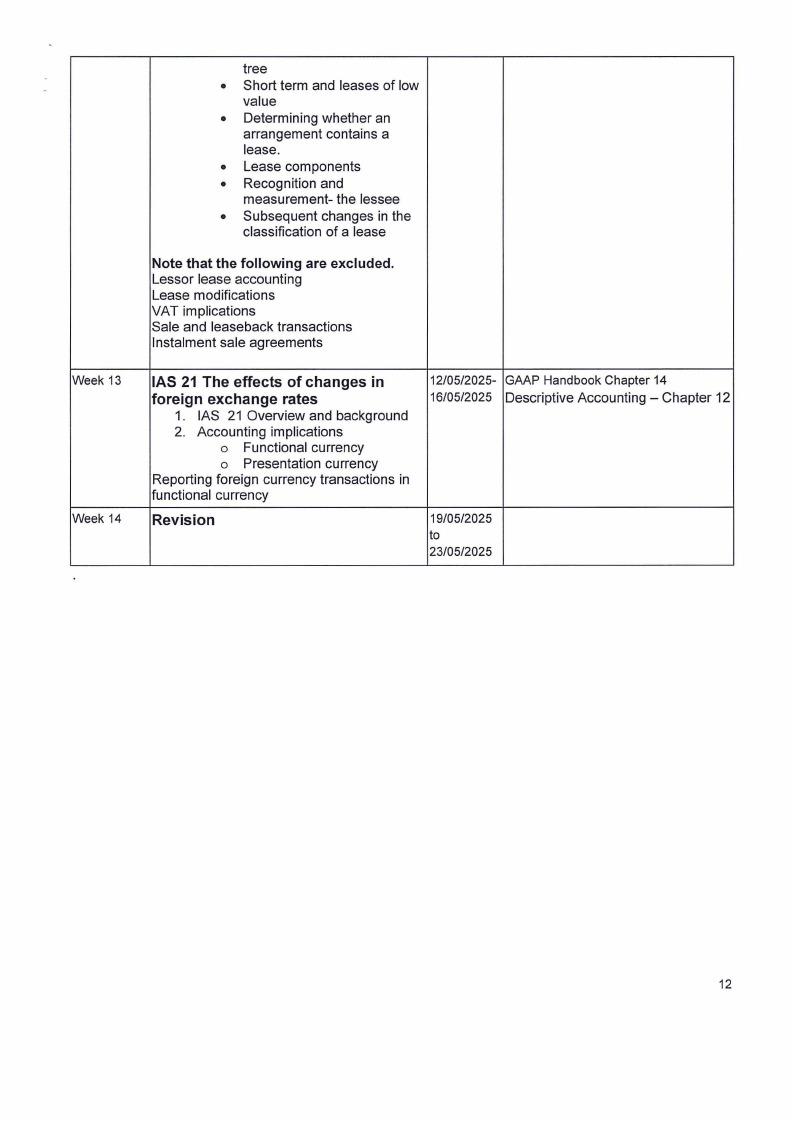
tree
Short term and leases of low
value
Determining whether an
arrangement contains a
lease.
Lease components
Recognition and
measurement- the lessee
Subsequent changes in the
classification of a lease
Note that the following are excluded.
Lessor lease accounting
Lease modifications
VAT implications
Sale and leaseback transactions
Instalment sale agreements
Week 13
Week 14
IAS 21 The effects of changes in
foreign exchange rates
1. IAS 21 Overview and background
2. Accounting implications
0 Functional currency
0 Presentation currency
Reporting foreign currency transactions in
functional currency
Revision
12/05/2025- GAAP Handbook Chapter 14
16/05/2025 Descriptive Accounting - Chapter 12
19/05/2025
to
23/05/2025
12

2.8 Page 18

▲back to top


General Academic Policies:
It is the student's responsibility to be familiar with and adhere to the University policies. These Policies can
be found in the University Prospectus or online at www.polytechnic.edu.na/prospectus.
Tests 1 and 2 will cover all the work as scheduled up to the day for the test date while Test 3 will cover the
entire course outline.
Failure to Pay Fees:
A student who fails to pay his/her fees may not be allowed to write the examination and if allowed, the
results will be withheld until all outstanding fees are paid in full.
Important Student Services at NUST
There are a variety of services which you can use at the NUST. These services are to your advantage -
Use them!!! They include the following:
• Student Counseling and Career Development - Dean of Students Office.
• Writing Centre and student academic problems -Teaching & Learning Unit (TLU)
• Campus Health and Wellness Centre (CHWC) - Dean of Student's office/ NUST Clinic
Authorization:
This course is authorized for use by:
-------------------------
H Namwandi
Section Head - Accounting
03 February 2023
Date
13