


 |
GSC711S - GLOBAL SUPPLY CHAIN MANAGEMENT - 1ST OPP - JUNE 2025 |
|
|
1 Page 1 |
▲back to top |
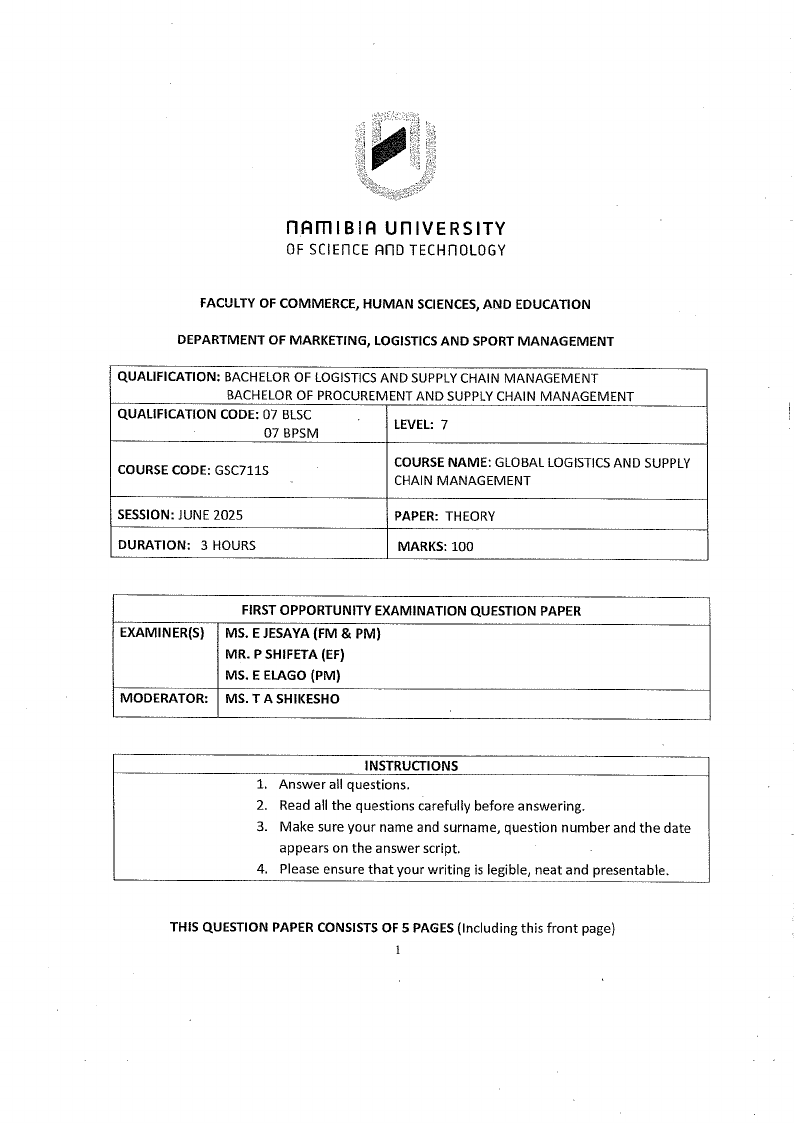
nAmlBIA UnlVERSITY
OF SCIEnCE Ano TECHnOLOGY
FACULTY OF COMMERCE, HUMAN SCIENCES,AI\\ID EDUCATION
DEPARTMENT OF MARKETING, LOGISTICSAND SPORT MANAGEMENT
QUALIFICATION: BACHELOR OF LOGISTICSAND SUPPLY CHAIN MANAGEMENT
BACHELOR OF PROCUREMENT AND SUPPLY CHAIN MANAGEMENT
QUALIFICATION CODE: 07 BLSC
07 BPSM
LEVEL: 7
COURSE CODE: GSC711S
COURSE NAME: GLOBAL LOGISTICS AND SUPPLY
CHAIN MANAGEMENT
SESSION: JUNE 2025
DURATION: 3 HOURS
PAPER: THEORY
MARKS: 100
EXAMINER(S)
MODERATOR:
FIRST OPPORTUNITY EXAMINATION QUESTION PAPER
MS. E JESAYA (FM & PM)
MR. P SHIFETA (EF)
MS. E ELAGO (PM)
MS.TA SHIKESHO
INSTRUCTIONS
1. Answer all questions.
2. Read all the questions carefully before answering.
3. Make sure your name and surname, question number and the date
appears on the answer script.
4. Please ensure that your writing is legible, neat and presentable.
THIS QUESTION PAPER CONSISTS OF 5 PAGES (Including this front page)
1
|
|
2 Page 2 |
▲back to top |
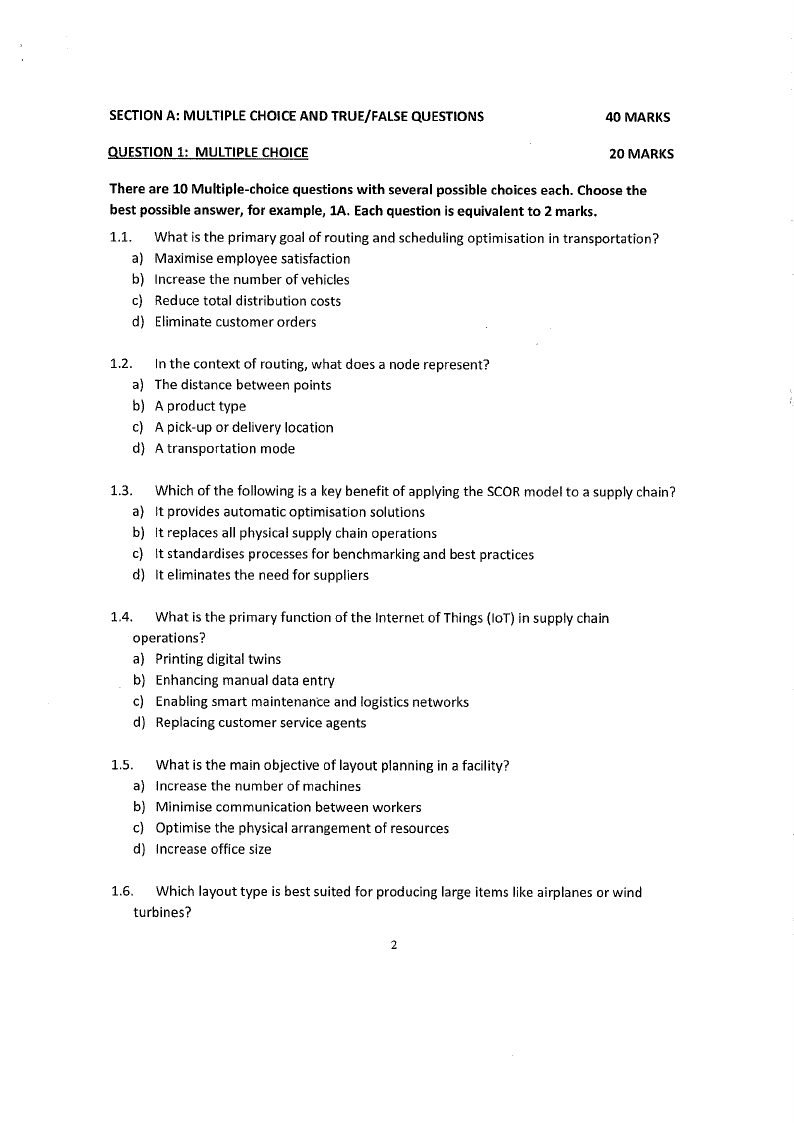
SECTION A: MULTIPLE CHOICE AND TRUE/FALSE QUESTIONS
40 MARKS
QUESTION 1: MULTIPLE CHOICE
20MARKS
There are 10 Multiple-choice questions with several possible choices each. Choose the
best possible answer, for example, lA. Each question is equivalent to 2 marks.
1.1. What is the primary goal of routing and scheduling optimisation in transportation?
a) Maximise employee satisfaction
b) Increase the number of vehicles
c) Reduce total distribution costs
d) Eliminate customer orders
1.2. In the context of routing, what does a node represent?
a) The distance between points
b) A producttype
c) A pick-up or delivery location
d) A transportation mode
1.3. Which of the following is a key benefit of applying the SCORmodel to a supply chain?
a) It provides automatic optimisation solutions
b) It replaces all physical supply chain operations
c) It standardises processesfor benchmarking and best practices
d) It eliminates the need for suppliers
1.4. What is the primary function of the Internet of Things (loT) in supply chain
operations?
a) Printing digital twins
b) Enhancing manual data entry
c) Enabling smart maintenance and logistics networks
d) Replacing customer service agents
1.5. What is the main objective of layout planning in a facility?
a) Increase the number of machines
b) Minimise communication between workers
c) Optimise the physical arrangement of resources
d) Increase office size
1.6. Which layout type is best suited for producing large items like airplanes or wind
turbines?
2
|
|
3 Page 3 |
▲back to top |
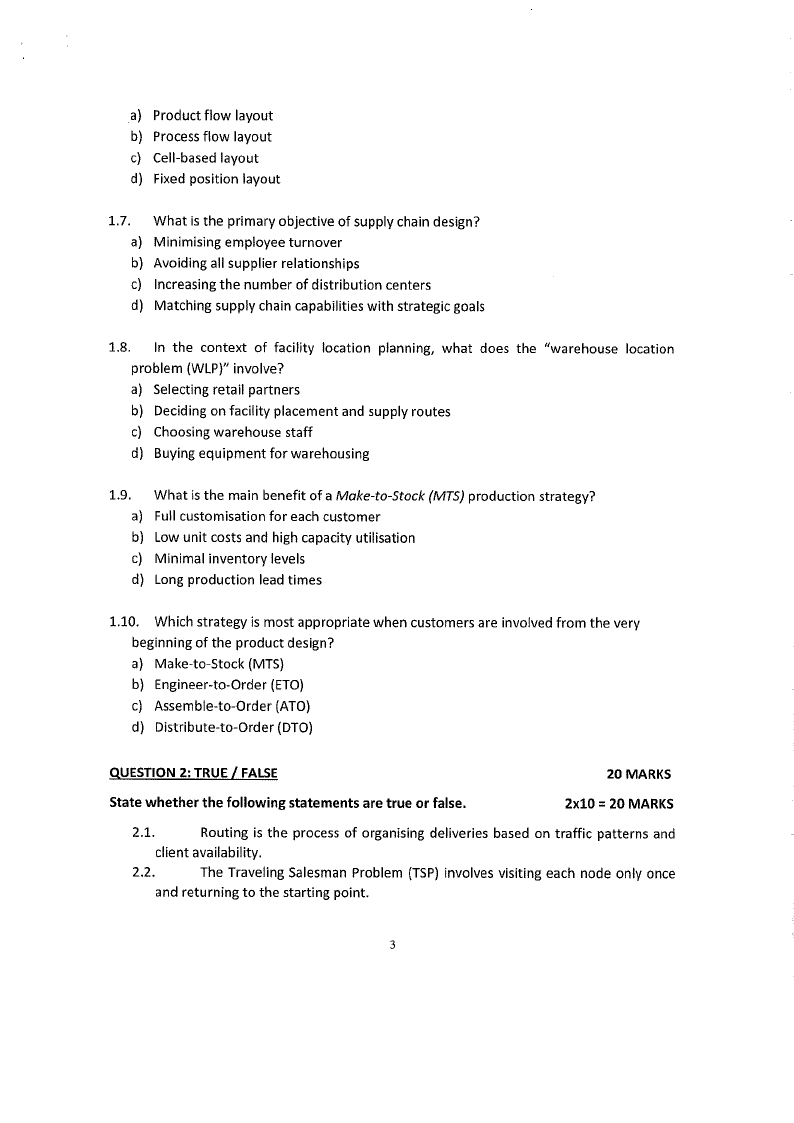
a) Product flow layout
b) Processflow layout
c) Cell-based layout
d) Fixed position layout
1.7. What is the primary objective of supply chain design?
a) Minimising employee turnover
b) Avoiding all supplier relationships
c) Increasing the number of distribution centers
d) Matching supply chain capabilities with strategic goals
1.8. In the context of facility location planning, what does the "warehouse location
problem (WLP)" involve?
a) Selecting retail partners
b) Deciding on facility placement and supply routes
c) Choosing warehouse staff
d) Buying equipment for warehousing
1.9. What is the main benefit of a Make-ta-Stack {MTS) production strategy?
a) Full customisation for each customer
b) Low unit costs and high capacity utilisation
c) Minimal inventory levels
d) Long production lead times
1.10. Which strategy is most appropriate when customers are involved from the very
beginning of the product design?
a) Make-to-Stock (MTS)
b) Engineer-to-Order (ETO)
c) Assemble-to-Order (ATO)
d) Distribute-to-Order (OTO)
QUESTION 2: TRUE/ FALSE
20 MARKS
State whether the following statements are true or false.
2x10 = 20 MARKS
2.1.
Routing is the process of organising deliveries based on traffic patterns and
client availability.
2.2.
The Traveling Salesman Problem (TSP)involves visiting each node only once
and returning to the starting point.
3
|
|
4 Page 4 |
▲back to top |
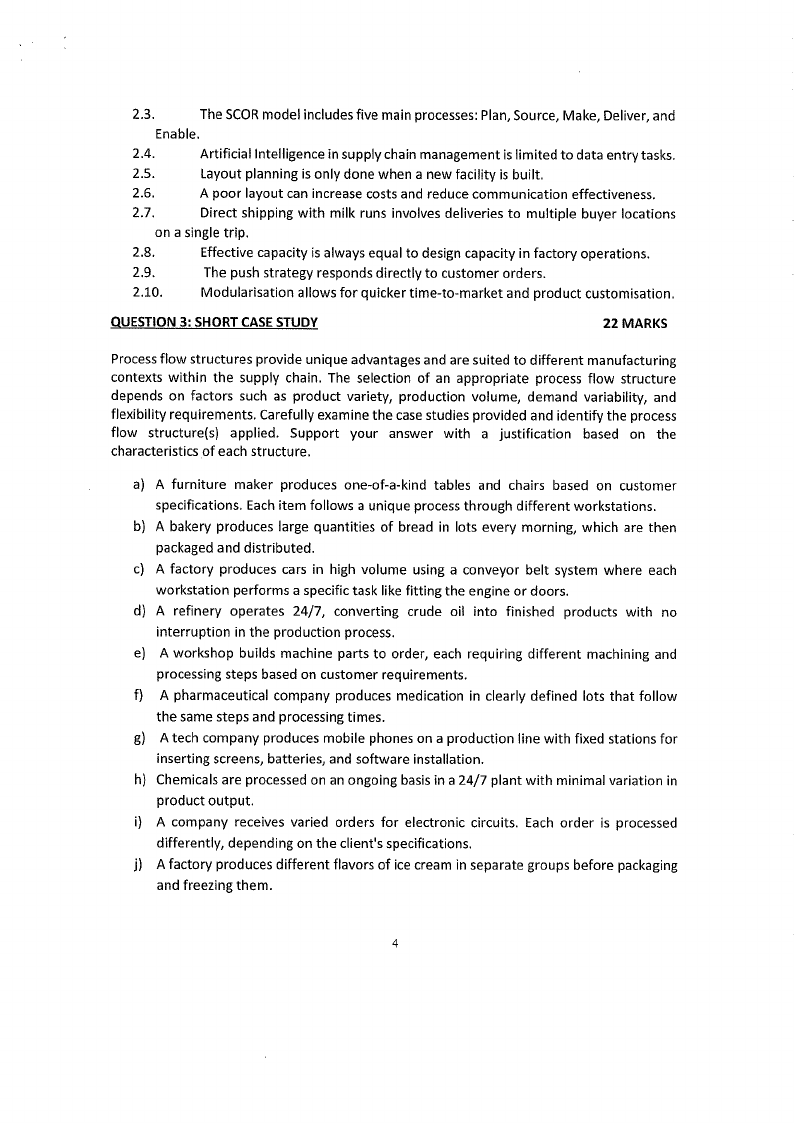
2.3.
The SCORmodel includes five main processes:Plan,Source, Make, Deliver, and
Enable.
2.4.
Artificial Intelligence in supply chain management is limited to data entry tasks.
2.5.
Layout planning is only done when a new facility is built.
2.6.
A poor layout can increase costs and reduce communication effectiveness.
2.7.
Direct shipping with milk runs involves deliveries to multiple buyer locations
on a single trip.
2.8.
Effective capacity is always equal to design capacity in factory operations.
2.9.
The push strategy responds directly to customer orders.
2.10.
Modularisation allows for quicker time-to-market and product customisation.
QUESTION 3: SHORT CASE STUDY
22MARKS
Processflow structures provide unique advantages and are suited to different manufacturing
contexts within the supply chain. The selection of an appropriate process flow structure
depends on factors such as product variety, production volume, demand variability, and
flexibility requirements. Carefully examine the casestudies provided and identify the process
flow structure(s) applied. Support your answer with a justification based on the
characteristics of each structure.
a) A furniture maker produces one-of-a-kind tables and chairs based on customer
specifications. Eachitem follows a unique process through different workstations.
b) A bakery produces large quantities of bread in lots every morning, which are then
packaged and distributed.
c) A factory produces cars in high volume using a conveyor belt system where each
workstation performs a specific task like fitting the engine or doors.
d) A refinery operates 24/7, converting crude oil into finished products with no
interruption in the production process.
e) A workshop builds machine parts to order, each requiring different machining and
processing steps based on customer requirements.
f) A pharmaceutical company produces medication in clearly defined lots that follow
the same steps and processing times.
g) A tech company produces mobile phones on a production line with fixed stations for
inserting screens, batteries, and software installation.
h) Chemicals are processed on an ongoing basis in a 24/7 plant with minimal variation in
product output.
i) A company receives varied orders for electronic circuits. Each order is processed
differently, depending on the client's specifications.
j) A factory produces different flavors of ice cream in separate groups before packaging
and freezing them.
4
|
|
5 Page 5 |
▲back to top |
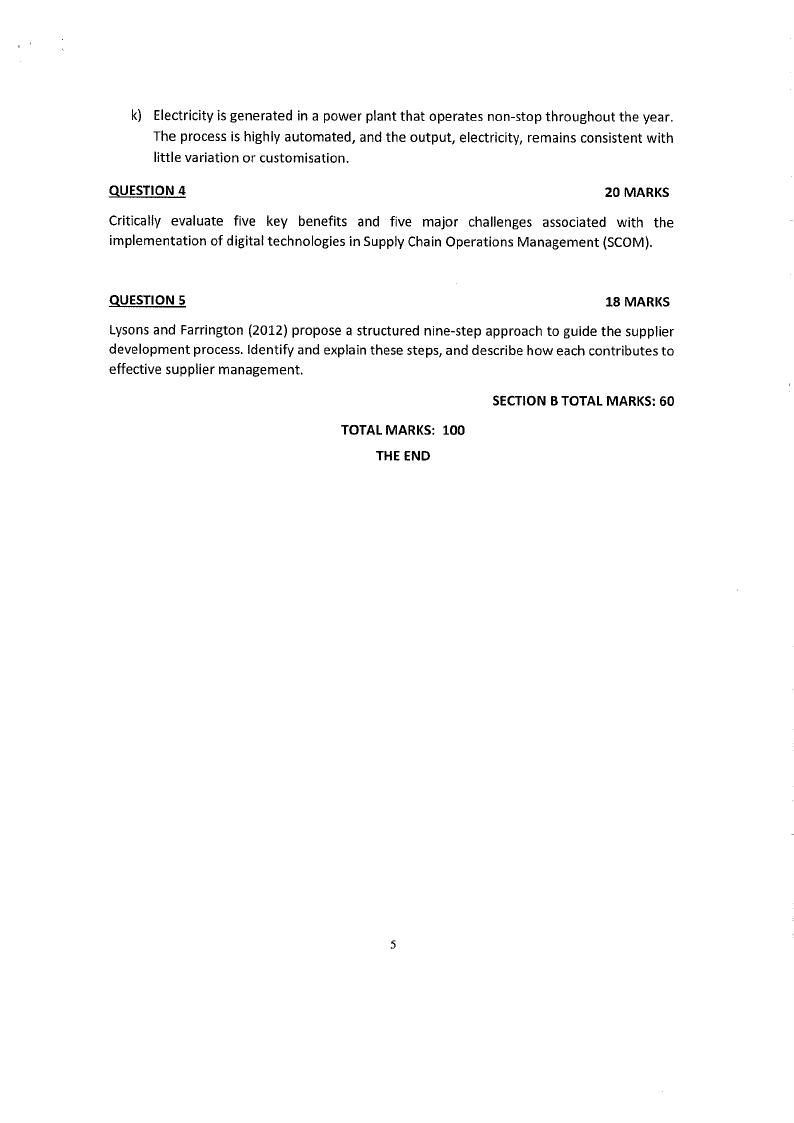
k) Electricity is generated in a power plant that operates non-stop throughout the year.
The process is highly automated, and the output, electricity, remains consistent with
little variation or customisation.
QUESTION4
20 MARKS
Critically evaluate five key benefits and five major challenges associated with the
implementation of digital technologies in Supply Chain Operations Management (SCOM).
QUESTION 5
18 MARKS
Lysonsand Farrington (2012) propose a structured nine-step approach to guide the supplier
development process. Identify and explain these steps, and describe how each contributes to
effective supplier management.
TOTAL MARKS: 100
THE END
SECTION B TOTAL MARKS: 60
5