


 |
TTL621S - Traffic and Transportation Legislation - 1st Opp -Nov 2025 |
|
|
1 Page 1 |
▲back to top |
nAm IBIA un IVE RSITY
OF SCIEnCE Ano TECHnOLOGY
FACULTY OF COMMERCE, HUMAN SCIENCES AND EDUCATION
DEPARTMENT OF SOCIAL SCIENCES
QUALIFICATION: BACHELOR OF TRANSPORTATION MANAGEMENT
QUAUFICATION CODE: 07BTMM
COURSE CODE: TTL621S
LEVEL: 6
COURSE NAME: TRAFFIC AND TRANSPORTATION
LEGISLATION
SESSION: OCTOBER 2025
PAPER: THEORY AND CASE STUDIES
DURATION: 3 HOURS
MARKS: 100
FIRST OPPORTUNITY EXAMINATION
EXAMINER{S) Mariette Hanekom
MODERATOR: Kirby Claasen
INSTRUCTIONS
1. The paper has 6 main questions.
2. ALL the questions are compulsory.
3. Read carefully before answering.
4. Write clearly and neatly.
5. Number the answers clearly and according the structure in the examination question
paper.
6. Write full sentences. Candidates will be penalised for incorrect spelling and illegible
handwriting, as well as for the inappropriate use of "bullet points".
PERMISSIBLE MATERIAL
The Namibian Constitution
THIS MEMORANDUM CONSISTS OF 6 PAGES (Including this front page)
|
|
2 Page 2 |
▲back to top |
QUESTION 1
1.1 The maximum allowable mass of a fully loaded motor vehicle is known as the ....
A.
Tare
B.
Permissible weight
C.
Gross Vehicle Mass
D.
Maximum Authorised Mass
1.2 How does the Roads Authority assist with road safety in Namibia?
A. By prescribing minimum standards and measures for the management and
maintenance of Namibian roads.
B. By establishing the National Road Safety Council.
C. By way of advertising and awareness campaigns.
D. They do not; this is not their job.
1.3 It is permissible to use the shoulder of the road in the following instance:
A.
When a truck driver wants to make way for fast-moving traffic
B.
To allow a state motorcade to pass
C.
When you are late for work and the traffic is backed up
D.
All of the above
1.4 Section 11 ofthe RTTA was amended in 2008 by way of the Road Traffic and
Transport Amendment Act 6 of 2008. The effect of this amendment is that:
A.
local authorities can now also appoint authorised officers.
B.
Authorised officers no longer have to be issued with a Certificate of
Appointment.
C.
An authorised officer no longer needs to produce his/her certificate of
appointment when requested to do so.
D.
None of these answers.
1.5 Where must an operator card be displayed?
A.
On the back of the vehicle
B.
It must be kept in the cab of the vehicle
C.
On the back of the vehicle, as well as on both sides
D.
On the front windscreen
1.6 That portion of a road, including the sidewalk, which is not the roadway or the
shoulder, is known as the ....
A.
Kerb
B.
Pavement
C.
Verge
D.
Edge of the roadway
1.7 The function of the Namibian Roads Authority (RA) is to:
A.
Licence vehicles and issue drivers' licences
B.
Manage the Namibian road network
C.
Construct and maintain roads
2
|
|
3 Page 3 |
▲back to top |
D.
Enforce the regulations on the transportation of dangerous goods
1.8 Four students are arguing about whether a driver with a learner's licence may have
passengers in the car when they are driving.
ZEBI says this is never allowed.
PRATA says yes they may, provided they are accompanied by a licenced driver.
RICHARD says yes they may, provided the passengers are not conveyed for reward.
LUCKY says yes they may, provided the passengers are not conveyed for reward and
they are accompanied by a licenced driver.
Who is correct?
A.
Zebi
B.
Prata
C.
Richard
D.
Lucky
1.9 Which of the following statements is correct?
A.
The driver is regarded as the operator of a vehicle
B.
The operator is regarded as the owner of the vehicle
C.
The owner of the vehicle is regarded as the operator of the vehicle
D. The driver and the owner are both regarded as operators of a vehicle
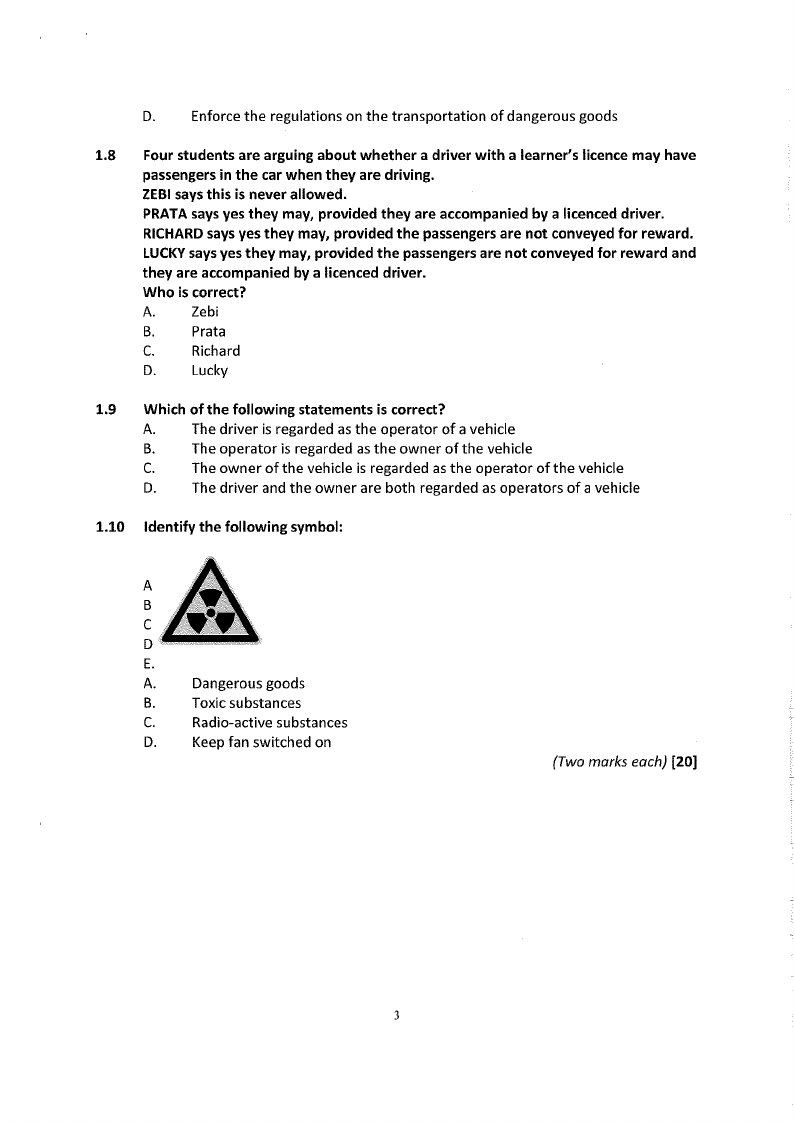
1.10 Identify the following symbol:
A
B
C
D
E.
A.
Dangerous goods
B.
Toxic substances
C.
Radio-active substances
D.
Keep fan switched on
{Two marks each) [20)
3
|
|
4 Page 4 |
▲back to top |
QUESTION 2
2.1 Distinguish between a driving inspector and a vehicle inspector.
(2)
2.2 List the categories for which operator cards can be issued.
(3)
2.3 List the 4 road user charges imposed by the Road Fund Administration (RFA). (4)
2.4 Which two human rights are regarded as absolute?
(2)
2.5 Distinguish between the Namibian Roads Authority (RA), the Roads Contractor
Company (RCC) and the Road Fund Administration (RFA) with regard to their
respective functions.
(3)
2.6 What is the difference between "gross vehicle mass" and "tare"?
(3)
2.7 Who may appoint authorised officers?
(3)
[20]
QUESTION 3
Read the following case study and indicate which human rights have been infringed. Refer
to the exact articles.
On 15 March 2025 Ulrich was stopped at the road block outside Windhoek. When he was
unable to produce receipts for the laptop computer and printer that he had in his car the
Traffic Inspector arrested him with the words: "you're a Nama. Nama's always steal
everything." He was arrested and taken to the Windhoek Police Station, where he was kept
in a holding cell. The cell was without any form of sanitation facilities as these facilities had
been demolished by previous prisoners. Ulrich was given no food for five days, after which
he was released without being charged.
Note: Marks will be deductedfor irrelevant references to the Namibian Constitution.
[10]
QUESTION4
Discuss the training requirements for dangerous goods drivers. Refer to both the UN Model
Regulations on the Transportation of Dangerous Goods, as well as the Road Traffic and
Transportation Act 1999.
[10]
4
|
|
5 Page 5 |
▲back to top |
QUESTION 5
You are the Manager: Logistics and Transportation of Minura Mining, a company that owns
a Uranium Mine in the coastal area of Namibia. It is your responsibility, amongst others, to
manage all transportation matters within the company, including ensuring that vehicles are
safe and meet legal requirements, and making sure that drivers are aware of their duties.
Answer the following questions:
5.1 What are dangerous goods and why must the transportation of such goods be
regulated?
(4)
5.2 What is a "competent authority"?
(2)
5.3 What is the minimum age that a person must be for you to appoint them as a driver,
for ordinary goods and dangerous goods respectively?
(2)
5.4 On route from Walvis Bay to Windhoek one of your drivers is involved in an incident
occurs and she is stopped by a dangerous goods inspector. What is an "incident"?
(3)
5.5 What are the requirements for somebody to be appointed as a dangerous goods
inspector?
(2)
5.6 One of the documents that your drivers must have in their vehicles at all times is a
Tremcard. What is this?
(4)
5.7 A specially equipped Toyota Hilux is used to transport small quantities of Uranium
from the mine to the harbour in Walvis Bay. This vehicle has a GVM of 3000kg. Does
it require an operator's card? Motivate your answer.
(2)
5.8 You want to obtain a personalised licence number reading D@NGER □ NA for this
vehicle. Will this be allowed? Motivate your answer.
(2)
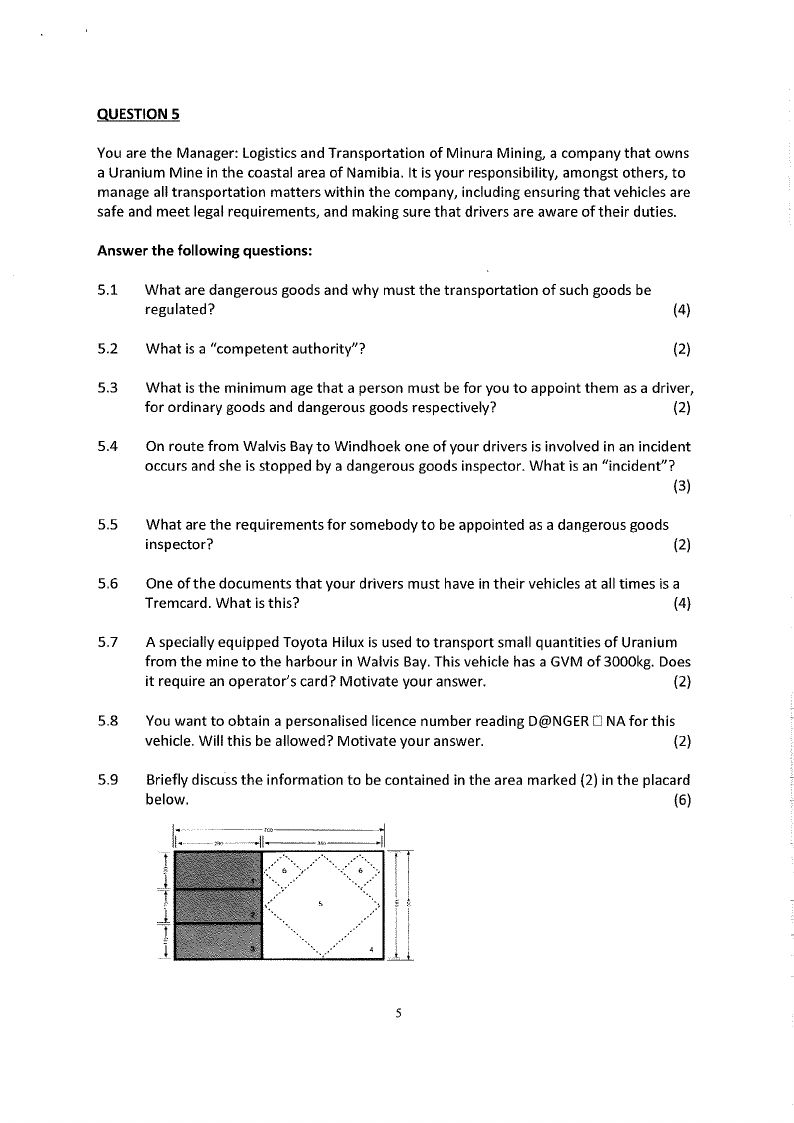
5.9 Briefly discuss the information to be contained in the area marked (2) in the placard
below.
(6)
5
|
|
6 Page 6 |
▲back to top |
5.10 How many placards must be placed on a vehicle transporting dangerous goods and
where should they be placed?
(3)
[30]
QUESTION6
In each of the following instances, indicate whether Mbiri must register as an operator.
Motivate your answers.
6.1 Mbiri is the owner of a 17-seater minibus which he uses to transport passengers to
Swakopmund. He employs Patrick as a driver.
6.2 Mbiri owns a 9-seater minibus which he uses as his family vehicle.
6.3 Mbiri is the owner of MB Recovery, a tow-in company that uses a converted 4X4
vehicle to tow vehicles.
6.4 Mbiri's neighbour owns a goods vehicle with a gross vehicle mass of 3 500kg. Mbiri
borrows the vehicle for a week to transport building material for his new house.
6.5 Mbiri is a taxi driver for Mbuetu. Mbuetu owns the vehicle.
Two marks each [10]
TOTAL MARKS 100
6