


 |
PRS521S - Principles And Practices Of Sport Management - 1st Opp - Nov 2025 |
|
|
1 Page 1 |
▲back to top |
n Am I BI A u n IVER s I TY
OF SCIEnCE Ano TECHnOLOGY
FACULTY OF COMMERCE, HUMAN SCIENCES AND EDUCATION
DEPARTMENT OF MARKETING, LOGISTICS AND SPORT MANAGEMENT
QUALIFICATION: BACHELOR OF SPORT MANAGEMENT
QUALIFICATION CODE: 07BSMN
LEVEL: 5
COURSE CODE: PRS521S
SESSION:
NOVEMBER 2025
COURSE NAME: Principles and practices of sports
management
PAPER:
THEORY
DURATION:
3 HOURS
MARKS:
100
FIRST OPPORTUNITY EXAMINATION QUESTION PAPER
EXAMINER(S) MR. PETER HAUFIKU (FT/ PT/ DI)
MODERATOR: Ms. Fortunate Sithole
INSTRUCTIONS
1. This paper comprises Four (4) Sections.
2. Answer all Four (4) Sections.
3. Read all the questions carefully before answering.
4. Marks for each question are indicated at the end of each question
5. Write clearly and neatly.
6. Number the answers clearly.
THIS EXAMINATION PAPER CONSISTS OF 5 PAGES (Including this front page)
I
|
|
2 Page 2 |
▲back to top |
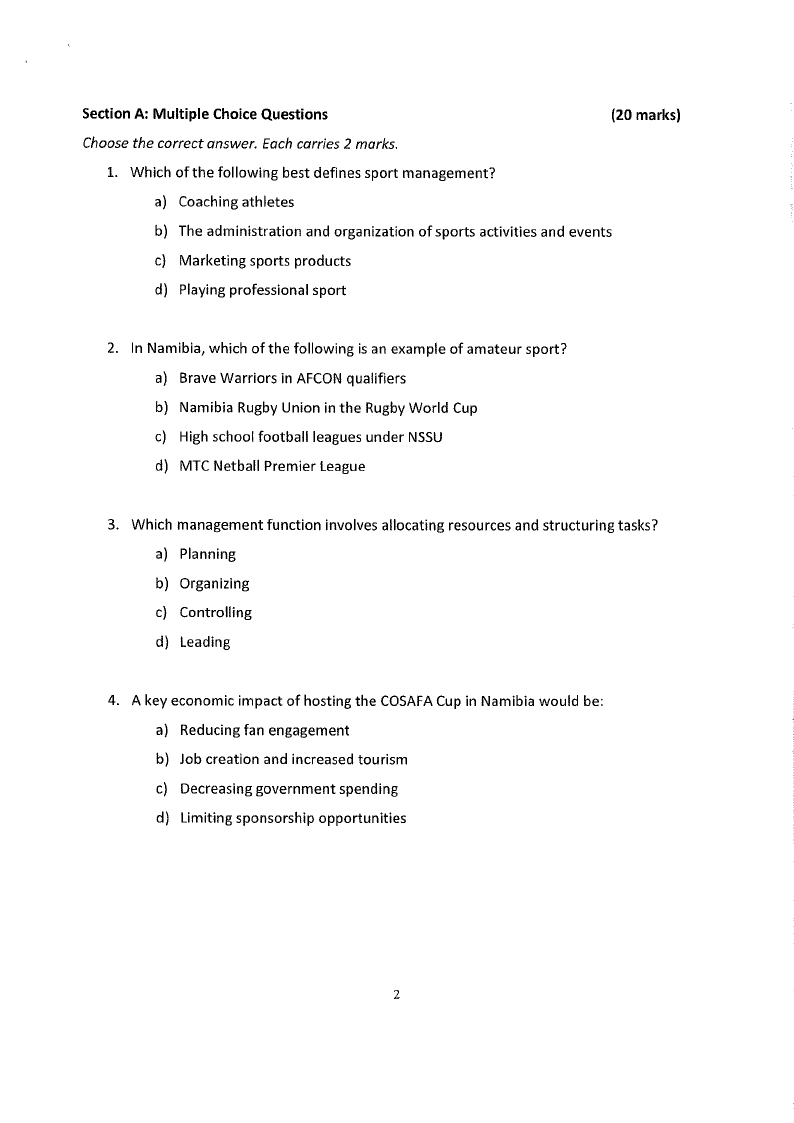
Section A: Multiple Choice Questions
(ZO marks)
Choose the correct answer. Each carries 2 marks.
1. Which of the following best defines sport management?
a) Coaching athletes
b) The administration and organization of sports activities and events
c) Marketing sports products
d) Playing professional sport
2. In Namibia, which of the following is an example of amateur sport?
a) Brave Warriors in AFCON qualifiers
b) Namibia Rugby Union in the Rugby World Cup
c) High school football leagues under NSSU
d) MTC Netball Premier League
3. Which management function involves allocating resources and structuring tasks?
a) Planning
b) Organizing
c) Controlling
d) Leading
4. A key economic impact of hosting the COSAFA Cup in Namibia would be:
a) Reducing fan engagement
b) Job creation and increased tourism
c) Decreasing government spending
d) Limiting sponsorship opportunities
2
|
|
3 Page 3 |
▲back to top |
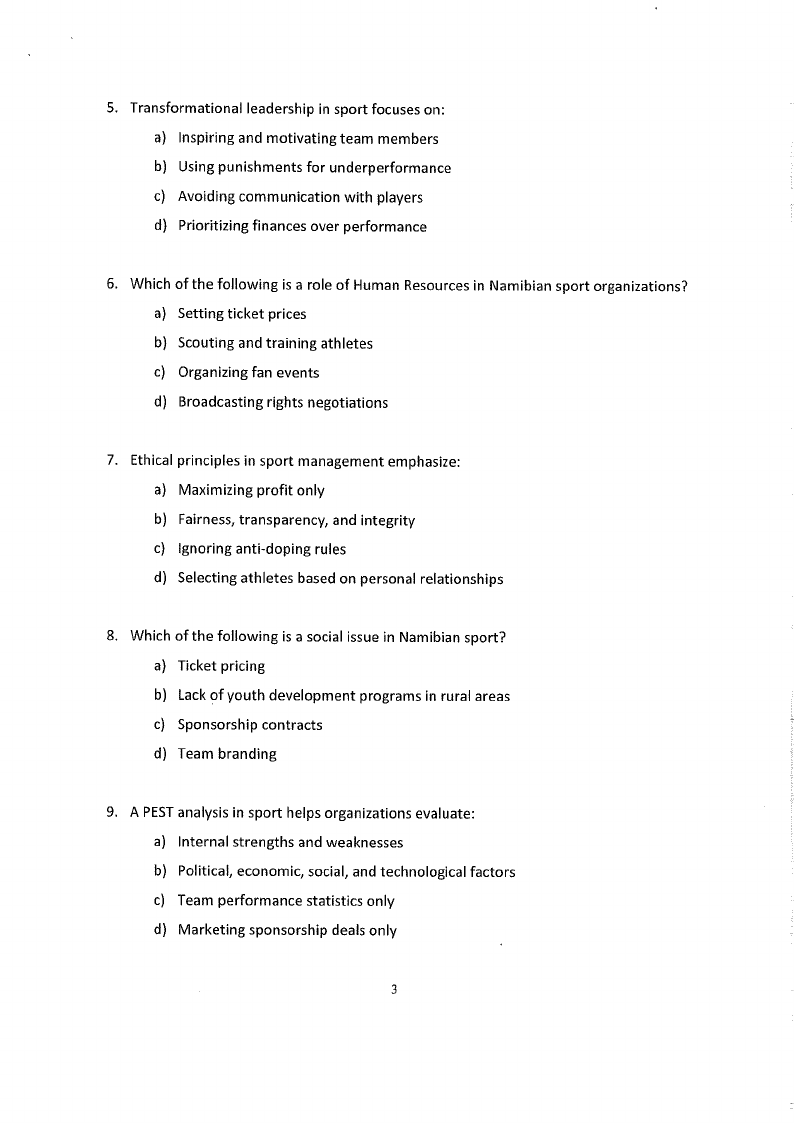
5. Transformational leadership in sport focuses on:
a) Inspiring and motivating team members
b) Using punishments for underperformance
c) Avoiding communication with players
d) Prioritizing finances over performance
6. Which of the following is a role of Human Resources in Namibian sport organizations?
a) Setting ticket prices
b) Scouting and training athletes
c) Organizing fan events
d) Broadcasting rights negotiations
7. Ethical principles in sport management emphasize:
a) Maximizing profit only
b) Fairness, transparency, and integrity
c) Ignoring anti-doping rules
d) Selecting athletes based on personal relationships
8. Which of the following is a social issue in Namibian sport?
a) Ticket pricing
b) Lack of youth development programs in rural areas
c) Sponsorship contracts
d) Team branding
9. A PEST analysis in sport helps organizations evaluate:
a) Internal strengths and weaknesses
b) Political, economic, social, and technological factors
c) Team performance statistics only
d) Marketing sponsorship deals only
3
|
|
4 Page 4 |
▲back to top |
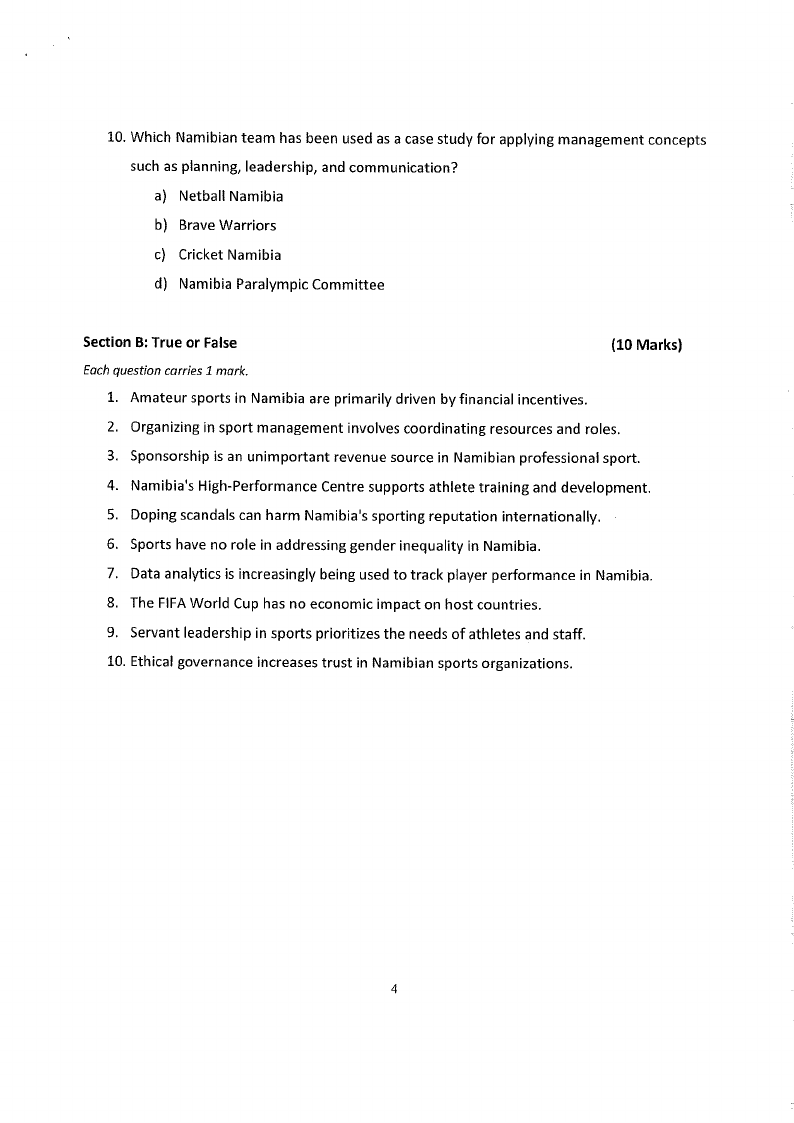
10. Which Namibian team has been used as a case study for applying management concepts
such as planning, leadership, and communication?
a) Netball Namibia
b) Brave Warriors
c) Cricket Namibia
d) Namibia Paralympic Committee
Section B: True or False
Each question carries 1 mark.
(10 Marks)
1. Amateur sports in Namibia are primarily driven by financial incentives.
2. Organizing in sport management involves coordinating resources and roles.
3. Sponsorship is an unimportant revenue source in Namibian professional sport.
4. Namibia's High-Performance Centre supports athlete training and development.
5. Doping scandals can harm Namibia's sporting reputation internationally.
6. Sports have no role in addressing gender inequality in Namibia.
7. Data analytics is increasingly being used to track player performance in Namibia.
8. The FIFA World Cup has no economic impact on host countries.
9. Servant leadership in sports prioritizes the needs of athletes and staff.
10. Ethical governance increases trust in Namibian sports organizations.
4
|
|
5 Page 5 |
▲back to top |
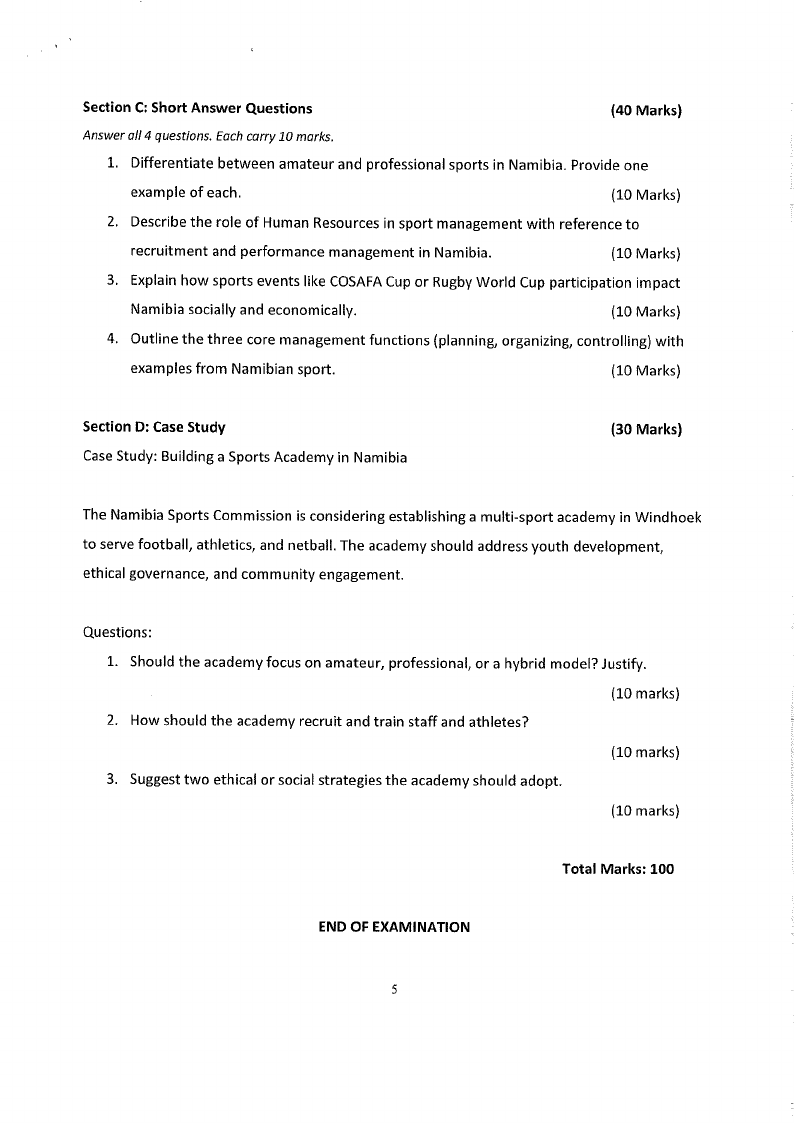
Section C: Short Answer Questions
Answer a/14 questions. Each carry 10 marks.
(40 Marks)
1. Differentiate between amateur and professional sports in Namibia. Provide one
example of each.
(10 Marks)
2. Describe the role of Human Resources in sport management with reference to
recruitment and performance management in Namibia.
(10 Marks)
3. Explain how sports events like COSAFA Cup or Rugby World Cup participation impact
Namibia socially and economically.
(10 Marks)
4. Outline the three core management functions (planning, organizing, controlling) with
examples from Namibian sport.
(10 Marks)
Section D: Case Study
Case Study: Building a Sports Academy in Namibia
(30 Marks)
The Namibia Sports Commission is considering establishing a multi-sport academy in Windhoek
to serve football, athletics, and netball. The academy should address youth development,
ethical governance, and community engagement.
Questions:
1. Should the academy focus on amateur, professional, or a hybrid model? Justify.
2. How should the academy recruit and train staff and athletes?
(10 marks)
3. Suggest two ethical or social strategies the academy should adopt.
(10 marks)
(10 marks)
Total Marks: 100
END OF EXAMINATION
5