


 |
IRL712S - INDUSTRIAL RELATIONS - 1ST OPP - NOV 2025 |
|
|
1 Page 1 |
▲back to top |
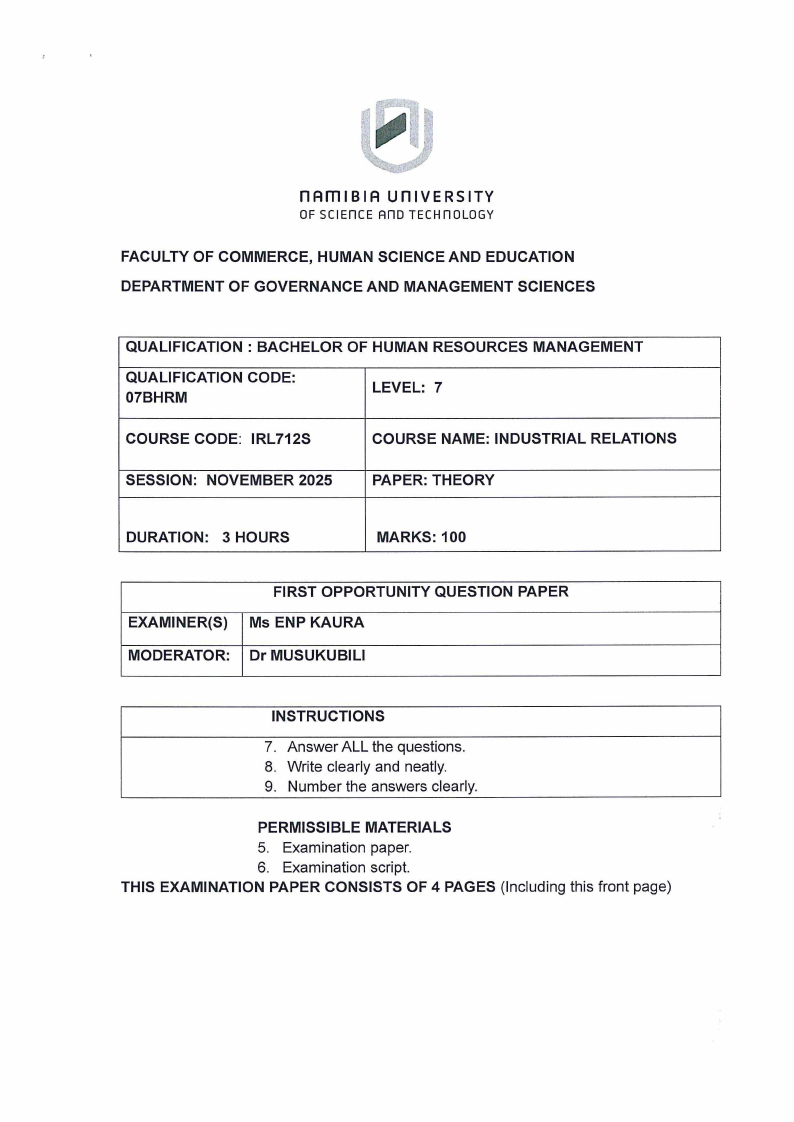
n Am I B I A u n IVE Rs I TY
OF SCI EnCE Ano TECH n □ LOGY
FACULTY OF COMMERCE, HUMAN SCIENCE AND EDUCATION
DEPARTMENT OF GOVERNANCE AND MANAGEMENT SCIENCES
QUALIFICATION : BACHELOR OF HUMAN RESOURCES MANAGEMENT
QUALIFICATION CODE:
07BHRM
LEVEL: 7
COURSE CODE: IRL712S
COURSE NAME: INDUSTRIAL RELATIONS
SESSION: NOVEMBER 2025
PAPER: THEORY
DURATION: 3 HOURS
MARKS: 100
FIRST OPPORTUNITY QUESTION PAPER
EXAMINER(S) Ms ENP KAURA
MODERATOR: Dr MUSUKUBILI
INSTRUCTIONS
7. Answer ALL the questions.
8. Write clearly and neatly.
9. Number the answers clearly.
PERMISSIBLE MATERIALS
5. Examination paper.
6. Examination script.
THIS EXAMINATION PAPER CONSISTS OF 4 PAGES (Including this front page)
|
|
2 Page 2 |
▲back to top |
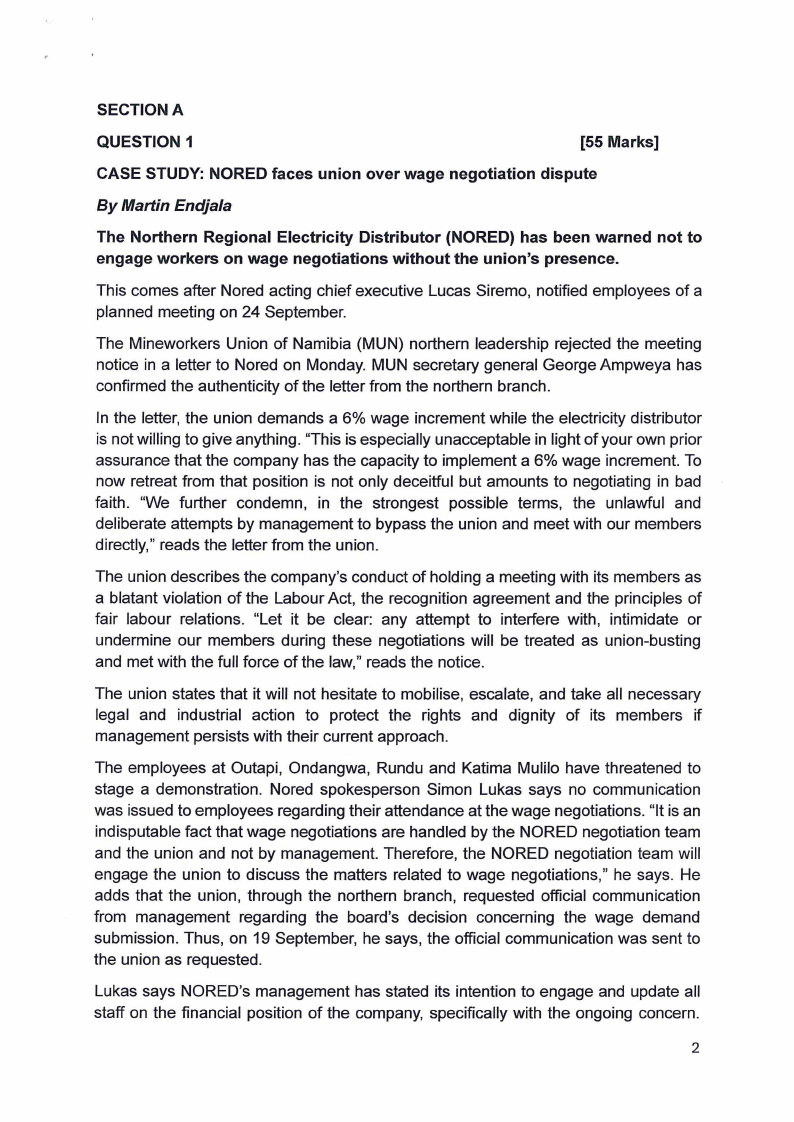
SECTION A
QUESTION 1
[55 Marks]
CASE STUDY: NORED faces union over wage negotiation dispute
By Martin Endjala
The Northern Regional Electricity Distributor (NORED) has been warned not to
engage workers on wage negotiations without the union's presence.
This comes after Nored acting chief executive Lucas Siremo, notified employees of a
planned meeting on 24 September.
The Mineworkers Union of Namibia (MUN) northern leadership rejected the meeting
notice in a letter to Nored on Monday. MUN secretary general George Ampweya has
confirmed the authenticity of the letter from the northern branch .
In the letter, the union demands a 6% wage increment while the electricity distributor
is not willing to give anything. "This is especially unacceptable in light of your own prior
assurance that the company has the capacity to implement a 6% wage increment. To
now retreat from that position is not only deceitful but amounts to negotiating in bad
faith. "We further condemn, in the strongest possible terms, the unlawful and
deliberate attempts by management to bypass the union and meet with our members
directly," reads the letter from the union.
The union describes the company's conduct of holding a meeting with its members as
a blatant violation of the Labour Act, the recognition agreement and the principles of
fair labour relations. "Let it be clear: any attempt to interfere with, intimidate or
undermine our members during these negotiations will be treated as union-busting
and met with the full force of the law," reads the notice.
The union states that it will not hesitate to mobilise, escalate, and take all necessary
legal and industrial action to protect the rights and dignity of its members if
management persists with their current approach.
The employees at Outapi, Ondangwa, Rundu and Katima Mulilo have threatened to
stage a demonstration. Nored spokesperson Simon Lukas says no communication
was issued to employees regarding their attendance at the wage negotiations. "It is an
indisputable fact that wage negotiations are handled by the NORED negotiation team
and the union and not by management. Therefore, the NORED negotiation team will
engage the union to discuss the matters related to wage negotiations," he says. He
adds that the union, through the northern branch, requested official communication
from management regarding the board's decision concerning the wage demand
submission. Thus, on 19 September, he says, the official communication was sent to
the union as requested.
Lukas says NORED's management has stated its intention to engage and update all
staff on the financial position of the company, specifically with the ongoing concern.
2
|
|
3 Page 3 |
▲back to top |
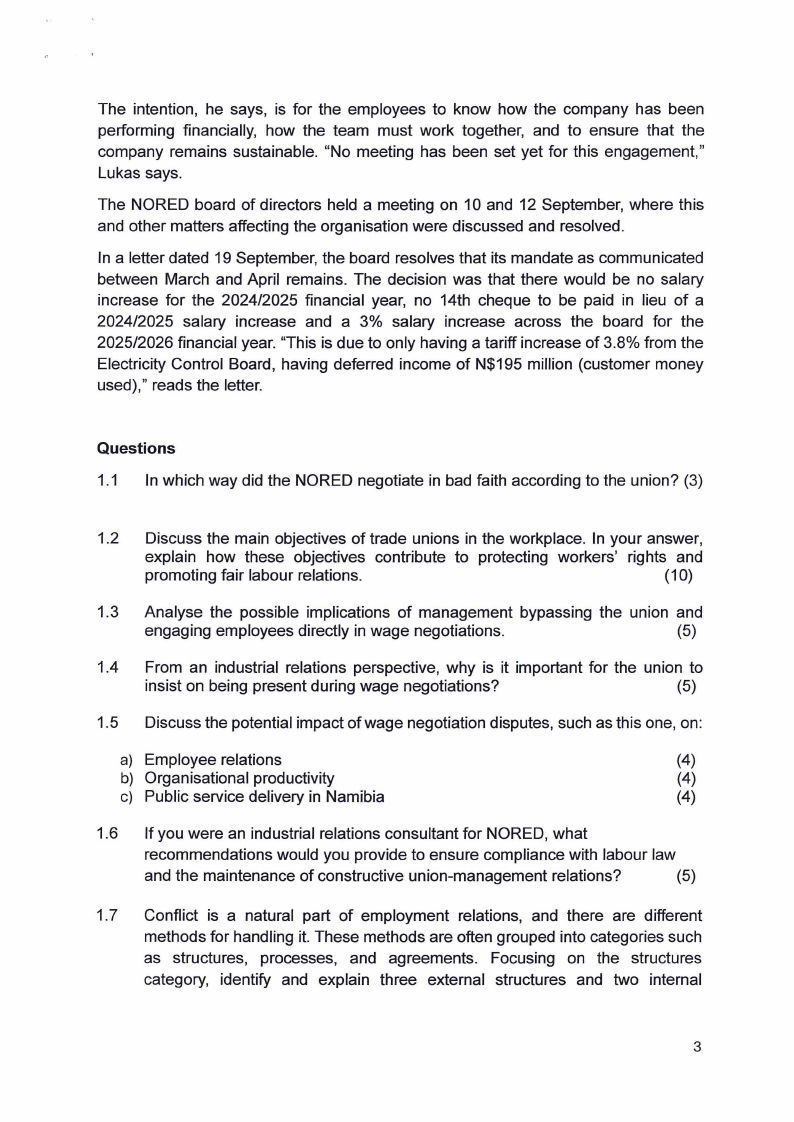
The intention, he says, is for the employees to know how the company has been
performing financially, how the team must work together, and to ensure that the
company remains sustainable. "No meeting has been set yet for this engagement,"
Lukas says.
The NORED board of directors held a meeting on 10 and 12 September, where this
and other matters affecting the organisation were discussed and resolved.
In a letter dated 19 September, the board resolves that its mandate as communicated
between March and April remains. The decision was that there would be no salary
increase for the 2024/2025 financial year, no 14th cheque to be paid in lieu of a
2024/2025 salary increase and a 3% salary increase across the board for the
2025/2026 financial year. 'This is due to only having a tariff increase of 3.8% from the
Electricity Control Board, having deferred income of N$195 million (customer money
used)," reads the letter.
Questions
1.1 In which way did the NORED negotiate in bad faith according to the union? (3)
1.2 Discuss the main objectives of trade unions in the workplace. In your answer,
explain how these objectives contribute to protecting workers' rights and
promoting fair labour relations.
(10)
1.3 Analyse the possible implications of management bypassing the union and
engaging employees directly in wage negotiations.
(5)
1.4 From an industrial relations perspective, why is it important for the union to
insist on being present during wage negotiations?
(5)
1.5 Discuss the potential impact of wage negotiation disputes, such as this one, on:
a) Employee relations
(4)
b) Organisational productivity
(4)
c) Public service delivery in Namibia
(4)
1.6 If you were an industrial relations consultant for NORED, what
recommendations would you provide to ensure compliance with labour law
and the maintenance of constructive union-management relations?
(5)
1.7 Conflict is a natural part of employment relations, and there are different
methods for handling it. These methods are often grouped into categories such
as structures, processes, and agreements. Focusing on the structures
category, identify and explain three external structures and two internal
3
|
|
4 Page 4 |
▲back to top |
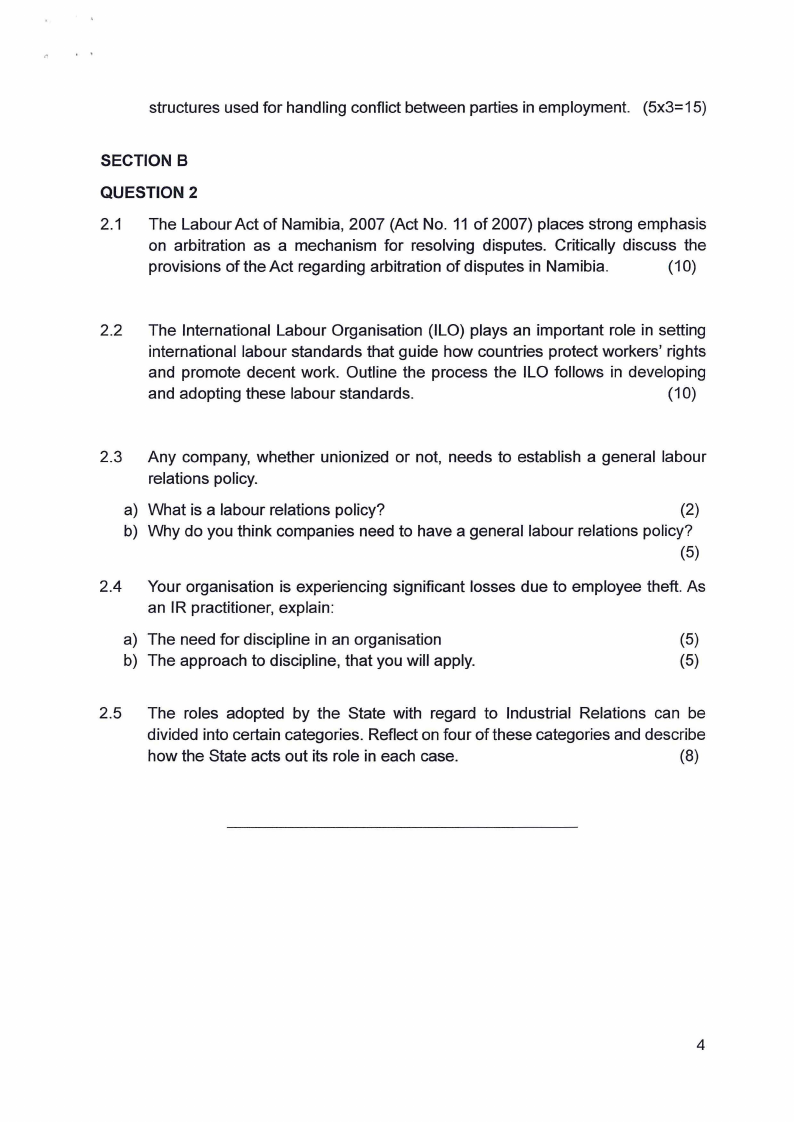
structures used for handling conflict between parties in employment. (5x3=15)
SECTION B
QUESTION 2
2.1 The Labour Act of Namibia, 2007 (Act No. 11 of 2007) places strong emphasis
on arbitration as a mechanism for resolving disputes. Critically discuss the
provisions of the Act regarding arbitration of disputes in Namibia.
(10)
2.2 The International Labour Organisation (ILO) plays an important role in setting
international labour standards that guide how countries protect workers' rights
and promote decent work. Outline the process the ILO follows in developing
and adopting these labour standards.
(10)
2.3 Any company, whether unionized or not, needs to establish a general labour
relations policy.
a) What is a labour relations policy?
(2)
b) Why do you think companies need to have a general labour relations policy?
(5)
2.4 Your organisation is experiencing significant losses due to employee theft. As
an IR practitioner, explain:
a) The need for discipline in an organisation
(5)
b) The approach to discipline, that you will apply.
(5)
2.5 The roles adopted by the State with regard to Industrial Relations can be
divided into certain categories. Reflect on four of these categories and describe
how the State acts out its role in each case.
(8)
4