


 |
FOC411S - FUNDAMENTALS OF CROP PRODUCTION - 2ND OPP - JULY 2025 |
|
|
1 Page 1 |
▲back to top |
nAmlBIA UnlVERSITY
OF SCIEn CE Ano TECHn OLOGY
FACULTY OF COMMERCE, HUMAN SCIENCESAND EDUCATION
DEPARTMENT OF TECHNICAL AND VOCATIONAL EDUCATION AND TRAINING
QUALIFICATION: NUST BRIDGING PROGRAMME -TVET AGRICULTURE SPECIALISATION
QUALIFICATION CODE: 04NBTA
LEVEL: 4
COURSE CODE: FOC411S
COURSE NAME: FUNDAMENTALS OF CROP
PRODUCTION
SESSION: JULY 2025
DURATION: 3 HOURS
PAPER:2
MARKS: 100
EXAMINER(S}
SECOND OPPORTUNITY EXAMINATION QUESTION PAPER
Ms. E MATALI
MODERATOR: Mr.A MERORO
I
INSTRUCTIONS
1. The paper has 3 SECTIONS (A, Band C).
2. Write clearly and neatly using a black or blue ink pen.
3. Each section must start on a new page.
4. All written work MUST be done in blue or black ink.
THIS QUESTION PAPER CONSISTS OF _5_ PAGES (Including this front page)
1
|
|
2 Page 2 |
▲back to top |
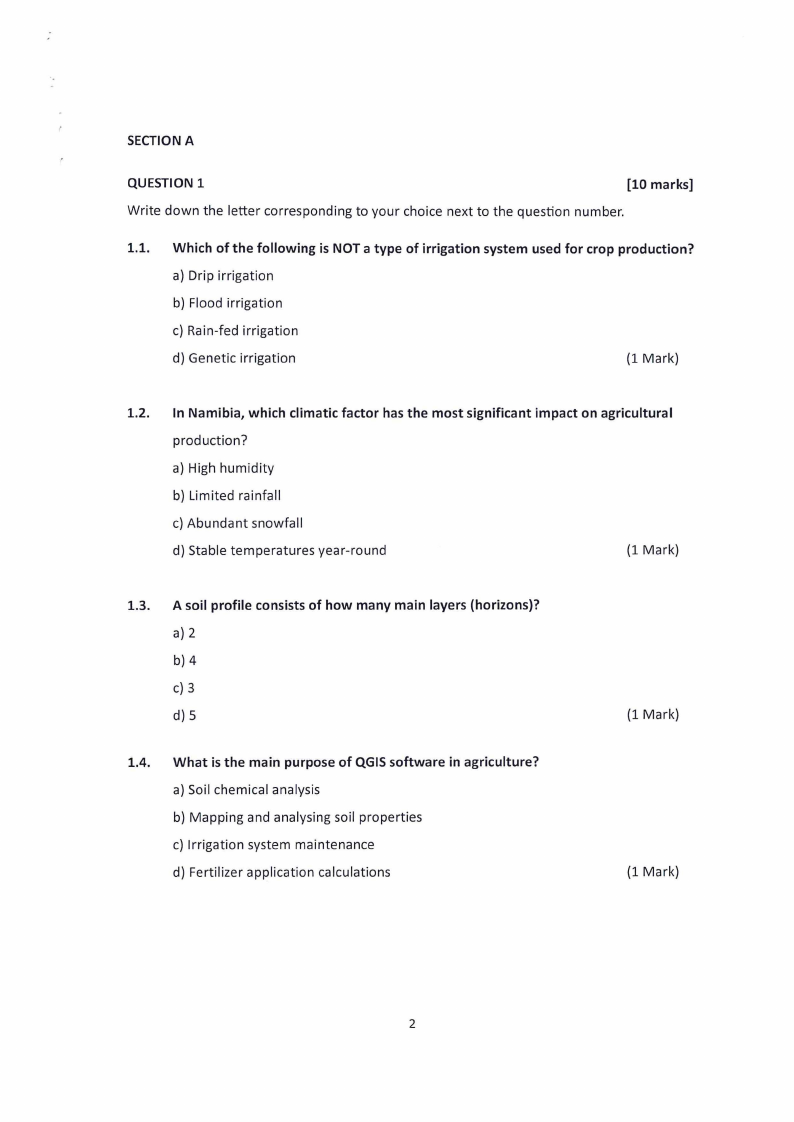
SECTIONA
QUESTION 1
[10 marks]
Write down the letter corresponding to your choice next to the question number.
1.1. Which of the following is NOT a type of irrigation system used for crop production?
a) Drip irrigation
b) Flood irrigation
c) Rain-fed irrigation
d) Genetic irrigation
(1 Mark)
1.2. In Namibia, which climatic factor has the most significant impact on agricultural
production?
a) High humidity
b) Limited rainfall
c) Abundant snowfall
d) Stable temperatures year-round
(1 Mark)
1.3. A soil profile consistsof how many main layers (horizons)?
a) 2
b)4
c) 3
d) 5
1.4. What is the main purpose of QGIS software in agriculture?
a) Soil chemical analysis
b) Mapping and analysing soil properties
c) Irrigation system maintenance
d) Fertilizer application calculations
(1 Mark)
(1 Mark)
2
|
|
3 Page 3 |
▲back to top |
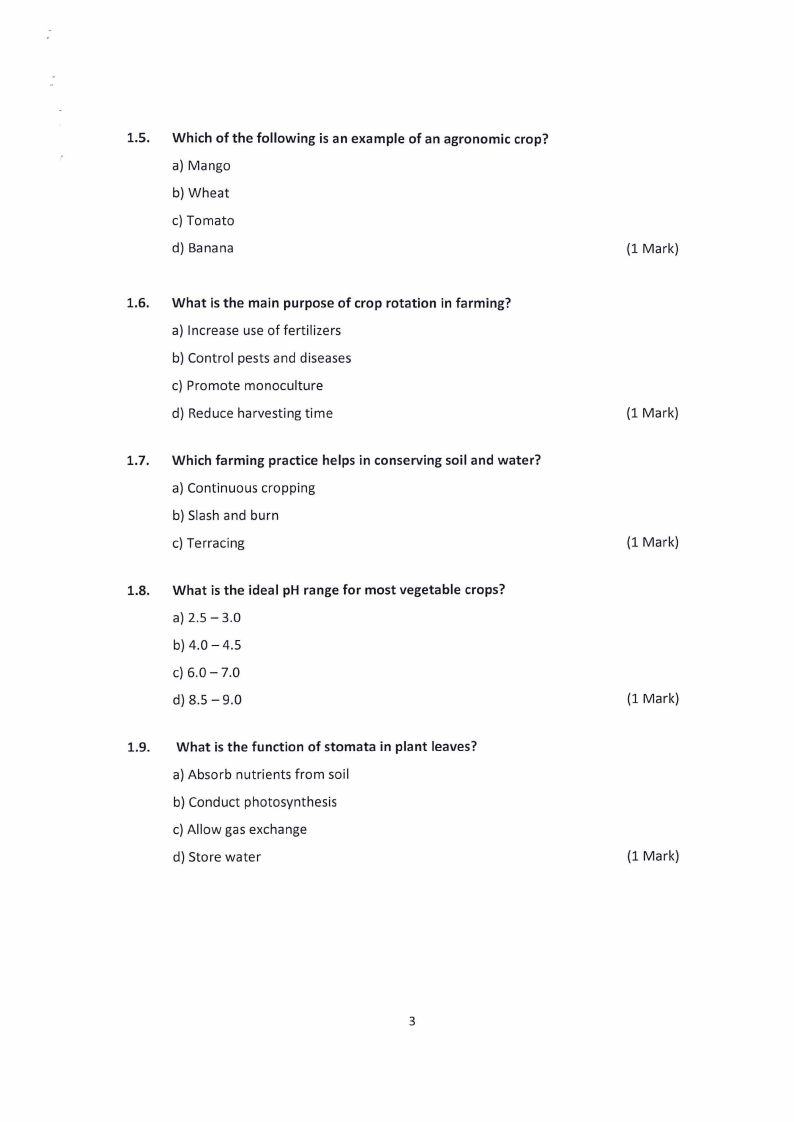
1.5. Which of the following is an example of an agronomic crop?
a) Mango
b) Wheat
c) Tomato
d) Banana
1.6. What is the main purpose of crop rotation in farming?
a) Increase use of fertilizers
b) Control pests and diseases
c) Promote monoculture
d) Reduce harvesting time
1.7. Which farming practice helps in conserving soil and water?
a) Continuous cropping
b) Slash and burn
c) Terracing
1.8. What is the ideal pH range for most vegetable crops?
a) 2.5 - 3.0
b) 4.0-4.5
c) 6.0- 7.0
d) 8.5 - 9.0
1.9. What is the function of stomata in plant leaves?
a) Absorb nutrients from soil
b) Conduct photosynthesis
c) Allow gas exchange
d) Store water
(1 Mark)
(1 Mark)
(1 Mark)
(1 Mark)
(1 Mark)
3
|
|
4 Page 4 |
▲back to top |
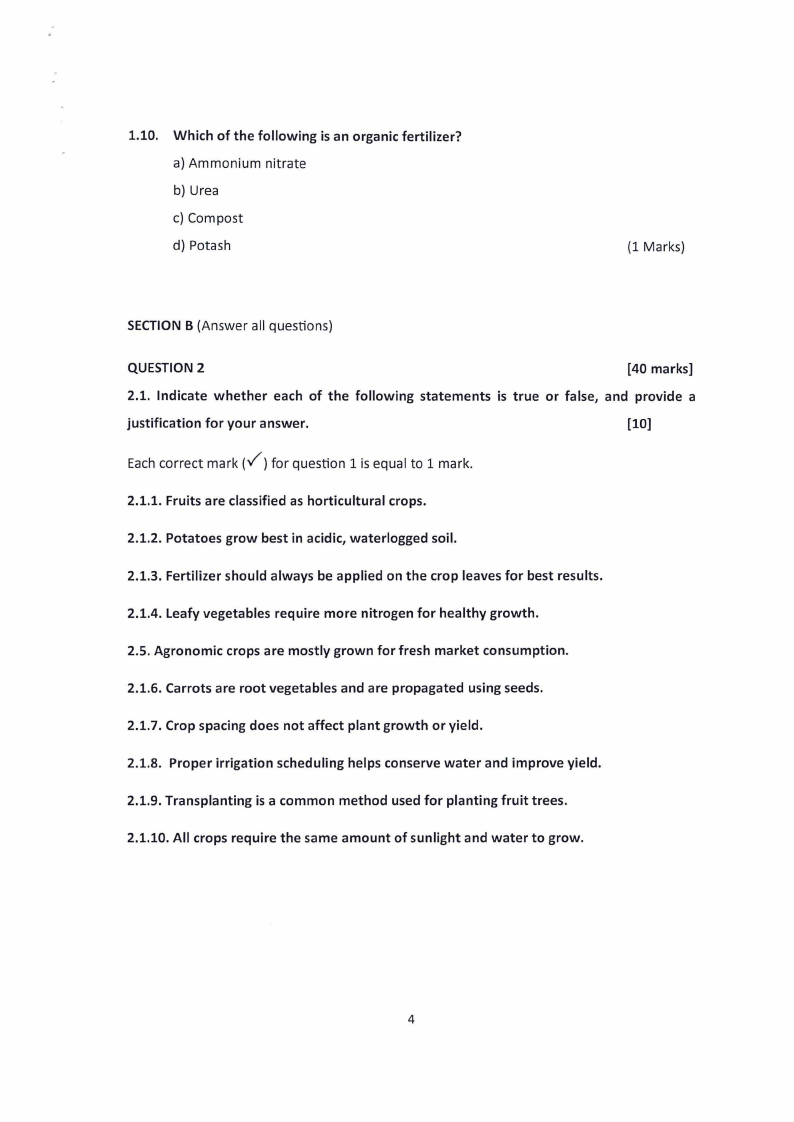
1.10. Which of the following is an organic fertilizer?
a) Ammonium nitrate
b) Urea
c) Compost
d) Potash
(1 Marks)
SECTIONB (Answer all questions)
QUESTION 2
[40 marks]
2.1. Indicate whether each of the following statements is true or false, and provide a
justification for your answer.
[10]
Each correct mark(/) for question 1 is equal to 1 mark.
2.1.1. Fruits are classified as horticultural crops.
2.1.2. Potatoes grow best in acidic, waterlogged soil.
2.1.3. Fertilizer should always be applied on the crop leaves for best results.
2.1.4. Leafy vegetables require more nitrogen for healthy growth.
2.5. Agronomic crops are mostly grown for fresh market consumption.
2.1.6. Carrots are root vegetables and are propagated using seeds.
2.1.7. Crop spacing does not affect plant growth or yield.
2.1.8. Proper irrigation scheduling helps conserve water and improve yield.
2.1.9. Transplanting is a common method used for planting fruit trees.
2.1.10. All crops require the same amount of sunlight and water to grow.
4
|
|
5 Page 5 |
▲back to top |
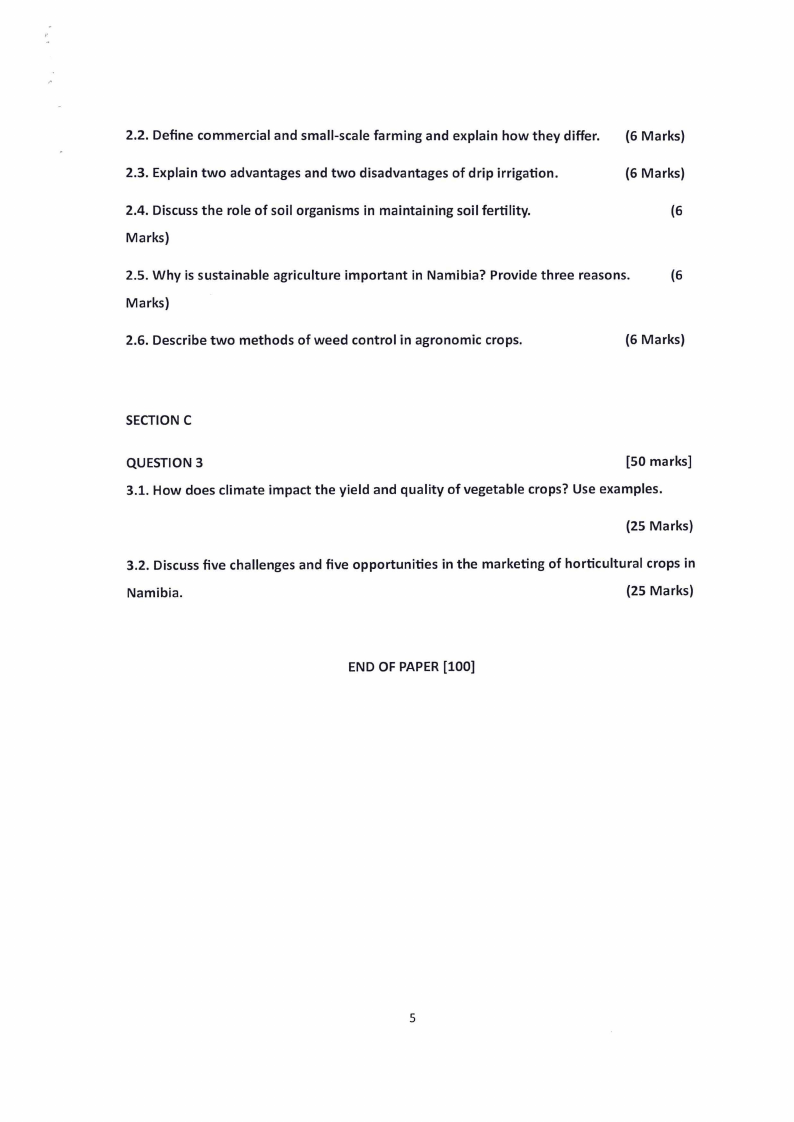
2.2. Define commercial and small-scale farming and explain how they differ. (6 Marks)
2.3. Explain two advantages and two disadvantages of drip irrigation.
(6 Marks)
2.4. Discuss the role of soil organisms in maintaining soil fertility.
(6
Marks)
2.5. Why is sustainable agriculture important in Namibia? Provide three reasons.
(6
Marks)
2.6. Describe two methods of weed control in agronomic crops.
(6 Marks)
SECTIONC
QUESTION 3
[50 marks]
3.1. How does climate impact the yield and quality of vegetable crops? Use examples.
(25 Marks)
3.2. Discuss five challenges and five opportunities in the marketing of horticultural crops in
Namibia.
(25 Marks)
END OF PAPER[100]
5